
17.3 Billion for a Handful of Loose Change: The True Story Behind the Closed Loop of Instant Retail Author: Li Bin (EMBA, China Europe International Business School, nearly 30 years of experience in the retail industry, former CEO of a billion-dollar retail chain, long-term focus on retail cost structure and platform ecosystem evolution), cover image from: Visual China
173 Billion Bought a Broken Silver: The True Story of Instant Retail's Closed Loop I. The Evolution of Triple Taxes
17.3 Billion for a Handful of Loose Change: The True Story of Instant Retail's Closed Loop Twenty years ago, I paid a transfer fee of 200,000 yuan (equivalent to over a decade's salary for an average worker at the time) to acquire a 20-square-meter store at Pacific Computer City. The disdain from the fat guy across the way was annoying, but I held my nose, signed the agreement, and paid the money. Because back then, whoever occupied a good location could "collect taxes." What I bought wasn't just a piece of concrete, but the privilege of "being seen," which I call "space tax." The better the location, the higher the space tax. When it reaches the ceiling, it will force one side of the industry chain to hit rock bottom. Either the landlord makes concessions, the merchant cuts quality, or the consumer foots the bill - this is the "impossible triangle" of space tax. When this triangular boundary is broken, the space tax will collapse - and almost all computer cities nationwide have disappeared.
17.3 Billion for a Handful of Loose Change: The True Story of Instant Retail's Closed Loop Ten years ago, I took on a mission to help a small to medium-sized frozen food brand turn a profit. On the first "Double Eleven" shopping festival, I watched as the balance in our express delivery account flowed away like water, with a comprehensive cost rate of over 30%. I knew this money had to be spent. It was the price of admission to the virtual traffic gate of online sales, buying the privilege of consumer "attention", which I call - traffic tax. The more traffic tax you pay, the more goods you sell. But this linear relationship won't last forever. When the traffic tax rate exceeds the merchant's break-even point, it may face collapse.
173 Billion for a Handful of Loose Change: The True Story of Instant Retail's Closed Loop To this day, when I use a platform's AI assistant to buy Bluetooth headphones, its homepage recommends one "main push" product and two "secondary push" products to me. When I use a third-party AI to inquire about washing machines, it recommends three products. I've also seen reports that ChatGPT has begun conditionally charging a 4% transaction commission. I've discovered that a new type of information privilege - cognitive agency - is emerging, and a new type of "tax" is evolving, which I call "intelligent tax".
173 Billion for a Handful of Loose Change: The True Story of Instant Retail's Closed Loop The evolution of these three taxes (space tax, traffic tax, and intelligence tax) is a history of the transformation of China's retail industry over the past 30 years. Behind this lies the three nodes of information power, which have undergone two major leaps: space tax monopolized physical information, traffic tax monopolized attention information, and intelligence tax is attempting to monopolize cognitive information.
17.3 Billion for a Handful of Loose Change: The True Story of Instant Retail's Closed Loop After seeing Old Zhang, the owner of a trading company, pay 20,000 yuan in rent - "space tax" - and another 20,000 yuan in flow-through fees - "traffic tax", as well as nearly 10,000 yuan in AI tool and API call fees - "intelligent tax" all in one day, I realized that with each increase in these three types of taxes, information power becomes more concentrated, more hidden, and harder to resist. In my article "A Day in the Life of Old Zhang", I mentioned that "A Day in the Life of Old Zhang is not an isolated case". Instant retail has already provided the answer.
173 Billion for a Handful of Loose Change: The True Story Behind the Closed Loop of Instant Retail From around 2010 when O2O began to take shape, to the launch of Meituan's Flash Purchase in 2018, and its upgrade to an independent brand in 2025, it has taken about 15 years for instant retail to transform from a "department store" to "everything delivered to your home" - and become the main battleground for retail businesses in 2025.
173 Billion Bought a Handful of Broken Silver: The True Story of Instant Retail's Closed Loop II. Why Did the Instant Retail War Erupt?
173 Billion Bought a Handful of Broken Silver: The True Story of Instant Retail's Closed Loop I reviewed data from the National Bureau of Statistics in recent years, which shows the online penetration rate of physical goods as follows: 27.6% in 2023, 26.8% in 2024, 26.1% in 2025, and 25.9% for the first half of 2026.
173 Billion Bought a Handful of Broken Silver: The True Story of Instant Retail's Closed Loop National social retail growth rate data: 3.5% in 2024, 3.7% in 2025, and 1.2% from January to July 2026, with a single-month year-on-year growth of only 0.2% in April, -0.6% in May, and 0.6% in the just-passed July.
17.3 Billion for a Handful of Loose Change: The True Story of Instant Retail's Closed Loop The revenue and growth rates of several major platforms over the past 15 years are shown in the chart below (calculated based on data extracted from the platforms' annual reports):
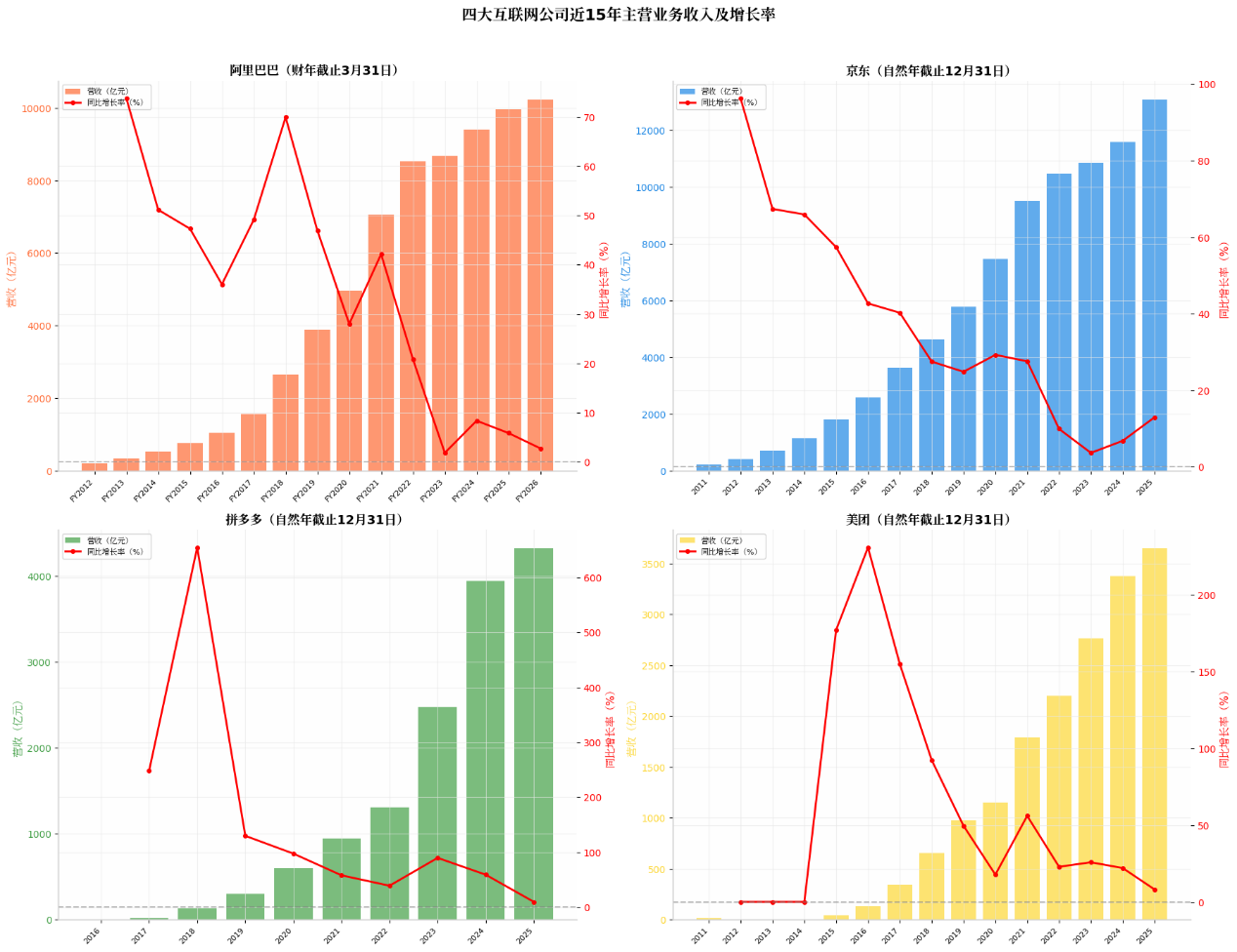
173 Billion Spent on a Handful of Loose Change: The True Story Behind the Closed Loop of Instant Retail The above data reflects that major platforms have transitioned from competing in incremental markets to engaging in a game of stock resources.
17.3 Billion for a Handful of Loose Change: The True Story of Instant Retail's Closed Loop It's not hard to judge - as the growth of social commerce slows and the penetration rate of e-commerce platforms levels off, the marginal investment effect of "traffic tax" will continue to decrease, until it reaches zero or even becomes negative.
17.3 Billion for a Handful of Loose Change: The True Story Behind the Closed Loop of Instant Retail The platform, driven by both capital and its own structured system, will likely increase its monetization rate. This is also one of the main reasons why platform merchants have felt that their business has become increasingly difficult to operate and their profits have become thinner in recent years.
173 Billion Bought a Handful of Loose Change: The True Story of Instant Retail's Closed Loop At the same time, actively seeking and expanding "new incremental markets" is also a necessary move for the platform. In November 2025, the Research Institute of the Ministry of Commerce released the "Instant Retail Industry Development Report". Relevant data from the report is shown in the figure below:
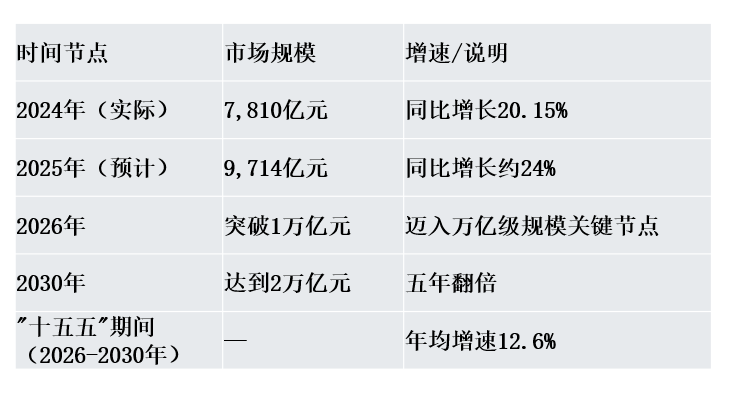
173 Billion Spent on a Handful of Silver: The True Story of Instant Retail's Closed Loop Based on the above information, the instant retail war in 2025 is inevitable, it's just that the timing happened in 2025. However, according to data from the Ministry of Commerce's report, the current penetration rate of instant retail is less than 2% (instant retail GMV/social zero total). Even if it reaches a scale of 200 billion yuan in 2030, its penetration rate will still be only 3%-5%. Combining the declining penetration rate of e-commerce platforms, social zero growth rate, and growth rate of various platforms, the 2025 instant retail war is more like a defensive war for self-preservation, rather than seeking incremental markets.
173 Billion Bought a Handful of Loose Change: The True Story of Instant Retail's Closed Loop Three: An Unprecedented Subsidy War
173 Billion Spent on a Handful of Loose Change: The True Story of Instant Retail's Closed Loop The latest instant retail war was sparked by JD.com in February 2025, when it launched a merchant recruitment campaign and introduced a policy requiring full-time couriers to pay five social insurances and one housing fund. JD Food Delivery officially went online in February, and on April 11, the "10 Billion Subsidy" program was fully rolled out. On April 15, Meituan upgraded its existing Meituan Flash Purchase to an independent instant retail brand, directly confronting JD.com. On April 30, Alibaba upgraded Taobao Hourly Delivery to Taobao Flash Purchase, following suit. This formed a "Three Kingdoms" landscape in the industry, with JD.com, Meituan, and Alibaba competing against each other. What happened afterwards was more brutal than I had imagined.
173 Billion Bought a Handful of Broken Silver: The True Story of Instant Retail's Closed Loop (1) What Did 173 Billion Burn Out?
¥173 Billion Spent on a Handful of Loose Change: The True Story Behind the Closed Loop of Instant Retail The battle is rapidly spreading from user subsidies to the entire industry chain. According to a HSBC industry research report, in the one-year period from Q2 2025 to Q1 2026, Meituan, Alibaba, and JD.com, the three platforms, collectively burned through ¥173 billion in the instant retail sector.
173 Billion Bought a Handful of Loose Change: The True Story of Instant Retail's Closed Loop This fire is burning the platform's own assets.
173 Billion for a Handful of Loose Change: The Truth Behind Instant Retail's Closed Loop Caixin reporting shows Meituan's core local commerce segment posted an operating loss of RMB 14.1 billion in Q3 2025, an operating loss margin of 20.9% — the company's first quarterly loss in three years. Core business operating margin collapsed from 21% in Q1 2025 to negative 20.9%.
17.3 Billion for a Handful of Loose Change: The True Story of Instant Retail's Closed Loop Alibaba classifies Freshippo under "other business units" and does not disclose its profit separately in its financial reports, only confirming that Freshippo has turned adjusted EBITDA positive, while the market generally predicts that its actual profit margin is not optimistic.
17.3 Billion Spent on a Handful of Loose Change: The True Story of Instant Retail's Closed Loop According to a survey by iResearch Consulting, the user retention rate for JD Instant Delivery is 47.24%, with an uninstallation rate of 18.64%.
173 Billion Bought a Broken Silver: The True Story of Instant Retail's Closed Loop This is not business expansion, it's a war of sovereignty - "don't want to leave infrastructure to competitors", or else we will lose the entrance to local life in the future.
173 Billion Bought a Handful of Broken Silver: The True Story of Instant Retail's Closed Loop (2) The Merchant's Backend is More Brutal than a Battlefield
17.3 Billion for a Handful of Loose Change: The True Story of Instant Retail's Closed Loop At the end of last year, I visited Nanjing and stopped by a small store I used to frequent. The store, tucked away in a small alley, originally had seating for 20 people. As I pushed open the glass door, I noticed three platform order reminders pasted on the wall, beeping intermittently. I'm familiar with the owner, and as we chatted casually about the store's operations, he showed me his phone's backend with a bitter smile: "Now, it's not me doing business, it's the platform doing business with me."
17.3 Billion for a Handful of Loose Change: The True Story of Instant Retail's Closed Loop A case reported by Caixin in July 2025 is highly representative: Jiangsu merchant Avin had an order worth 35.88 yuan, but after deducting 18 yuan in merchant subsidies, 0.96 yuan in platform commissions, and 3.45 yuan in delivery service fees, the actual receipt was only 14.47 yuan, with a receipt rate of 40%. An investigation by CCTV's "Weekly Quality Report" on August 10, 2025, was even more startling: a certain merchant had 4,158 orders in June, with a total turnover of 162,215.8 yuan, but after deducting platform fees, food costs, rent, labor, and other expenses, the merchant actually lost 10,340.47 yuan - not a profit, but a loss of over 10,000 yuan. Avin's dine-in orders also plummeted from 40% to 10%, with merchants trapped in a closed loop where "not doing takeout means death, but doing takeout also means death".
173 Billion Spent on Shattered Silver: The True Story of Instant Retail's Closed Loop (3) Consumer Perception is Being Quietly Replaced by AI Proxies
173 Billion for a Handful of Broken Silver: The Closed-Loop Truth of Instant Retail As a consumer, I too am locked inside another closed loop—when I need something, I no longer "search" for it; I am "recommended" to it.
17.3 Billion for a Handful of Loose Change: The True Story of Instant Retail's Closed Loop A few days ago, my USB drive broke. I opened Meituan and didn't search for "USB drive", but instead spoke to Meituan's AI assistant "Xiao Tuan" in the dialogue box: "Recommend a USB drive." Xiao Tuan didn't give me a list, but instead recommended just one: Sandisk for 50 yuan, with monthly sales of 98 and delivery in 26 minutes. I asked follow-up questions: "Why aren't there any others?" It then recommended three more: Kingston for 23 yuan, Aipate for 38 yuan, and Lenovo for 34 yuan. These came from three stores I had never heard of: Hui Gou Mao Life Supermarket, Ling Shi Gou Supermarket, and Tai De Department Store. The delivery time was 49 to 59 minutes. Additionally, under the main recommendation, it promoted "small capacity, large capacity, and special function" models, totaling four options.
17.3 Billion for a Handful of Loose Change: The True Story Behind Instant Retail's Closed Loop I opened JD Instant Delivery again and asked the same question. It recommended a SanDisk for ¥44.9, two different capacity Kingston products priced at ¥49.9 and ¥114.9, all of which were available for delivery tomorrow. The homepage displayed three products, and the dropdown menu showed "1300+ products" in total.
173 Billion for a Handful of Loose Change: The True Story of Instant Retail's Closed Loop Yesterday, due to time constraints, I needed food delivery to solve the dinner problem for two people. I told Xiaotuan: "Two adults, one dinner, with both meat and vegetables." It recommended two double-person set meals, one of which was 48.9 yuan. I opened it and saw that it had sold over 3,000 in half a year. The other was a sauerkraut fish double-person meal, priced at 54.9 yuan, with sales of over 6,000 in half a year. I didn't say I wanted to eat fast food, and I didn't say my budget was 50 yuan. But Xiaotuan made these decisions for me. What it recommended to me was not "what I wanted to eat," but "what the algorithm thought I should eat" - based on my location, my historical orders, the merchants the platform is subsidizing, and whether the merchant had purchased AI-recommended positions.
17.3 Billion for a Handful of Loose Change: The True Story Behind Instant Retail's Closed Loop I calculated the orders that Xiaotuan recommended to me:
17.3 Billion for a Handful of Loose Change: The True Story Behind Instant Retail's Closed Loop A 50-yuan USB drive, with the merchant actually receiving 37.5 yuan. I later asked a friend who sells digital accessories, and he said that the gross margin for this type of standard product is usually less than 10%. In other words, the merchant can earn at most 3.75 yuan from this sale - assuming they haven't been forced by the platform to participate in a promotional activity.
17.3 Billion for a Handful of Loose Change: The True Story Behind Instant Retail's Closed Loop After several attempts, I confirmed one thing: smart taxation is no longer the exclusive domain of e-commerce, it has entered my daily consumption through instant retail - the platform uses algorithms to act as an agent for my cognition.
173 Billion Buys a Handful of Silver Scraps: The Closed-Loop Truth of Instant Retail IV. The Industry's Bottom Line: Two Associations Speak Out on the Same Day
17.3 Billion Spent on a Handful of Loose Change: The True Story Behind Instant Retail's Closed Loop I found that on July 15, 2025, the China Cuisine Association and the China Chain Store Association issued a public statement on the same day. The signal is clear - a large-scale subsidy war has begun, and merchants are struggling to keep up.
17.3 Billion for a Handful of Loose Change: The True Story Behind the Closed Loop of Instant Retail What's the problem? The high subsidies from platforms have driven takeaway prices lower than dine-in prices, causing consumers to shift online. Some restaurant owners have complained: the kitchen is busy to the point of being overwhelmed, but the dining area is empty, and when the accounts are settled at the end of the month, the profits are as thin as paper.
17.3 Billion Spent on a Handful of Loose Change: The True Story of Instant Retail's Closed Loop The Cooking Association is calling on platforms to adjust their subsidy behavior: stop engaging in "tens of billions of subsidies" without considering costs; meanwhile, platforms and merchants should have a reasonable proportion of subsidy costs. In simple terms, if this continues, the entire industry will be hurt.
173 Billion Bought a Handful of Loose Change: The True Story of Instant Retail's Closed Loop On the same day, the China Chain Store & Franchise Association issued a proposal to all its members and related companies, entitled "Initiative on Regulating the Order of Instant Retail Market". The proposal is based on a small-scale survey of 33 member companies conducted by the association, with feedback data that is alarming: 30%-70% of companies are forced or indirectly forced by platforms to participate in price subsidies and bear the subsidy share, with some cases exceeding 70%; during price subsidy activities, the average profit margin of single orders has decreased significantly, with a decline of 10%-30% in most cases.
17.3 Billion for a Handful of Loose Change: The True Story of Instant Retail's Closed Loop The most significant part of this initiative is the three demands made of the platform: First, it is no longer allowed to use covert means, such as "traffic bias" or "search demotion," to force merchants into price wars. Second, contracts and algorithmic rules cannot impose excessive subsidies on merchants, and the sharing ratio must be reasonable. Third, it is the familiar "choose one of two" requirement.
17.3 Billion for a Handful of Loose Change: The True Story of Instant Retail's Closed Loop In addition, the association also made a very practical request: platforms must publicly disclose on their app's homepage or a prominent position how subsidies are provided and how algorithms are used for ranking. Ultimately, businesses should have the right to set their own prices and decide whether or not to participate in activities, and this autonomy should be returned to them.
17.3 Billion Spent on a Handful of Loose Change: The True Story Behind the Closed Loop of Instant Retail However, once the platform subsidy war is launched, it's hard to stop. Merchants' demands are difficult to satisfy, and associations find it hard to immediately intervene - everyone knows this is unsustainable, but no one dares to stop first.
173 Billion Bought a Handful of Loose Change: The True Story of Instant Retail's Closed Loop Five: After the Tide Recedes, the Loose Change Reveals Itself
173 Billion Spent on Instant Retail: The Truth Behind the Closed Loop A survey by iResearch Consulting shows that instant retail users have been divided into three categories: 49.3% are price-driven, highly sensitive to prices; 26.8% are value-driven, more focused on quality and experience, with stable consumption; and 19.5% are opportunistic, only placing orders during promotional periods.
173 Billion Bought a Handful of Loose Change: The True Story of Instant Retail's Closed Loop Six: Lightning Warehouse: A Microcosm of the Pre-Warehouse for Loose Change
173 Billion Bought a Handful of Loose Change: The True Story Behind Instant Retail's Closed Loop The association's statement was unable to stop the trend in time. However, the "loose change" is real, and the truth was first exposed at the most peripheral end of instant retail's capillaries - the flash warehouses.
1.73 Billion for a Handful of Loose Change: The True Story of Instant Retail's Closed Loop Spicy reported in March 2025 on a typical example: a 24-hour supermarket franchisee in Northern China, with monthly sales of 320,000 yuan. After deducting platform commissions, rider subsidies, and product losses, the store actually lost 18,000 yuan.
173 Billion Spent on a Handful of Loose Change: The True Story of Instant Retail's Closed Loop I noticed a survey by Lei Feng Net in November 2024: in the bustling instant warehouses, only 40% of individual franchise store owners were able to turn a profit and were satisfied with their operating results. In the second half of 2024, a large number of instant warehouses closed down, which suggests that even before the platform subsidy war began in 2025, this sector was already deeply mired in a profitability dilemma of "scattered silver".
173 Billion Bought a Handful of Broken Silver: The True Story of Instant Retail's Closed Loop Seven: Instant Retail - The Ultimate Closed Loop of Triple Taxes
173 Billion Bought a Handful of Broken Silver: The Brutal Truth About the Closed Loop of Instant Retail Having come this far, the "three taxes" framework I established in my previous article has been brutally verified in the case of instant retail.
173 Billion for a Handful of Loose Change: The True Story of Instant Retail's Closed Loop As I mentioned in "A Day in the Life of Lao Zhang," the three taxes are not a replacement relationship, but rather a "multi-loop parallel" overlapping and nested hybrid structure in special scenarios. Instant retail is the ultimate form of this "multi-loop parallel" overlap - spatial tax (front-end warehouse/store rental), traffic tax (platform fees + flow competition bidding), and intelligent tax (algorithmic scheduling, AI dynamic pricing, intelligent customer service) all weigh on merchants at the same time, forming a "three-tax penetration."
173 Billion for a Broken Silver: The True Story of Instant Retail's Closed Loop But more importantly, it's the ultimate self-built "closed-loop sovereignty". In the era of space tax, Suning and Gome locked down physical entrances, POS machines, and distribution centers, but third-party logistics still had loopholes; in the era of traffic tax, Taobao locked down search recommendations, Alipay, and Cainiao, but the express delivery alliance was not entirely self-built. Instant retail is the first platform to deeply self-build all three ends of "information - transaction - fulfillment": the information end is fully controlled by algorithmic recommendations, the transaction end is locked down by one-click payment, and the fulfillment end is fully self-operated by the rider network, front warehouses, and distribution algorithms.
17.3 Billion for a Handful of Loose Change: The True Story of Instant Retail's Closed Loop The closed loop has been established, but the profits within it are inherently fragmented.
173 Billion Yuan for a Handful of Silver: The Closed-Loop Reality of Instant Retail Brokerage calculations of the unit economics for instant retail show: Meituan's food delivery average order value is 34.1 yuan, with revenue per order of 6.8 yuan and a monetization rate of roughly 20%. Meituan Flash Purchase posted an average order value of 68 yuan in Q4 2025, with unit economics (revenue per order minus cost per order) losing 0.7 yuan per order.
17.3 Billion for a Handful of Loose Change: The True Story of Instant Retail's Closed Loop Looking at the situation of listed company Dingdong Maicai, we can more clearly see the profitability of the front-warehouse model: non-net profit margin has long been around 1%, with fulfillment cost rate at 18.6% (Q2 2026 data, previously at 21%-23%) which is a rigid expense; Meituan also stated in its earnings call that the long-term profitability target for Xiao Xiang Supermarket is only a low single-digit profit margin.
17.3 Billion for a Handful of Loose Change: The True Story of Instant Retail's Closed Loop After several years, a market size of 200 billion may be realistic, but every single coin must first pass through the hands of delivery riders: the platform has locked in fulfillment, and the hard costs of fulfillment have locked in the profit margins. I call it - 200 billion in loose change, easily lost with a single misstep.
173 Billion Bought a Handful of Broken Silver: The True Story of Instant Retail's Closed Loop 8. The Cost of a Closed Loop: The Dilemma of Monetization Rates and Regulatory Intervention
17.3 Billion for a Handful of Loose Change: The True Story of Instant Retail's Closed Loop As I explained in the second section of this article, the essence of this war is the platform's self-preservation efforts. But what happens after self-preservation? The flames of war have died down, and the ledger can't remain in the red forever. The platform needs to recoup its losses, and under the dual influence of capital and its own systems, increasing the monetization rate is likely to be a high-probability event. However, industry analysts believe that a 15% monetization rate is already a high threshold, and exceeding 18% may cause merchants to flee. If the rate falls below 15%, it will be unable to cover fulfillment costs.
173 Billion for a Handful of Scraps: The Closed-Loop Truth of Instant Retail In January 2026, the Office of the State Council's Anti-Monopoly and Anti-Unfair Competition Commission launched a market competition investigation and assessment of the food delivery platform industry; in March, the State Administration for Market Regulation explicitly halted irrational price competition. In my view, the deeper consideration behind regulatory intervention is to prevent platforms from using their locked-in closed loops to squeeze suppliers from above and merchants from below—taking from both ends—and further monopolizing the industry chain's profits.
173 Billion Bought a Handful of Broken Silver: The True Story of Instant Retail's Closed Loop IX. Conclusion
17.3 Billion for a Handful of Loose Change: The True Story Behind Instant Retail's Closed Loop In the end, I didn't buy the U-disk through Xiaotuan, but instead went to a small store downstairs. The owner pulled out a 55-yuan U-disk from under the counter, which was a bit more expensive than Xiaotuan, but I could test it on the owner's computer, return or exchange it if needed, and even exchange a few pleasantries and cigarettes with the owner.
17.3 Billion for a Handful of Loose Change: The True Story of Instant Retail's Closed Loop Looking at the QR code on his counter, I was reminded of the "suboptimal closed loop" I wrote about earlier. In the era of smart taxation, the significance of this QR code has changed - it's not only a tool for "reducing platform fees," but also a channel for "bypassing AI decision-making."
173 Billion for a Broken Silver Piece: The True Story of Instant Retail's Closed Loop Little teams can recommend products to the whole world, but they can't deliver a single cigarette, provide a trial experience, or engage in a few conversations. The 173 billion yuan spent on creating a closed loop has locked in information, transactions, and fulfillment, but ultimately cannot lock in the trust that lies in the broken silver piece downstairs. This trust is essentially merchants using warmth to compete with the platform for discourse power. This is a blind spot in information power and also an area where merchants can still dig deep.