
A Day in the Life of Lao Zhang: When Platforms, AI, and Landlords Come to Collect Rent Author: Li Bin (EMBA, China Europe International Business School, nearly 30 years of experience in the retail industry, former CEO of a multibillion-yuan retail chain, long-term observer of retail cost structure and platform ecosystem evolution), original title: "A Day in the Life of Lao Zhang: Triple Taxes and Closed-Loop Lock-in --- The Structural Game and Symbiosis of Platforms, AI, and Merchants", cover image from: Visual China
A Day in the Life of Lao Zhang: When Platforms, AI, and Landlords Come to Collect Rent In previous articles, we discussed the "three taxes" that exist in China's retail industry - space tax, traffic tax, and intelligence tax; the "three powers" - physical information rights, traffic entry information rights, and cognitive agency rights; as well as the closed-loop theory that runs throughout - information → transaction → fulfillment.
A Day in the Life of Lao Zhang: When Platforms, AI, and Landlords All Come to Collect Rent In this article, we shift our focus from theory back to reality, and take a look at what it's like when three pressures converge on one person at the same time.
Lao Zhang's Day: When Platforms, AI, and Landlords All Come to Collect Rent Then, let's take a look at the relationship between platforms, AI, and merchants - how they are intertwined in a complex dance of mutual dependence and conflict.
A Day in the Life of Lao Zhang: When Platforms, AI, and Landlords All Come to Collect Rent I. The Real Picture of Triple Taxes --- A Day in the Life of Lao Zhang
A Day in the Life of Lao Zhang: When Platforms, AI, and Landlords Come to Collect Rent Lao Zhang is the owner of a trading company, having been in business for over 20 years. He is cautious and likes to handle everything personally, which has kept his company small but also afloat.
A Day in the Life of Lao Zhang: When Platforms, AI, and Landlords Come to Collect Rent It was 8:30 on a morning at the end of the month. Lao Zhang had just opened the office door when his phone buzzed. The landlord sent a WeChat message, brief and to the point: "Director Zhang, the end of the month has arrived, and the rent for next quarter is 20,000 yuan." This was the "space tax" - the physical information rights rent paid for the 60-square-meter street-front store downstairs. Lao Zhang responded with a simple "okay". He had been watching this street for ten years and knew that the price was non-negotiable.
Mr. Zhang's day: When platforms, AI, and landlords come to collect rent 9:00 AM. An operations staff member knocks on the door, saying: "Director Zhang, the promotional account balances for the three platforms are all depleted. If we don't top them up today, our traffic will be cut off this afternoon." Mr. Zhang asks how much is needed, and the staff member replies: "Based on this month's pace, we should replenish 200,000 yuan first." This is the "traffic tax" - the competitive bidding fees paid to make product information "visible" on the virtual shelves of the platforms.
Mr. Zhang's day: When platforms, AI, and landlords all come to collect rent Mr. Zhang had just picked up his cup of water when his colleague in charge of visual design arrived: "Boss Zhang, the AI graphic design tool subscription is about to expire. If we renew by the end of the month, there's a discount."
A Day in the Life of Lao Zhang: When Platforms, AI, and Landlords All Come to Collect Rent Right after that, the customer service manager also burst in: "Director Zhang, our API call volume has exceeded the limit this month, we need to top up our quota, or the intelligent customer service will be suspended tomorrow." —— Continue to pay.
Old Zhang's Day: When the Platform, AI, and Landlord All Come Collecting By afternoon, the platform's AI assistant had recommended yet another "smart pricing tool," promising to optimize conversion rates—for a price, naturally.
A Day in the Life of Lao Zhang: When Platforms, AI, and Landlords All Come to Collect Rent These scattered expenses are what might be called "intelligent taxes" - paying cognitive rent to obtain cognitive agency from AI, so that product information can be "read" by algorithms and recommended.
One Day in the Life of Lao Zhang: When Platforms, AI and the Landlord All Come Collecting At 2 p.m., Lao Zhang checks his dashboard: GMV hit this month's target, but return rates are running high and traffic weight is slipping. That means maintaining the same exposure next month will require even more ad spend.
A Day in the Life of Lao Zhang: When Platforms, AI, and Landlords Come to Collect Rent It's 4 pm. Lao Zhang is in his office doing the accounts. Rent is 20,000 yuan, advertising expenses are 20,000 yuan, AI tools and API calls cost nearly 10,000 yuan, and then there are platform fees, logistics, after-sales service, and losses from refunds - this month's net profit is less than 5%. He gets up to call a friend, who says he hasn't made any money this year. Lao Zhang forces a smile: it seems there are others who are even worse off than himself.
Mr. Zhang's Day: When Platforms, AI, and Landlords Come to Collect Rent At 8 pm, Mr. Zhang came across a news article: OpenAI would be charging Shopify merchants a 4% commission. He was taken aback - what's with this new variant of a tax?
Lao Zhang's Day: When Platforms, AI, and Landlords All Come to Collect Rent He put down his phone and gazed at the convenience store downstairs, where the owner's wife was smiling and handing a familiar customer an extra bunch of scallions.
Lao Zhang's Day: When Platforms, AI, and Landlords Come to Collect Rent He suddenly realized: he can't outrun platforms, nor can he outrun AI, but the store downstairs, platforms can't take away its warmth, and neighborhood relationships are something AI can't replace. Perhaps, this is the gap.
A Day in the Life of Lao Zhang: When Platforms, AI, and Landlords All Come to Collect Rent Lao Zhang's day is not an isolated case.
Lao Zhang's Day: When Platforms, AI, and Landlords Come to Collect Rent In the era of space taxes 20 years ago, merchants handed out DM flyers on the streets, set up tables to display products in front of their stores as long as it didn't rain, and even put up stages at mall entrances to sing and dance --- all in their own way to compete for physical information rights.
Lao Zhang's Day: When Platforms, AI, and Landlords Come to Collect Rent In recent years, the retail industry has entered the era of "traffic tax". Merchants have set up stalls at subway entrances and markets, and added customers on WeChat. They have also used Douyin and Xiaohongshu to promote their products - all in an effort by merchants to compete for the right to control traffic entry points and information.
Lao Zhang's Day: When Platforms, AI, and Landlords Come to Collect Rent By now, AI has evolved at an increasingly rapid pace, with growing capabilities. Merchants have begun purchasing AI tools, training intelligent customer service agents, and optimizing product titles. The goal is to enable products to be understood by algorithms - this is a competition for cognitive agency.
Mr. Zhang's Day: When Platforms, AI, and Landlords All Come to Collect Rent It ultimately boils down to — after going in circles, three types of disputes, and three types of taxes, all weighing on him at the same time.
Mr. Zhang's Day: When Platforms, AI, and Landlords All Come to Collect Rent The Evolution of Er San Tax -- From Alternative Illusions to Overlaid Reality
A Day in the Life of Lao Zhang: When Platforms, AI, and Landlords Come to Collect Rent November 11, 2009, is a day worth remembering in China's e-commerce industry. On this day, Tmall launched the first "Double Eleven" shopping festival. According to public reports, only 27 stores participated at the time, yet it achieved a sales volume of 52 million yuan, making Tmall famous overnight. Since then, every year's "Double Eleven" has become a "National Shopping Festival".
Lao Zhang's Day: When Platforms, AI, and Landlords Come to Collect Rent This also drove the rapid rise of Chinese e-commerce, and for a long time afterwards, almost everyone said that online would replace offline, and spatial tax would be replaced by traffic tax.
A Day in the Life of Lao Zhang: When Platforms, AI, and Landlords Come to Collect Rent Just a few years after 2009, O2O companies such as Ele.me, Meituan, Daily Youxian, Hema, and Dingdong Buy Vegetables emerged one after another, sparking heated discussions. The concept of "local life and instant retail" began to sweep the nation's retail industry, and public opinion shifted towards "online and offline will converge, with one tax eating away at the other".
Lao Zhang's Day: When Platforms, AI, and Landlords Come to Collect Rent But after over a decade, the reality is: offline hasn't died, and online hasn't become the only option. Why? Because with each technological revolution, the rent collectors aren't "demolishing the old closed loop," but rather building a "new closed loop." Malls haven't disappeared, they've just changed from being the "only entrance" to becoming "experience nodes"; platforms haven't disappeared, they've just changed from being "information intermediaries" to becoming "infrastructure."
Mr. Zhang's Day: When Platforms, AI, and Landlords All Come to Collect Rent The Triple, Triple-Burden Structure
Mr. Zhang's Day: When Platforms, AI, and Landlords All Come to Collect Rent First, refer to the diagram below (a schematic illustration of multiple taxes overlapping and piling up):
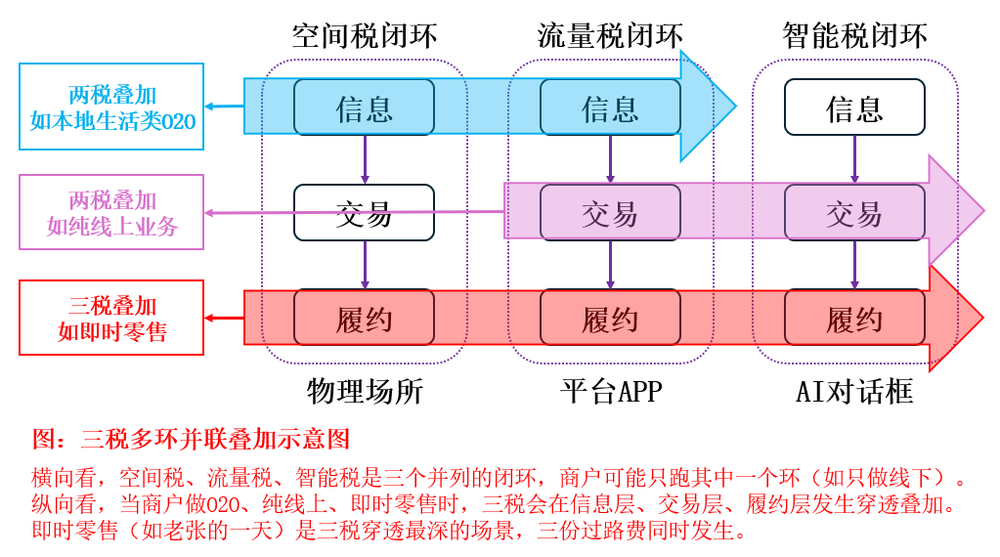
Mr. Zhang's Day: When Platforms, AI, and Landlords Come to Collect Rent Many merchants thought that by moving from offline to online, they could replace "space taxes" with "traffic taxes"; and by using AI, they could replace "traffic taxes" with "intelligence taxes".
Mr. Zhang's Day: When Platforms, AI, and Landlords All Come to Collect Rent The reality is just the opposite. The relationship between the three taxes is not a simple "large ring enclosing a small ring" nesting structure, but rather a "multi-ring parallel" overlapping structure combined with a nesting structure under special circumstances.
Mr. Zhang's Day: When Platforms, AI, and Landlords All Come to Collect Rent The specific locking process and method for each link are shown in the diagram below:
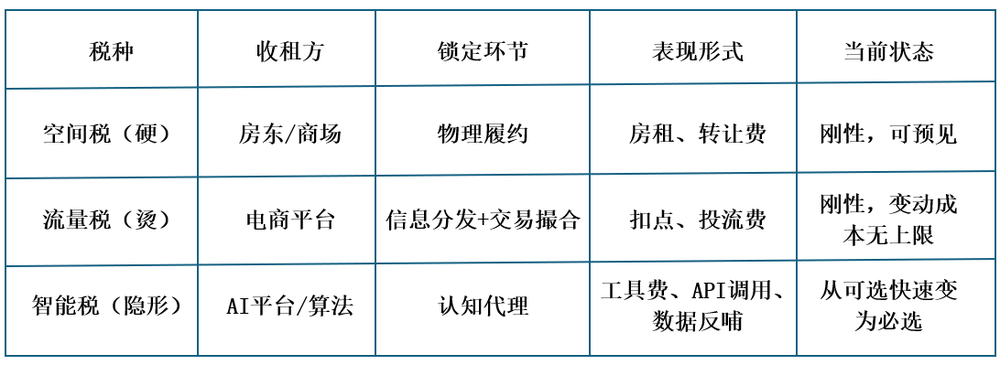
A Day in the Life of Lao Zhang: When Platforms, AI, and Landlords Come to Collect Rent Lao Zhangs can choose to only operate offline (paying only spatial taxes) or only online (paying only traffic taxes), or temporarily not purchase AI tools, or select any two of these options. These are the choices available to merchants under the "multi-ring" overlapping structure. However, once they decide to engage in "instant retail" - where the same product must pass through "offline stores + online platforms + AI tools" in the circulation process - this is a special scenario with a nested structure (three taxes penetrating), at which point all three tolls must be paid.
Mr. Zhang's Day: When Platforms, AI, and Landlords Come to Collect Rent The problem is: faced with three closed loops, merchants think they still have choices, but in fact, their space for choice is being compressed.
A Day in the Life of Lao Zhang: When Platforms, AI, and Landlords Come to Collect Rent It's a simple realization - the knowledge and skills involved in repetitive work are being leveled by AI (which is also one of the reasons behind the frequent media reports of companies like Zhang's laying off employees one day and Li's optimizing their staff the next). Applying this understanding to the retail industry, it's not hard to see that: when competitors are all using AI tools to optimize their copy and using smart customer service to reduce costs and increase efficiency, those who don't will be left behind in the competition for efficiency.
One Day in Old Zhang's Life: When Platforms, AI, and Landlords All Come to Collect Rent The smart tax is following the exact trajectory of the traffic tax before it: first free to cultivate dependence, then gradually monetized, and ultimately evolving from an "efficiency tool" into a "barrier to entry." This isn't alarmist rhetoric—it's the historical arc of the traffic tax, from nothing to something to burdensome, now playing out in real time.
Mr. Zhang's Day: When Platforms, AI, and Landlords Come to Collect Rent Four, Three Taxes: Why You Can't Escape -- Closed-Loop Sovereignty and Reinforcement
Mr. Zhang's Day: When Platforms, AI, and Landlords All Come to Collect Rent Merchants aren't trying to evade, but can't escape.
Mr. Zhang's Day: When Platforms, AI, and Landlords Come to Collect Rent After moving from offline to online, he found that there is also "rent" online (commissions + traffic fees); after switching from platform A to B or C, he discovered that the path is similar - first subsidies, then charges.
A Day in the Life of Lao Zhang: When Platforms, AI, and Landlords Come to Collect Rent Doing private domain operations? It's essential to distinguish between two types: in-platform private domain (such as Taobao members or Douyin fan groups), which is encouraged by the platform and is essentially a refined operation within a closed loop, and out-of-platform private domain diversion (such as adding WeChat or pulling independent stations), which is a breakthrough. However, platforms restrict this through measures like in-platform sensitive word filtering, transaction anomaly monitoring, and limited traffic and reduced authority.
Lao Zhang's Day: When Platforms, AI, and Landlords Come to Collect Rent Diversifying across multiple platforms is indeed a rational risk-hedging strategy: reducing the risk of policy changes on a single platform, increasing income sources, and spreading the fixed costs of the operations team. However, essentially it's just a shift from paying one traffic tax to paying multiple traffic taxes, with each platform's commission and flow-in costs converging in the long term. While risk is diversified, the tax rate itself hasn't decreased.
Mr. Zhang's Day: When Platforms, AI, and Landlords All Come to Collect Rent The inescapable core is closed-loop sovereignty.
Lao Zhang's Day: When Platforms, AI, and Landlords Come to Collect Rent The platform, through infrastructure construction, has integrated the three stages of "information, transaction, and fulfillment" into the node with the lowest transaction cost: physical stores, APPs, and AI dialogue boxes. When merchants try to expand into multiple channels or users have become accustomed to "ordering online and fulfilling offline", bypassing the platform's designated entry points will cause the costs of the other two stages to skyrocket to unbearable levels.
Lao Zhang's Day: When Platforms, AI, and Landlords Come to Collect Rent More hidden than the entrance to the welding workshop is the one-way data accumulation: the merchants' transaction data and behavioral data, which are generated in three stages, are largely deposited in the platform's data system. This data is not the fourth entrance to the closed loop, but rather the closed loop's self-reinforcing mechanism - it allows the platform to understand users far better than the merchants. What's even more deadly is that merchants, even if they want to escape, are unable to do so due to their lack of user awareness.
Lao Zhang's Day: When Platforms, AI, and Landlords All Come to Collect Rent This is not the malice of a certain platform, but a structural lock-in at the infrastructure level.
Lao Zhang's Day: When Platforms, AI, and Landlords Come to Collect Rent Five, Three Taxes' Symbiosis——The Result of a Three-Sided Game of Love and Murder
A Day in the Life of Lao Zhang: When Platforms, AI, and Landlords All Come to Collect Rent On the surface, it appears to be a game of cat and mouse between three parties: platforms, AI, and merchants. However, upon closer inspection, each party is inseparable from the other two.
Mr. Zhang's Day: When Platforms, AI, and Landlords Come to Collect Rent (1) Platforms and Merchants: Interdependent but with Asymmetric Rights
Lao Zhang's Day: When Platforms, AI, and Landlords Come to Collect Rent The platform needs merchants to provide goods; without goods, the platform is an empty shell, and tax sources dry up. Merchants also need the basic infrastructure provided by the platform - payment, logistics, credit, and after-sales rules. However, the platform holds the sovereignty of the closed loop: how information is distributed, how transactions are completed, how goods are delivered, and how after-sales disputes are handled - all the rules are in the platform's hands.
Lao Zhang's Day: When Platforms, AI, and Landlords Come to Collect Rent Platforms won't squeeze merchants to death - if they die, there will be no taxes to collect, which would be detrimental to the platforms. As long as merchants can make a profit, they won't easily exit - the sunk costs of exiting are too high, and the cost of exiting is unbearable for merchants. The two sides can only reach a sustainable balance of dependence: platforms occasionally raise the "tax rate" but control it within the range that merchants can bear; merchants constantly compress their own costs to maintain increasingly thin profits.
Mr. Zhang's Day: When Platforms, AI, and Landlords Come to Collect Rent (2) AI and Platforms: Competing for Cognitive Entry Points
Old Zhang's Day: When Platforms, AI, and Landlords Come to Collect Rent This is a new variable in the era of smart tax. In response to this new variable, platforms are building their own AI shopping assistants (such as Taobao's Qianwen and JD.com's Jingyan), which I think are intended to occupy the "information entrance" in the first place and avoid being intercepted by neutral AI. However, neutral AI (such as Kimi and ChatGPT) is cutting in with "cognitive agency" - consumers have demands to inquire about AI and let it recommend products, and AI directly gives answers (several options). As a result, platforms may degenerate into "fulfillment channels".
A Day in the Life of Lao Zhang: When Platforms, AI, and Landlords Come to Collect Rent The signs are already there - OpenAI recently started charging Shopify merchants a 4% commission. Neutral AI is attempting to build a new closed loop of "information → transaction → fulfillment". On the surface, platforms and AI appear to be cooperating, but in reality, they are competing to control the consumer's first point of contact.
Mr. Zhang's Day: When Platforms, AI, and Landlords Come to Collect Rent (3) AI and Merchants: Data Feeding and Tool Dependence
Mr. Zhang's Day: When Platforms, AI, and Landlords Come to Collect Rent Purchasing AI tools to reduce costs and increase efficiency is becoming a consensus among businesses. However, they may not be aware that with each API call and each interaction, the AI system receives valuable feedback from the data, which the platform then uses to train more accurate algorithms, allowing AI to "understand their customers better than they do." Businesses think they are just buying tools, but in reality, they are also paying an invisible "data feedback tax."
A Day in the Life of Lao Zhang: When Platforms, AI, and Landlords Come to Collect Rent From this, it's not hard to understand: this isn't simply a matter of "who's bullying who", but rather a triangular structure. In this structure, each party is trying to expand its own closed loop, yet none can completely break away from the other two. Ultimately, the three parties are interdependent, yet also extracting from each other. This is the symbiotic relationship between the three types of taxes, and between the taxes and merchants.
Mr. Zhang's Day: When Platforms, AI, and Landlords Come to Collect Rent When you put these three groups of relationships together, you'll find that: platforms want to lock in a closed loop, AI wants to intercept cognition, and merchants want to preserve their profits --- these three things cannot happen at the same time. If someone tells you they can satisfy all three parties simultaneously, either they're cheating or they haven't balanced their books yet. I call this the "Three-Party Paradox", but it's more straightforward to call it "Three-Party Mutual Strangulation".
Lao Zhang's Day: When Platforms, AI, and Landlords Come to Collect Rent So the reality is not "who eliminates who", but rather the three parties dynamically seeking a "all can survive but none are comfortable" equilibrium point. This equilibrium point is the boundary of symbiosis. The barriers of this boundary, apart from the interests that the three parties need to maintain, will also not be allowed to be broken by regulators.
Lao Zhang's Day: When Platforms, AI, and Landlords All Come to Collect Rent Six: A Preview of Two Roads
Lao Zhang's Day: When Platforms, AI, and Landlords Come to Collect Rent Since there's no escape and no death, what's the way out for merchants? I think there are two paths. The first is external breakthrough: in the gaps of the three taxes, establish a "semi-autonomous suboptimal closed loop" - with stores as the entrance, private domains as relationships, and temperature as asymmetric advantages. The second is internal breakthrough: on the basis of the suboptimal closed loop, reconstruct organizational efficiency, and turn the saved customer acquisition costs into investments in people. These two paths, one seeking space externally and the other seeking efficiency internally, are indispensable.
Lao Zhang's Day: When Platforms, AI, and Landlords Come to Collect Rent Seven, Conclusion
Lao Zhang's Day: When Platforms, AI, and Landlords All Come to Collect Rent More than 20 years ago, when I signed that 200,000 yuan transfer agreement at Guangzhou Pacific Computer City, I thought that was the most ruthless rent I'd ever pay in my life.
A Day in the Life of Old Zhang: When Platforms, AI, and the Landlord All Come Collecting Rent Ten years ago, watching the balance in my Zhitongche advertising account drain away like water, I consoled myself—at least online was cheaper than offline.
A Day in the Life of Lao Zhang: When Platforms, AI, and Landlords Come to Collect Rent Today, as I watch Lao Zhang being squeezed by three types of "tax" at the same time, I finally understand: the people collecting rent may change, but the logic of rent collection remains the same.
A Day in the Life of Lao Zhang: When Platforms, AI, and Landlords All Come to Collect Rent The three parties - platforms, AI, and merchants - will continue to engage in a game of cat and mouse within this triangular structure. Some will be left behind, while others will find new coordinates to survive.