Why must finance serve the real economy?: China's warning from the 500-year "cycle law" of industrialization When capital no longer flows to factories but instead floods into exchanges, the foundation of an empire begins to rot. This is the fatal mistake that every generation of world leaders has made at the height of their glory.
Why Must Finance Serve the Real Economy?: China's Warning from the 500-Year "Cycle Law" of Industrialization Professor, Antai College of Economics and Management, Shanghai Jiao Tong University

Article 1: Why Must Finance Serve the Real Economy?: China's Warning from the 500-Year "Cycle Law" of Industrialization A "cycle law"
Why must finance serve the real economy?: China's warning from the 500-year "cycle law" of industrialization In the 500-year history of modern industrialization, Western countries that have successively dominated the world seem to have fallen into a doomed "cycle law": from thriving commerce and trade, to flourishing manufacturing, to booming finance, to finance becoming detached from the real economy, to the hollowing out of manufacturing, and finally to national decline. Venice, the Netherlands, the UK, and the US, these four economies that have successively dominated the world, have all followed almost the same trajectory in completing the cycle from prosperity to decline.
Why must finance serve the real economy?: China's warning from the 500-year "cycle law" of industrialization Thriving commerce stimulates a series of demands for transportation, metallurgy, shipbuilding, and production materials, and the resulting primitive capital gives rise to the emergence of manufacturing; the prosperity of commerce and manufacturing further stimulates the demand for credit and long-distance payment methods, giving birth to the financial industry. This is a stage of mutual benefit and interdependence among the three. However, once the financial industry becomes powerful, it begins to develop independently of commerce and manufacturing, forming financial monopolies and oligarchs, which in turn squeeze out manufacturing, leading to hollowing out and ultimately resulting in the decline of the national economy.
Why must finance serve the real economy?: China's warning from the 500-year "cycle law" of industrialization To understand the internal mechanism of this cycle law, it's necessary to first recognize the origin of finance and its logic of alienation. The starting point of finance is the simplest lending behavior - industrial capital chasing production profits, financial capital earning interest in return, serving as a lever for industrial development, and becoming the bloodstream of the real economy. However, the profit-driven nature of capital is bound to drive finance towards alienation.
Article 1: Why Must Finance Serve the Real Economy?: China's Warning from the 500-Year "Cycle Law" of Industrialization Marx had long accurately summarized this evolutionary path: from simple commodity circulation W-G-W (commodity - money - commodity), where money is just an intermediary for exchange; to industrial capital circulation G-W-G' (money - commodity - money), where capital relies on production to achieve accumulation; and finally evolving into usury capital G-G' (money - money), completely bypassing the production and commodity links, achieving "money directly making money" - this is the most illusory, most deceptive, and most predatory ultimate form of capital.
Article 1: Why Must Finance Serve the Real Economy?: China's Warning from the 500-Year "Cycle Law" of Industrialization In line with this theoretical framework, finance has also undergone a gradual process of "virtualization" in real historical terms: from lending (finance leveraging industries) to investment and securitization (chasing market value growth), and finally to a self-sustaining cycle where everything can be securitized - financial assets are repeatedly packaged, sliced, and repackaged, until no one can see what the underlying assets are. The 2008 subprime crisis was the extreme product of this logic. The essence of finance is the time value of money, but when this logic is taken to the extreme, making money becomes the only purpose, and whether there is physical output is no longer important - after all, money can be used to buy goods. And when one day money can't even buy goods, this story will come crashing down. The foundation of finance is currency, and the essence of currency is a general equivalent that can buy goods. A currency that can't buy goods is just a deceptive piece of paper.
Why must finance serve the real economy?: China's warning from the 500-year "cycle law" of industrialization Historically, when manufacturing prosperity reaches its peak, the speculative nature of the financial industry begins to reveal itself unscrupulously. Financial bubbles drive up prices, land, and labor costs, providing other countries with opportunities to hollow out the domestic manufacturing industry. More dangerously, in the absence of national regulation, financial capital is stripped away from trade and manufacturing, forming an independent economic and political monopolistic force - ultimately achieving "privatization of gains and socialization of risks": the global public pays for financial crises, while financial oligarchs enjoy bonuses with bailout funds.
Article 1: Why Must Finance Serve the Real Economy?: China's Warning from the 500-Year "Cycle Law" of Industrialization 500 years, same old road
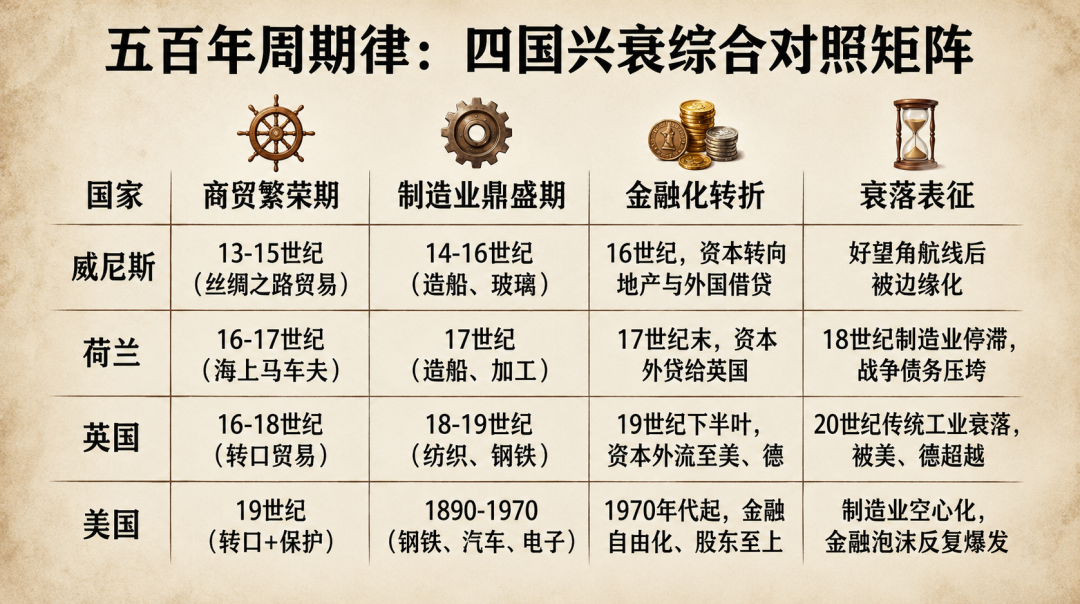
Article 1: Why Must Finance Serve the Real Economy?: China's Warning from the 500-Year "Cycle Law" of Industrialization Venice is the first specimen of this cycle law. Medieval Venice, which had almost no manufacturing industry, accumulated primitive capital through trade with the East and developed a handicraft manufacturing industry, including wool textiles, glass, and leather goods, with the financial industry rising accordingly. However, the discovery of the Cape of Good Hope route in the 16th century shook Venice's position as a trade center, and the excessive prosperity of the financial industry pushed up wages and costs. Rich merchants withdrew their funds from manufacturing to real estate, government bonds, and foreign loans. Kindleberger recorded: "Bankers and usurers rarely lent to domestic manufacturers, but increasingly lent to foreign borrowers." The manufacturing industry withered, the shipbuilding industry declined, and Venice withdrew from the European power center.
Why must finance serve the real economy?: China's warning from the 500-year "cycle law" of industrialization The Netherlands is a case in point. In the 17th century, the "sea-borne carriers" possessed the world's most powerful navy, ocean-going fleet, and financial industry, with a national total income 30%-40% higher than the combined total of England, Scotland, and Wales. Dutch shipbuilding techniques were the best in the world, and even British imports of sugar, tobacco, and diamonds had to be processed in the Netherlands. However, it was no coincidence that the first financial bubble in human history - the 1636 "Tulip Mania" - occurred in the Netherlands; futures trading for herring could be conducted even before they were caught, known as "trading in the wind"; gambling was rampant, and large amounts of capital flowed out of the country. The Dutch government attempted to correct this - issuing a decree requiring futures contracts to be settled with physical delivery - but under the lobbying of financial monopolistic capital, the decree existed in name only. This failed correction tells the world that to reverse the spontaneous trend of finance squeezing out manufacturing, extremely strong national will and sustained institutional determination are needed - and this is precisely
Article 1: Why Must Finance Serve the Real Economy?: China's Warning from the 500-Year "Cycle Law" of Industrialization The most ironic thing is that Dutch financial capital itself provided blood transfusions to its competitors. A large amount of Dutch funds flowed into the UK, subscribing to British government bonds and buying British stocks. Braudel lamented: "The constant inflow of Dutch funds injected vitality into British credit... however, unexpectedly, the UK responded with military force and knocked it to the ground." Montesquieu's observation in 1729 was apt: "People invest their funds in beautiful palaces, rather than in fleets and national construction."
Article 1: Why Must Finance Serve the Real Economy?: China's Warning from the 500-Year "Cycle Law" of Industrialization The UK is the most complete specimen of this cycle law. Like Venice and the Netherlands, it started with transit trade, but placed more emphasis on industrial policy - from the Tudor dynasty to the mid-19th century, nearly three hundred years of mercantilist policies transformed the UK from a wool-exporting country into the "workshop of the world". List wrote: "Once the UK grasped any industrial sector, it persisted unremittingly... with the same care as protecting a young seedling." In 1815, British MP Henry Brougham explicitly stated: "To strangle foreign manufactures in their cradle, it is worth incurring a loss on the export of British manufactured goods."
The cycle of financial overreach: What Britain's decline teaches China about industry versus finance Once Britain ascended to hegemony, however, the overexpansion of its financial sector once again cannibalized manufacturing. Kindleberger captured this shift precisely: "Successful entrepreneurs and their descendants migrated from industry into finance." Running factories was endless trouble; capital operations yielded handsome returns—by the 19th century, apart from the landed aristocracy, Britain's wealthiest cohort was precisely "those engaged in commercial and financial occupations," while those who struck it rich in manufacturing were rare. Between 1904 and 1913, foreign securities markets lured nearly half of Britain's savings and 5% of its national income overseas. The irony is stark: this nation, which rose on mercantilism and trade protection, became the world's champion of laissez-faire after reaching the top—and when confronted with latecomers like the US, Germany, and Japan that industrialized through state intervention, Britain was trapped in path dependency, watching helplessly as it was overtaken.
Why must finance serve the real economy?: China's warning from the 500-year "cycle law" of industrialization The US is retracing the same path. From the 19th century's high tariffs protecting infant industries, to 1953 when manufacturing value-added reached a historical peak of 28.3% of GDP, the US rise is reminiscent of the English model. However, a turning point occurred in the 1970s: after the collapse of the Bretton Woods system, financial liberalization accelerated, and the profit structure underwent a fundamental reversal - between 1965 and 1980, the average proportion of manufacturing profits to total domestic profits was 49.1%, which plummeted to 20.9% between 2000 and 2015; during the same period, the proportion of financial industry profits rose from 17% to 28.9%. More fatally, the "shareholder supremacy" doctrine reshaped corporate governance: between 2003 and 2012, S&P 500 component stocks used 91% of their net profits for stock buybacks and dividend distributions, which further increased to 96% between 2007 and 2016. By the third quarter of 2024, the proportion of US manufacturing to
Article 1: Why Must Finance Serve the Real Economy?: China's Warning from the 500-Year "Cycle Law" of Industrialization The decline of Boeing is a painful footnote. This American pride, which created the B-52 bomber, the Apollo moon rocket, and the 747 airliner with its excellent engineering culture, was dominated by financial logic after its acquisition of McDonnell Douglas in 1997 - with some software development for the 737 MAX outsourced to Indian college graduates at $9 per hour, while American engineers earned $35 to $40 per hour. Two fatal crashes that killed 346 people were attributed to a "culture of prioritizing profits over safety" in a congressional investigation report. Boeing, once a pride of human engineering, became a victim of financial engineering, serving as a mirror that reflects how the soul of an industrial giant can be hollowed out when financial logic surpasses manufacturing logic.
Why Finance Must Serve the Real Economy: China's Warning from the 500-Year "Cycle Law" of Industrialization Dajie's "Firewall" - An Alternative Possibility
Article 1: Why Must Finance Serve the Real Economy?: China's Warning from the 500-Year "Cycle Law" of Industrialization If the trajectory of the UK and US has verified the "rule" that "financialization leads to the decline of manufacturing," then Germany and Japan have provided an alternative path of building a country on the foundation of manufacturing.
Article 1: Why Must Finance Serve the Real Economy? China's Warning from Five Centuries of Industrial "Cyclical Law" Germany developed a "social market economy" model in which banks and enterprises form long-term partnerships, freeing companies from the anxiety of quarterly earnings reports. Its more than 2,700 "hidden champions"—family-owned manufacturing firms that hold global leadership positions in niche segments—remain unlisted, ignore short-term stock price fluctuations, and focus on perfecting a single technology to its utmost. Even amid the global wave of financialization, German manufacturing has maintained its share of GDP at around 20 percent. Japan, meanwhile, adopted a "keiretsu" system of main banks and cross-shareholding that shielded companies from hostile takeover threats and enabled a focus on long-term R&D—Toyota was able to spend decades refining "lean production," and Sony could sustain investment in transistor technology that ultimately reshaped the global consumer electronics landscape.
Article 1: Why Must Finance Serve the Real Economy?: China's Warning from the 500-Year "Cycle Law" of Industrialization However, these two "firewalls" also developed cracks after the 1990s: German banks' patient shareholding began to loosen, and more and more small and medium-sized enterprises were acquired by private equity funds; Japan, after the bursting of its real estate bubble, experienced a weakening of its main bank system and the dissolution of cross-shareholdings. The pervasive nature of financial logic poses a continuous challenge, even to countries with the deepest manufacturing roots - institutional design may be effective, but it requires ongoing maintenance to keep pace with the times, otherwise financial logic will eventually find a way to seep in.
Article 1: Why Must Finance Serve the Real Economy?: China's Warning from the 500-Year "Cycle Law" of Industrialization Two Types of Bubbles: Creative and Parasitic
Why must finance serve the real economy?: China's warning from the 500-year "cycle law" of industrialization The discussion of "finance must serve the real economy" cannot fall into a binary opposition of black and white. Financial forms must match the stage of industrial development: the handicraft era requires partnership financing, the industrialization era requires bank credit, and the technological innovation era requires capital markets - because high-tech industries are light-asset and high-risk, and the bank credit model is naturally ineffective. The capital market, through the mechanism of "shared risk and shared returns," embraces uncertainty rather than avoiding it, which is a path that the banking system can never provide.
First, finance must serve the real economy. This requires distinguishing between two fundamentally different types of bubbles. A technology securities bubble, despite destroying vast amounts of wealth, can through trial and error give rise to revolutionary technological breakthroughs—the internet bubble spawned Google and Amazon, while the new energy bubble produced Tesla and CATL. A real estate bubble, by contrast, is essentially a static pricing of scarce resources like land and space. It creates no disruptive new technologies, only widening wealth disparity—"the rich get richer, the poor get poorer." Families holding multiple properties see their assets appreciate effortlessly, while ordinary families must drain generations of savings. When such a bubble bursts, all that remains is bad debt and unfinished construction, not a reservoir of new technology.
Why must finance serve the real economy?: China's warning from the 500-year "cycle law" of industrialization The distinction between "necessary bubbles" and "harmful speculation" lies in whether funds truly enter research and development and production, rather than being used for major shareholders to reduce holdings and cash out; whether there is a genuine technological and industrial foundation, rather than mere conceptual fabrication; and whether the assets anchored by the bubble have the ability to continuously generate new productive forces. The problem has never been with finance itself, but rather with the lack of effective national policy regulation, allowing finance to become detached from the real economy and inflate on its own. As Cambridge University economist Zhang Xiaozhuang pointed out, when the degree of financialization is high, the nature of financial markets to pursue short-term gains will cause any factor that may reduce short-term profits to be met with a negative reaction. The countermeasure, on the one hand, requires restricting certain powers of the financial industry, and on the other hand, must make people believe that although restrictions on the financial industry will lead to a decline in financial profits in the medium and short term, they will reverse corporate investment behavior and prompt companies to increase long-term investment in research and development. In a larger economic body
Article 1: Why Must Finance Serve the Real Economy?: China's Warning from the 500-Year "Cycle Law" of Industrialization A Warning for China
Why must finance serve the real economy?: China's warning from the 500-year "cycle law" of industrialization Looking back at 500 years of industrialization history, the birth and extreme development of financial capitalism require four conditions to be met simultaneously: (1) financial capital infiltrates and dominates state power; (2) cross-border capital achieves free flow; (3) the state tolerates or even encourages huge wealth disparities; and (4) the manufacturing industry has foreign competitors acting as "white knights." When these conditions are met, financial capital has the confidence to abandon its home country's real economy and pursue "empty and false" gains under the temptation of global arbitrage.
Why must finance serve the real economy?: China's warning from the 500-year "cycle law" of industrialization Marx accurately summarized this historical chain in "Das Kapital": "Declining Venice lent large amounts of money to the Netherlands, Venice... became the hidden foundation of the Netherlands' wealth. The relationship between the Netherlands and the UK was similar... and now a similar situation exists between the UK and the US. Many mysterious sources of capital that have emerged in the US today were just yesterday the capitalized 'blood of children' of the UK." This chain of capital flow from "Venice → Netherlands → UK" extended in the 20th century to a new chain of "UK → US → China". Each generation of hegemony thinks it can forever stand at the top of the food chain reaping wealth, but forgets that the manufacturing foundation beneath its feet has been hollowed out.
Article 1: Why Must Finance Serve the Real Economy?: China's Warning from the 500-Year "Cycle Law" of Industrialization For China, the warning significance of this cycle law is self-evident. Currently, China does not fully meet the above four conditions - the socialist system has forcefully suppressed the growth space of conditions (1) and (3) from the design stage, and the massive manufacturing industry and the reshaping of the global supply chain have not led to a trend of Chinese companies concentrating on a single late-developing country on a large scale. However, if India becomes the "successor" in the future, it will pose a severe challenge - its population size is equivalent to China's, and it is also younger.
Why must finance serve the real economy?: China's warning from the 500-year "cycle law" of industrialization Upholding the principle of "finance serving the real economy" as its foundation, limiting the development of virtual finance that deviates from the real economy, and using benefits to offset drawbacks, should be the unwavering direction of China's financial industry. However, this does not mean denying the unique value of capital markets in technological innovation - on the contrary, a well-developed capital market is one of the highest forms of finance serving the real economy. What truly needs to be done is to establish a fair, transparent, and law-based market environment, ensure that rights and responsibilities are equal and risks are borne by individuals, while being highly vigilant about asset bubbles in the real estate sector and other areas that lock national wealth in non-productive fields, ensuring that capital always flows to the most innovative and dynamic productive sectors.
Why must finance serve the real economy?: China's warning from the 500-year "cycle law" of industrialization Can Trump's manufacturing reshoring be successful? When the incentive mechanisms of Wall Street, the tenets of corporate governance, and the rules of the game of the capital market have not changed, it is impossible to truly bring manufacturing back through tariffs and subsidies alone. Maintaining China's manufacturing foundation has always been a top priority concerning the country's fate. No matter how dazzling and beautiful the exterior of the financial edifice may be, if it does not have a solid foundation of manufacturing at its base, the so-called prosperity will ultimately be an illusion built on quicksand.
Article 1: Why Must Finance Serve the Real Economy?: China's Warning from the 500-Year "Cycle Law" of Industrialization References:
Wen Yi: Why Must Finance Serve the Real Economy? China's Warning from the 500-Year "Cyclical Law" of Industrialization [1] Friedrich List. The National System of Political Economy [M]. Trans. Chen Wanxu. Beijing: The Commercial Press, 1983.
Wen Yi: Why Must Finance Serve the Real Economy? — China's Warning from the 500-Year Cycle of Industrialization [2] Charles Kindleberger. World Economic Primacy: 1500-1990 [M]. Trans. Gao Zugui. Beijing: The Commercial Press, 2003.
Article 1: Why Must Finance Serve the Real Economy?: China's Warning from the 500-Year "Cycle Law" of Industrialization [3] Fernand Braudel. Civilization and Capitalism, 15th-18th Century (Volume 3) [M]. Translated by Gu Liang and Shi Kangqiang. Beijing: The Commercial Press, 2018.
Article 1: Why Must Finance Serve the Real Economy?: China's Warning from the 500-Year "Cycle Law" of Industrialization [4] Karl Marx. Das Kapital (Volume 1) [M]. Translated by the Central Bureau of Marxist-Leninist-Stalinist Works of the Communist Party of China, Beijing: People's Publishing House, 2004.
Wen Yi: Why Must Finance Serve the Real Economy? China's Warning from Five Centuries of Industrialization's "Cyclical Law" [5] Greenfeld, L. The Spirit of Capitalism: Nationalism and Economic Growth [M]. Harvard University Press, 2009.
Article 1: Why Must Finance Serve the Real Economy?: China's Warning from the 500-Year "Cycle Law" of Industrialization [6] Bernstein W J. A Splendid Exchange: How Trade Shaped the World. Grove Press/Atlantic, Inc., 2009.
Article 1: Why Must Finance Serve the Real Economy?: China's Warning from the 500-Year "Cycle Law" of Industrialization [7] Halford Mackinder. Democratic Ideals and Reality. Translated by Wang Dingjie. Shanghai: Shanghai People's Publishing House, 2016.
Article 1: Why Must Finance Serve the Real Economy?: China's Warning from the 500-Year "Cycle Law" of Industrialization [8] William Engdahl. A Century of War: Anglo-American Oil Politics and the New World Order. Translated by Zhao Gang, et al. Beijing: Intellectual Property Publishing House, 2008.
Article 1: Why Must Finance Serve the Real Economy?: China's Warning from the 500-Year "Cycle Law" of Industrialization [9] US Bureau of Economic Analysis (BEA). National Income and Product Accounts [EB/OL]. (2026-05-29) [2026-06-01]. https://apps.bea.gov/iTable/?reqid=19&step=2&isuri=1&categories=survey.
Article 1: Why Must Finance Serve the Real Economy?: China's Warning from the 500-Year "Cycle Law" of Industrialization [10] World Bank. World Development Indicators [EB/OL]. (2026-05-29) [2026-06-01]. https://databank.worldbank.org/source/world-development-indicators.
Article 1: Why Must Finance Serve the Real Economy?: China's Warning from the 500-Year "Cycle Law" of Industrialization [11] Jiang Yuzhou. How Can Finance Make the "Return" of American Manufacturing Become a "Reversal"? [EB/OL]. (2026-04-02) [2026-06-01]. https://www.guancha.cn/jiangyuzhou/2026_04_02_812272.shtml.
Article 1: Why Must Finance Serve the Real Economy?: China's Warning from the 500-Year "Cycle Law" of Industrialization [12]Robison P. Boeing's 737 Max Software Outsourced to $9-an-Hour Engineers [EB/OL]. (2019-06-28) [2026-06-01]. https://www.bloomberg.com/news/articles/2019-06-28/boeing-s-737-max-software-outsourced-to-9-an-hour-engineers.
Article 1: Why Must Finance Serve the Real Economy?: China's Warning from the 500-Year "Cycle Law" of Industrialization [13] Li Haiyan. Looking Back at Japan's Economy in the Heisei Era [M]. Beijing: China Financial Publishing House, 2020.
Article 1: Why Must Finance Serve the Real Economy?: China's Warning from the 500-Year "Cycle Law" of Industrialization [14] Tang Zhi Shang Long. The Lost Manufacturing Industry: The Defeat of Japanese Manufacturing [M] translated by Lin Chao. Beijing: Mechanical Industry Press, 2015.
Wen Yi: Why Must Finance Serve the Real Economy? China's Warning from the "Cyclical Law" of Five Hundred Years of Industrialization [15] Chang H J, Amsden A H. The political economy of industrial policy[M]. London: Macmillan, 1994.