
What the bosses value most is the right to hire and fire at will.
When it comes to hiring at factories, the term "outsourcing" can have unpleasant connotations.
Job seekers fear that the wages advertised in recruitment ads will be lowered after entering the factory, workers are worried about deductions from their wages and fear that their salaries will be intercepted by intermediaries, while workshop managers have to constantly handle new employees who have just started and are already planning to quit.
But executives are still using it — and finding it more effective with each use.
Why is that?
What bosses value most is the right to freely add or reduce staff.
Key Points
flexibility
The boss is not buying cheaply, but rather with the option to change his mind at any time.
First, it's essential to clarify some concepts. Recruitment outsourcing, labor dispatching, and business outsourcing are different. When a company outsources its recruitment work to a third party, it does not necessarily mean that it has used dispatched labor; similarly, purchasing an independent business outcome is not equivalent to directly using dispatched workers.
This article explores how factories have handed over a large number of frontline employees to labor companies and intermediary agencies for long periods of time, while gradually withdrawing from recruitment, talent retention, and training work.
This model has strong practical appeal for many manufacturing industry bosses.
The consumer electronics industry's orders are extremely unstable. A manufacturing temporary worker platform researched by Zhang Dandan's team at Peking University's National Development Institute covers approximately 500 enterprises and 700,000 workers, and has completed more than 2.5 million job matches. According to platform data, during the trough of labor demand, the number of new employees per month is less than 10,000, while during the peak period, it can reach 50,000, with hourly worker prices fluctuating greatly between 16 yuan and 32 yuan.
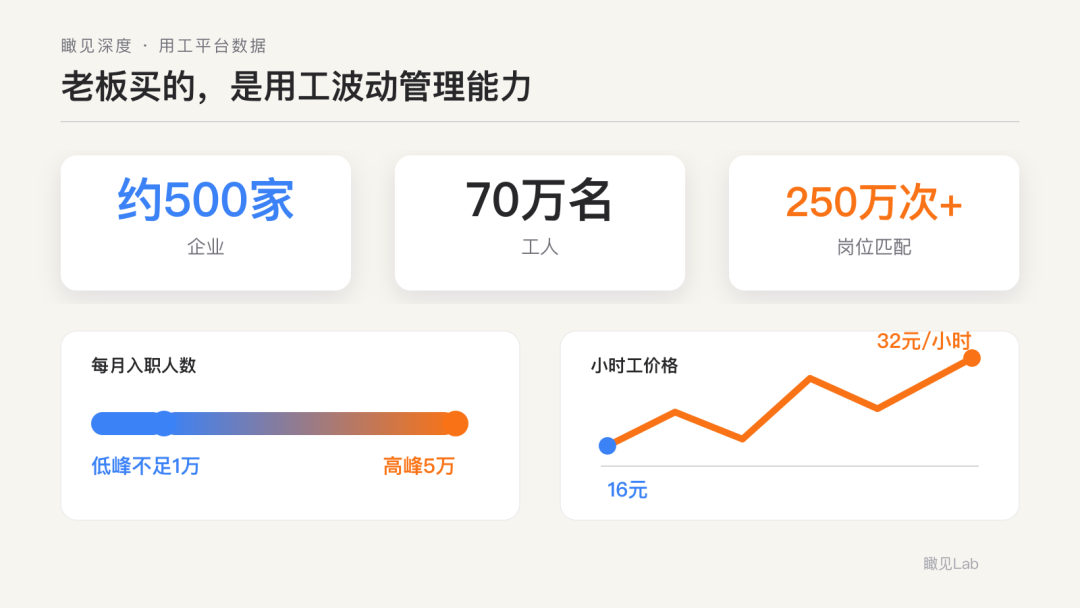
Manufacturing outsourcing platform samples and price fluctuations (based on publicly available research data compiled by Zhang Dandan's team)
Orders come in quickly, and factories cannot afford to hire and train slowly. Labor companies can dispatch several thousand people in just a few days. Once orders decrease, factories do not need to retain the manpower from peak periods.
In terms of daily management and cost accounting, matters such as recruitment, signing labor contracts, handling social insurance, personnel entry and exit, and dispute resolution can all be outsourced to external agencies. The employment liability does not legally disappear with the contract, but what the employer sees is an adjustable service fee, rather than a specific individual.
This employment method may not be more economical, but it is easier to calculate and easier to revoke.
A rebate chain refers to a type of business model where companies offer rebates to customers who purchase their products, and in turn, these customers can use the rebates to buy other products from partner companies, thereby creating a chain of rebates and purchases. This model is often used by e-commerce platforms and online retailers to incentivize customers to make repeat purchases and increase sales. For example, JD.com and Alibaba's Tmall have both used rebate chain models to promote sales during major shopping festivals such as Singles' Day.
Referral fees have made personnel movement a business in itself
What factories need is not a list of names, but workers who can show up on the production line on time during peak production periods. In order to compete for labor, labor service companies and intermediaries have started to attract workers by offering refunds. Workers can receive an extra sum of money, on top of their wages, for working a certain number of days or staying on the job until a specific date.
In reports on the 2020 Kunshan Shengshuo incident, it was mentioned that an 18-year-old temporary worker entered the factory through an agency, and after accumulating 55 working days and being on the job for 90 days, could receive a refund of over 10,000 yuan. Another interviewee received a refund of 11,500 yuan. His goal was not to stay long-term, but to complete the required work, receive the refund, and then end his employment.
Five years later, an investigation by the People's Daily again uncovered a labor recruitment chain leading to Dongguan. A job seeker worked in a factory for a month, only to have his wages withheld by the labor services company, which then had him switch to another factory to complete three more months; on a recruitment chain that changed hands multiple times, the promised hourly wage of 30 yuan for workers was reduced to 18 yuan by the time it reached them.
Two news stories, separated by five years and occurring in different locations, can be explained by subsequent field research as to why similar recruitment methods have emerged.
Whether young people can endure hardship does not explain why this profit chain exists. Rebates have changed the benefit relationship between workers and intermediaries.
A field study on the Yangtze River Delta published in Open Times found that "rebates" were distributed through several channels, including labor service companies, job brokers, employment agencies, and workers themselves. A job seeker may be transferred to different hands over 10 times during the job search process. According to the study, during the peak hiring season in 2020, the highest rebate could reach 12,000 yuan per person. Some intermediaries would even encourage workers to change jobs and participate in the next round of profit-sharing after they received the rebate.
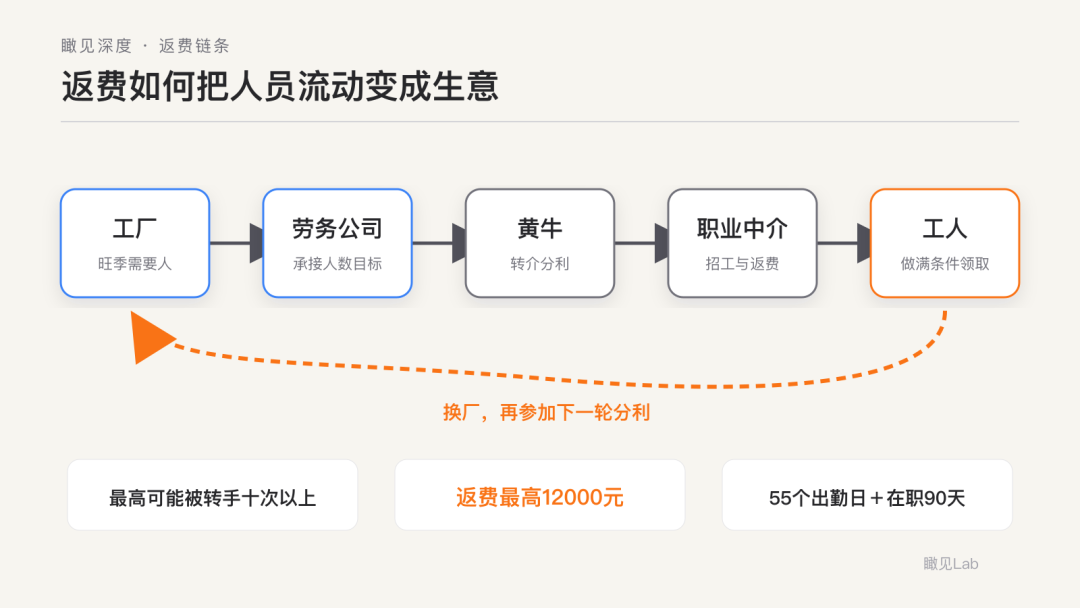
Referral fees have formed a profit-sharing chain between labor companies, intermediaries, professional brokers, and workers (according to field research compiled by Open Times)
The intermediary's income comes from constantly sending people, while the worker's extra income is obtained after completing the prescribed working hours. No one gets more rewards just because they have trained someone to maturity and let him work stably in the factory for five years.
Workers are also calculating. With a low basic salary, uncertain recruitment promises, and unclear career advancement channels, a sum of money that can be obtained in three months is more tangible than technical accumulation that can only be achieved in several years.
This mechanism rewards mobility and punishes those who stay behind.
Hidden costs refer to the indirect or intangible expenses associated with a particular business operation, investment, or project that are not immediately apparent or explicitly stated. These costs can include things like labor costs, maintenance and repair expenses, and opportunity costs, among others. In the context of business and technology, hidden costs can have a significant impact on a company's bottom line and overall profitability. For example, a company may invest in a new software system, but the hidden costs of training employees to use the system, as well as the potential downtime and lost productivity during the implementation process, can add up quickly. Similarly, a company may launch a new product, but the hidden costs of marketing and advertising, as well as the potential costs of recalls or warranty claims, can be substantial. As such, it is essential for businesses to carefully consider and account for hidden costs when making investment decisions or launching new initiatives.
The costs saved by the bosses ultimately have to be made up for by the workshop.
The short-term benefits and long-term losses of outsourcing are not on the same balance sheet.
The benefits of having fewer permanent workers, reducing recruitment teams, and adapting to changes in orders can be seen quickly. However, with new employees constantly being trained and teams needing to readjust, issues such as decreased proficiency, increased rework, and unstable delivery times exist within the production and quality management departments.
The cost on the human resources department's books may have decreased, but the workshop still has to pay the price for repeated training and running-in.
A study published in the International Journal of Production Research found that a higher proportion of temporary workers is associated with deteriorated quality performance, including increased defect rates and customer return rates. Another study published in the Journal of Advanced Mechanical Design, Systems, and Manufacturing noted that after employee turnover, new replacements require a period of time to recover to the original level, during which their work efficiency and output will decrease.
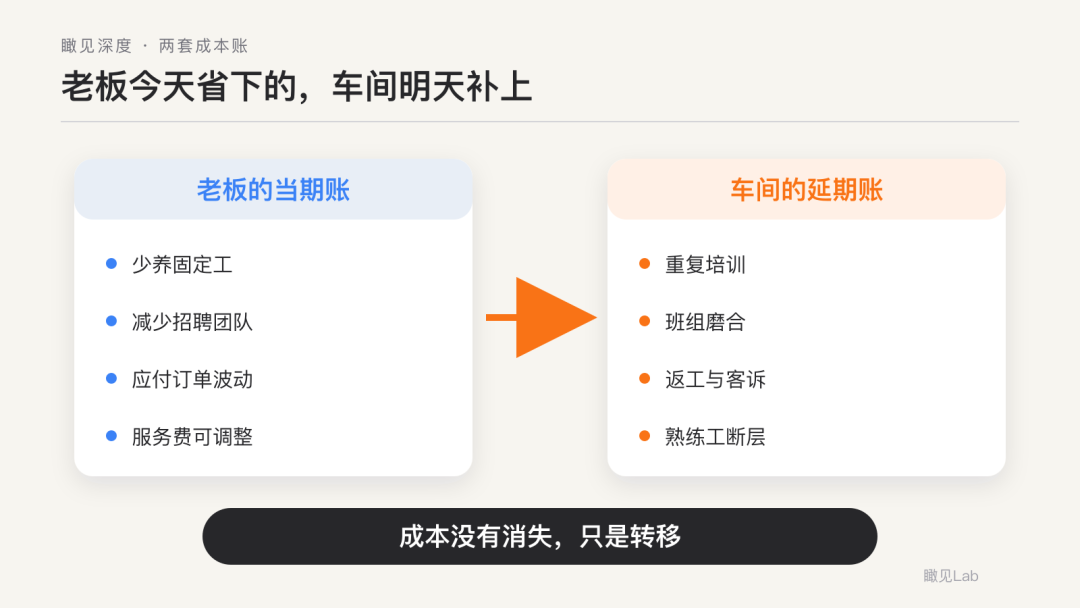
the current benefits of outsourcing versus the delayed costs borne by the workshop
The use of outsourcing does not necessarily lead to quality issues. The cost of personnel replacement exists, but this cost is rarely fully reflected in the cost accounting of outsourced procurement.
The boss sees today that the recruitment task has been completed. However, several months later, issues such as rework, overtime, customer complaints, and a shortage of skilled workers are difficult to accurately trace back to the original outsourcing contract that was signed.
No translation provided as there is no text to translate.
The less factories are able to hire on their own, the more they cannot give up outsourcing
The costs incurred over the long run also include the erosion of the factory's own workforce capabilities.
When a factory has not been in direct contact with job seekers for a long time, it gradually loses its sense of the labor market. Why do workers come to work here? Why do they leave? What kind of salary can retain skilled workers? What kind of team leader is worth cultivating? Enterprises are also increasingly relying on intermediary agencies to provide solutions.
Many dispatched workers are exposed to recruitment groups, short video accounts, and intermediaries before arriving at the factory. In this recruitment process, the first things explained are usually wages, referral fees, and resignation periods. What products the factory produces and what skills can be learned from the job may not be clearly explained by the intermediaries.
A survey of the manufacturing recruitment market by Sociological Research found that while labor intermediaries can provide workers with a certain degree of flexibility, they also contribute to high worker mobility and low skill levels. Factories' long-term reliance on temporary workers means that job positions are often unable to support long-term learning and skills training; as the number of retained workers dwindles, the factory is forced to continue relying on external labor when personnel shortages arise again.
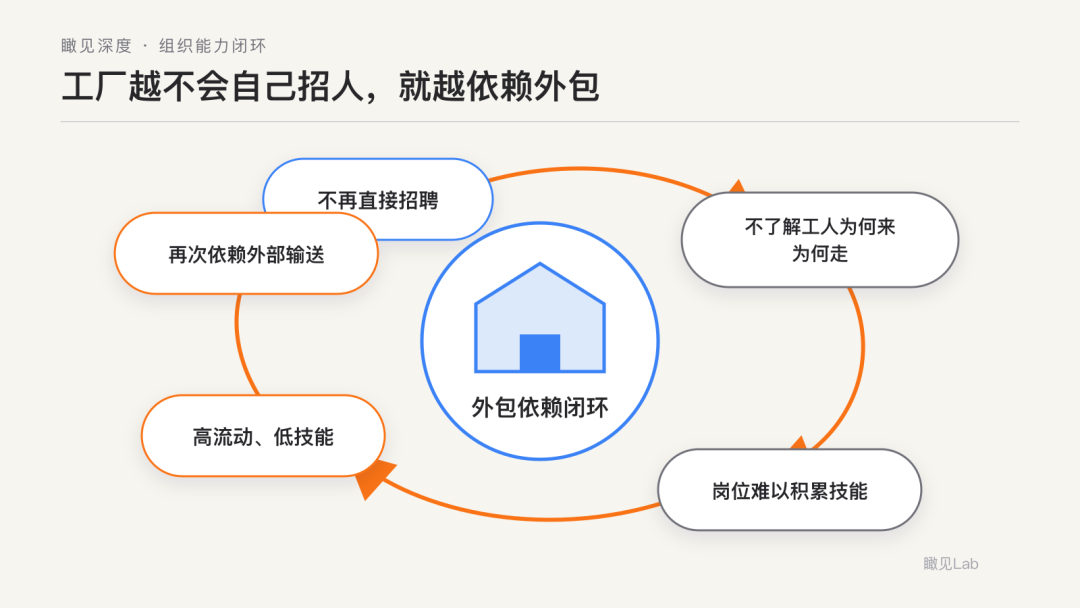
the vicious cycle of outsourcing dependence formed after the degradation of factory labor capacity
Labor fluctuations will not disappear, but will instead oscillate back and forth between recruitment, production, and personnel loss.
No translation provided as there is no text to translate.
What can be outsourced is the peak, what cannot be outsourced is the factory itself.
Labor dispatching is not inherently an illegal act, nor does it mean that all outsourcing should be abolished. The law has its own limitations. Dispatching is a supplementary approach that can only be used to fill temporary, auxiliary, and substitute positions, and the number of employees used in this manner should not exceed 10% of the total workforce in principle.
But core production roles have long been filled by dispatched workers, with companies distancing themselves from direct labor relations under the guise of business outsourcing. In this way, outsourcing has become more than just a tool for improving efficiency—it has also become a wall for shirking responsibility.
The 2026 nationwide special campaign to clean up and regulate the human resources market order will still focus on cracking down on behaviors such as operating labor dispatch services without permission, disguising dispatch services as outsourcing, and fake recruitment. Cases published by the Supreme People's Court also demonstrate the principle that labor relations are primary and dispatch services are secondary, meaning whoever actually employs the workers is responsible.
The scope of outsourcing needs to be redefined.
During peak order periods, external help can be utilized, and recruitment can also be outsourced to professional services. However, core positions, such as who will handle recruitment, salaries, and how rebates will be transparently fulfilled, as well as how to retain skilled workers and improve their skills, all need to be addressed within the factory itself.
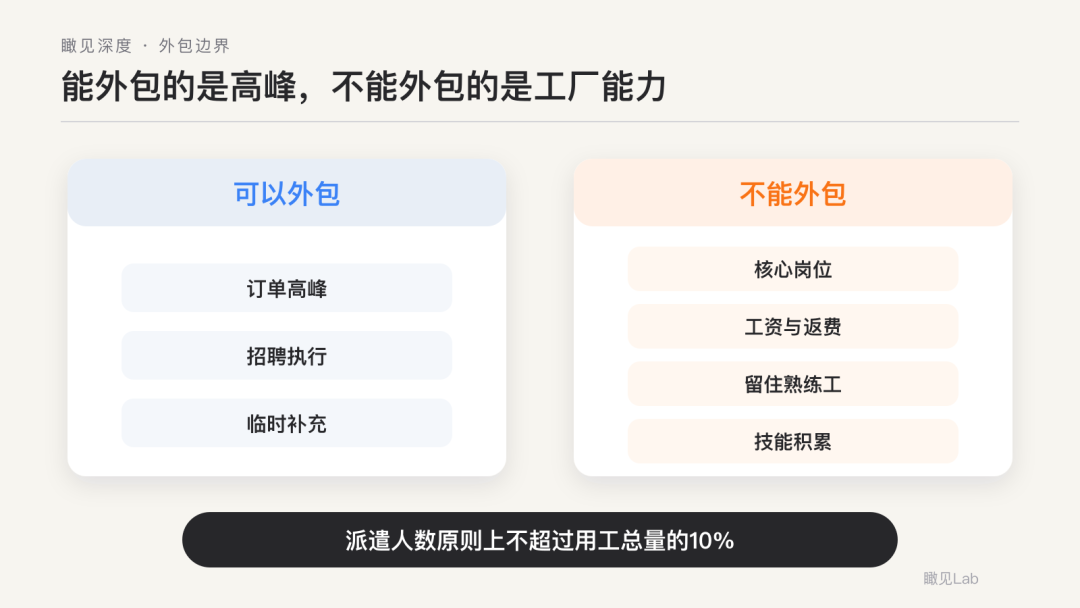
Elastic demand that can be outsourced and core factory capabilities that cannot be outsourced
Bosses like to outsource because it can immediately make today's problems disappear.
What disappeared, however, was the responsibility, not the cost.
A factory that even its own workers are not willing to own will find it difficult to truly possess quality, technology, and a future.
请提供需要翻译的中文文章,我将将其翻译成清晰的彭博式英文。
The article is primarily driven by the author's selection of topics, and involves verification of information and judgment of viewpoints, while also referencing publicly available reports, academic research, and relevant information released by the Ministry of Human Resources and Social Security and the Supreme People's Court. Cases such as Kunshan, Dongguan, and the labor chain have retained the original boundaries of the reports or research papers, and have not made speculative comments about specific companies based on information beyond the materials. Artificial intelligence is used to organize materials, correct textual errors, and provide formatting assistance.
Primary Sources
The information mainly comes from media sources such as People's Daily, Time Finance, Open Times, and the China Finance 40 Forum, as well as documents released by relevant departments, and academic papers related to manufacturing employment.