

(Thanks to Yu Bai for the perfect photography)
However, the mushroom farmer gave me a perspective on the market. In the mountains, when picking dried mushrooms, the mushroom farmers who lease the mountains have a habit: they will find the newly emerged seedlings in the mountains and cover them with small brackets. Dried mushrooms usually grow under pine trees, and in natural growth without care, pine needles and withered branches will fall all over them, embedding themselves in the mushroom body and making them difficult to clean. The shape will also not grow properly. Covering them not only makes them easier to clean, but also preserves their shape, making them more attractive and thus more valuable.
So "nurturing" has clear economic benefits in the world of fungi.
Now back in the secular world, various things are coming to the forefront. While crazily managing cortisol and missing the good times in Yunnan, I suddenly thought of the inspiration given to me by Junzi: what is the relationship between the current market and "nurturing" anyway?
Global long-term interest rates rose collectively on the day. The yen fell to its lowest point since the Japanese government intervened in the foreign exchange market at the end of July, with Besent strongly supporting Japan's decisive action, and the market is almost certain that the Bank of Japan will raise interest rates in September; coupled with the euro zone's August inflation rising to a nearly three-year high, which also gave the European Central Bank's hawks a boost. As a result, the sell-off spread to emerging markets, with bond yields in South Africa, South Korea, and Poland also rising collectively.
So, behind this round of sell-offs, what is the market really worried about: credit, inflation expectations, or interest rate hike expectations?
I think it's still mainly the Fed's rate hike expectations, with other factors playing a supporting role. But this judgment itself is not complex, what's complex is the process by which it was formed. Over the past two weeks, the narrative struggle in the market has had two main characters, one being Fed Chairman Powell and the other being Treasury Secretary Yellen.
The two are also fellow disciples, both trained under Druckenmiller. The senior apprentice, Bessent, first made his mark during the Quantum Fund's 1992 assault on the pound sterling, where he took part in key decisions and earned Druckenmiller's admiration. The junior apprentice, Warsh, was once a partner at Druckenmiller's own family office, Duquesne.
Before one became Treasury secretary and the other Fed chair, Druckenmiller's imprint was visible in both of their philosophies, and at times they conveyed their positions in "Stan's language."
Druckenmiller's core philosophy is that the old path of the past few decades must come to an end, and that quantitative easing and long-term low interest rates will distort market prices, causing more money to flow into financial speculation - a view that apprentice Wash has always adhered to; while senior apprentice Besant is more like implementing this idea in the fields of finance and industry: relaxing regulations, cutting taxes to attract investment, and adding some targeted tariffs to bring production and capital expenditures back to the United States, allowing private enterprises to make money in the real economy.
This was supposed to be a dream team, with Besant in charge of fiscal and industrial tools, and Wash responsible for making the Federal Reserve more restrained and market-oriented, building a bridge between the central bank and the market - perhaps America could truly be great again.
Beisen has been taking intense actions over the past half month, increasing buybacks and shortening the maturity of its bond issuances. The Ministry of Finance stated that if necessary, it can utilize nearly $1 trillion, and is even researching whether to suspend issuance of ultra-long-term national debt. In short, the goal is to suppress long-term yields before the midterm elections. Trump added that "if needed, the US military will be deployed."
Various unplanned interventions and statements, a series of operations as fierce as a tiger. Lyn Alden commented that this is a textbook-level "Streisand effect".
The term "Streisand effect" originated in 2003, when a photographer took aerial photos of the California coastline to document coastal erosion, one of which captured Barbra Streisand's mansion in Malibu. Streisand sued, demanding the photo be removed and seeking damages. Before the lawsuit, the photo had been downloaded only a handful of times; after the lawsuit, the media reported extensively, and the photo was viewed hundreds of thousands of times.
The things you try to hide become all the more public because of the act of hiding itself. The bond market operates on the same logic. The more the Ministry of Finance rushes to push down long-term yields, the more the market wants to know what you're really afraid of.
However, whether or not it was written by AI is not important, the logic and argumentation in this article are well worth considering:
The Ministry of Finance's justification for the repurchase is to provide "liquidity support" to the "continuously strong buyers" in the market. However, this raises a question: if there are still continuously strong "buyers" in the market, it proves that the market is healthy and does not need official intervention, as money is doing its job.
Situations that truly require official intervention are those like auctions ending without a buyer, traders' balance sheets becoming stuck, and institutions engaging in consecutive forced liquidations, such as the 2020 US Treasury market and the 2022 UK bond market. However, none of these scenarios are present now, with fluctuations being controllable and transactions proceeding in an orderly fashion, like a normally growing mushroom.
US inflation has now missed its target for five straight years, hovering persistently between 3% and 4%. Unemployment sits at 4.1% — full employment by any definition. Yet with relative peace and full employment, the deficit is running near 6% of GDP. Total national debt has surpassed $40 trillion, and net interest payments this year will exceed $1.1 trillion, already larger than the defense budget.
A borrower maintaining a 6% deficit in a state of full employment, with inflation exceeding targets for five consecutive years, and debt surpassing 40 trillion, is being charged interest solely based on the level of economic growth, without any additional risk premium or term premium. This treatment would be unimaginable in any emerging market country. As a result, Druckenmiller said that the bond market has been extremely accommodating for many years and finally cleared its throat to speak up, only to be suppressed by the Ministry of Finance.
The market is rapidly refining its understanding, but such an unusual disturbance can only be reflected in prices for now.
By September, Japan is set to raise interest rates, Europe has reason to do so, and the atmosphere in the US has also built up to this point, so the market will definitely recalculate the next moves of the central banks of various countries.
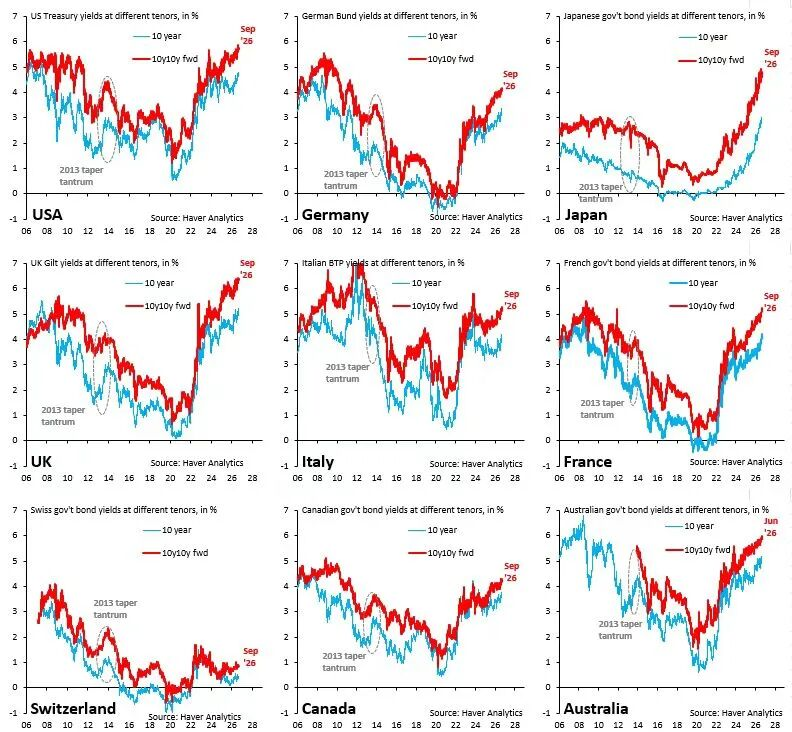
But here's a more fundamental question: how do we distinguish between the parts of prices that reflect genuine inflationary pressure and forward pricing, and those that are merely the market's knee-jerk reactions to forward guidance and rhetorical noise?
While picking boletus in Yunnan, I also visited Fuxian Lake, which was breathtakingly beautiful.
The market is like a lake, easily stirred up but with its own internal logic. Beneath the surface, capital flows, duration demand, and inflation expectations all operate at their own pace. The problem is that there are too many people throwing stones into the lake, and they're all large stones. If the finance minister or the Federal Reserve chairman speaks carelessly, it's not impossible that a landslide could occur. As a result, it's becoming increasingly difficult to discern what's really causing the market's fluctuations.
In other words, this is a narrative of facts rather than a moment of rapid escalation.
Of course, there's another possibility: the market has actually gotten smarter, learning how to play the game with the stone-throwers and shifting to a different style of interaction. Using "the more you don't want something, the more I'll do it" as a way to get you to stop doing something.
Going back to the oyster mushrooms, the reason the mushroom farmer's nurturing is effective is that it only blocks the pine needles and does nothing else. The mushrooms can grow as they should, and the trellis only ensures that they are not buried by debris. If the mushroom farmer is dissatisfied with the slow or uneven growth of the mushrooms and tries to shape them by hand every day, the mushrooms will likely be ruined.