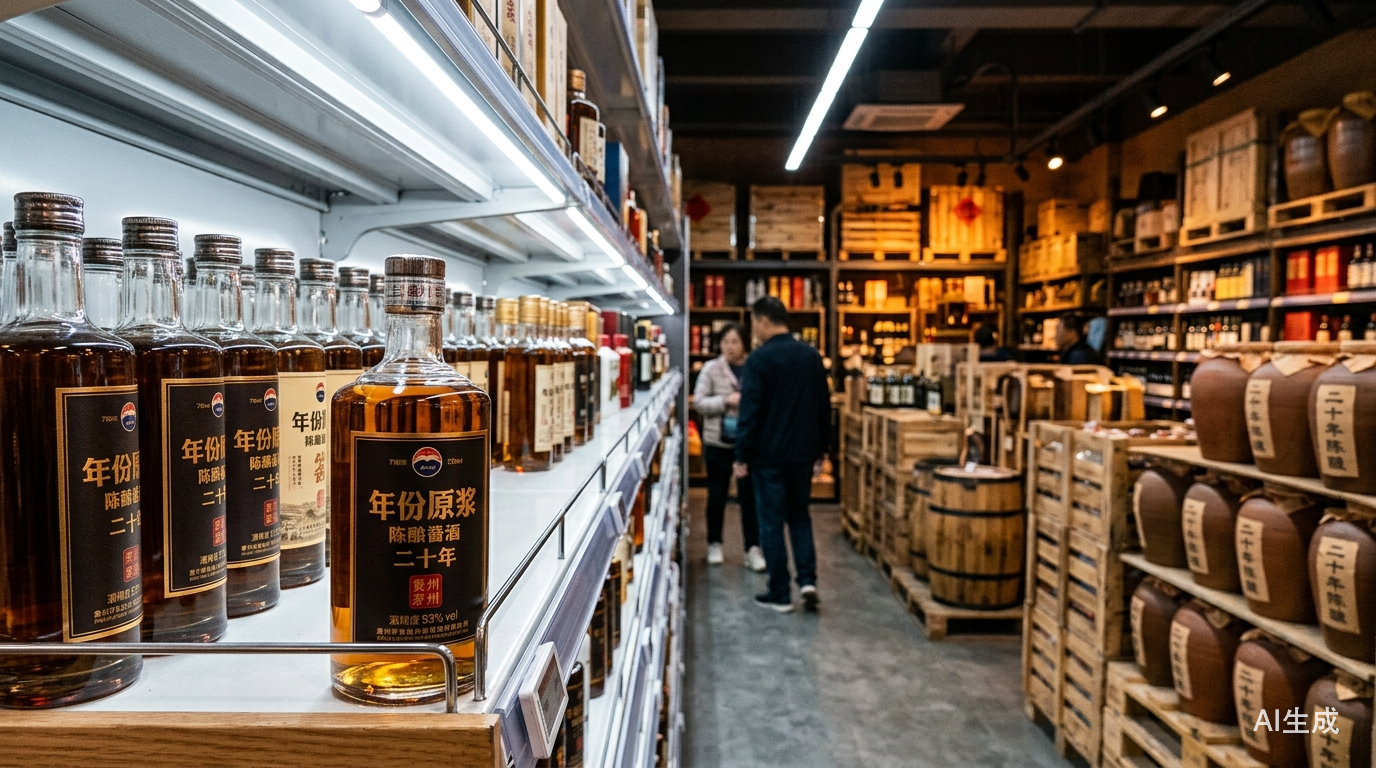
The Boxed Mart Shaoxing Yi Hao 10-year-old wine, touted as a "10-year-old wine", is experiencing "tight inventory" again.
On September 1, with the Mid-Autumn Festival less than a month away, Boxed Mart's Jianxiang Yihao 10-year baijiu, priced at 198 yuan per bottle, once again displayed a "stock shortage" indicator. This self-operated baijiu, which has been on the market for only a month, explicitly labels the content and proportion of the base liquor aged over 10 years, using transparent pricing to strip away the "high-price story" surrounding baijiu.
However, Box Horse is not an isolated case. Nandu Bay Finance's Wine and Spirits New Consumption Index project team noticed that Yonghui Supermarket's Yonyouhui Xiaozhui also clearly labels the specific proportion of aged liquor on the bottle, with a price of only 66 yuan per bottle. At the same time, including its own brands such as Qixian Jingxian Biyu and Aolizi, are also following this market trend. These products, with their low prices and strong sales momentum, are gradually bringing down the high prices of traditional Chinese liquor.
The rise of budget-priced sauce-flavor baijiu can be attributed not only to the channel restructuring brought on by the industry's deep adjustment period, but also reflects a deeper transformation within the sector: production has largely ground to a halt, base liquor is being offloaded at rock-bottom prices or sold via judicial auction, and the premium "bubble" on high-aged liquor is rapidly deflating. In the view of industry insiders, however, this is not necessarily a bad thing—it is an inevitable process of market consolidation and a return to rationality.
Some wineries only sell products without actual production, with cellar rentals available for as low as 10,000 yuan per year.
"I used to work in sales at my relative's winery, now I can only make a living by driving for a ride-hailing company," said Mr. Liu, a driver, to a reporter on the road from Maotai Airport to Maotai Town. The winery where he worked stopped producing new batches of liquor after its last production run in October 2024 and has not started a new "down sand" (a process of adding ingredients to make sauce wine) since then. He added that the winery has not gone bankrupt, but is just clearing out its inventory to recoup its funds, "as for whether it will resume production later, it depends on the situation."
Mr. Liu told Nandu Bay Finance reporters that the winery increased its production capacity to over 500 tons starting in 2019, during the peak of the "sauce wine craze", when the market was booming and the wine produced in Maotai Town was "basically selling well". However, in 2023, the sauce wine market cooled down significantly, and the expanded production capacity became a heavy burden. "Now, with weak demand for baijiu, prices have been cut to one-third of what they were before, yet still, no one is interested. Later, my relatives' company couldn't even pay salaries, so I had to start driving a car for a living."
Similarly, there's Mr. Zhu, who runs a barbecue stall near the 1915 Square in Maotai Town. He told Nan Dubei Finance reporters that his family operates a winery with an annual production capacity of about 600 tons, but the output has been decreasing year by year since 2024, and this year they have "basically no plans to produce." To clear their inventory as soon as possible, the whole family is using all their connections to sell the wine through online channels, introductions from friends, and even setting up street stalls. "We'll decide whether to resume production after we've sold out, depending on the situation."
As the main production area and birthplace of sauce-flavored baijiu, Maotai Town has experienced the rise and fall of the "sauce wine fever" over the past decade. Starting in 2018, the sauce wine industry was booming, with traffic congestion everywhere in the town, hotels were fully booked, and as long as there was production capacity, profits could be made, attracting capital to pour in. However, after 2023, the boom subsided, and the industry plummeted. In 2025, there were even reports that "more than 70% of sauce wine companies had stopped production." Although local people think this figure is "exaggerated," the reality is that some wine companies have stopped production and are clearing inventory, and many OEM merchants have withdrawn from the market, which is visible to the naked eye.
In response, some wine companies have transitioned from being "sedentary merchants" to "traveling merchants".
"This year, Guizhou Moutai said it wants to change from 'sitting merchant' to 'traveling merchant', but we small distilleries have already started doing so," said Mr. Wang, who works at a branded hotel store on the riverside road, while recommending products to a reporter from Nandu Bay Finance. Before 2025, the hotel stores in Maotai Town mostly waited for customers to come to them, but now they are proactively seeking customers on the roadside like never before. "In the past, most visitors came looking for liquor, but now, unless there's a major event like the Moutai shareholders' meeting, there are hardly any outside visitors. Even when people do come, they're mostly group tourists, and few actually buy liquor."
During the conversation, Mr. Wang also recommended the wine cellar rental business to the Nan Dubei Finance reporter. It is said that cellar rental is one of the common OEM customization models in Maotai Town, with the annual rent for a cellar reaching as high as 100,000 yuan during peak periods. However, after visiting, the reporter found that, including Mr. Wang, many wine companies are now quoting prices of only 15,000 to 20,000 yuan, which includes external packaging customization, blending, filling, and logistics, among other full-suite services. Even salespeople from mid-sized brand wine companies proactively introduced the offer, saying "you can rent a cellar for 10,000 yuan, with no threshold."
Some baijiu base wines have been sold at "Coca-Cola prices," with high-end premium prices experiencing a "bubble burst."
In addition to wineries suspending production and clearing inventory, the sharp decline in the price of baijiu base liquor has also drawn attention, with frequent "dirt-cheap" transactions appearing in court auction channels.
NDWB Financial News reporters noted that approximately 300 tons of base liquor at Guizhou Gaojiang Liquor Co., located in Maotai Town, Renhuai City, Guizhou Province, were recently put up for judicial auction. The appraised value was about 10.8 million yuan, with a starting bid of 7.56 million yuan. The lot ultimately sold for 7.597 million yuan, translating to a unit price of just 12.7 yuan per jin (half-kilogram).
Gao Jia Wine Industry is the controlling enterprise of *ST Yan Shi, formerly known as Shanghai Jun Dao Wine Industry, which was previously delisted, and is also the main production entity of its products. Since May this year, Gao Jia Wine Industry has sold approximately 1,400 tons of base wine on the Alibaba auction platform, with a total amount of approximately 54.39 million yuan, and an average price of around 19.4 yuan per kilogram. Notably, even the prices of finished wines have been heavily discounted, with a 2023 vintage Kunsha sauce wine, originally priced at 799 yuan per bottle, being sold for just 90 yuan per bottle at the "Jun Dao Guichun Official Flagship Store" Douyin store affiliated with Shanghai Jun Dao Wine Industry.
Low-priced auctions are not isolated cases. In January, approximately 91.4 tons of base liquor from Guizhou Diaotai Yipin Guobin Wine Factory was auctioned off twice without a buyer, before being sold for 3.73 million yuan, equivalent to around 20 yuan per kilogram. In March, 1,375.32 tons of bulk base liquor (including 505 tons of ten-year-old sauce wine) stored at the Maotai Town Wenxing Wine Factory failed to attract any bidders. Last August, 153 tons of base liquor from Maotai Town Guowu Jian Wine Industry Co., Ltd. had a starting price of 6.6096 million yuan, or 30 yuan per kilogram, but received no bids. Meanwhile, in March last year, 171.1 tons of liquor from Maotai Town Tailang Wine Factory was sold at auction for 960,000 yuan, with a transaction price as low as 2.8 yuan per kilogram, and the buyer was a daily necessities store.
Looking back at the peak of sauce wine, the base wine prices were a completely different story. According to a previous report by Nandu Bay Finance, in 2021, the average annual price increase of base wine in Maotai Town was around 30%, with some vintage base wines even exceeding 300 yuan per kilogram.
The sharp decline in the price of aged baijiu this year is a sign that the bubble has burst. A person in charge of a leading liquor company in Maotai Town explained to reporters that many so-called "high-aged" sauces have inconsistent quality and are not matched with their prices. In the past two years, the focus of baijiu consumption has shifted to leading brands, and small and medium-sized wineries have fallen into sluggish sales, forcing them to sell their previously hoarded high-aged baijiu at lower prices, or even auction them off through court-ordered sales.
The industry generally believes that the inventory bubble accumulated from the industry's blind expansion and market misjudgment in the early years is now being squeezed as consumption returns to rationality. The low-price sale of high-year base wines, although a helpless move for wine companies to recover funds, is also a "necessary path" for the market to clear out and return to value.
Can self-operated products become the "export" of sauce wine? High thresholds may block most companies
Under the dual pressure of sluggish product sales and plummeting bulk wine prices, some sauce wine enterprises have begun to target "self-operated products" as a way to explore new paths for clearing inventory.
"Self-operated products" refers to private-label brands owned by retail channels. Unlike the loose traditional model where OEM manufacturers exit after production, this approach involves long-term partnerships between liquor companies and channels—supermarkets, chain retailers, instant-retail platforms—built on deep co-development, joint operations, and shared data. Under this model, gross margins are significantly compressed, but sales volumes stand to gain substantially.
Among them, some liquor companies have benefited from their self-operated products. For example, Jiuguijiu, whose net profit attributable to the parent company increased by 37.57% year-over-year, saw its Jiugui series become the only growing product line, with a growth rate of 16.04%. According to Nandu Bay Finance, after Jiuguijiu collaborated with Pang Dalai to launch the "Jiugui Freedom Love" product last year, it has started to reap the benefits this year.
Several sauce wine companies have partnered with channels to lay out self-operated products. The partner for HeMa's Jiuxiang Yihao 10-year-old sauce wine is Chuanjiu Group; Aolizi sauce wine has partnered with Renhuai Daguojiu sauce; Bobo Jiangjiu has reached a cooperation agreement with Yonghui; meanwhile, some medium-sized sauce wine companies have also cooperated with instant retail platforms to develop channel-exclusive products, which are about to be launched.
Some believe that sacrificing high profit margins and premiums to access emerging channels as self-operated products may be a "lifeline" for baijiu sales and inventory clearance. However, industry insiders warn that self-operated products are not just about being low-priced. Baijiu industry analyst Cai Xuefei notes that while self-operated products are price-driven, price is not the primary factor in baijiu consumption. Instead, brand image, market recognition, product taste, and consumer cultivation are the core of long-term competitiveness, requiring sustained and refined operations.
The industry believes that the rise of self-operated products, although changing the pricing and sales logic of the liquor industry, has not lowered the industry's entry threshold. A person in charge of a wine company that has cooperated with channels told Nan Dubei Finance that the head channels' screening standards for suppliers are much stricter than those of traditional distribution channels, requiring not only product and cost control, but also that enterprises have a certain market scale and achieve full-chain traceability of products. "These two conditions are enough to keep most small and medium-sized sauce wine companies out," they said.
Nandu Bay Finance also noted that the number of well-known domestic channels is currently limited, while the number of sauce wine enterprises remains large. Taking Renhuai, a core production area, as an example, after several years of "shutdowns and restructuring", there are still 868 registered wine companies. The competition to enter the self-operated product track is fierce, as can be imagined.
Regarding the product clearance progress of small and medium-sized soy sauce enterprises, as well as changes in the market environment, what are your observations, feel free to discuss in the comments section.