
In recent years, as a social media personality, Xiao Zao Jun has frequently participated in various exploration activities, with the Intelligence Computing Center being one of the main destinations.
By my rough count, I've personally visited more than 50 intelligent computing centers.
Everyone knows that AI is currently developing rapidly, and the entire society's demand for computing power is experiencing explosive growth. To meet these demands, all parts of the country are accelerating the construction of intelligent computing centers.
The outside world's perception of data centers is mostly limited to vague impressions of being "high-end", "money-burning", and "power-hungry". However, what makes data centers so special? How much money and electricity do they actually burn? And how high is their utilization rate? People still lack a clear and intuitive understanding.
Xiao Zaojun started dealing with data centers 20 years ago, but back then they were mainly hosting rooms and traditional IDCs focused on general computing services. However, after visiting so many intelligent computing centers, I found that the construction and operation logic of intelligent computing centers are indeed very different from those of general computing centers.
Next, I will share my genuine feelings based on my own experiences and observations.
From "Tong Suan" to "Zhi Suan", it's not just about replacing a chip
Many people think that building an intelligent computing center is just a matter of replacing the CPUs in servers with GPUs. They also believe that an intelligent computing center is essentially a data center, and its construction and operation should be roughly the same as those of traditional data centers.
This perspective is clearly incorrect. The Intelligent Computing Center is not simply a replacement of device hardware, but rather a complex chain reaction that it triggers, which is far more complicated than imagined, and can even be said to be a comprehensive reconstruction from hardware to operations.
First and foremost, the most intuitive change is the power density.
Traditional computer cabinets typically have a power consumption of around 4kW to 6kW, whereas intelligent computing cabinets, packed with high-power AI acceleration cards such as GPUs and NPUs, often see their single-cabinet power consumption soar to 20kW or even over 40kW.
This means that if an existing data center is converted from general-purpose computing to AI computing, the facility's power supply system would need to undergo large-scale expansion and renovation to accommodate the surging electricity load.
In addition to power supply, heat dissipation is also a major problem.
Traditional air cooling faces enormous pressure when dealing with such high heat density. If it were to be modified to liquid cooling, it would require re-laying pipes, which would involve huge engineering quantities and costs, potentially even more expensive than building anew.
Several intelligent computing centers I visited have adopted super node solutions, and I thought they would definitely use liquid cooling, but it turned out they still use air cooling. It's not that they don't know liquid cooling is better, but the conditions don't allow for it, so they have to use air cooling.
This results in a significant compromise in cooling efficiency, making it difficult to reduce the Power Usage Effectiveness (PUE), and the noise is deafening. In simple terms, although energy consumption is expensive, the cost of renovation is even more expensive.
Another often-overlooked factor is floor load-bearing capacity.
The total weight of a standard cabinet is around 1 ton, while the weight of a smart cabinet, due to its densely packed AI acceleration cards and complex liquid cooling pipes, easily exceeds 1.5 tons and can reach over 2 tons.
The floor load-bearing capacity of old data centers often fails to meet this standard, and must undergo reinforcement, which is another significant expense.
At present, demand for data center retrofits is widespread, particularly in major cities and surrounding areas, as well as among the many private data centers operated by enterprises and public institutions.
For these units, land resources are already scarce, and although they generally have their own data centers, the scale is small, the space is limited, and they are already being used for general calculations. Now, with the increasing demand for intelligent computing, they need to squeeze in some intelligent computing equipment or dismantle the general computing equipment and replace it with intelligent computing equipment, which poses a big problem.
This is still a limitation in terms of hardware, and the requirements for network architecture and management operations of the intelligent computing center are also very different from those of the general computing center, with greater implementation difficulties and higher technical and financial thresholds.
In short, embracing intelligent computing is not as simple as just buying a card.
For many companies, the traditional approach of "self-built transformation" for private clouds (private data centers) may not be feasible in the intelligent computing era. Renting computing power may be a more economical, efficient, or perhaps more inevitable and realistic choice.
A single B300 system (8 cards) costs between 10 million and 14 million yuan, while a set of Ascend 384 super nodes costs between 120 million and 150 million yuan. The IT hardware cost for a single 1GW-level intelligent computing center alone is between 4.5 billion and 7 billion yuan (using domestic chips). Intelligent computing is absolutely a game that only wealthy enterprises can afford to play.
"Dong Suan" vs "Xi Suan", the cost difference is astonishing
For large enterprises such as operators and internet service providers, there is a strong inclination to build new intelligent computing centers, especially in "East Data West Computing" hub nodes like Inner Mongolia, Guizhou, and Heilongjiang.
Newly built AI computing centers are typically planned from the ground up, allowing them to adopt high-density liquid cooling architectures and dedicated power infrastructure directly. This approach avoids the steep retrofitting costs and performance trade-offs associated with adapting existing facilities.
The western hub node has a unique natural cold source and land resource advantage, with low land prices and relatively complete supporting facilities. The local government of the hub node often designates a specific area to cluster data centers, such as Horinger in Inner Mongolia.
More importantly, these locations have a significant advantage in terms of energy costs, with an abundance of green energy resources and low electricity prices.
All of this, simply put, is about saving money.
The costs of the Intelligent Computing Center include construction costs (Capex) and operational costs (Opex).
First, looking at construction costs, or Capex:
The cost of device hardware is not significantly different, but there may be some variation in logistics and warehousing.
Land costs in the west are only 1/5 to 1/3 of those in the east, which can save tens of millions of yuan for large data centers. Additionally, land approval processes are stricter in the east, with restrictions such as being far away from residential areas.
Civil construction, mechanical and electrical costs, with comprehensive construction costs in the western region being 15% to 30% lower.
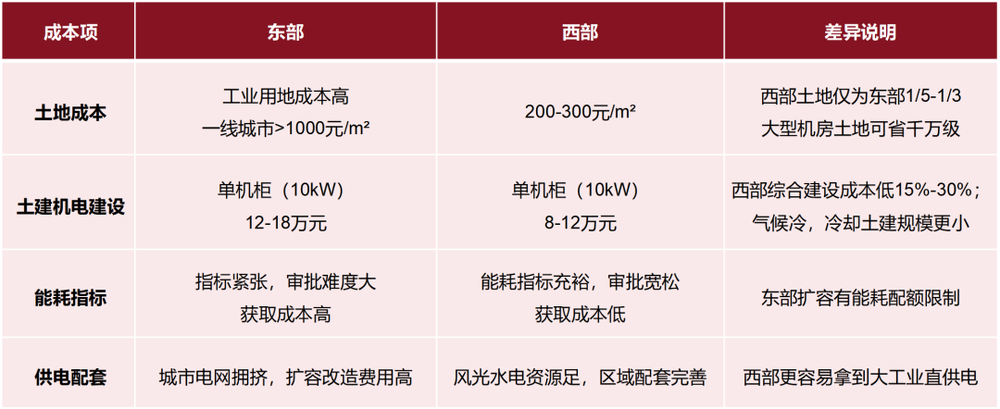
Capital Expenditure Costs Comparison
Now let's look at operating costs (Opex):
The cost of human operation and maintenance is low, with the intelligent computing center requiring few personnel, and the overall difference is not significant.
Electricity costs are the biggest differentiator. The price of electricity for industrial and commercial use in the east is 0.6-1.0 yuan/kWh, while the western region can achieve around 0.3 yuan/kWh, with a high proportion of green electricity.
A 100MW data center in the western region can save over 100 million yuan in electricity costs annually. The H100 cluster from NVIDIA, the cost difference in electricity between the east and west can exceed 3 million yuan annually.
The western region is basically a cool climate, with a long natural cooling period, and sometimes in winter it can even achieve complete natural cooling, with a PUE of 1.15-1.20. The eastern region is sweltering in summer, with a PUE often reaching 1.3-1.4 or even higher, making cooling more power-hungry and costly.
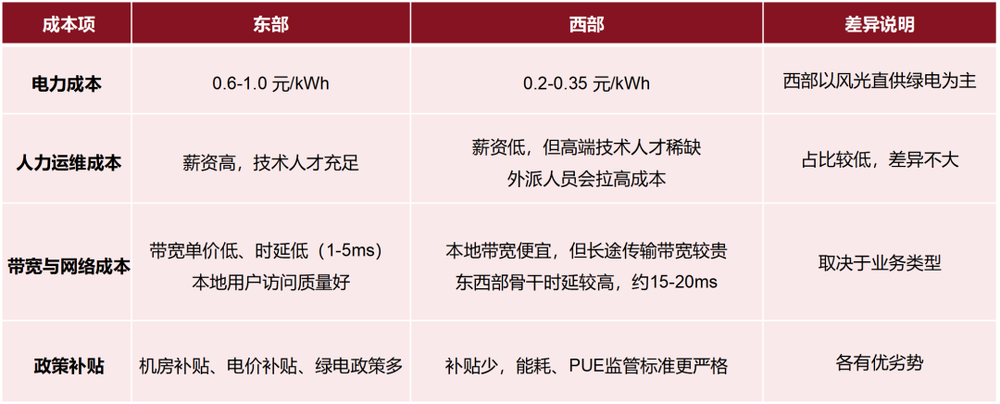
Operational Expenditure Comparison
A rough estimate suggests that for a 100MW data center, with eastern electricity prices at 0.7 yuan/kWh and western electricity prices at 0.3 yuan/kWh, and assuming 8,760 hours of operation per year with an IT load rate of 85%, the western region would require 5.5 billion yuan less in construction investment (Capex) compared to the eastern region. In terms of operating costs (Opex), the western region would also require 4.4 billion yuan less than the eastern region.
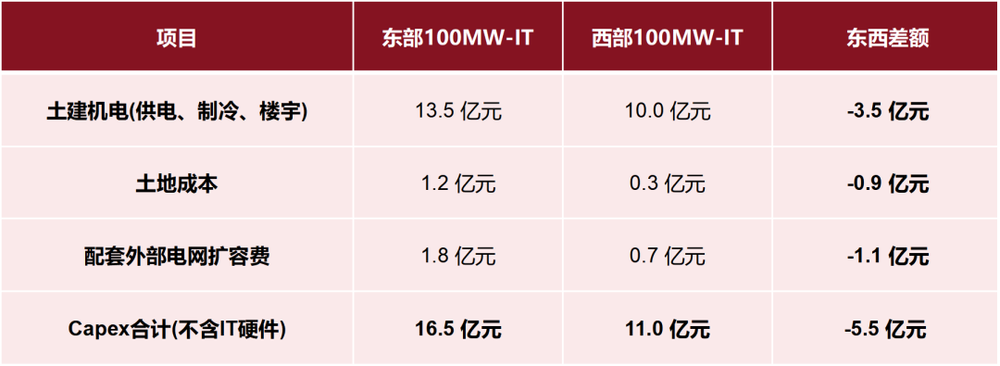
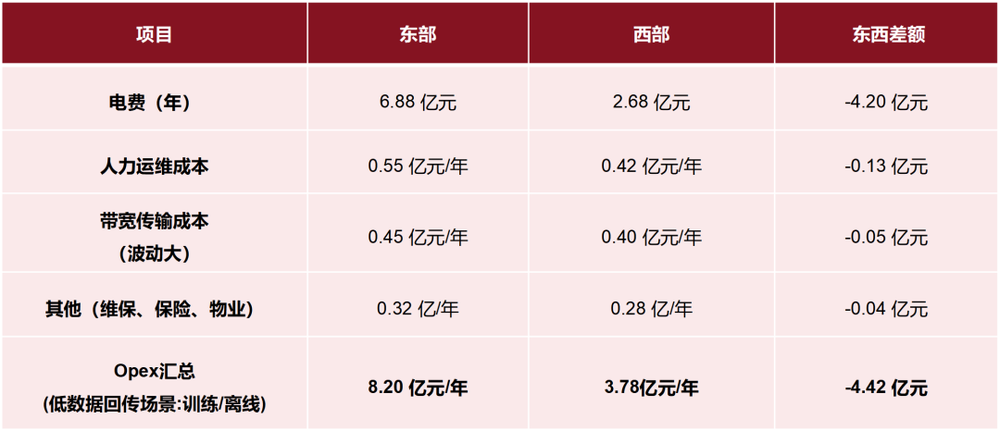
If compared over a 10-year full lifecycle TCO (Capex + 10 × Opex), the west would be approximately 4.97 billion yuan less than the east (this data is only a rough estimate and is for limited reference).
There are several points that need attention:
First, there's the cost of network transmission. For applications that require large amounts of two-way data transmission, such as inference and real-time services, the long-haul backbone bandwidth costs of the Western Data Center will be increased, with expenses potentially reaching hundreds of millions of yuan, which is very expensive and may offset some of the savings from reduced electricity costs.
Secondly, the Western Data Center is affected by fluctuations in wind and solar power, requiring some implicit investment in energy storage, which will increase Capex by 80-150 million yuan.
Third, the western regions are relatively remote, which entails certain logistics costs. If equipment failures occur, spare-parts delivery and emergency repairs could also be problematic, and these factors need to be taken into account.
Fourth, in terms of talent, although the Intelligent Computing Center does not require a large number of personnel, it still needs some professional talent, either through training and development, and consideration must be given to the costs of relocation subsidies for remote deployment or local recruitment and training cycles.
Local data centers, why are they still under construction
Many newly built data centers visited by Xiao Zao Jun are still located in core cities in the east or surrounding areas, or in cities that are not hubs for the "Eastern Data and Western Computing" project.
We also mentioned earlier that building new intelligent computing centers in the western region has a huge cost advantage, so why do operators and some enterprises still insist on building new intelligent computing centers locally?
The primary motivations include several factors:
First, there is the demand for latency.
This is easy to understand, as some computing businesses are extremely sensitive to latency, such as autonomous driving, industrial internet control, and high-frequency financial trading. Although the cost is lower in the west, it cannot meet this rigid requirement, so it must be deployed locally or at the edge to ensure millisecond-level response speeds.
Secondly, there are the requirements for data compliance and security.
Some industries, such as finance, government affairs, and healthcare, have strict compliance requirements for local data storage and processing, and data cannot be transmitted across regions, so it is necessary to build intelligent computing centers locally.
Third, there are special requirements.
Some projects are invested in by local governments with clear intentions of attracting investment and driving industry growth. Local investments naturally would not build computing power centers in other locations, but instead hope to drive the development of the local digital economy industrial chain through the construction of intelligent computing centers, promoting employment and tax revenue growth.
Some of these data centers also serve as demonstration models, often requiring them to receive visits and inspections to showcase the achievements and capabilities of local governments or industrial parks in the digital economy and new infrastructure construction. If built in western regions, it would be difficult for visitors to even make the trip.
The operator's intelligent computing center has a large proportion of users from local government departments, so building some model intelligent computing centers locally is both a business need and a consideration of multiple factors. Many things cannot be considered solely from the perspective of cost.
Domestic computing power accounts for a significantly increased proportion
During visits to numerous intelligent computing centers, it is clear that the vast majority of new intelligent computing equipment uses domestically produced chips. Almost all of them are modular data centers, and most are in the form of super nodes. It's unnecessary to mention the specific manufacturer, as it's easy to guess.
Although many domestic computing power manufacturers' brands can be seen at exhibitions and in the news, in actual projects, there are no more than three domestic chip manufacturers.
Sometimes I wonder, who exactly are those domestic computing power brands that aggressively promote themselves and spin tales in the capital market actually selling to?
In recent days, a manufacturer's latest financial report data showed that in the first quarter of 2026, the company ranked first in the domestic AI accelerator card market with a 37% share, accounting for 70% of the total domestic chip volume. A research report by Morgan Stanley also predicted that in 2026, the company's share of the domestic AI accelerator chip market will reach 62%.
Computing cards are not like memory, they are not casually compatible, and require in-depth software and hardware adaptation and ecosystem collaboration. The cost of such adaptation is extremely high, and once a technical route is chosen, migration is extremely difficult.
As a result, clients tend to be more cautious when purchasing computing power cards, preferring to choose leading manufacturers with mature ecosystems and numerous successful case studies rather than blindly trying out niche brands.
While many emerging domestic computing power brands are visible today, the market will ultimately undergo a shakeout, leaving only a few that truly survive and capture mainstream market share.
The utilization rate of computing power is higher than imagined
Many people are concerned about the utilization rate of intelligent computing centers. Some also believe that these intelligent computing centers are currently just for show, with a high idle rate.
In reality, the situation is not as it seems. According to data from on-site research, the resource utilization rate of intelligent computing centers is generally above 80%, with some intelligent computing centers' peak utilization rates even approaching 100%.
Many intelligent computing centers are being built and sold simultaneously, with equipment being snapped up as soon as it is put on the market.
The entire society's demand for computing power is genuinely in existence. There is no unsellable computing power, only computing power that is not priced appropriately. As long as the pricing is reasonable and can satisfy users' actual training and inference needs, computing power resources will be quickly absorbed.
People should be able to clearly feel that AI applications are penetrating into various industries at an unprecedented rate. Ordinary users are becoming increasingly dependent on AI applications such as WorkBuddy, Kimi, Gemini, Coze, Claude Code, and Ji Meng, and their willingness to pay is also becoming stronger.
These demands ultimately translate into rigid consumption of computing power. Operators engaging in token operations have actually seized upon this trend, attempting to solve the issues of supply and demand for computing power, thereby achieving new growth.
Government demand, enterprise demand, and consumer demand together form the foundation that supports the high utilization rate of intelligent computing centers.
For now, it appears that the development of intelligent computing is being constrained by production capacity rather than demand. Many B300 and Ascend 950 super nodes, such as intelligent computing devices, are in short supply, and even if you have the money, you can't buy them, with long wait times for delivery.
In conclusion
That's Xiao Zaojun's view on the current trend of building intelligent computing centers.
The construction of the Intelligent Computing Center is not simply a matter of piling up equipment, but a systematic project that involves restructuring infrastructure, precise cost calculation, and deep ecological binding.
In our country, the core competitive logic in the AI field is to compete on costs, or in other words, to compete on electricity bills.
The competition in AI is about computing power, algorithms, and data. We have an advantage in data, and the gap in algorithms is not significant. In terms of computing power, we are currently lagging behind in hardware and ecosystem for boards and cards, but we have a significant advantage in electricity costs and the scale of infrastructure.
The entire country is now undergoing a comprehensive transition to electricity, with high-speed rail, new energy vehicles, drones, and AI computing power all relying on electricity. According to the latest news, the installed capacity of domestic photovoltaic power generation has exceeded that of coal-fired power for the first time, becoming the largest source of installed power in China.
Thus, by leveraging the advantages of green electricity, through a computing power layout like "Eastern Data and Western Computing", we have a complete opportunity to establish a competitive advantage in AI computing power costs, thereby taking the initiative in the new round of global technological competition.