
As of the end of August 2026, the disclosure of 2026 semi-annual reports for 42 A-share listed banks has been completed. A seemingly contradictory signal has emerged: the "deposit regularization" trend that has continued for several years has not reversed - Agricultural Bank's personal time deposit balance reached 14.30 trillion yuan at the end of June, an increase of 9422.14 billion yuan from the end of last year; Industrial and Commercial Bank's average personal time deposit balance increased by another 1 trillion yuan year-over-year in the first half of the year. However, another curve has turned: high-cost time deposits are being repriced in batches as they mature, driving down banks' liability costs significantly.
For example, Ping An Bank's average deposit interest rate for the first half of the year was 1.38%, down 38 basis points year-over-year; Agricultural Bank's average deposit interest rate fell from 1.42% in the same period last year to 1.13%, a decline of 29 basis points; Nanjing Bank's personal deposit interest rate in local currency decreased by 37 basis points from the end of last year; Ningbo Bank's average deposit interest rate dropped by 39 basis points year-over-year.
The scale is still increasing, but costs are decreasing. The mid-term financial reports of listed banks in 2026 truly reveal that it's not that "the normalization has reversed", but rather the high-interest liabilities locked in during the previous period are entering a concentrated repricing cycle, which is becoming the first driving force for the stabilization and repair of the bank's interest rate spread in this round.
The size of the issuance moves inversely with the cost of interest payments.
Pricing adjustments are happening faster than structural transformations
Based on semi-annual report data, banks' absorption of funds still favors fixed-term deposits, but high-cost existing deposits are being repriced, which is the core mechanism for improving current liability costs.
Agricultural Bank disclosed that as of the end of June 2026, the balance of personal time deposits was 14.30 trillion yuan, an increase of 9422.14 billion yuan from the end of the previous year. The balance of corporate time deposits was 5.31 trillion yuan, an increase of 2288.14 billion yuan from the end of the previous year. Industrial and Commercial Bank of China adopted the average balance approach, with the average balance of personal time deposits in the first half of the year at 13.37 trillion yuan, an increase of 10025.15 billion yuan from the same period last year. The average balance of corporate time deposits was 8.26 trillion yuan, a year-on-year increase of 5784.93 billion yuan. Although the two banks have different statistical calibers, they both point to one fact: time deposits are still expanding, and personal time deposits are the main contributor to the growth of liability scale.
In contrast to the direction of scale expansion, the cost of regular deposits has decreased significantly. The annualized average interest rate for individual time deposits at Industrial and Commercial Bank of China (ICBC) fell from 2.04% in the same period last year to 1.69%, and that for corporate time deposits fell from 1.95% to 1.54%. At Agricultural Bank of China (ABC), the rate for individual time deposits fell from 2.10% to 1.67%, and that for corporate time deposits fell from 2.30% to 1.81%. This means that even if the balance of time deposits continues to grow, the high-interest-rate deposits locked in earlier will mature and be renewed at lower interest rates, causing the bank's daily average interest rate to gradually decline.
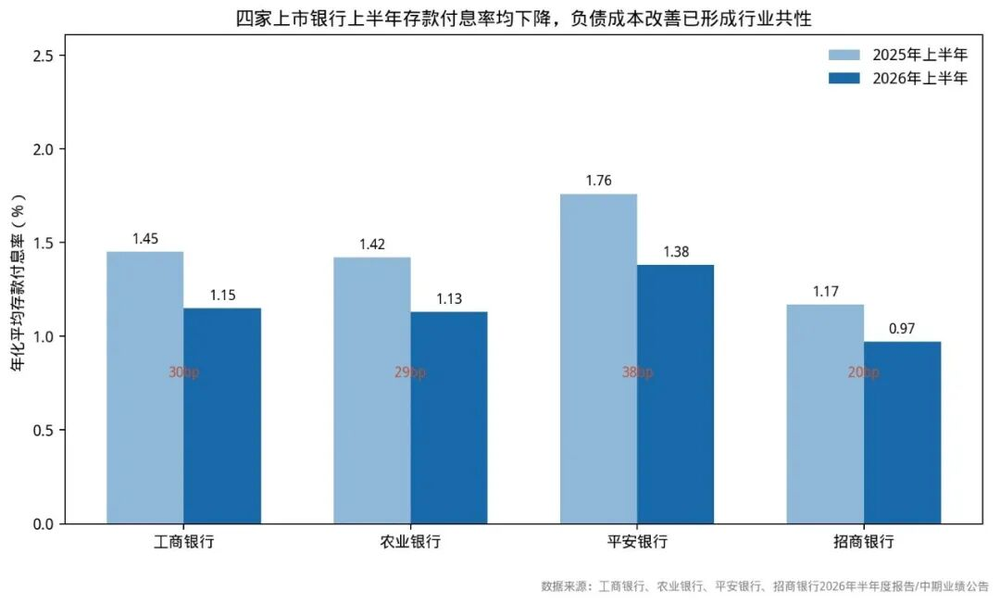
The average annualized deposit interest rate of four listed banks
The daily average interest rate is more reflective of changes in costs. The four sample banks all adopted an annualized average caliber: Ping An Bank's decreased from 1.76% to 1.38%, a drop of 38 basis points; Industrial Bank and Agricultural Bank both fell by about 30 basis points; China Merchants Bank's annualized average cost rate for customer deposits decreased from 1.17% to 0.97%. China Merchants Bank's lower cost rate is related to its demand deposit base and customer structure; Ping An Bank's largest decline was due to the combined effects of high-cost stock rebalancing and proactive liability management.
From an industry perspective, the improvement in liabilities has already taken effect. Industrial Bank's deposit interest expenses decreased by 3.8509 billion yuan year-over-year, a decline of 15.6%; Agricultural Bank's interest expenses for absorbing deposits were 184.18 billion yuan, a year-over-year decrease of 29.476 billion yuan. However, as the decline in asset yields has not yet ended, the decrease in liability costs is more of a buffer for the net interest margin rather than a sufficient condition for a full recovery in profitability.
Inventory levels continue to expand
Rolling over at maturity is pulling down the average cost
According to the semi-annual report, the "balance increment" of regular deposits and the "interest payment cost" have shown a phased decoupling: the former is supported by customers' risk preferences and product acceptance, while the latter depends on the speed of high-cost existing deposits maturing. Currently, repricing is happening faster than structural transformation, rather than the end of the trend towards regular deposits.
In recent years, residents and enterprises have allocated large amounts of funds to medium- and long-term time deposits to lock in yields, resulting in a heavy burden of existing costs. In the first half of 2026, this burden began to be released as the maturity cycle arrived. Industrial Bank attributed the decline in deposit interest expenses to a "30 basis point decrease in the average weighted interest rate of customer deposits"; data disclosed by Agricultural Bank showed that interest rate factors became the dominant item affecting interest expenses.
This breakdown is more explanatory of the current changes than the "decrease in time deposits". Even if time deposits continue to increase, as long as the prices of new and renewed funds are lower than those of maturing funds, the daily average interest rate will still decline. On the other hand, if deposit growth slows down significantly, even if the existing structure remains unchanged, interest expenses may decrease due to the base effect. To determine the improvement in liabilities, it is necessary to observe the scale, structure, maturity, and pricing simultaneously.
ICBC's term structure further reveals the cost difference. In the first half of the year, the average interest rate paid on personal time deposits was 1.69%, and 1.54% for corporate time deposits; while the rates for demand deposits were 0.05% and 0.47%, respectively. The rolling renewal of time deposits is not without cost, but the cost of renewal is significantly lower than in the previous high-interest rate cycle.
A seasoned banking industry researcher believes that judging the deterioration of liability costs solely by the growth of time deposit balances overlooks the crucial role of the repricing timeline: the size of time deposits represents the retention of funds, while the maturity structure determines when costs are reflected in the profit statement. Therefore, "high-interest time deposit balances" should be understood as "repricing resources" rather than a one-way cost burden. However, this resource has a clear time boundary: as high-cost funds are gradually replaced by low-interest liabilities, the marginal benefits that can be released by the same mechanism will decrease.
He said that whether the regularization truly brings relief cannot be determined solely by the decline in the first-half payment rate, and instead requires continuous observation of three variables: whether maturing funds continue to be locked into longer-term investments, whether newly issued time deposit rates can continue to lower the average cost, and whether settlement and wealth management can accumulate more low-cost funds.
The aforementioned banking researcher believes that the proportion of demand deposits is a higher-quality leading indicator than "growth in time deposits." Its formation does not rely on simply lowering deposit interest rates, but rather on the linkage between high-frequency accounts, corporate financial services, agency settlement, and wealth management. If customer funds remain in demand deposit accounts or low-volatility cash management products for an extended period, the stability and cost advantages of a bank's liabilities can be enhanced simultaneously. From this perspective, future liability capabilities will shift from "whether time deposits can be absorbed" to "whether settlement and wealth management funds can be cultivated while absorbing time deposits." The former solves the problem of retaining existing deposits, while the latter determines whether cost improvements can be sustained.
Debt Dividend Enters the Second Half
The return on assets still determines the upper limit of the net interest margin
The first half of 2026 was a period of concentrated improvement in liability costs, but the industry's net interest margin only slightly increased month-over-month. The future performance of interest spreads will increasingly depend on the combined effects of asset-side pricing, growth in liability scale, and retention of low-cost funds, rather than mainly relying on the repricing of existing time deposits.
According to statistics from NBD's reporter, the China Banking and Insurance Regulatory Commission disclosed that the net interest margin of commercial banks in the second quarter of 2026 was 1.41%, up 1 basis point from the first quarter. The improvement varied significantly among different types of institutions: large commercial banks, city commercial banks, rural commercial banks, and private banks saw a month-on-month increase, while joint-stock commercial banks remained flat and foreign banks declined.
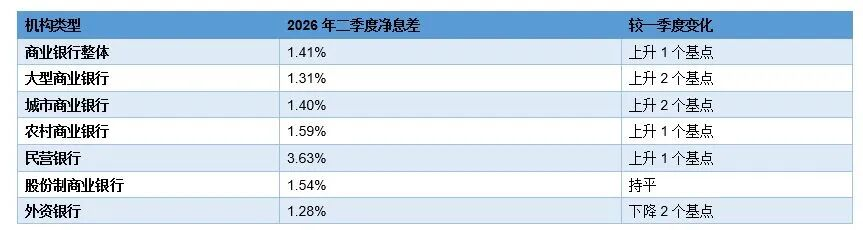
Data source: National Financial Regulatory Administration website, "Table of Key Indicators for Commercial Banks by Institution Type, 2026"
The aforementioned industry researcher believes this indicates that the decline in liability costs has not been evenly transmitted among different types of institutions. Banks with stable settlement deposits, a wide retail customer base, or stronger asset-liability management capabilities are more likely to convert cost improvements into resilient interest spreads. Institutions with rapidly declining asset-end yields and insufficient replacement of high-cost liabilities may still face pressure.
Therefore, the real incremental change in the 2026 mid-year report lies not in whether "deposit regularization" disappears, but in the fact that the banking industry has entered a stage where liability management is shifting from scale expansion to cost management, and then from cost management to customer operations. The continued growth of time deposits does not hinder the decline in interest rates, but whether the cost advantage can be maintained in the future depends on three conditions: whether high-cost existing deposits can mature in an orderly manner, whether demand deposits can truly increase, and whether asset yields can gradually stabilize.