Recently, shoe giant Aokang International released its half-year report for the 2026 fiscal year, drawing attention. Its revenue declined by nearly 30% year-over-year, and it still reported a loss of over 6.6 million yuan after excluding non-recurring gains and losses.
However, the attention it has drawn is not entirely due to this single financial report, but because the report has once again brought to the forefront the decline of domestic leather shoe brands.
Over the past four years, Oukang has accumulated losses of more than 900 million yuan and closed over 3,000 stores. In 2025, its flagship category - men's shoes - saw revenue decline by 27% year-on-year. Its old rival is also struggling. Fugui Bird has long gone bankrupt, while Hongqiao has been losing money for years, closing nearly 200 stores in 2025 and another 142 in the first half of 2026, and is still in the process of adjustment.
For comparison, according to data from Euromonitor, the market size of China's men's shoe market has not changed significantly over the past five years. Under the premise that the overall scale has not changed much, Euromonitor's data shows that in the past five years, the market share ranking of China's men's shoe market has been relatively stable, with some changes in ranking, but traditional men's shoe brands have never entered the top ranks. The top ten brands in terms of market share are all sports brands, with some sports brands rising from around 20th to within the top 10 in the past five years, such as Anta and Tebu.
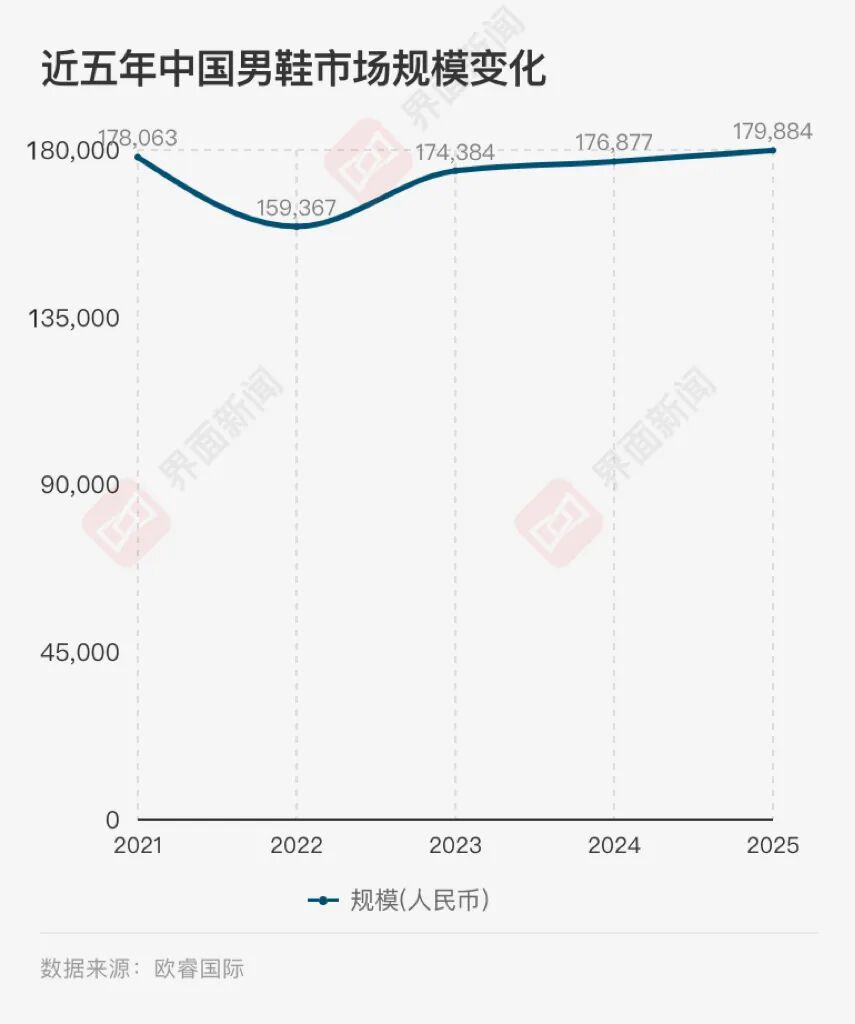
Illustration: Interface News Lou Yuanqin
In other words, it can be inferred that Chinese male consumers abandoned leather shoes and instead bought more sneakers.
Euromonitor International senior analyst Lan Tian for China's footwear and apparel sector told Jiemian News that the logic behind Chinese men's shoe choices has fundamentally shifted — from "matching identity and occasion" to "balancing comfort, style and versatility across scenarios." In the post-pandemic era, the rise of casual office wear and outdoor lifestyles has brought sneakers into commuting and light business settings.
In 2026, the trend of low-top vintage sneakers made a comeback, with loafers, boat shoes, and lightweight derbies also gaining popularity, all driven by the same logic: consumers no longer pursue thick, heavily formal designs, but instead value lightness, elegance, and effortless comfort. Lan Tian said that comfort, health awareness, and outdoor activities will continue to drive the cross-category penetration of sneakers, breaking down the original barriers between sneakers and business shoes.
Xu Wei, a man nearing 40, told Interface News that he has leather shoes in his closet, but wears them infrequently, about once or twice a year, usually for company annual meetings. He also noticed that even at these events, some colleagues choose to wear sneakers. In recent years, he has not purchased any new leather shoes, instead buying new shoes from sports brands. Recently, he has also bought shoes from outdoor sports brands that have entered the Chinese market, including Keen and On.
Jiemian News has found through sorting the financial reports of parent companies of representative mid-to-high-end sports brands that, in contrast to the large-scale closures of domestic leather shoe giants, these mid-to-high-end outdoor brands are opening stores at a rapid pace. Although the financial reports do not separately disclose the revenue data of these brands in the Chinese market, they often mention the pleasing growth performance in the Chinese market.
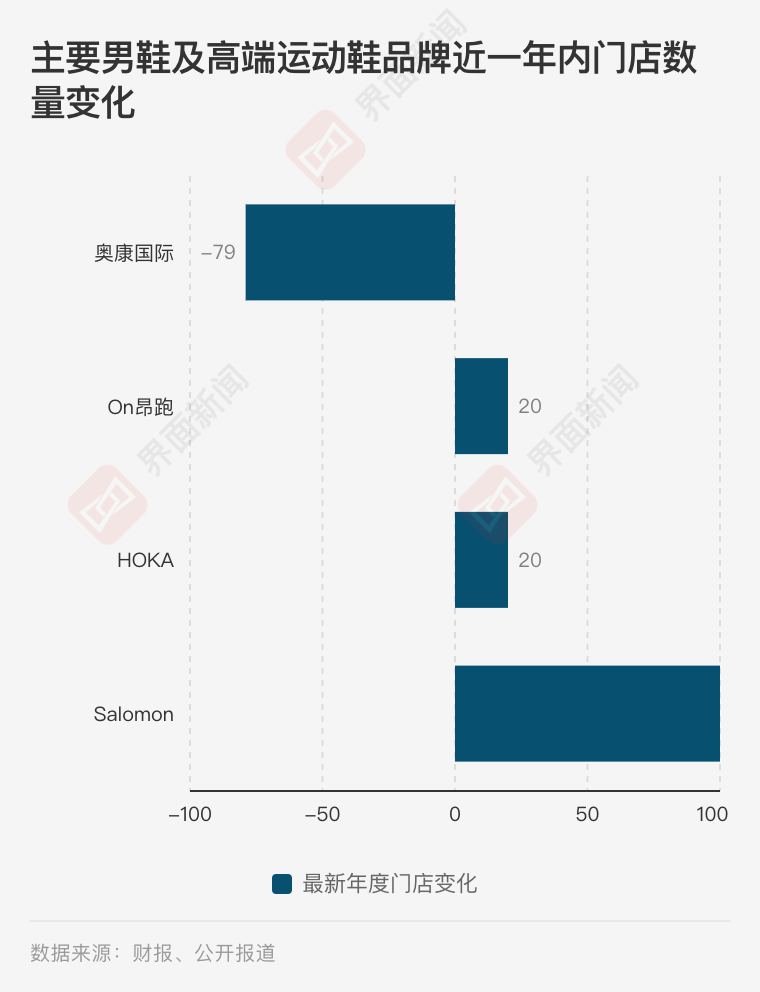
One backdrop for the increase in the number of these brand stores is that shopping destinations in cities of different tiers are all inclined to recruit more non-leather shoe brands.
The domestic leather shoe giant's stronghold is mainly in the sinking market dominated by third- and fourth-tier cities. In these markets, competing for consumers mainly relies on the efforts of franchisees. However, in recent years, the storefronts on commercial pedestrian streets in these areas have been gradually taken over by sports brands such as Anta and Tebu, or other product stores like clothing stores and jewelry stores. Many of the leather shoe giant's early franchisees have chosen to seek other opportunities.
The Hubei Enshi Daily reported that Liang Xin, who ran a franchise business in Hubei Enshi, had previously opened six OKAI franchise stores, but the once-thriving leather shoe business gradually declined, and he eventually closed four stores, leaving only two. According to the report, this was due to a shift in market direction, with "fewer people wearing formal leather shoes on a daily basis, except for certain professional groups, and most people opting for comfortable sports shoes instead."
In first-tier cities, high-end shopping malls in core business districts have also allocated their first-floor and street-front locations to brands like Salomon, Descente, and Kappa. These locations were previously occupied by luxury brands and high-end cosmetics brands.
“Men’s shoes used to be sold mainly on the fourth floor of department stores, paired with menswear. When shopping malls emerged, men’s footwear was not a priority for property owners,” Du Bin, secretary-general of the Brand Professional Committee of the Shanghai Shopping Center Association, told Jiemian News. “Department stores and shopping malls used sports brands to meet male customers’ footwear needs. Now, with the outdoor trend gaining momentum, outdoor sports brands have become a prime target for tenant recruitment.”
However, even though the overall market for outdoor sports shoes is growing rapidly, the competition in this market is also complex, and the specific market environment that individual brands need to cope with is not the same.
The mid-to-low-end market is extremely crowded, with fierce competition mainly relying on price wars and sales volume. Currently, aside from offline struggles to secure prime locations in pedestrian zones to capture valuable offline traffic, online battles are unfolding on multiple platforms such as Tmall and Douyin. For sports shoes priced at around 100-200 yuan, if they are several yuan more expensive than competitors' offerings, consumers will no longer choose them.
In this market, domestic and foreign traditional sports giants such as Nike, Adidas, Anta, and Li-Ning have product layouts. Many white-label manufacturers are also participating in the competition. Among them, Li-Ning and 361 Degrees consider this market as their main core market, but in recent years, they have faced significant pressure on their overall performance. For example, in the first half of 2026, the revenue of Li-Ning's main brand decreased by 2.2% year-over-year, and the number of stores began to decline.
In the mid-to-high-end market, competition centers on product technology and the "story" beyond the shoe itself. Beyond the traditional sportswear giants, this segment includes brands mentioned earlier such as On, Salomon, and HOKA. Sole technology is a point of emphasis across nearly all mid-to-high-end products. Brands are also keen to sponsor various sporting events to reinforce their professional image. Over the past year, brands like Salomon have focused on trail running, while On has used tennis as its breakthrough. Large-format stores, artistic visual campaigns, and poaching marketing talent from luxury and designer brands are all part of the competitive playbook. These brands have generally posted stronger growth than traditional players. Consumers not only buy athletic shoes from them but also absorb education about outdoor lifestyles, creating a self-reinforcing cycle.
It's worth noting that sneakers aren't the only ones eating into leather shoe sales. A wave of emerging Chinese men's footwear brands is also capturing consumer attention. Xu Wei, for instance, has bought from PANE. Other similar labels on the market include Zuxia Industry. These brands offer stylish designs at mid-to-premium price points, and they understand marketing and prioritize operations—carving out a niche in what was effectively an underserved segment. They're growing fast, but their scale remains relatively small for now. In terms of sales volume and store footprint, they haven't yet built enough momentum to pose a genuine threat to the domestic leather shoe giants.
Sneakers are replacing traditional business leather shoes, but the market is not simply undergoing a complete "sportification," Lan said. "We also notice that the head effect of non-sports men's shoes is weakening: except for high-end business leather shoes with luxury attributes that still serve formal wear needs, the middle market is being diverted by smaller but more distinctive lifestyle brands."
It's not just the men's shoe market, but China's entire wearable retail market is changing along with shifts in consumer lifestyles and shopping preferences, and the trend in the men's shoe market is not an isolated phenomenon.
Down jackets have replaced suits, yoga pants have replaced formal trousers, and sneakers and outdoor shoes have replaced high heels and leather shoes, marking a profound shift in Chinese consumers' fashion consumption habits, from "paying for status" to "paying for comfort and relaxation", and from "matching occasions" to "enjoying personal experience". This trend, driven by the evolution of fashion aesthetics and changes in lifestyle, is unlikely to reverse in the short term. As a result, many brands that specialize in business attire have been put on the defensive. Consumers' demand for business shoes and clothing will not disappear, but once they have purchased what they need, it is difficult to persuade them to buy again.