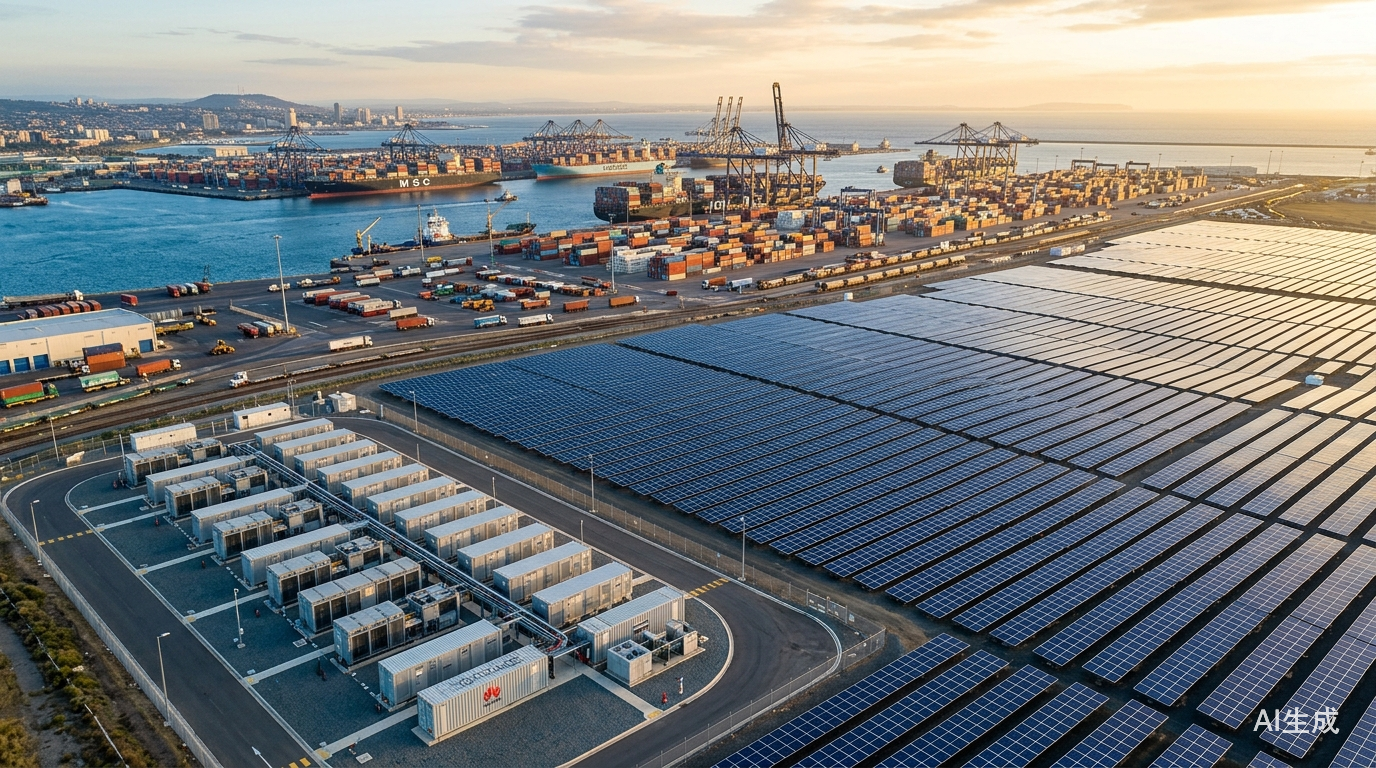
Recently, due to the impact of the US administrative order on power equipment control, the secondary market stock price of Sungrow Power Supply (300274.SZ), the global leader in photovoltaic energy storage, has continued to decline. As of the close on September 1, the market value of Sungrow Power Supply had fallen below the 200 billion yuan mark and continued to hover around 180 billion yuan.
Although Sungrow's annual reports have not separately disclosed revenue and profit data for its US business, the US is undoubtedly one of its key markets. According to a review by Daily Economic News of multiple public announcements and investor relations activity records from Sungrow, in December 2024, the company listed Europe, the US, Australia, and the domestic market as key areas for "in-depth development", and stated that "securing a higher market share in overseas markets is crucial for the company's long-term high-quality growth".
The impact on the US market is still being assessed, but analysts predict that it may lead to increased competition and potentially disrupt the current market landscape, with some estimating a 10% to 15% decline in sales for domestic companies, while others foresee opportunities for growth and expansion, particularly for companies like Tesla and Apple, which have already established a strong presence in the market, with Tesla's sales expected to increase by 20% and Apple's market share predicted to rise by 5%.
To assess the impact of the US market on Sungrow Power Supply, one must first clarify its business revenue structure.
As of the first half of 2026, approximately 90% of Sungrow's revenue came from sales of power electronics conversion equipment such as PV inverters and energy storage systems, with PV inverters and other power electronics conversion equipment accounting for roughly 40% and energy storage systems about 50%. An additional 4% came from new energy investment and development, with a minimal share—under 1%—derived from PV power plant generation.
By region, Sungrow Power generated revenue of 30.912 billion yuan and net profit of 5.259 billion yuan in the first half of 2026. Overseas revenue reached 22.69 billion yuan, down year on year, but as domestic revenue narrowed, the overseas share of total revenue rose to 73.40%.
In terms of profit margins, the company's 2025 annual report disclosed that the domestic business gross margin was less than 20%, while the overseas business gross margin exceeded 40%.
It can be seen that, whether in terms of market size or profitability, the overseas market is crucial to Sungrow Power Supply.
The US is one of the key countries for Yanghsun Solar in overseas markets.
Sungrow Power has two key overseas operating entities, one of which is its wholly-owned subsidiary Sungrow Power (HongKong) Co., Limited (hereinafter referred to as Sungrow Hong Kong), with its main operating address in the Hong Kong region. Sungrow Hong Kong holds 100% of the shares in Sungrow USA Corporation (hereinafter referred to as Sungrow USA), with its main operating address in California, USA, and is responsible for product sales.
In 2025, Hong Kong Sunning's operating revenue was 19.620 billion yuan, with a total profit of 887 million yuan and a net profit of 390 million yuan; US Sunning's operating revenue was 17.247 billion yuan, with a total profit of 897 million yuan and a net profit of 444 million yuan.
In 2025, Sungrow's overseas regional operating revenue was 53.992 billion yuan, with Hong Kong Sungrow and US Sungrow accounting for 36.34% and 31.94% of the overseas regional revenue, respectively.
In April 2025, Sungrow disclosed in an investor relations report that revenue from the US market accounted for around 10%-20% of its total revenue. Assuming this proportion has not changed significantly over the past year, calculations suggest that Sungrow's revenue in the US market for the first half of 2026 was approximately 3 billion yuan to 6.2 billion yuan. (Note: This figure is a calculation by the reporter based on hypothetical assumptions and is not officially disclosed data, and does not have investment reference value.)
" I believe tops of a tops top of a tops top of aations of top of a only minimal top of a common data only minimal top of a common data only minimal top of that only minimal top of a common data only more common data only more common of a only more minimal data only more only common data of a only more common of a only more common of a only more common of a only more common of that only more common of a more common of a only more common of a only more more common of a more only more common of a more only common data of more only common data of " " " " " " " " " " " " " " " " " " " " " " " " " " only " " " " " " " " " " " " " " " " " " " " " " " " " " " " " " " " " " " " " " " " " " " " " " " " " " " " " " " " " " " " " " " " " " " " ". " " " " " " " " " " " " " " " " " " " " " " " " " " " " " " " " " " "
Amid cost and geopolitical disruptions
will hedge against the contraction of its US business through three channels
In recent years, the US has introduced import control policies targeting multiple industries, with photovoltaic energy storage equipment also being subject to policy scrutiny. The escalation of geopolitical risks has sparked market discussion about whether Yangguang Yuchuang will build a factory in the US and reduce policy risks through localized production. However, building a local factory would mean a large capital expenditure, which would significantly increase the operational pressure of heavy-asset operations for the company.
On the evening of August 29, Yangguang Power Supply replied to institutional investors, making its stance clear that it does not consider localization for now: "The current competitive environment is unfair to Chinese companies, and even if we build a local factory, American consumers will still have doubts, and producing in the US will be difficult to achieve a cost advantage. In the long term, against the backdrop of geopolitical fluctuations, the company's US business volume will gradually shrink, and the company will make a transformation."
Yingli Solar has outlined three strategies: increasing investment in technological innovation, shifting resources to non-US overseas markets, and focusing on channel business, while adopting a moderate contraction strategy for its US business to control overall operational risks.
From the perspective of incremental markets and the second curve, the company's R&D expenses in the first half of 2026 increased by only 2.85% year-over-year, compared to the double-digit growth in investment in previous years, indicating a more cautious R&D spending strategy.
To hedge against overseas policy risks, the company relies on multiple markets, including Europe, Asia-Pacific, and the Middle East, to drive business growth. From a business perspective, aside from the US, non-American regions such as Europe, the Middle East, and Africa, as well as Asia-Pacific, are the main contributors to overseas revenue. In 2025, the Middle East secured several large orders, but revenue from the region fluctuated with project deliveries. In the first half of 2026, the Middle East market's performance was significantly impacted by the high base effect of a large energy storage project in Saudi Arabia from the same period last year, with revenue in the sector declining from 5.7 billion yuan to 1.1 billion yuan, a year-over-year drop of 91%. Additionally, the company's performance also depends on diversified orders from the commercial, residential, and channel sectors in Europe and Asia-Pacific.
But beyond the US, Europe also presents policy variables. From April to May this year, under European Commission rules, projects using inverters from "high-risk countries" will be ineligible for public funding from the EU budget, the European Investment Bank, and other sources.
During an investor conference call on July 1, Sungrow stated that projects affected by the financing rules account for approximately 20% of the European market, but the company's participation in such projects is relatively small, resulting in limited direct impact in the short term. It is understood that Sungrow's Polish factory is under construction and is expected to be completed in the first half of 2027, covering inverters and energy storage products, aiming to meet local demand in Europe and enhance customer confidence. The company's Thai factory is already in operation, and in the future, it will layout overseas production capacity based on the principles of globalization and being closer to customers.
Meanwhile, the company is betting on the computing power supply chain to open up new growth potential. Its self-developed EnerNeo solid-state transformer (SST) has achieved a peak efficiency of 98.5%, and its 800V high-voltage DC products have completed small-batch deliveries to AIDC computing facilities. The company has also entered into strategic partnerships with Alibaba Cloud and Dongyangguang. "We have built up substantial positioning and expertise in areas such as AIDC, renewable energy, ancillary storage, and independent energy storage, and we expect related businesses to grow explosively," the company said.
Objectively speaking, the global computing power supply industry is still in the early stages of commercialization, and the landing of large-scale batch orders remains uncertain, so it remains to be seen whether this new business can generate significant profits after long-term market testing.