I cried three times in the past week.
It was because of "Full House" (@The Shadow Standing Up) where the parents suddenly grew old;
It was because of "The Heroic" (@不吃榨菜AIGC), where "I may not be able to save everyone today, but that doesn't mean I won't be able to in the future," said the reckless hero, Ah Niu;
There was also an instance involving "The Anti-Paradise" (@Pan Yu Yan) where Zeng Liang, who spent his entire life escaping the "Dream House" to return to reality, was used...
Many of the AI videos and creators I listed may still be unfamiliar to some readers, but they have garnered attention across the entire network on a scale of hundreds of millions, achieving a viral level of popularity.
More importantly, the recent surge of AI-generated videos, known as "masterpieces", are not just about showing off skills, but rather serious expressions that reflect on reality, touch on human nature, and even examine history.
This level of dissemination, combined with a bold and outspoken perspective on historical and real-world issues, and the fact that creators can use AI tools to resonate with, empathize with, and even further rationalize with their audience, suggests that the "singularity" of AI film and television creation transitioning from a niche to a mainstream phenomenon is approaching rapidly.
Recent moves by mainstream film and television companies have also served as further evidence.
The AI version of the web series "Soul Ferry" has officially gone online, and the first AI long drama "Journey to the West 2" has been broadcast via satellite using the innovative model of "producing, reviewing, and broadcasting simultaneously".
The impending "convergence" of AI super-creators and mainstream film and television professionals heralds the arrival of an era belonging to serious AIGC creators.
The acceleration of this era is far from being driven by the single desire of the film and television industry to "reduce costs".
AI film and television production must rely on its inherent advantages, accurately catering to certain unmet needs of the audience, and breaking through the glass ceiling of traditional movies and long dramas.
At this point, it is necessary to take a closer look at these works, setting aside the myth of traffic and the charm of technology.
It's not just about being fast, but also about responding to reality in real-time.
Fast, but not in a "conveyor belt" sense - this is the overall impression given by the latest batch of AI "masterpieces".
Although AIGC technology can greatly accelerate film and television production, many top AI creators have chosen to release content at a pace of weekly, biweekly, or even irregular updates in order to guarantee quality and personalization, rather than prioritizing speed above all else.
However, these works are extremely sensitive to real-world issues and respond very quickly.
Those traditional film and television creations, which require waiting and settling for a while to capitalize on real-world hot topics, are often seized upon by AI creators who "strike while the iron is hot". Regardless of whether the work's form of expression is based on real-world themes or not.
For example, the Chinese fantasy AI short drama "Fei Yao Zai" went viral on Douyin after its launch in late August.
It learns from the style of "Liaozhai" which uses "flower spirits and fox ghosts" to discuss human affairs, but the human affairs it discusses are not about bookworms being heartless or etiquette harming people.
The first episode, "The Mute Girl Xiaohe," uses the tragedy of a pipa player falsely accused of sorcery to show how sexual rumors can kill, how the tide of public opinion can be steered, and how gossip can define a person however it pleases. It also alludes to the powerful colluding like rats in a hole.
In the comments section, the audience's evaluation of this episode is a reflection of the current state of Chinese online public opinion.
For example, the realistic AI short drama "The Office" (@Monster), which has been compared by netizens to the Chinese version of "Taxi Driver".
The office here doesn't follow the usual procedures of justice, with methods that include but are not limited to setting traps, going undercover, and using physical violence. The things they handle are the kind of things that make people seethe with anger in real life but often feel powerless to do anything about.
Similar to the child and organ trafficking in episodes 1-2, and the intangible cyber violence in episodes 3-4 that can be as deadly as murder. This almost synchronizes with the real-life arrest and trial of human trafficker "Mei Yi" and the incident of a 26-year-old Japanese female fan who livestreamed her own suicide.
As for the theme of the series, the creator explicitly stated in the video description: since there are no perfect stories in reality, I will let Jiang Lan and Shen Xingjie, the two main characters, create this ending.
There are also some inexplicable confusion and insoluble anxieties in reality that traditional film and television creations find difficult to address while being commercial, but AI creators are willing to explore and test the waters.
For example, @站立起来的影子, representing the "Alien Series" of short films, released two popular AI short films, "Anyway, No Time to Live" and "Family Photo", in August.
Among them, "Anyway, No Time to Live" has received over 16 million likes on Douyin alone (as of September 1) and has been played more than 120 million times.
The short film points to the "time anxiety" of office workers. Although they may have 50 years of life left, the amount of time that truly belongs to them can be counted in just a few dozen days. And for the sake of money, even these few dozen days may have to be sold, possibly even to aliens.
For example, the fourth episode of the sci-fi AI short drama "Reverse Side" (@Pan Yu Yan).
This was originally a flagship AI episode focusing on an otherworldly battle royale, emphasizing visual spectacle without specific real-world references.
The protagonists are roommates living in a university dormitory who find themselves trapped in an inverted world, with their sole goal being to escape back to reality.
In the fourth episode, a main character finally escapes back to reality. However, his experience in the last virtual world, where he repeatedly runs towards the "Dream House" only to rapidly age along a fixed route, has a somewhat poignant real-world implication, suggesting that "life is a wilderness, not an orbit".
It can be said that "instant response", which has a clear attitude towards real issues, has almost become a necessary option for AI film and television creation.
Drawing lessons from the past to dispel the obstacles in one's mind
In addition to responding to reality, AI-powered film and television creation with a historical orientation has also experienced a surge in recent times.
In just the past month, a steady stream of representative works has emerged, including “问苍生” (@青瓜蛋), “乱” (@我叫孙皓冉), and “大明太子康斯坦丁” (@爱讲故事的XY), with 17.93 million, 2.32 million, and 1.16 million views on Bilibili, respectively.
In fact, since the AI short film "Huo Qubing" achieved over 100 million views with a computing cost of 3,000 yuan in March this year, using AI technology to create historical dramas has been a direction of concern in the film and television industry.
After all, one of the major production thresholds for historical dramas is the large number of personnel and huge costs involved. If AI technology can be used to complete scenes with thousands of horses and soldiers with just one click, it will greatly lower the creative threshold and risk for historical dramas.
However, from a practical perspective, AI creators who are passionate about history have taken the lead in the industry, opening up new avenues of thought.
Judging from the production quality and dissemination feedback of a series of historical AI short films represented by "Ask the Heavens", "Chaos", and "Constantine, the Crown Prince of the Ming Dynasty", whether or not the works can restore historical scenes with the highest audio-visual standards does not determine their success or failure. What netizens are most concerned about is whether the works convey a distinct and extreme historical perspective.
Taking "The Question of Life" as an example, this story, told through the eyes of a historian, describes the miserable history of the late Eastern Han dynasty. The "abnormalities" described by the historian are merely a way for the downtrodden to survive.
Meanwhile, the leader of the peasant uprising, Zhang Jiao, was portrayed as a "Heavenly Master" hero who suffered for the people.
This view of history is emotional and relatively new, but to a certain extent, it avoids the long-term warlord chaos, local fragmentation, and economic decline objectively triggered by the Yellow Turban Rebellion, and cannot be considered impartial.
But refusing to see history in black and white terms is perhaps what drives the viral spread of "The Questioning Life".
The AI short film "Constantine, the Crown Prince of the Ming Dynasty," which portrays the tragic song of the Southern Ming dynasty's exile with a sympathetic eye, also has a similarly clear historical stance.
The story ultimately revolves around the Southern Ming prince Zhu Cizhao. This Catholic, who was baptized as a child, did not receive the support of the Roman Catholic Church. In order to ensure that the common people who followed and supported him would be remembered and leave their names in history, he chose to voluntarily walk into Wu Sangui's ambush and allow himself to be captured.
This immense sympathy for the Ming dynasty has led to comments like "why are my eyes getting wet" frequently appearing in the live chat for "The Great Ming Dynasty Emperor Constantine".
In comparison, the AI short film "Luàn" which depicts the Hou Jing Rebellion, presents a more nuanced portrayal of the rebel general Hou Jing and Emperor Wu of Southern Liang, also known as the "Monk Emperor".
The historical perspective of "Luàn" is distinct, as seen in its depiction of the brutality of dynastic change: massacres, the destruction of Buddhism, the burning of books, with rivers of corpses and widespread cannibalism.
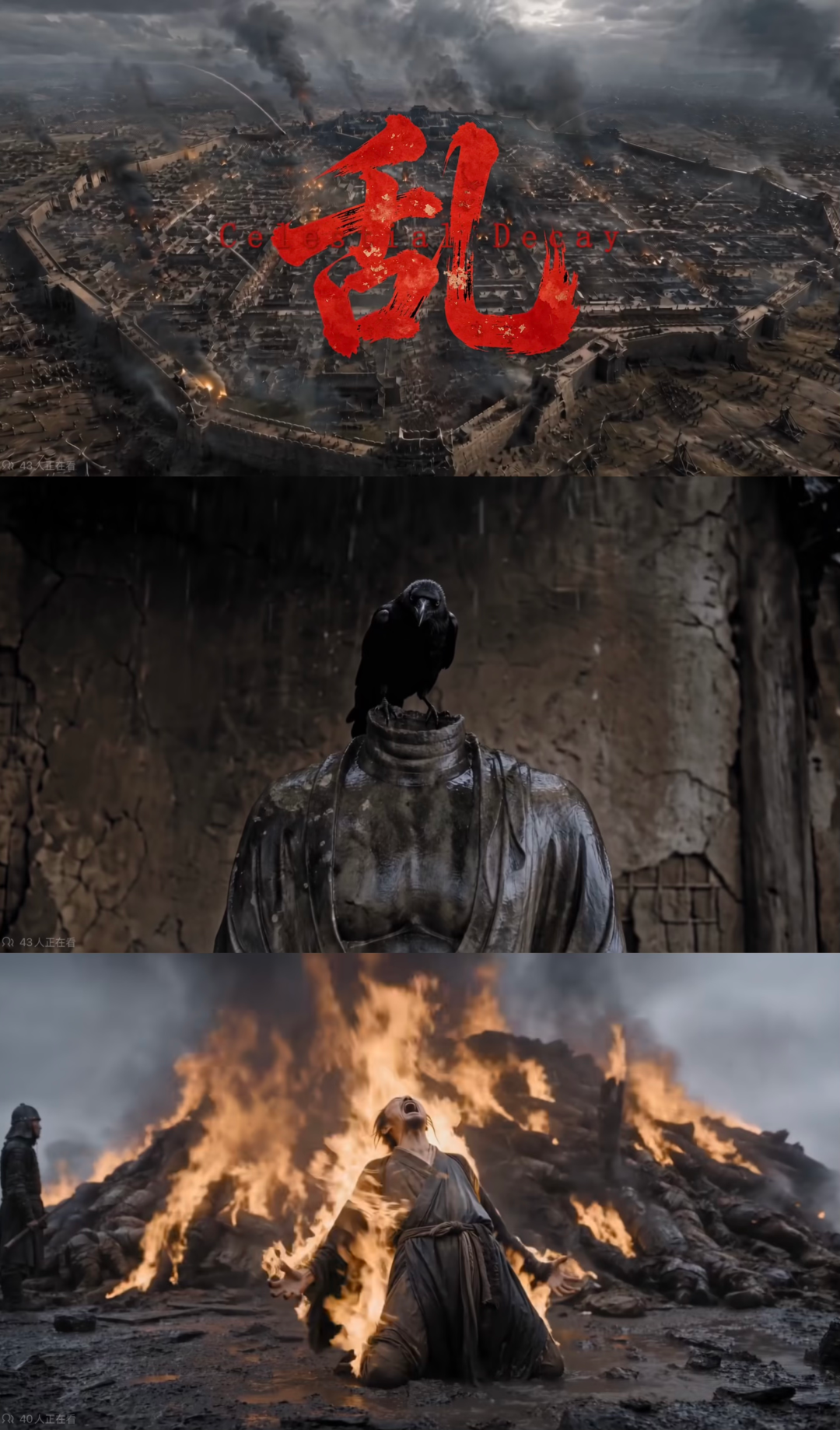
Notably, the above-mentioned historical AI works all exceeded 20 minutes in length, falling into the mid-to-long video category. From a technical standpoint, these three AI works are not top-notch. If not for their extreme and distinctive expression of historical views, they may not have achieved their current level of influence and penetration.
At the moment of the "singularity"
The shift toward deeper integration of AI with reality in film and television creation is undoubtedly worthy of encouragement. Likewise, the bold advance into the depths of historical subject matter deserves full recognition.
When AI creators start to truly think about society, question life, and reflect on history, it marks the moment when this type of content is moving out of its primitive stage and entering the mainstream.
The concept of the "serious AIGC creator era" is proposed because once the AI creation group and the formal film and television industry officially "meet", a group of creators with a clear appearance will emerge.
Firstly, they have the willingness to challenge themselves in serious subject matters such as reality, history, and classics; secondly, they possess the corresponding creative self-discipline and capabilities, even if they are not necessarily from a film and television professional background.
They may become the most vibrant, stable, and promising group in the AI film and television production field, similar to the "serious runners" in the running circle.
However, there is another side to the coin.
We must note that these AI-generated video "masterpieces" have a tendency to purify their viewpoints while also conveying a sense of seriousness.
In terms of realistic expression, the audience's survival anxiety is met with a precise corresponding response from the content; their real fears are amplified by the creators. This cycle of repetition and continuous reinforcement can easily solidify stereotypes.
The expression of an extreme view of history is also in this ambiguous area: it's difficult to distinguish whether the creator is intentionally pursuing dramatic tension or has actually proposed a brand new historical perspective; whether the intention is to arouse emotions or to carry out a serious public discussion.
We hope that at the moment when we truly enter the "serious AIGC creator era", we can break through the creative threshold while avoiding the dangerous emotional trap.