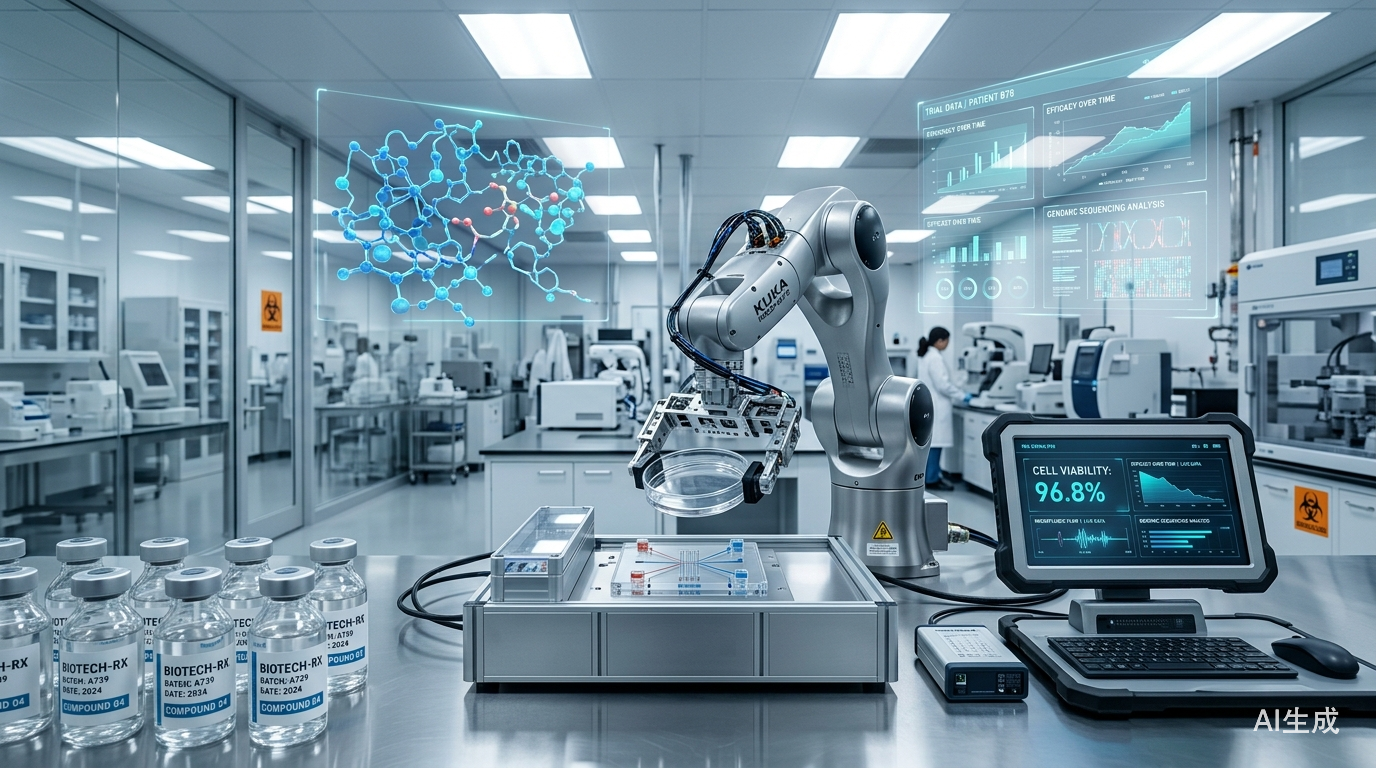
AI is no longer just a tool for showing off in laboratories, it is making the medical ideal of "one person, one medicine" a reality.
On August 19, pharmaceutical giant Merck and Moderna jointly announced a major development: their jointly developed mRNA anti-tumor vaccine intismeran, used in combination with the PD-1 antibody drug pembrolizumab, achieved positive results in a Phase III clinical trial for malignant melanoma. This vaccine is likely to become the "world's first" therapeutic cancer vaccine, not only designed with AI assistance but also customizable for each patient. This is not just the routine progress of a new drug, but a breakthrough from 0 to 1 in the fight against cancer.
At the same time, in July this year, AI pharmaceutical company YingSi Intelligent's self-developed idiopathic pulmonary fibrosis drug Rentosertib officially launched Phase III clinical trials. This is also the world's first AI-dominated drug with a full chain of AI target discovery + AI molecular design, and if it is ultimately approved, the industry's valuation and ecosystem will usher in a historic reconstruction.
What is AI ultimately changing?
AI pharmaceuticals involve machine learning participating in various stages of drug research and development. The traditional approach is "screening": it relies on manually building a massive compound library and using high-throughput experiments for physical blind screening, similar to finding a needle in a haystack.
AI technology can now effectively address the "discovery" phase. Ren Feng, co-CEO and CSO of Insilico Medicine, explained in an interview with Beijing Business Today that successful drug development depends on the Right Target, Right Molecule, and Right Clinical Trial. AI systematically improves quality on the first two R's—integrating massive multi-omics data to identify targets genuinely linked to disease mechanisms, and conducting large-scale virtual screening before synthesis to eliminate high-risk molecules early.
Ren Feng summarized the shift in the R&D paradigm in one sentence: previously, drug development was like "holding a key to find a lock," where researchers would first study the biological mechanisms of a target and then forcibly link it to a disease; now, AI starts with large amounts of omics data from patients and reversely identifies which neglected target is the real "lock".
Ying Silicon's Pharma.AI platform compresses the preclinical candidate drug nomination cycle from an average of 2.5 to 4 years to 12 to 18 months; Ji Tai Technology's AI nano-delivery platform NanoForge has a database of over 10 million lipid structures, which can shorten the average development time of targeted drug delivery from several years to 2 to 3 months; Tsinghua University's team-developed DrugCLIP platform even boosts virtual screening speed by a million times.
But can these molecules, accelerated into clinical trials by AI, complete the entire course smoothly?
In the preclinical research stage, AI can predict a drug's metabolism, toxicity, and antitumor activity in specific tumor models. In the clinical trial stage, AI can optimize patient enrollment criteria, predict clinical endpoints, and even design more efficient trial protocols.
Industry insiders say that AI can bring more "players" to the starting line of the marathon more quickly, but it can't provide much help in completing the entire course. The success rate of AI drugs in Phase I clinical trials is indeed impressive, reaching 80% to 90%, far surpassing the 40% to 65% of traditional methods. However, by Phase III, the 10% pass rate is no different from traditional drug development.
The first half is about competing in algorithms and platform capabilities, the second half is about competing in what?
The "first half" of AI pharmaceuticals is a competition of algorithms and platform capabilities. Ying Silicon Intelligence completed in 18 months what traditionally takes four and a half years, while Jing Tai Technology built an AI and robot laboratory with a dry and wet closed loop - these are all impressive achievements in the first half.
2026 is seen by the industry as the "litmus test year" for AI pharmaceuticals. Ren Feng noted, "The first half of the game is about algorithms and platform capabilities, while the second half is about whether you can produce clinical results."
This shift is particularly evident in the capital markets. A pharmaceutical industry analyst at a securities firm told 21st Century Business Herald: "AI pharmaceuticals currently mainly compress the preclinical discovery cycle of molecules, but still cannot bypass the rigid barrier of clinical trials that can take several years. Once operations fall behind, plans need to be revised and communicated with regulatory authorities repeatedly, patient enrollment is slow, and safety signals are misjudged, even the best molecules will fail before dawn."
A more practical issue is that clinical trials themselves are becoming increasingly complex. Taking popular areas such as autoimmune diseases, GLP-1 metabolic drugs, and tumors as examples, homogeneous competition is fierce, and pharmaceutical companies are adopting stricter research designs, such as head-to-head comparative trials, multi-indication expansion, and multi-endpoint evaluations, to prove the advantages of their own products. Inclusion and exclusion criteria are also becoming more refined. However, under the traditional manual management model, clinical trial data is scattered across different medical institutions and systems, which cannot be effectively connected, resulting in frequent data loss and logical contradictions, severely slowing down the R&D progress.
Faced with reality, players are also diverging. As capital begins to ask "where is the cash flow," different types of AI pharmaceutical companies are making different choices. This divergence is reshaping the industry's landscape.
Some companies have chosen the path of "selling services". JingTai Technology positions itself as AI+CRO, providing drug discovery and development services to pharmaceutical companies, with revenue of 803 million yuan in 2025, up 201% year-on-year, and achieving annual profitability for the first time. This path has more stable cash flow and a clearer profit path, but the ceiling is also relatively limited.
Another class of companies has chosen a more adventurous "selling pipelines" approach - with self-developed pipelines at its core, achieving monetization through external licensing. Ying Shi Intelligent is a typical representative. Since 2026, the company has successively reached cooperation agreements with Schwiva, Lilly, SK Biopharm, and Takeda, with a cumulative total of BD signing amount approaching $7.5 billion. However, behind the impressive signing figures, the company's 2025 financial report shows an adjusted loss of $43.8 million, further expanding from $21.2 million in 2024.
An increasing number of companies are realizing that they may not have to make an either-or choice between two paths. Yingxi Intelligent positions itself as "selling both shovels and digging for gold" - software serves as a "foot in the door", and as customers use it and discover its effectiveness, they will consider expanding cooperation; in-house research and development pipelines drive the verification of core value. Jite Technology has taken a similar approach, with first-half 2026 operating revenue reaching 154 million yuan, representing a year-over-year increase of 13,399%, exceeding last year's full-year revenue by 47%. Adjusted net loss narrowed significantly by 56.4%.
For traditional pharmaceutical companies that have already achieved commercialization, the approach to AI is different. Yinnuo Pharmaceutical views AI as a technological upgrade to its existing research and development methods - from bioinformatics to computer-aided drug design, and then to generative AI, which is essentially a natural extension of the same methodology. The true advantage of such companies lies in the decades of accumulated internal research data, including records of failed experiments, which are often more valuable than successful cases.
Efficiency is the key to "survival"
AI pharmaceuticals have entered a critical cycle of value validation. It can create candidate molecules more quickly, allowing limited funds and manpower to be concentrated on truly promising pipelines. According to industry data, AI can shorten the preclinical research and development cycle by 40% to 60% and reduce costs by tens of millions of dollars.
From the financing perspective, a research report by Orient Securities indicates that in the first half of 2026, the number of financing events related to AI pharmaceuticals accounted for 11.5% of the innovative drug sector, and the financing amount accounted for 19.2%, making it the third-largest sub-track in the innovative drug sector, following small molecules and antibodies. Primary market capital has begun to pay a valuation premium for the platform capabilities of AI pharmaceuticals.
From an industry perspective, according to Healthcare discovery AI, there are currently over 173 global AI-discovered drug projects in the active clinical stage, including 56 Phase II projects and 15 Phase III projects, with an expected 15-20 new projects to enter pivotal confirmatory clinical trials by 2026.
The phase III results for Rentosertib will not be available for several years. Regardless of the outcome, AI has already changed the underlying logic of drug development. The ultimate goal of this transformation is to enable patients to access safe and effective new drugs as quickly as possible. For companies, whoever can truly convert AI capabilities into research and development efficiency will be the one to survive in this ruthless industry.
As stated by Wu Xiaoying, EY Greater China Consulting Services Leader, AI cannot eliminate the uncertainty of drug development, but it can make the uncertainty more accurately priced, which may be the true sign of the industry's maturation.