
On August 28, 2026, Powell took a hawkish stance at the Jackson Hole annual meeting, which slightly halted the upward momentum of the 10-year US Treasury yield. However, due to the recent deterioration of the situation in the Middle East, the 10-year US Treasury yield has continued to rise and is now around 4.81%, hitting a new high for the year.
So, why do capital markets pay such close attention to changes in long-term bond yields? Because they are an important component of the Financial Condition Index (FCI).
For instance, a popular allocation scheme is: long-term interest rates 45%, credit spreads 37%, exchange rates 6%, stocks 5%, and short-term interest rates 4% (note: Goldman Sachs Financial Conditions Index). In other words, the weight of long-term yields is as high as 45% (note: based on the weighting scheme derived from quantitative model regression results).
So, why does the long-term yield have such a high weight? The article "The US Treasury's Hidden Debt Restructuring" implies an intuitive explanation: since long-term debt can be used for hidden debt restructuring, the long-term yield reflects a country's sovereign debt risk.
More critically, this is actually a form of credit risk that is highly contagious, meaning that when sovereign debt risk spreads significantly, the credit risk of the entire economy will also increase.
In summary, like credit spreads, long-term bond yields should also be given a higher weight in the financial conditions index.
Of course, it should be noted that this is only one of many possible explanatory frameworks. Under this economic framework, financial conditions are essentially equivalent to systemic credit risk, and a tightening of financial conditions is equivalent to an increase in credit risk.
Monetary Policy and the Distribution of Inflationary Pressure
In the article "On the Relationship Between Real Interest Rates and Nominal Interest Rates," we found a new approach to observing inflationary pressure - directly using nominal interest rates for observation.
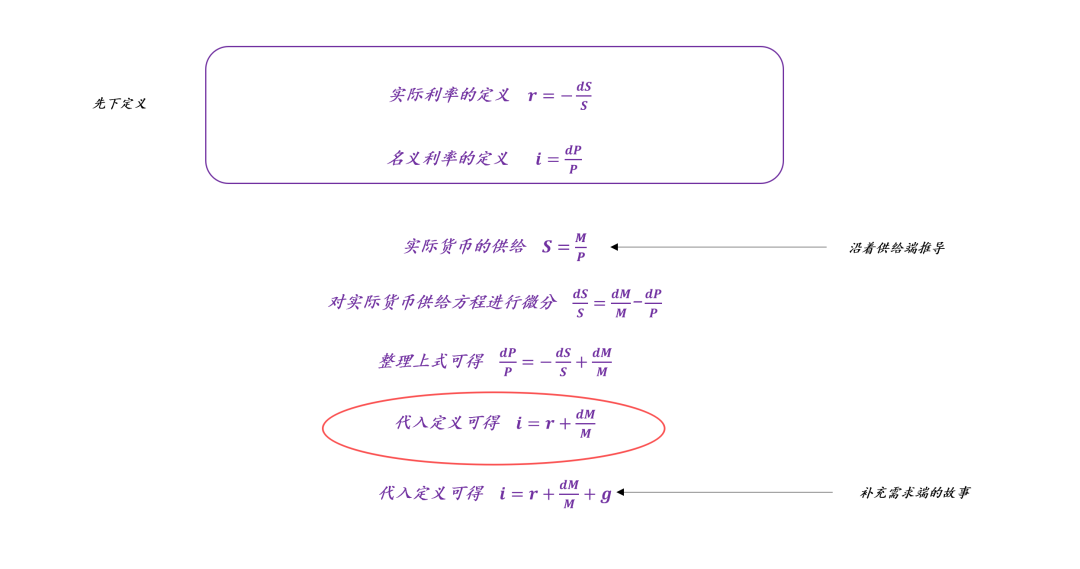
From this perspective, inflation has two specific sources:
One part is the actual interest rate, namely -dS/S, the contraction of the monopolistic factor supply, which is not controlled by the central bank;
Another component is the growth in the money supply, namely dM/M, which includes both the increase in government debt and the increase in private debt.
However, i typically refers to the entire yield curve, so we need to quantify the entire yield curve, denoted as |i|, which represents the average yield.
In other words, |i| is determined by several exogenous variables: 1) the supply of monopoly factors; 2) the growth rate of government debt; and 3) the growth rate of private debt.
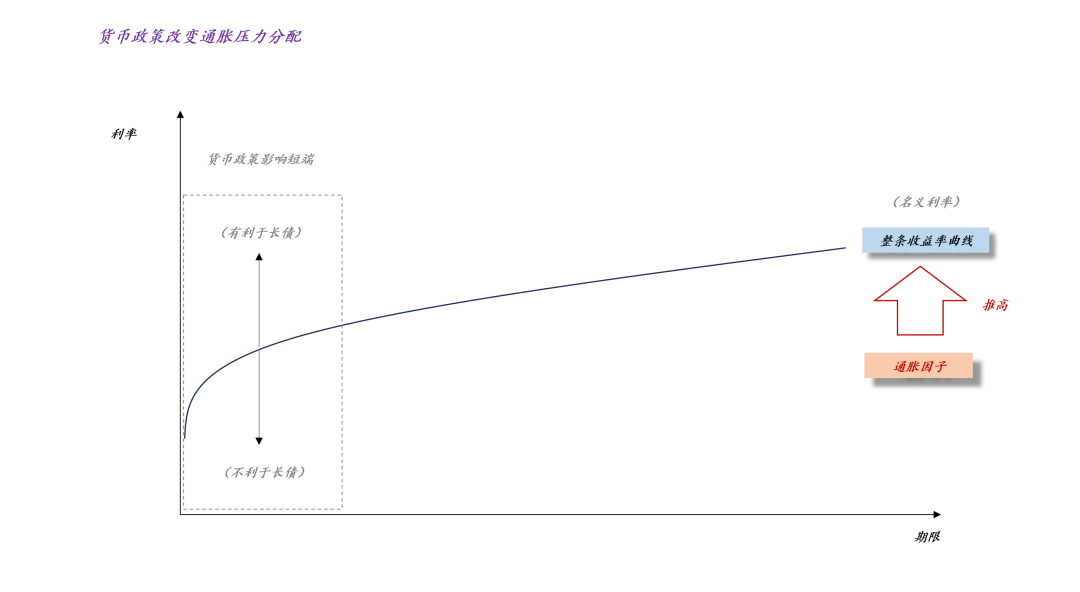
As shown in the figure, the responsibility of monetary policy is to allocate weights, which is to allocate more to the short end or to the long end.
Thus, given the |i| value, we have a seesaw effect: if the Fed is hawkish and short-term interest rates are high, then long-term interest rates will be lower, and financial conditions will be looser; conversely, if the Fed is dovish and short-term interest rates are low, then long-term interest rates will be higher, and financial conditions will be tighter.
Here, we need to note one point: the aforementioned situation belongs to a special boundary scenario where the market starts to focus on the sovereign credit risk issues of US Treasuries.
In general scenarios, short-term debt rates and long-term debt rates move in the same direction, meaning that when the Federal Reserve pushes up short-term debt rates, it increases long-term debt rates, thereby tightening financial conditions in the system.
The market is expected to participate in short-term interest rate pricing
In the above discussion, we discovered a new seesaw: at the boundary conditions, short-term debt rates and financial conditions are a seesaw.
So, what scenario is the market most looking forward to? The market has stronger pricing power for short-term yields.
Under the abundant reserve system, the Federal Reserve and the capital markets jointly manage the short-end yield curve (similar to the ancient concept of "the king and the horse, ruling the world together"). The Federal Reserve provides a dot plot and forward guidance, while the capital markets determine the 2-year US Treasury yield based on specific data within this framework.
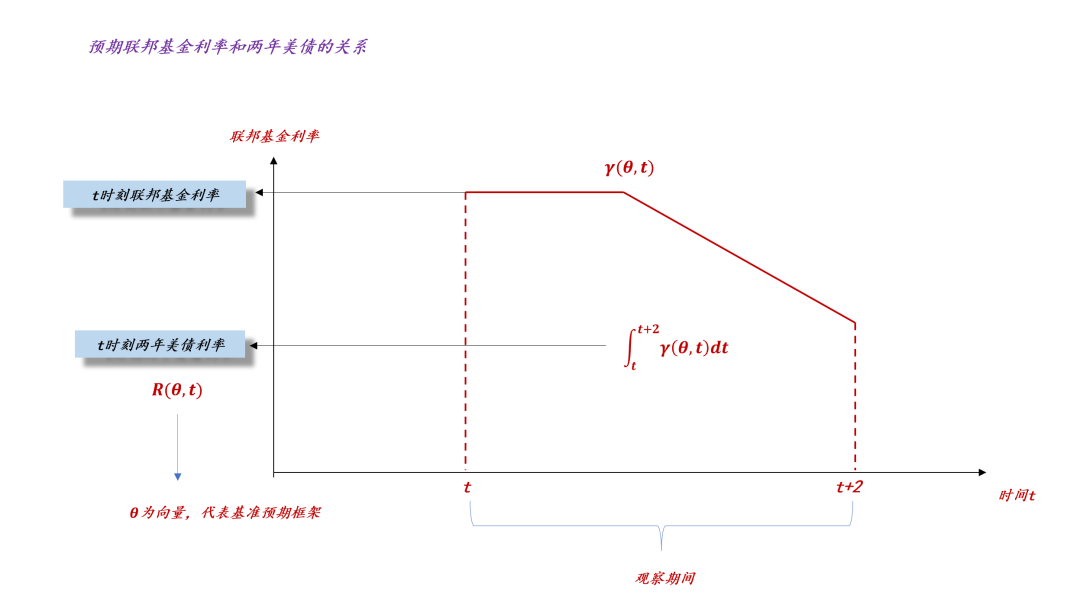
The chart illustrates the formation process of the two-year US Treasury yield, with the Federal Reserve providing the framework and the market providing expectations based on data. It is evident that in this model, the market has a high level of participation and a greater sense of security.
However, under the scarce reserve system, everything changed, with the Federal Reserve solely managing the short-end of the yield curve.
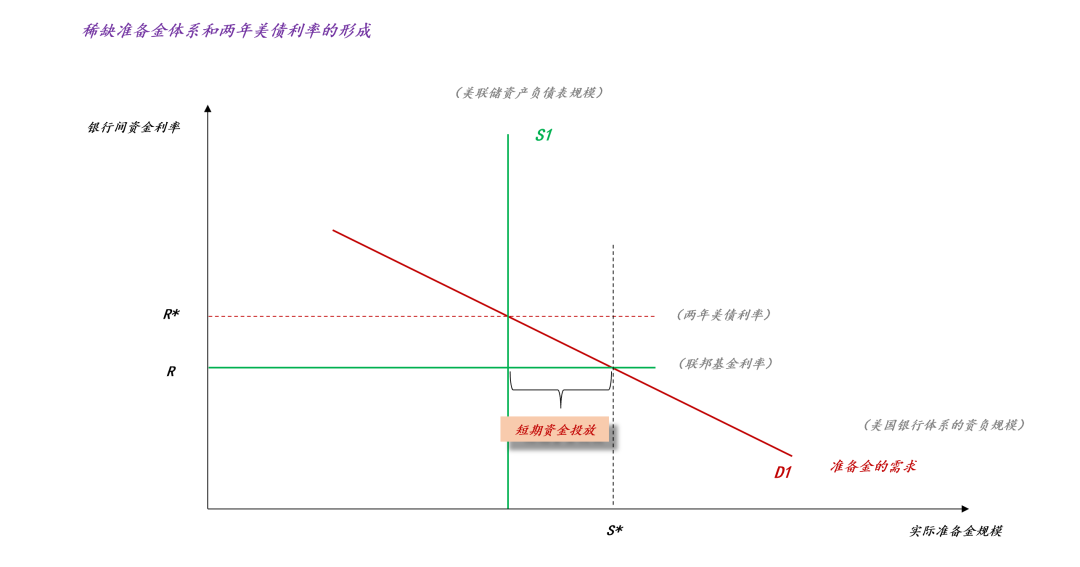
As shown in the figure, the generation mechanism of the two-year US Treasury yield has undergone a fundamental change, and it completely depends on the demand D1 and supply S1 of medium- to long-term funds, having nothing to do with market expectations.
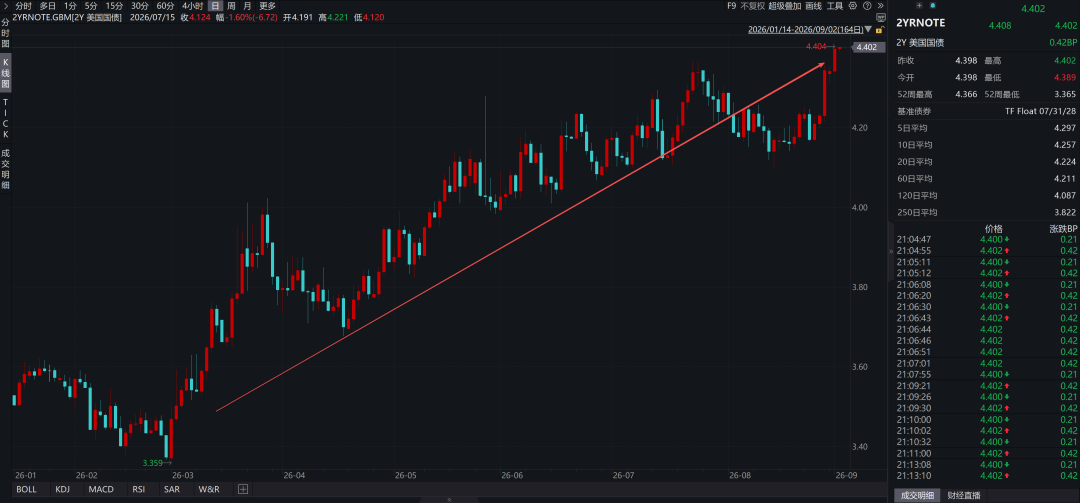
In other words, the continuously rising two-year US Treasury yield is purely the result of the Federal Reserve's tightening of medium- to long-term funding, squeezing out liquidity. Therefore, under this model, market participation is low, with almost no sense of security.
By comparing the two different mechanisms for generating 2-year US Treasury yields, we can understand what Volcker took away and why he is so hated by Wall Street.
The actual meaning of "沃什" is not clear without more context, but "沃什" is likely a transliteration of the English word "wash".
At the Jackson Hole symposium on August 28, Walsh reaffirmed his stance.
It will not allow the market to re-participate in short-term interest rate pricing
Making forward guidance a routine practice is something my colleagues and I adopted during the global financial crisis, when it was essential, and we made a big deal of it when we launched it. However, like other conventions left over from past crises, I believe it has outlived its usefulness and become more of a hindrance than a help.
In normal times, the role of forward guidance should be strictly limited and constrained, otherwise it can easily create "chaos" in the name of "clarity". Excessive sharing of policy consideration details and over-committing to future decisions can mislead the market, businesses, and households. Moreover, I believe that when policymakers make quasi-promises about interest rates throughout the cycle, we restrict our own freedom to make the right decisions when we truly need to make a judgment.
Wash's implicit message was clear: allowing capital markets to participate in short-term pricing is acceptable during a financial crisis, but it poses significant problems in normal times. Therefore, he once again rejected allowing capital markets to participate in short-term pricing.
2. It pledged to respond more promptly to changes in inflation
Third, there should be no misunderstanding: the Federal Reserve's 2% price stability goal, as measured by the personal consumption expenditures (PCE) price index, is a firm and fixed goal. Let us be equally clear about another aspect of that goal: price stability is not automatically achieved, and inflation is not necessarily mean-reverting. Achieving price stability is the Federal Reserve's mandate.
Fourth, the Fed also has a responsibility for maximum employment. Achieving both ends of our dual mandate over the medium term is not a zero-sum game. I do not believe the Fed's dual mandate is in conflict. After all, high inflation itself is highly detrimental to economic prosperity.
Fifth, short-term interest rates are the primary tool for achieving a dual mandate. Unconventional policies to stimulate economic activity may be suitable for times of genuine crisis, but should be used with caution, or not at all, in other circumstances.
The underlying message is also clear: since the Federal Reserve has refused to let the market participate in short-term pricing, the Fed is reiterating its commitment that short-term interest rates will provide timely feedback to inflation.
So, the so-called "hawkish remarks" are based on "pledges" to gain the market's trust, and the actual effect depends on what Powell does in practice.
In conclusion
Unfortunately, Wash had just finished speaking confidently when the test arrived.
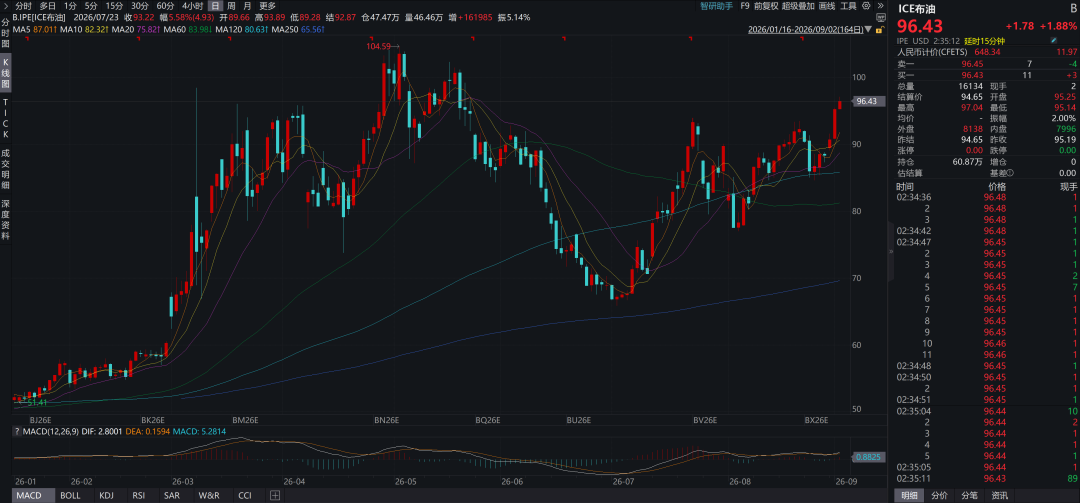
As shown in the chart, the turmoil in geopolitics has driven up crude oil prices, with Brent crude rising to over $95. As a result, inflationary pressure is being factored into the overall bond yield curve from the real interest rate side, presenting an opportunity to test how Powell will allocate pressure.
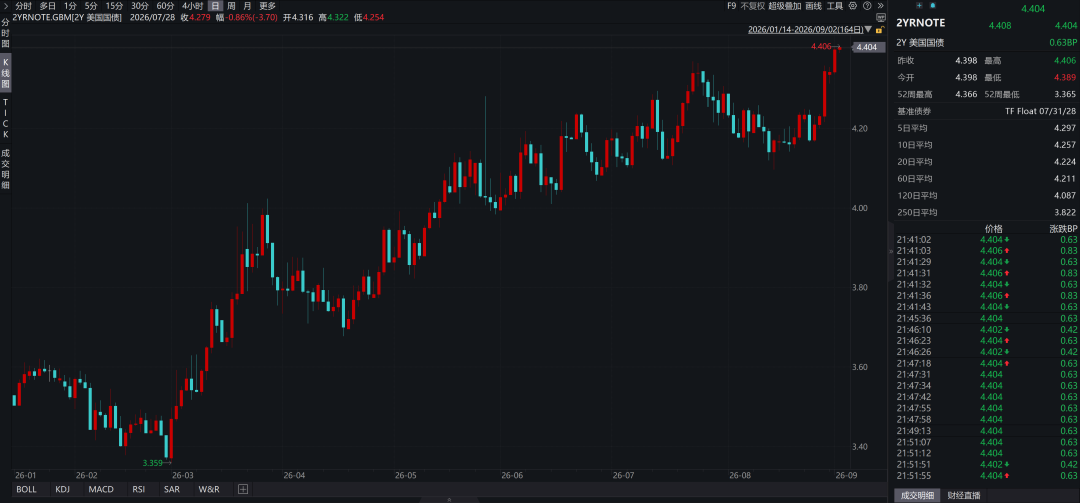
As a result, the market found that the two-year US Treasury yield only rose from 4.35% to 4.40%, and he did not fulfill his "pledge" to let short-term debt bear more inflation pressure.
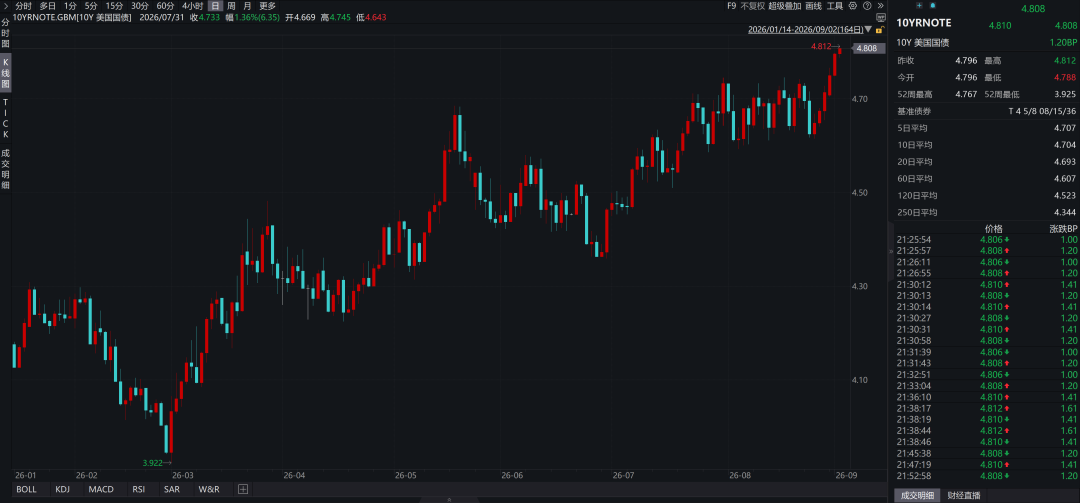
The market has voted with its feet, expressing its distrust of Powell, and pushed the 10-year US Treasury yield to 4.81%, a new high for the year.
So why is Powell downplaying his own commitment? The speech in Jackson Hole also provides an answer:
Expectations for growth in capital expenditures and corporate earnings are currently at relatively high levels. I will continue to monitor changes in their growth rates, or the second derivative. The subsequent ripple effects on asset prices, business confidence, resident income, and expenditures are also important aspects that need to be measured.
Credit spreads for corporate bonds and leveraged loans are near the bottom of their historical range, and issuance in these markets has been quite strong this year. Shifting from fixed-income markets to banking, in the July Senior Loan Officer Opinion Survey, banks told us that their standards for commercial and industrial loans are at the easier end of their historical range, which helps explain the growth we've seen in these loan categories this year. The credit and loan markets show little sign of being constrained by policy.
Certain industries - such as real estate and agriculture - are showing signs of stress, but overall, I find it difficult to describe the broad financial environment as restrictive.
In other words, Wash believes that current financial conditions are not yet tight enough, so since a more gradual increase in short-term interest rates is beneficial for tightening financial conditions, he will raise the two-year US Treasury yield at a more gradual pace.
In practice, Volcker also did this, and in the face of a new round of inflationary pressure, Volcker carefully distributed the pressure evenly to both the short and long ends, which, in the eyes of the market, was tantamount to a breach of trust.
Finally, I believe, those investors who cried "Wash is an amateur" will sorely miss Powell, a true "big dove" who had Wall Street at heart, only to be replaced by Wash.
In summary, Powell is not an outsider, but rather his stance is severely at odds with that of Wall Street. His true "crimes" are two-fold: 1) taking away the pricing power of short-term debt from the capital markets; and 2) attempting to tighten financial conditions.