Fable 5.1 and Mythos 5.1 have just been released.
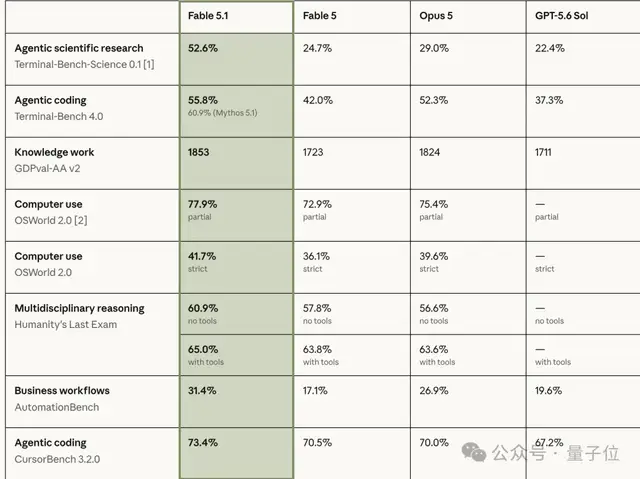
It ranked first in all 8 public benchmark tests, with prices reduced by as much as 45%.
Particularly in terms of scientific research and code, it has clearly surpassed Fable 5 and GPT-5.6 Sol.
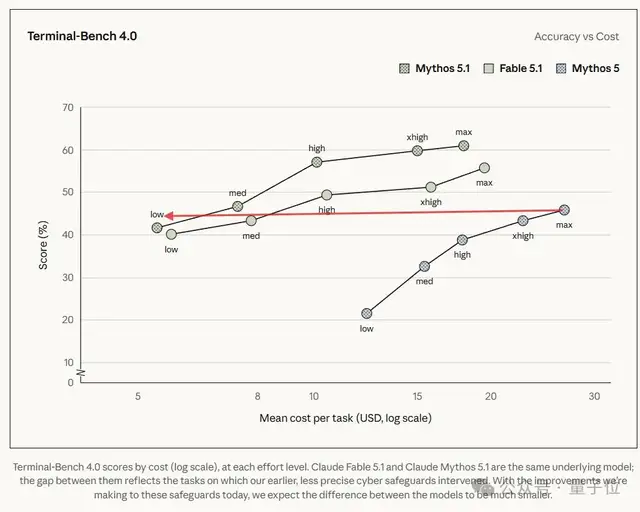
From a more intuitive perspective, running Fable 5.1 with medium to low reasoning levels now yields performance roughly equivalent to the old version of Mythos 5 running at very high or even the highest reasoning levels.
This wave is believed to have been dominated by "Fable" which surpassed "Mythos".
In terms of pricing, Fable 5.1 has reduced the cache read price to $0.25 per million tokens, a 75% decrease.
The input and output prices are consistent with Fable 5, at $10 and $50 per million tokens, respectively.
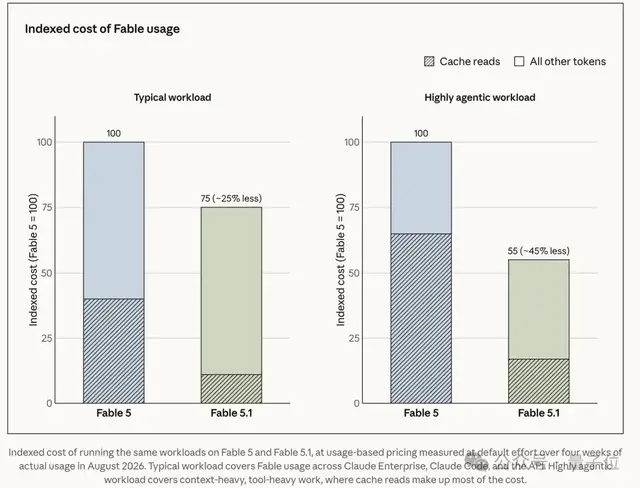
It appears that only one price has been reduced, but the actual impact is relatively large, as cache reading accounts for the majority of the cost in smart contract tasks.
According to data provided by Anthropic, the cost of typical workloads is down by about 25% compared to Fable 5, and can be as much as 45% lower for highly anthropomorphized tasks.
The official video release stated:

This is achievable because it excels at handling multi-step tasks.
In this type of task, if a tiny error occurs in the second step, the entire process collapses by the 40th step, whereas Fable 5.1 can maintain stable output throughout.
If it encounters an insurmountable problem, it will inform you of the solutions it has already attempted and at which stage it is stuck.
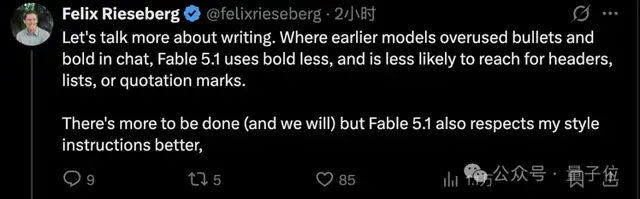
Researcher Flix Rieseberg also particularly noted that, in terms of writing, Fable 5.1 reduces the use of bold text, and uses fewer headings, lists, or quotes, and better follows style prompt words.
You're asking if I can open-source my style prompt, right.
As usual, Fable 5.1 is available to all users, while Mythos 5.1 is only provided to vetted cybersecurity and life sciences institutions through a trusted access program.
Research in Action: Protein Design, Generating Maps of Venus, and GPU Acceleration
Beyond benchmarking, Anthropic also showcased the practical applications of Fable 5.1 and Mythos 5.1 in scientific research.
In terms of protein design, Anthropic used Mythos 5.1 to design high-affinity binding proteins using open-source protein design and folding tools, and sent the designs to two external institutions for experimental verification.
On three targets, the binding affinity of the designs generated by Mythos 5.1 was 10 times better than the best solutions from the Adaptyv Bio protein design competition. Across all 12 targets, the hit rate was nearly 50%, compared to the typical hit rate of 10% to 15% in the current field of protein design.
High-affinity binding proteins are the first step in the development of many common drugs, directly determining whether a drug can take effect at a lower dose.
In astronomy, Fable 5.1 trained a neural network on radar images captured by NASA's Magellan more than 30 years ago, generating new high-resolution topographic maps for about one-third of Venus' surface.
Previously available terrain maps only covered one-fifth of Venus' surface, with a resolution of 10 to 20 kilometers. Fable 5.1 has increased the resolution to 2 to 3 kilometers, with a 25% improvement in height accuracy compared to before. The map has been released open-source under the CC protocol, for reference by the upcoming NASA VERITAS and ESA EnVision missions, to help determine key geological features for future observations.
In terms of computational biology, Mythos 5.1 accelerated the runtime of 7 open-source deep learning models by up to 2.5 times by writing custom GPU kernels and caching intermediate results, with completely consistent output.
In actual research, biologists may need to run these models thousands of times, testing all possible mutations near every human gene, and the optimized model can reduce GPU costs by 30% to 60%.
This type of optimization typically requires a performance engineering team to spend several weeks, a luxury many academic labs cannot afford, whereas Mythos 5.1 achieved it in just a few days, relying solely on open-source code.
Anthropic plans to open-source these optimizations in the near future.
Along with the release of Fable 5.1, there are some special provisions and API changes.
First, let's briefly discuss the safety aspect.
The false positive rate of Fable 5.1's network security has been reduced by 60% compared to Fable 5, and it is now allowed for discovering software vulnerabilities, but developing exploit programs is still prohibited. Dual-use tasks such as penetration testing, exploit generation, and binary-based vulnerability scanning will still be redirected to the Opus series models.
The false positive rate for fundamental biology and medical questions has been reduced by 85%, but queries related to life science research and development are still routed to the Opus model for processing, and professionals need to access it through the Life Science Validation Program (LSVP) of Mythos 5.1.
Then there's the heavy-hitter of a new addition: the counter-distillation mechanism.
Starting today, newly registered API accounts will no longer be able to manually edit the Claude context in multi-turn conversations while preserving the thought process records.
There was a previously documented common tactic: in multiple rounds of conversation, manually tamper with Claude's previous context, but deliberately retain the thought process records. This way, the model's reasoning process produced under one set of instructions can be replayed under a new set of instructions that may be adversarial.
The road is now completely blocked.
The approach is to add a signature to each thought chain block.
When a user sends the assistant's response back to the API in subsequent requests, the system uses this signature to do two things: verify that the current model has the right to read this block, and verify that the entire conversation preceding this block, including the system prompt, tool list, and all historical messages, is identical to when it was originally generated.
As long as anything in the conversation is tampered with, the signature verification will fail.
How the system handles failures depends on a parameter set by the developer, prefix_mismatch_behavior. The default value is "error", which directly returns a 400 status code and rejects the request. If it is set to "drop_block", the system will silently drop the block and all subsequent thought chains, while the request itself will continue to execute.
The discarded parts will not be charged for, and they will be listed in the input_transformations array in the response.
What operations will trigger validation failure?
The document provided a detailed list, including editing, reordering, or deleting any previous user, assistant, or system messages, modifying top-level system prompt words, making any additions, deletions, or name changes to the tool list, removing a certain block of thought from the conversation history while keeping subsequent blocks, and referencing an image or document URL that returned different content between two requests.
Any of the above will cause all subsequent thought chain blocks to fail.
On the other hand, some operations are secure:
Appending new messages at the end of the conversation, removing thought chain blocks from the beginning of the history, modifying request parameters such as max_tokens, adding or removing cache_control tags, as well as server-side compaction or context editing, will not trigger validation failure.
There is also a design for chain verification, where each thinking chain block records the information of its previous block, forming a chain that spans rounds. Blocks can be removed from the head of the chain, but if one is removed from the middle, all subsequent blocks will become invalid, and the entire chain will be invalidated from the point of the break onwards.
To avoid getting developers stuck, Anthropic also provides a series of alternative solutions that can achieve the same effect without touching the history records.
You need to modify the instructions midway. Use in-conversation system messages instead of directly changing the top-level prompt.
Is a temporary reminder required for each round? Use a round-level system message with a clear_at parameter to replace the old method of "inserting first and then deleting".
Is it necessary to add or remove tools midway? Use the tool_addition and tool_removal blocks to replace direct editing of the tool list.
Context trimming is needed, using server-side compression and context editing to replace client-side brutal truncation.
If you are using official products such as Claude Code, claude.ai, Claude Managed Agents, or Claude Agent SDK, no changes are needed, as they automatically ensure that conversation prefixes are not tampered with.
However, if you are a developer who directly calls the Messages API, Anthropic suggests that you should strictly use the messages array as append-only, and then run a complete multi-turn conversation test in the "drop_block" mode of prefix_mismatch_behavior to check if there are any prefix_binding_mismatch entries in the logs.
The document also specifically mentioned a scenario that is easy to get stuck in.
If you maintain a tool or framework where users call with their own API keys, new registered users will hit this verification earlier, because developers' own keys are likely to have been registered before August 31 and have not yet been enforced.
For such situations, it is recommended to proactively set up prefix_mismatch_behavior and conduct tests in advance, rather than waiting for users to encounter issues first.
One More Thing
Company A is making such a big fuss, OpenAI next door definitely can't sit still.
But their new model, Astra, is almost ready, so they can only release some symbolic previews for now.
Ilya also made a rare appearance to call for enhanced cybersecurity as Fable 5.1 and OpenAI Astra were released.
According to a reference link from Anthropic, https://www.anthropic.com/claude-fable-and-mythos-5-1,