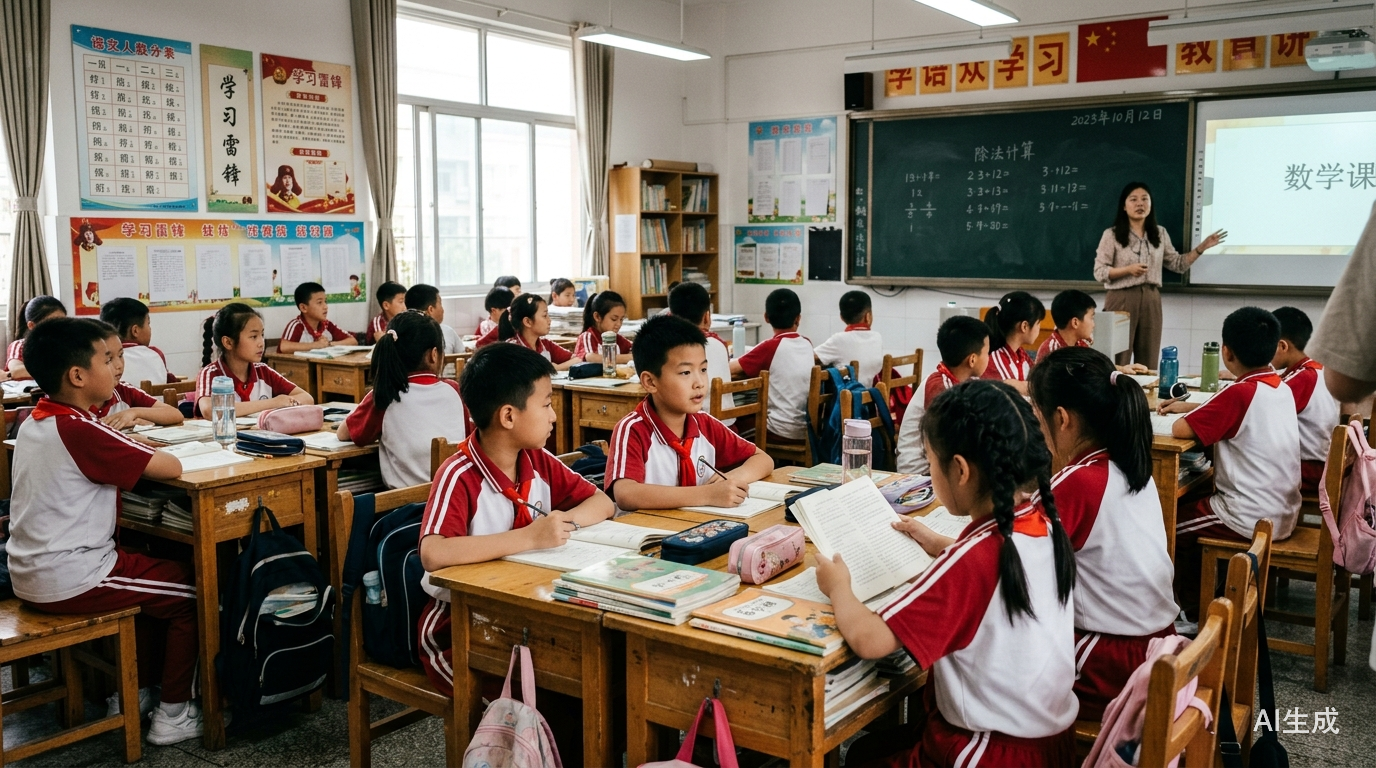
The header image is from: AI generation
As the new semester begins, some kids in New York City will find that this year's classrooms are a bit different from the past - if they don't know how to do a math problem, they can no longer casually open an AI software to give them step-by-step answers; if they get stuck on a writing assignment, they can't let it generate a "reference" article first; even the generative AI functions that have been quietly embedded in learning software will disappear from the classroom in batches.
For a child accustomed to "just ask AI whenever there's a question," this may bring some very tangible inconveniences: a problem might require several extra tens of minutes of thought; when unable to write the opening of an essay, they'll have to stare at a blank page for a while; and when encountering a question they don't know, they can only admit: I don't know.
This is precisely what New York wants to take away from children. On September 2, New York announced that it will implement a one-year "student-facing generative AI" pause policy for 2-K to eighth-grade students starting from the 2026-2027 academic year, affecting nearly 600,000 public school students, approximately two-thirds of the entire New York City public school system.
According to rules released by the New York City Department of Education, students in grades 2 through 8 are not allowed to use generative AI software designed for students; AI functions in more than 38 previously approved educational projects will be stopped or shut down. Teachers can still use AI for lesson preparation and handling some administrative tasks, as long as it meets safety standards. There are exceptions for students with disabilities, multilingual learners, and some vocational education programs.
New York hasn't completely banished AI from schools, instead it has done something more subtle: redrawn the boundaries between AI and children based on age.
High school students will still have access to AI, with New York requiring them to receive critical thinking education about AI twice a year. Some high school classrooms will also pilot five vetted AI education tools, but their use must be under direct teacher supervision and is subject to strict time limits.
However, for younger children, New York is opting to hit the brakes. At the same time, New York is also tightening up on screen time: no regular one-on-one screen use for second grade and below; no more than 30 minutes per day recommended for third to fifth grade; and no more than 45 minutes per day recommended for sixth to eighth grade.
Outside of classrooms in New York, nearly the entire adult world is racing in the opposite direction. Companies are requiring employees to learn about AI, programmers are starting to use Coding Agent, consulting firms are training employees to use large models, and entrepreneurs are discussing how to use agents to replace parts of their workflows. The message from articles is repeated to adults: you must learn to hand over work to AI as soon as possible, or you may be left behind by the times.
Not an 'Anti-AI Movement', but Redrawing Boundaries for Growth
Over the past three years, education policies in multiple countries have undergone similar fluctuations. They have not formed a globally synchronized "AI ban", but a common trend has become increasingly clear: being more cautious with younger students and gradually opening up to older students; rather than just looking at whether tools are being used, considering factors such as age, scenario, teacher supervision, privacy, and learning purposes together. UNESCO proposed in its 2023 generative AI education guidelines that an age threshold should be set for students' independent use of generative AI, with a reference lower limit of 13 years old. This suggestion is not a global uniform rule, but it has for the first time pushed "age appropriateness" to the center of AI education discussions.
France provided more specific tiered rules for 2025: at the primary school stage, students can learn what AI is, but they are not allowed to directly operate generative AI; it is not until the 4e stage, equivalent to the fourth year of junior high school in France, that classroom use is permitted under the explanation, accompaniment, and restriction of teachers; high school students can use it more autonomously within the learning framework clearly defined by teachers. The French Ministry of Education also made it clear that using generative AI to complete homework without teacher permission and without students' own understanding and processing can be considered cheating.
Japan has not implemented a nationwide blanket ban, but revised guidelines for elementary and middle schools by the end of 2024 also emphasize the "human-centered" principle of use and control the pace of diffusion through pilot schools for generative AI. Australia, on the other hand, has established a national framework for generative AI in schools since 2023, constraining its use with six principles including teaching and learning, human and social welfare, transparency, fairness, accountability, privacy, and security, and reviewing it annually, as the education department acknowledges that the technology itself is still rapidly evolving.
The differences behind these policies are not as great as they seem. Most educators do not deny that children will eventually need to learn how to use AI, the debate is about whether AI should serve as a "scaffold" or a "replacement" before children have established a solid foundation in cognition, language, reading, reasoning, and social skills. If AI only amplifies efficiency after children have formed basic abilities, it is more like a calculator, search engine, or dictionary; but if it completes the most difficult parts for children before they have formed these abilities, education is not facing a new tool, but rather the learning process itself being redivided.
China's Education Sector Reaches a Crossroads
This contradiction is not unique to New York. China is becoming more proactive in incorporating artificial intelligence into its education system, while also setting clear boundaries for younger students. In December 2024, the Ministry of Education deployed measures to strengthen AI education in primary and secondary schools, proposing that lower-grade primary school students focus on perception and experience, upper-grade primary school and junior high school students focus on understanding and application, and high school students focus on project creation and cutting-edge applications, emphasizing the need to prioritize human development, promote thinking, and improve problem-solving abilities.
By 2026, the "Artificial Intelligence + Education" action plan will further promote the integration of AI education into local curriculum systems, while emphasizing the combination of technology education and humanities education, and attaching importance to the enlightenment and spiritual cultivation of students.
What is truly noteworthy is the 2025 "Guidelines for the Use of Generative AI by Primary and Secondary School Students." The document is explicit: at the primary school level, students are prohibited from independently using open-ended content generation functions, though teachers may appropriately employ AI as a teaching aid in the classroom; at the middle school level, students may moderately explore logical analysis of generated content; at the high school level, inquiry-based learning incorporating technical principles is permitted. The guidelines also require students to refrain from simply copying AI-generated content as homework answers, avoid excessive reliance on AI in creative and personalized expression tasks, and remind parents to guard against the erosion of character development caused by technological over-dependence.
In other words, China's policy is not about "keeping children as far away from AI as possible," but rather about doing two seemingly contradictory things at the same time: enabling the next generation to possess AI literacy while preventing AI from replacing the cognitive growth that children should experience on their own.
But this is also the most difficult part of a real school. On the one hand, AI can already serve as a good "scaffold". The Ministry of Education mentioned this year when introducing the practice of the High School Affiliated to Renmin University of China, where students use large models to perform semantic clustering on a large amount of historical materials, and use AI to simulate population growth or analyze satellite remote sensing images. Teachers, on the other hand, focus on model construction, in-depth reading, scientific analysis, and value reflection. This use of AI is not about providing students with ready-made answers, but rather about allowing them to use tools to access scales of materials and experimental environments that were previously difficult to enter.
On the other hand, when the same large model is applied to a homework scenario, where it can provide solutions, essays, outlines, and summaries simply by inputting the problem, teachers and parents find it difficult to determine whether the child is actually learning or just managing a machine that is doing the learning for them.
The real challenge is not "whether or not to let children use AI", but how to leverage AI to help children go further, without replacing the journeys they must undertake themselves.
One Self-Solved Problem Can Have Value Beyond the Answer
Imagine a typical evening. A 10-year-old child is stuck on a math problem: they understand the conditions and recognize the numbers, but they just don't know where to start with the first step. They draw a diagram on their draft paper twice, the first time getting the quantitative relationship backwards; the second time, they calculate halfway and find the result impossible, so they strike out the entire line of numbers. After more than 10 minutes, they start to get frustrated and even think about saying "I won't do it". If at this time, they take a photo of the problem and send it to an AI, a few seconds later, they will get a clear and logical solution, possibly more comprehensive than their parents' or teachers' explanations. The homework will move forward immediately, and the evening will become much easier.
There is a concept in learning science that is not romantic but very important - "productive failure", which can be understood as "failure with output". Relevant research has found that under suitable teacher guidance and subsequent instruction, allowing students to first attempt to solve a problem they have not yet mastered, exposing their own errors and knowledge gaps, can actually help them understand concepts more deeply and improve their ability to apply them.
The biggest temptation of generative AI lies in its ability to compress the uncomfortable process. In 2025, an MIT Media Lab experiment on writing involving 54 adults found that participants who did not use tools showed stronger and broader brain connections. In contrast, participants in the LLM group performed weaker in remembering the content of their articles and feeling "this is what I wrote". The research team referred to this phenomenon as a possible "cognitive debt".
However, this study had a small sample size, primarily targeting adults, and was initially released as a preprint, with subsequent researchers raising methodological concerns about the sample size, EEG analysis, and result interpretation. Therefore, it should not be oversimplified to "AI makes children stupid." The only question worth retaining is: if a person consistently skips the most laborious cognitive processes during the formation of their abilities, what will happen in the long term, which we still do not know. [9]
Another study from Microsoft Research and Carnegie Mellon University examined 936 real-world AI usage cases from 319 knowledge workers, finding that the more participants trusted AI, the less critical thinking effort they reported; meanwhile, AI did not eliminate thinking entirely, but rather shifted some thinking to verifying information, integrating answers, and supervising tasks.
Kicking AI Out of Childhood Doesn't Mean We're Protecting Kids
We should be cautious of outsourcing thought, and not simply resort to another simplistic answer by rebranding AI as the latest "boogeyman" after television, video games, and mobile phones. The truly valuable aspects of AI in education are equally specific. For a family that cannot afford long-term one-on-one tutoring, AI can provide low-cost explanations and exercises to a certain extent; a child who is too afraid to raise their hand in class can repeatedly ask questions until they understand; multilingual learners, students with reading barriers, and those with certain special education needs can access support that was previously expensive and scarce through voice, rewriting, translation, and personalized pacing.
New York's new policy also reserves necessary exceptions for assistive technology for students with disabilities and English language learners, which shows that even the most cautious policies do not deny the compensatory value of technology.
A more realistic concern is that simply banning AI may create new inequalities. Prohibiting AI in schools does not mean it will disappear from homes. Families with more resources can still subscribe to AI services and hire parents or teachers to instruct their children on how to "correctly use" them. In contrast, under-resourced children may lose out on both public, guided AI education and be suddenly confronted with a ubiquitous tool when they enter university and the workforce.
Therefore, the truly fair approach is not to keep all children away from AI until they are adults, but to enable all children to learn how to interact with AI in a safe, transparent, and age-appropriate environment. Australia and Japan have chosen to establish frameworks, pilot programs, and continuously update them, rather than providing a permanent answer all at once, which essentially acknowledges that this is a set of social rules that need to evolve with children, schools, and technology.
So, New York's one-year pause policy is worth noting but not necessarily worth copying. Its greatest value may not be in providing a "correct answer," but rather in bringing to the forefront an issue that was previously obscured by narratives of efficiency and innovation: is education about preparing children for their future use of tools, or about helping individuals develop fundamental abilities that are not dependent on tools? Both are important, it's just that the order cannot be completely reversed.
What Really Needs to Be Rebuilt Isn't the 'Ban or Not Ban AI' Rules
If this debate is left to schools alone, it will most likely end in failure. The reason students hand their homework to AI isn't just that the tools are too convenient—it's also because the learning we've designed for them increasingly resembles a checklist of tasks to be completed as quickly as possible: assignments submitted on time, exams scored, competitions won, application portfolios polished. Parents fear falling behind, schools worry about rankings, and the entire society rewards output that is faster, more standardized, and more quantifiable.
In such an evaluation system, a child who is willing to spend 40 minutes thinking about a problem on their own may be seen as "inefficient". If the social reward mechanism remains unchanged, even the strictest AI ban can be easily circumvented, because AI has simply taken our original pursuit of efficiency to the extreme.
A truly better educational environment should first allow for different age groups to have different technological permissions. In the early stages, students can learn about AI, discuss AI, and observe how AI answers questions under the guidance of teachers, without necessarily having a personal assistant that can generate answers for them at all times. As their basic reading, expression, math, and judgment skills gradually develop, they can then be introduced to more complex uses of technology in a step-by-step manner.
Secondly, schools need an education AI that knows when not to give answers, rather than one that simply provides more answers. It should first ask children "what steps have you thought of so far," require them to draw diagrams, list conditions, and explain their reasoning, and only provide a hint when necessary, rather than displaying the complete solution on the screen at once. If technology companies really want to enter the field of children's education, they should use "whether it promotes independent thinking" as a core product metric, rather than just focusing on retention, usage time, and answer efficiency.
More importantly, the way assignments and evaluations are conducted must also change. If an assignment only requires a standard answer, a correctly formatted essay, or a report that can be copied, then AI will naturally become the optimal solution. Future schools may need more process-based evidence: classroom discussions, oral explanations, draft and revision records, real projects, and face-to-face defenses, allowing teachers to see how students "think and arrive at their conclusions," rather than just looking at the final product submitted.
Teachers also need more time and better training to do this. We cannot reduce human teaching input on the one hand and require teachers to solely bear the responsibility of identifying AI, correcting dependence, cultivating critical thinking, taking care of emotions, and maintaining classroom relationships on the other.
Families also need to reunderstand the concept of "help". Sometimes, the hardest thing is not teaching children to use a new tool, but rather resisting the urge to take away their difficulties. When a child is struggling with a problem, parents can certainly provide hints; however, if we rush them to complete it quickly, to get it right quickly, and to move on to the next task quickly every time, AI is simply automating this adult anxiety. What we can truly give to children may be a slower opportunity: allowing them to stare blankly, allowing them to try and fail, allowing them to figure it out 20 minutes later, or even allowing them not to figure it out today.
We always discuss how to help children adapt to the AI era, but rarely ask in return: can we build the AI era into a society more suitable for children to grow up in?
Don't Impose Adult World's Efficiency Anxiety on Children
This may be the real takeaway from the debate in New York. The AI era will not be halted by a single set of rules, and children all over the world will ultimately live in a world where machines can provide answers, write texts, perform calculations, generate images, and even act on their behalf at any time.
It's impossible for us to completely preserve a "childhood without AI" for them. However, society can still decide what should be accelerated by machines and what should be intentionally left to children themselves during the first few years when they initially develop their reading abilities, language skills, sense of numbers, curiosity, self-efficacy, and interpersonal relationships.
Adults are all too familiar with the logic of efficiency: emails must be written faster, reports must be generated faster, code must be launched faster, and meetings must be summarized faster. We even feel anxious if we don't fully utilize AI. But children are not a production system waiting to be optimized, and childhood is not a preparatory assembly line for career training.
A 10-year-old child spends a long time solving an unimportant problem, and the clumsiness and slowness, from the perspective of an adult's productivity, is almost worthless; but it is in these moments without shortcuts that he first realizes "I can figure something out that I didn't know how to do by myself". This experience may later become the patience to face new problems, the courage to not immediately escape from mistakes, and the habit of asking "why" again even when all the machines give what seems to be a correct answer.
So, what the entire society should be vigilant about is not just whether children will use AI to cheat, or whether a single exam can prevent the use of ChatGPT. The deeper issue is: if we make "getting results faster" the default value in education, why would a child still want to go through the slow, repetitive, frustrating, and unrewarding process of learning? If schools, families, and society only reward results, it's almost a rational choice for children to outsource the process to AI. At that point, the problem is no longer that AI is taking away thinking, but that we have already made thinking worthless in our evaluation system.
Perhaps what the next generation truly needs is not a set of courses that teach them to "win at the AI starting line" from a young age, but rather a more patient social arrangement: sufficient good teachers, classrooms where they can make mistakes with confidence, blank time that is not filled with screens, AI tools that are fairly accessible yet used in moderation, families that do not become anxious if their children are a bit slow, and an education system that does not view scores, efficiency, and output as the only values. We should of course teach children to harness technology, but first, we must ensure they possess a self that can think, express, judge, and interact with others without relying on technology.
We always like to ask: how can children adapt to the future? Perhaps in the AI era, we should ask the opposite: what kind of future are we, as adults who have already mastered the rules, prepared to create for children? If a society cannot tolerate the hesitation, clumsiness, failure, and prolonged thinking of childhood, then what truly needs to be redesigned may never have been just the AI in the classroom.
Source:
Mayor Mamdani and Chancellor Samuels have introduced the nation's broadest moratorium on generative AI in schools, prioritizing students' needs, and issued guidelines on artificial intelligence and screen time.
NYC Public Schools / Chalkbeat, 2023-2024: New York public schools' 2023 restrictions on ChatGPT, subsequent adjustments, and open records on embracing AI education.
UNESCO, 2023: Guidance for Generative AI in Education and Research.
The French Ministry of Education, Japan's Ministry of Education, Culture, Sports, Science and Technology, and the Australian Department of Education, for 2024-2025: France's AI usage framework for education; Japan's Generative AI Guidelines for Primary and Secondary Schools 2.0; and the Australian Framework for Generative AI in Schools.
The Ministry of Education of the People's Republic of China, between December 2024 and April 2026, has deployed efforts to strengthen artificial intelligence education in primary and secondary schools, and implemented the "Artificial Intelligence + Education" action plan.
The Ministry of Education's Basic Education Teaching Guidance Committee, May 2025: "Guidelines for the Use of Generative Artificial Intelligence in Primary and Secondary Schools (2025 Edition)"
The Ministry of Education of the People's Republic of China, 2026-07-21: "Embracing the Future, Marching Towards the New": Primary and Secondary School AI Education Practice Cases.
Learning and Instruction, 2021: Robust effects of the efficacy of explicit failure-driven scaffolding in problem-solving prior to instruction.
MIT Media Lab and arXiv, 2025-2026: Your Brain on ChatGPT: Accumulation of Cognitive Debt when Using an AI Assistant for Essay Writing Task, as well as subsequent methodological reviews.
[10] Microsoft Research / Carnegie Mellon University, CHI 2025: The Impact of Generative AI on Critical Thinking: Self-Reported Reductions in Cognitive Effort and Confidence Effects From a Survey of Knowledge Workers.