If time were to rewind three years, Gao Shan, who had just started his freshman year, would not have thought that he would find a business opportunity due to AI.
It was originally a very unremarkable side business: ghostwriting. At the time, ChatGPT had just emerged, and he recommended AI-assisted writing to his girlfriend, only to accidentally discover a tiny business opportunity in the education sector.
His company has expanded from an initial two people to 30. Over the past year, he has focused on three things: customized AI-enabled educational materials, selling digital literacy courses, and selling VR equipment to schools. In his hometown in Shandong, a fourth-tier city with an average salary of 7,000 yuan, his team members have a monthly income of around 15,000 yuan, roughly double the local average.
But what has supported his expansion is not his mastery of any cutting-edge technology, but rather the shared anxiety of 18 million first-line teachers.
AI-Enhanced Courses Create New Teaching Performances
On May 28, 2026, a 26-year-old female teacher in Haikou collapsed at the podium during a competitive teaching session, sparking widespread attention on social media.
Over the past decade or so, people have become accustomed to publicly criticizing formalism in open classes. It is only when faced with life and death that everyone truly realizes the physical and mental pressure that formalism brings to teachers.
Frontline teachers are speaking out online, sharing the illnesses they have developed due to the pressures of competing in teaching competitions. Some have contracted chronic atrophic gastritis after participating in district-level competitions, while others have suffered from severe depression and somatization after provincial competitions.
The rise of AI has made the digital transformation of education a hot topic. In March, the Ministry of Education held a deployment meeting for the National Education Digitalization Strategy Action 2026, requiring the comprehensive and in-depth promotion of "Artificial Intelligence + Education". In April, it subsequently released the "Artificial Intelligence + Education" Action Plan, guiding the implementation of AI empowerment. The top-level macro design is well-intentioned, and its implementation in grassroots teaching is also straightforward, resulting in AI-empowered courses.
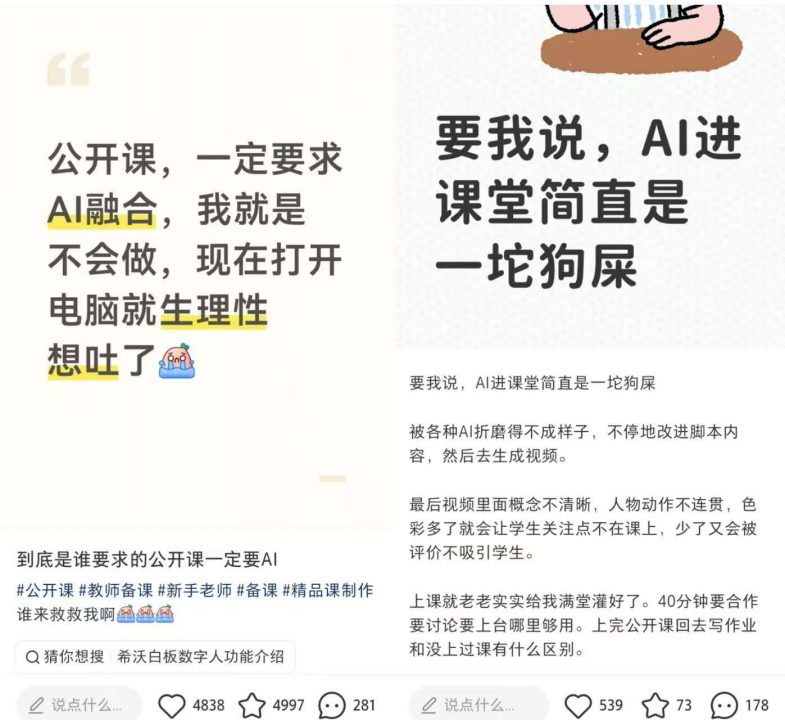
AI-empowered courses are forcing teachers to upgrade their skills in using AI tools
Wang Zai'an, a post-00s teacher, teaches at a junior middle school in a third-tier city in Liaoning. His ideal AI-enabled education is one that achieves personalized education for students, which is why he strongly supports introducing AI into teaching early on. However, in reality, the implementation only involves adding an AI template to PPT presentations and including two paragraphs of pop-up animations, which is then touted as AI-enabled education.
"Everything can be related to digital humans," he joked, saying that now, regardless of the subject or type of class, the classroom content always requires adding a segment of dialogue with digital humans. Chinese class requires making a phone call to Li Bai, history class requires chatting with Qin Shi Huang, and even his geography class was once suggested to include an AI character. The problem is, he was teaching about contour lines on topographic maps, which has no relation to any character.
"It's simply to show that this course has AI," during the competition, judges want to see the pursuit of trendy topics, so it must be added, but as for how this segment is deeply connected to the course, nobody seems to care.
Public lectures have turned into a show of skills, ranging from using AI to generate images and videos, to creating smart objects with bean bags and embedding HTML into web pages. If contextual teaching is advocated, digital figures like Qin Shi Huang will even replace the teacher to introduce the story of unifying the six states.
Before the competition, teachers would repeatedly rehearse their course content. With each rehearsal, judges, experts, and students would provide feedback, from teaching design to PPT layout, from classroom pace to revisions of the script, repeatedly refining it. After seven or eight iterations, they would finally take the stage to perform.
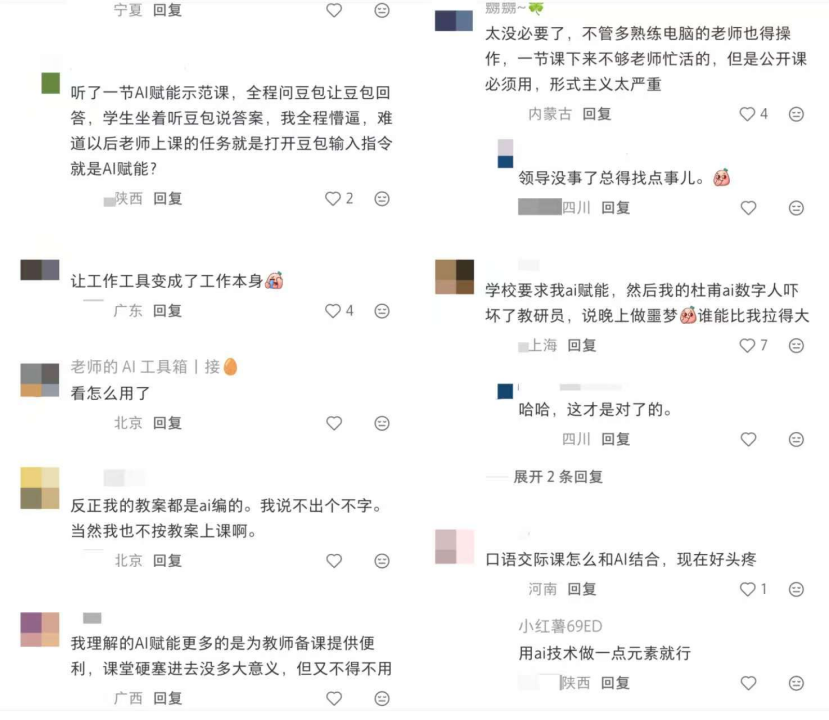
AI-empowered courses turn tools into jobs
Due to policy requirements, the school had also held AI empowerment conferences, but Wang Zhan felt that the content lacked practicality.
There was an event where the lecturer on stage mistakenly used the ChatGPT logo for DeepSeek, which made Wang Zhan even more skeptical of the training.
However, there is a colleague who is ten years older than me, and he is very excited about this training, because he has always wanted to learn about AI, but he hasn't had the time or a specialized course to systematically get started. In Wang Zhan's view, the teachers are still very passionate and idealistic about teaching, but the actual situation is quite different.
The school has more than 50 teachers, but only a handful of young teachers like Wang Zai'an have been able to effectively apply AI to their teaching. As a result, considering practical factors, the school has not mandated the use of AI tools in daily teaching.
But Su Ke is an exception, where "whether AI is used" has become a rigid standard in the evaluation. For this, teachers have to squeeze out time and energy from their daily teaching to learn various AI tools, adjust prompt words, generate digital humans, and create interactive courseware, finally performing a lesson empowered by AI to win the sparse applause from the audience.
Students still sit in the audience below the stage, and to liven up the class, a few children are occasionally selected to go on stage to interact with the digital human. However, no matter how novel the format is, the essence of teaching has not changed, and most children are aware that they are participating in a teaching performance.
Who is making money from AI-powered course formalism?
When open courses had to incorporate AI as a hard metric, savvy businessmen caught wind of the potential profits.
Gao Shan Company's business operations are mainly divided into three categories: the research and development of various AI-enabled course materials, AI tool learning courses, and the promotion of VR equipment and AI courses to schools and educational institutions. Although the business seems to require being close to cutting-edge information, Gao Shan has chosen to locate its office in its hometown in Shandong, where rent and labor costs are much lower than in Beijing, Shanghai, or Guangzhou.
The peak seasons for Gaoshan Company's business are from March to May and September to November every year, when the demand for customized courses is the highest. Orders pour in densely and urgently, covering a wide range of subjects from elementary school to junior high school, and from Chinese to geography. Over the past three years, the team has customized AI-enabled courseware for around 2,000 to 3,000 teachers, with prices ranging from 800 yuan to 10,000 yuan per order, which is not cheap.
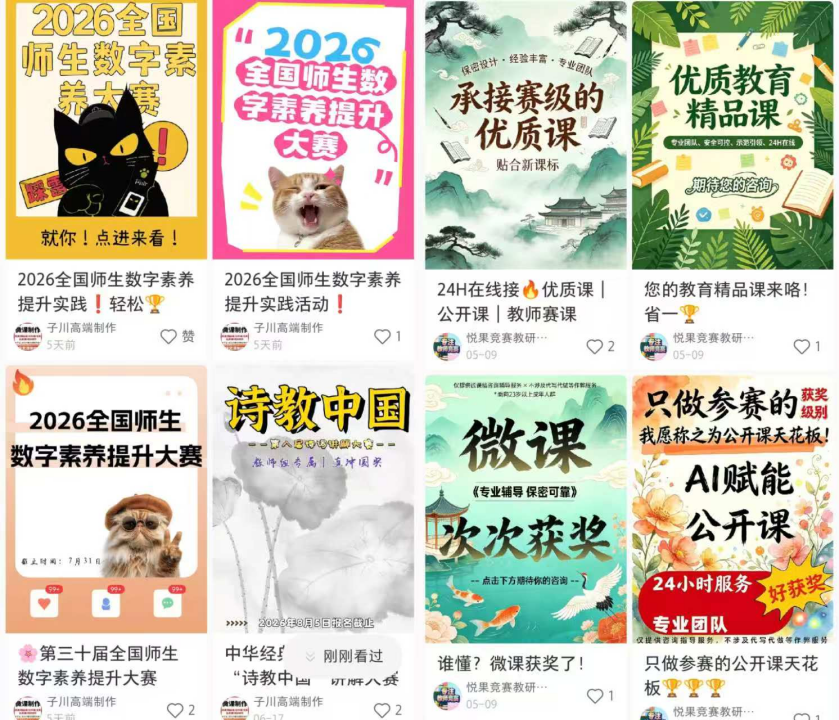
AI-powered open courses have given rise to a multitude of courseware service providers, with the market size expected to reach 10.8 billion yuan by 2025, according to a report by iiMedia Research. The report also notes that the number of courseware service providers has increased by 35.7% in the past year, with companies such as China Education Television, New Oriental, and TAL Education emerging as major players in the industry. Additionally, the report highlights that AI technology has enabled the development of more personalized and interactive courseware, with 71.4% of users expressing satisfaction with AI-powered courses.
Low-income teachers are willing to spend a high price on customized PPTs because they value the professional appearance and effectiveness of their teaching materials, and are willing to invest in tools that can help them better engage their students and improve their teaching quality.
Gao Shan cited a case he was proud of: last year, a teacher from a suburban town in a first-tier city found Gao Shan's team and spent 5,000 yuan to customize an AI PPT. The PPT included digital human interaction, 3D scenes, and dynamic data graphs, and won an award in a teaching competition. With this achievement, she was transferred from the suburban town school to a county town, and eventually to a good school in the city.
"That's not really our achievement—we're just adding icing on the cake, since she's already a very hardworking and capable teacher." The reason teachers place such importance on this competition is that the results are directly tied to professional title evaluations and career advancement.
Although the specific requirements for teacher title evaluations vary by region, competition teaching scores are undoubtedly a crucial factor. In Linhai, Zhejiang, winning a first prize in the provincial excellent lesson competition adds 5 points, while in Jiyang District, Jinan, Shandong, business competition scores account for up to 20% of the total recommended score. In Tianjin, having given more than two municipal open classes is a hard threshold for evaluating senior teacher titles.
For teachers with rich teaching experience, what is lacking in their competition performances is not content, but rather the ability to package and present themselves. Gao Shan frankly stated that what they do is help teachers complete the "face project" with less effort.
In addition to direct customized courseware, AI-powered courses have also spawned derivative courseware production classes and equipment sales.
On social media, it's common to see packaged AI-enabled courseware and production materials for sale. However, Gao Shan is not selling this type of courseware, but rather a one-week AI digital literacy course developed based on his own experience, which mainly introduces the tools and methods needed to produce courseware. "Several hundred teachers have purchased it, but after buying it, they rarely study it, giving up after watching just two lessons, and ultimately still coming to me to customize courseware.
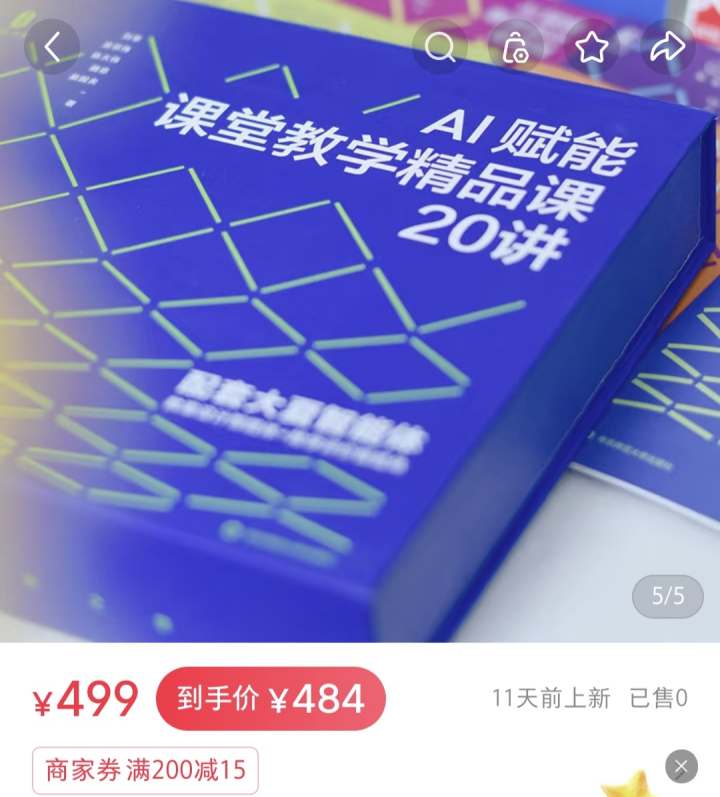
Designing AI-empowered courses is itself a course worth studying. With the increasing integration of artificial intelligence in education, educators are faced with the challenge of creating curricula that not only teach AI concepts but also leverage AI tools to enhance the learning experience. To design such courses, educators must first identify the learning objectives and outcomes they want to achieve. They should then consider how AI can be used to support these goals, whether through adaptive learning systems, intelligent tutoring systems, or other AI-powered tools. The course design process should also involve selecting appropriate AI technologies and integrating them into the curriculum in a way that is seamless and effective. This may require educators to develop new skills and knowledge in areas such as machine learning, natural language processing, and data analytics. Furthermore, educators should consider the ethical implications of using AI in education, including issues related to bias, privacy, and transparency. They should also be prepared to address potential challenges and limitations of AI-powered education, such as the need for high-quality data and the risk of over-reliance on technology. Ultimately, designing AI-empowered courses requires a deep understanding of both the subject matter and the AI technologies being used. By taking a thoughtful and intentional approach to course design, educators can create learning experiences that
For teachers, time is a scarce resource. A 2026 survey by Education Magazine of 81,387 primary and secondary school teachers found that 96.71% of teachers sleep less than 8 hours a night, and they have to spend a lot of time dealing with non-teaching task arrangements, leaving no time to learn new tools. Moreover, many lesson preparation tasks are arranged on short notice, with urgent deadlines, and can only be outsourced at a cost, with finished products being used in class.
AI-powered education is not only reflected in teachers' teaching activities, but has also become a decorative facade that schools want to showcase.
In teaching research papers, immersive courses built on VR and AI outperform traditional classroom instruction. In 2023, an empirical study across 12 middle schools in Zhejiang found that after adopting VR-based teaching experiments, student operational error rates dropped by 62%, while the completeness of lab reports improved by 38%.
But in reality, a complete VR setup costs as much as 10,000 yuan, and equipping a class of 30 students would run into the hundreds of thousands. What's more, the technology still needs to be popularized—most teachers haven't received systematic training in VR and AI, so in most primary and secondary schools, this equipment just gathers dust. After visiting more than 30 schools, Gao Shan found that idle equipment is the norm.
They attempted to promote VR devices and their self-developed accompanying courses to schools, which initially showed great enthusiasm but often lost interest due to the significant investment required. The majority of their actual clients were universities in the Guangdong region. For example, they once created a simulated course for the College of Mechanical and Electrical Engineering, allowing students to operate in a virtual reality environment and avoid injuries during experiments.
In this situation, training, equipment, and courses have formed a layered industrial chain: some people sell courses, some people sell equipment, and others sell services.
They are all trying to enable education with AI, but Gaoshan observed, "Currently, all AI-enabled education can only be used for demonstration purposes." Nevertheless, this does not hinder his team from continuing to recruit, expand, and develop new customers.
AI in Education: Sounds Great, but Does It Work?
Frontline teachers often have a lot of complaints when it comes to A-powered courses. They are tired of the formalistic performances, but cannot refuse them. This is actually the inevitable result of a whole system working together.
First, the penetration rate of terminal devices in schools remains low, with students having almost no devices at all.
At the school Wang Zhan attends, students are required to hand in their mobile phones before entering the classroom. Without devices, there can be no interaction, and it's impossible for AI to be integrated into the classroom. In his hometown in Shandong, Gao Shan sometimes hears parents calling for a return to blackboards. "They have an instinctive aversion to smart screens, thinking they're harmful to the eyes and will lead to addiction in children."
Without terminals, real-time interaction becomes an empty phrase, and most AI-enabled courses can only become upgraded versions of PPT, with teachers still being performers on stage.
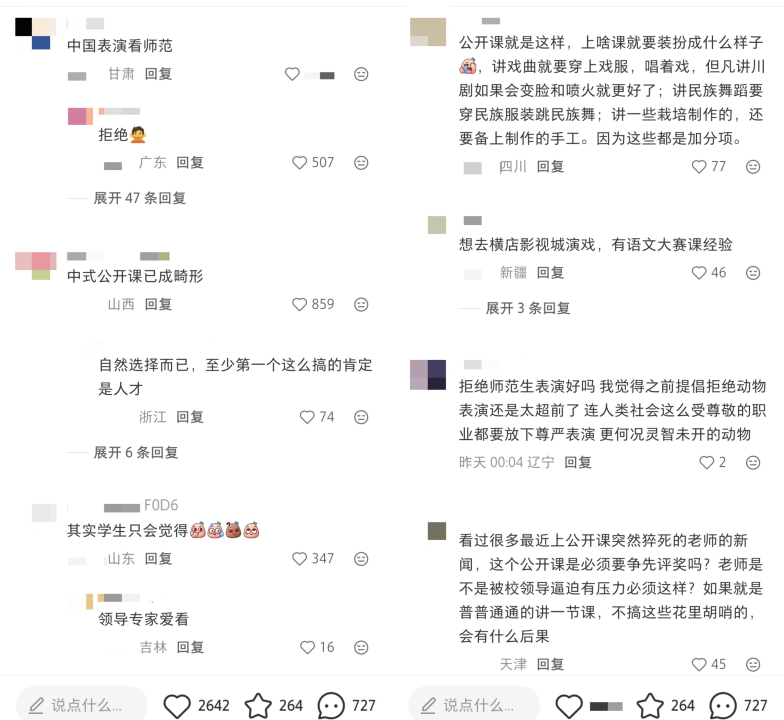
China Performance Display Standard
Beyond the hardware gap, there is also a deep-seated inertia in the evaluation system.
Wang Zhan'an, a newly minted teacher, still has strong ideals and sentiments about education. He hopes that after AI empowers education, the education evaluation system will have fewer knowledge-based assessments and more open-ended questions that exercise critical thinking skills. Therefore, every time he prepares his lessons, he also considers incorporating context and setting open-ended questions.
But what he faces every day is an exam system built around memorizing knowledge points. Students have to memorize place names, climate types, and all kinds of tables. "You go to great lengths to get AI to build an interactive scenario-based lesson that exercises students' thinking, and then the exam still tests them on fill-in-the-blank questions. So what's the point of doing open-ended assignments?"
With the arrival of the AI era, students' critical thinking skills have gained greater emphasis. But for a long stretch before that, advancing to the next level of schooling remained the bottom line, test scores were the hard currency, and any reform involving AI-enabled courses was little more than decorative window dressing.
"Many people feel that the competition evaluation system itself is a source of formalism." Gao Shan is also somewhat puzzled: teachers' career advancement is tightly bound to these competitions, yet the judges focus on whether teachers use AI rather than whether the lesson truly mastered the material and enabled students to learn.
"I met a teacher whose lecture was excellent. I told them, 'Your class is already good enough—you don't need to force AI into it.' They replied, 'I have no choice, it's required from above.'" Under this logic, teachers are left with no option but to pad their lessons with extra content.
Finally, there is the threshold of the technology itself.
Wang Zhi'an attempted to use Claude to create a mini-program for teaching assistance, a simple question bank system. After a week of effort, he had set up the framework and run the code, but had to manually import the question bank one by one. "The time it took to import the question bank was even longer than writing the code," he said. With updates relying solely on him, frequent textbook revisions and changes in current events made it impossible for one teacher to maintain a continuously updated system.
This also confirms Gao Shan's observation: "Most AI tools on the market are not designed for educational scenarios. Teachers want to create a lesson plan that meets the competition requirements, but after struggling for half a day, it still doesn't work." Downloading, logging in, configuring the environment, writing prompt words... each step is a hurdle. For teachers whose working hours are already saturated, these hurdles are major obstacles.
Taking various factors into account, AI-enabled education remains a beautiful promise.
When digital humans like Qin Shi Huang can recount the history of unifying the six states and standardizing weights and measures on their own, what role do humans play in the classroom?
Wang Zhan'an was once perplexed by this issue. "Six months ago, I thought AI was invincible, but now I think it's still far from being a true replacement for humans. Maybe you can ask it to write an official document, and it can produce something that looks pretty good. But if you ask it to design a lesson with depth, it still has difficulties.
The emotional currents between people and the sparks struck by clashing minds remain beyond AI's reach.
When discussing the issue of water scarcity in Western Asia, he would pose an open-ended question in class: "Most countries are without rivers, so what can these countries do?" The responses from students after some thought have sometimes surprised him. "He actually thought of starting a war, an idea that of course needs guidance, but I think it's a result of his thinking, and it's more meaningful than a standard answer."
This kind of thinking is the part that AI cannot replace. It doesn't require performance or packaging, just someone who can guide the questioning and a curious mind that yearns for answers.