As large models become increasingly powerful, what kind of AI are enterprises willing to pay for?
The capability of a model alone is perhaps no longer sufficient to justify a company's adoption of AI. The market's focus has shifted from the model itself to how AI can generate tangible, quantifiable output.
The semi-annual report recently disclosed by Bairong Intelligence presents just such a trajectory of change.
In the first half of 2026, the company's total revenue was affected by external factors and experienced fluctuations; on the other hand, its AICC business saw a year-on-year increase of 52%, with revenue from new scenarios targeting more industries growing by 195%.
AICC, or AI Contact Center, refers to the integration of AI into a company's contact center, enabling agents to directly handle inquiries, marketing, services, and operations.
Bairong disclosed that the company has honed its mature AICC and enterprise-level Agent capabilities in financial scenarios and is now replicating them in more scenarios, including logistics and securities firms.
The daily processing volume of its logistics project has increased from less than 1,000 deliveries at the initial launch to over 15,000 deliveries. A leading securities firm has also expanded its deployment scale from around 30 seats at the beginning of the year to around 210 seats.
Moreover, this model is continuing to expand outward. The RaaS model adopted by Bairong, which charges based on results, allows processing volume and deployment scale to be more directly converted into revenue.
Once a benchmark scenario is successfully implemented, the same set of capabilities and knowledge can be replicated to more positions and more industries.
As the deployment scale expands, a large amount of interactive feedback generated by actual operation can continue to be fed back into model training and strategy optimization, forming a data flywheel.
This chain continues to expand outward, and capital and industrial resources are also beginning to play new roles.
Bairong introduced the concept of "technology-driven AI Roll-up", which essentially involves acquiring more real business entry points through investment, cooperation or industry integration, and then embedding the verified Agent capabilities into them.
Thus, Baiying plans to start from a specific contact scenario and build a growth mechanism that gradually expands.
First, pilot and refine the model, then expand its deployment, gradually promoting cross-industry replication, using real data to continuously improve the model, and leveraging industry resources to open up more workflow entry points.
In the latest earnings call, Bairong CEO Zhang Shaofeng defined this round of adjustments as a strategic upgrade, with the starting point being AICC and a batch of silicon-based employees who have truly begun to take on specific tasks.
Bairong's Strategic Shift Revealed in Latest Financial Report
Looking at the latest semi-annual report, a notable feature is that Baiying's different businesses have already shown differentiation.
This earnings report also reclassifies revenue according to business attributes, dividing operations into three main segments: AI decision-making, AICC, and other businesses. This reclassification itself makes Bairong's ongoing business transformation more straightforward.
In the first half of 2026, Bairong achieved revenue of 914 million yuan, a year-over-year decrease of 43%; gross profit fell from 1.182 billion yuan to 488 million yuan, with the gross margin declining from 73% to 53%.
On the profit side, the company turned from a profit of 201 million yuan in the same period last year to a loss of 322 million yuan.
The financial report explains that this round of fluctuations has a relatively clear external background —
The regulatory documents related to internet-based lending services, which were released in 2025 and formally implemented in October of the same year, combined with a series of regulations that have been implemented in the first half of this year, have led some financial institutions to suspend the operation of certain products, thereby affecting Bairong's corresponding mature businesses.
In the first half of this year, Bairong AI's decision-making business revenue was 372 million yuan, down 26% year-over-year; revenue from other businesses was 377 million yuan, down 62% year-over-year, with the latter's decline mainly due to a contraction in intelligent marketing and operations revenue from some credit products.
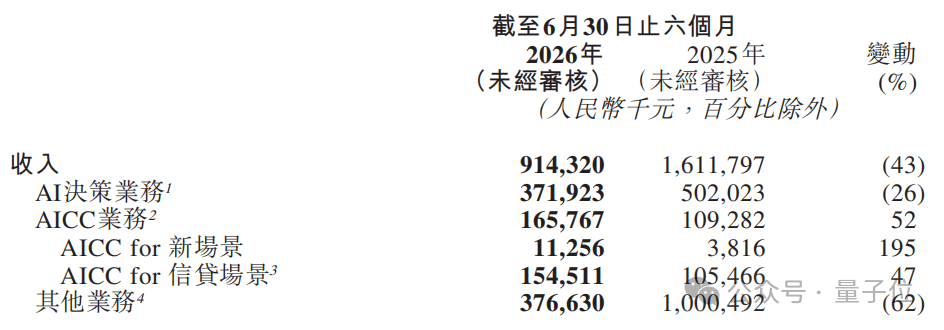
However, the fundamentals of AI decision-making have not seen corresponding fluctuations in operations.
In the first half of the year, the business had 141 core institutions, with core institution revenue accounting for 84% of the total, up from 76%, and a retention rate of 96%. Among them, core revenue from banks and internet platform institutions increased by 1% year-over-year.
Therefore, the management of Baiying still positions AI decision-making as an important foundation for profits and cash flow, to support the next stage of AI investment.
On the other hand, Bairong's AICC has deviated from its growth curve in the opposite direction.
In the first half of this year, the business achieved revenue of 166 million yuan, up 52% year-over-year; of which, credit scenario revenue was 155 million yuan, up 47% year-over-year, and new scenario revenue was 11.26 million yuan, up 195% year-over-year.
New scenarios currently account for around 7% of AICC's revenue, with the scale still small, but the growth rate has started to emerge in the financial data. AICC's overall proportion of Baiying's revenue has also risen from around 6.8% in the first half of 2025 to approximately 18.1% in the same period this year.
This increase was influenced by AICC's own growth and the contraction of total revenue, but the diversification of the business structure has become relatively clear.
Research and development investment has further strengthened this trend.
Bairong's research and development expenses increased from 302 million yuan to 394 million yuan in the first half of the year, up 31% year-over-year, with the proportion of revenue rising to 43%; as of the end of June, 901 of the company's 1,477 employees were research and development personnel, accounting for 61%.
Choosing to continue increasing R&D investment during a period of overall revenue pressure also means that Bairong's AI strategic adjustment has begun to take effect in terms of resource allocation.
Cheung Shao-feng further clarified on the conference call that AICC's new scenarios have become a key growth business for the group, undertaking the task of replicating across industries and seeking new increments, and new resources will also be prioritized towards AICC's new scenarios and other silicon-based positions.
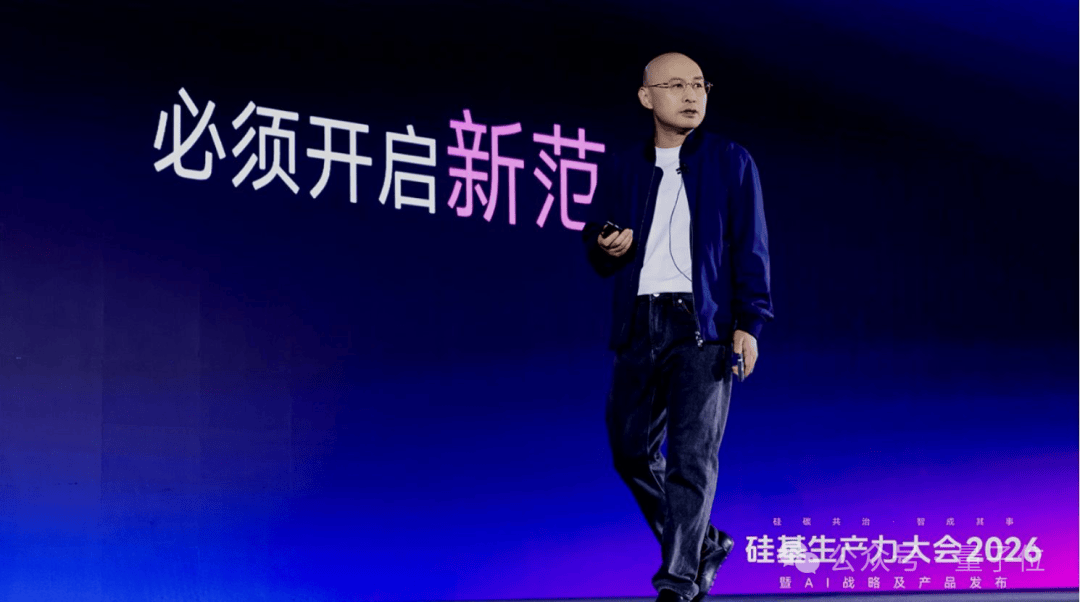
Bairong Intelligent Founder and CEO Zhang Shaofeng
The strategic upgrade announced by Bai Rong this time is first reflected in the expansion of industry scope.
Bairong's previous AICC capabilities were mainly accumulated in the financial field, and are now being extended to service-intensive industries such as logistics, aviation, securities, banking, telecommunications and insurance.
The complexity of tasks undertaken by AI has also changed in line with the evolution of the industry.
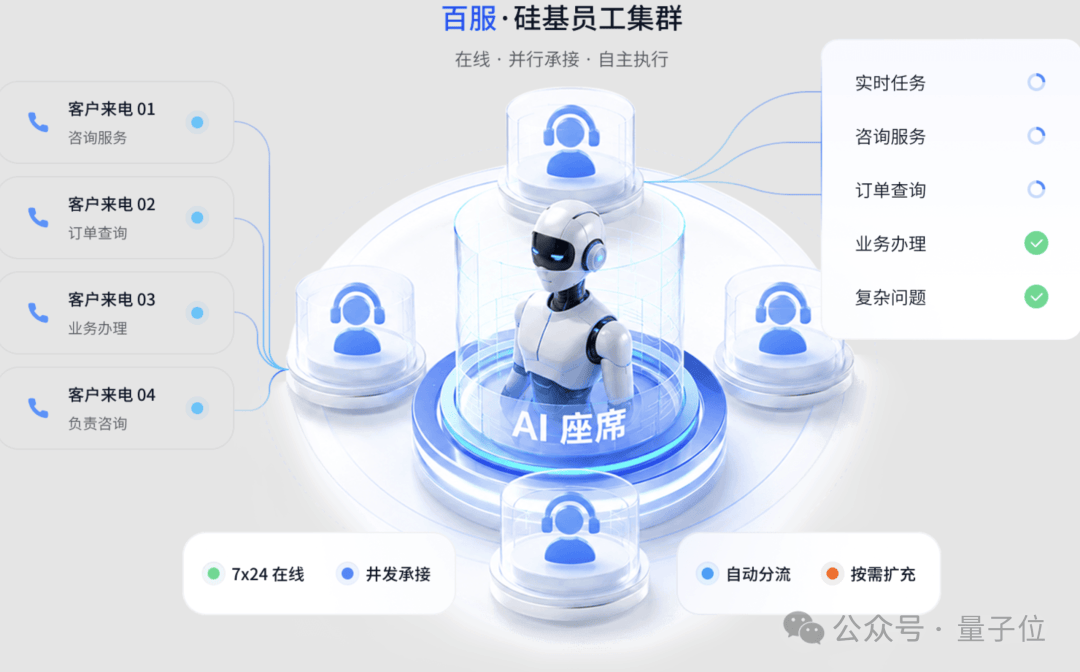
The previous generation of AICC was more commonly applied in outbound scenarios, relying on keyword matching and preset dialogue, and is suitable for standardized tasks such as notification reminders and fixed-process marketing.
In contrast, complex inbound calls are distinctly different. After users initiate a call, their problems, modes of expression, and emotions are all difficult to anticipate in advance, and AI must be able to understand open-ended questions, maintain long-term multi-round conversations, and invoke knowledge bases and internal business systems to continue completing subsequent tasks.
Zhang Shaofeng revealed on a conference call that traditional chatbots, when faced with such complex scenarios, have a transfer-to-human rate of as high as 70% to 80%. The new generation of AICC aims to bridge the gap between understanding problems and completing the service process.
Bairong refers to this type of enterprise-level Agent that has entered actual service processes as "silicon-based customer service".
In terms of cross-industry replication, Bairong has also made some tangible progress.
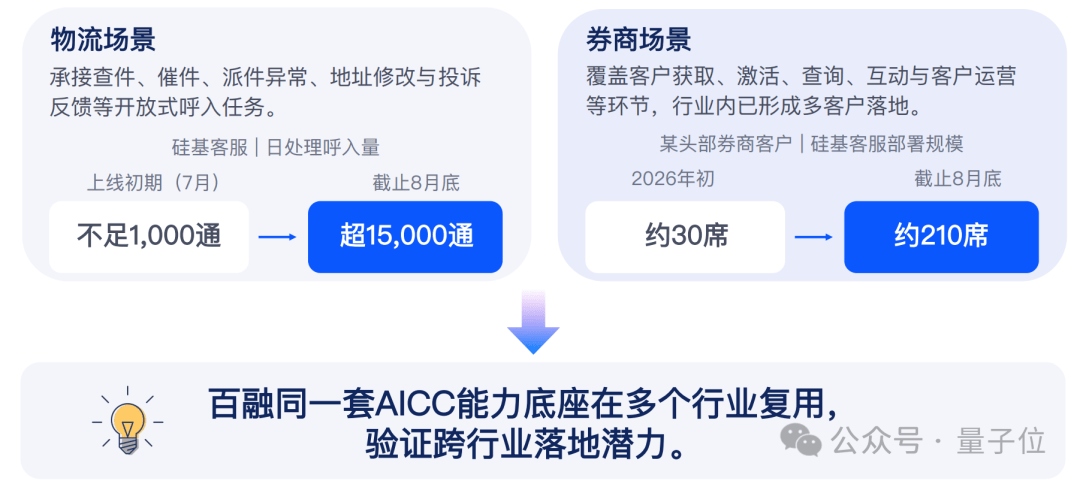
In July, Bairong's silicon-based customer service started handling complex inbound tasks such as package inquiry, delivery exceptions, and complaint feedback in logistics scenarios, with daily processing volume increasing from less than 1,000 calls at the initial launch to over 15,000 calls by the end of August.
In the securities sector, as of July, Bairong had signed contracts with or was in the process of contracting with 13 institutions, including a leading securities firm that expanded its deployment scale from approximately 30 seats at the beginning of the year to around 210 seats.
These advancements indicate that the AICC capabilities, which were previously mainly focused on financial scenarios, have begun to enter new production environments.
The industries that Bairong has currently chosen to prioritize entry into also have relatively clear commonalities - they have continuous and massive C-end interaction demands, and the industry concentration is relatively high.
Logistics generates inquiries about checked and abnormal items every day, while aviation has long-term demands for services such as ticket refunds and rescheduling; leading enterprises are also relatively concentrated, and once a benchmark project is successfully implemented, the same capabilities can be more easily replicated internally to more scenarios and across the same industry.
The call also revealed another aspect, where the time-consuming process of promoting across industries is currently focused on the procurement verification cycle of large enterprises, as well as system integration and production cutting.
Before large-scale enterprises formally adopt a system, they usually need to go through a proof of concept (POC) to verify the problem resolution rate, proportion of human intervention, response efficiency, and stability. After entering production, business volume will only be gradually released after safety, compliance, and service boundaries have been confirmed.
So the difficulties of scaling up are no longer just about the model.
A new question arises: since enterprise-level Agents can be applied to many scenarios, why does Bairong choose AICC as the most important breakthrough point for now?
Why Did Enterprise-Grade Agents First Land in AICC?
Enterprise-level Agents have increasingly entered repetitive workflows, but to transition from technical availability to large-scale implementation, the first challenge to be addressed is how to clearly measure business value.
The adoption of AI by enterprises ultimately comes back to the issue of return on investment. However, in many scenarios, it is difficult to directly quantify in the short term how much AI has improved decision-making quality and released hidden efficiencies.
AICC is relatively special.
Contact centers have long been responsible for handling a large volume of inquiries, marketing, and service tasks, with clear boundaries, processes, and evaluation standards. After the integration of AI, the processing volume, human transfer ratio, and unit service cost can all be quickly reflected in the operational results.
Top venture capital firm a16z had also previously listed programming, enterprise search, and customer support as several scenarios where enterprise-level AI is likely to be applied in production earlier on.
The customer service field has clear business objectives, with most processes already documented, and retains a manual backup path, making it naturally suitable for Agents to gradually take over standardized work.
Of course, Baiying's choice of AICC is also due to its own accumulation.
Zhang Shaofeng revealed that the company's customer service and marketing silicon-based employee project has been in place since 2017 and has undergone seven or eight years of continuous iteration. The financial industry has high requirements for accuracy, stability, and compliance, resulting in capabilities that highly overlap with AICC's needs for voice interaction, intelligent contact, and complex process execution.

Bairong has thus built a relatively complete technical system around real production environments.
First and foremost is the core model capability.
Bairong currently possesses the BR-Voice multi-modal voice model, the BR-LLM-Proactive proactive dialogue model, and the BR-Vision-Doc document understanding model.
All three belong to Bairong's self-developed vertical basic models, with the first two being important foundations for the AICC vertical model.
The technical route of this model system is relatively clear - it does not pursue being "comprehensive", instead placing more emphasis on optimization around specific tasks.
Zhang Shaofeng revealed that the company's models pre-trained for phone scenarios have parameter scales mainly controlled between 0.4B and 30B, with the core goal of achieving a balance between accuracy, stability, response latency, and inference cost that is more suitable for production environments.
On the conference call, Zhang Shaofeng further explained the differences between this route and those of some overseas AICC companies.
According to its observations, companies such as Sierra and Decagon are mostly based on third-party foundational models like OpenAI and Anthropic, and then build applications and harness engineering on top of them. In contrast, Bairong has incorporated vertical foundational models at the bottom layer into its own technology system, with key links such as pre-training, post-training, and inference optimization all controlled by itself.
This allows for continued judgment of whether issues arise from the application engineering layer or the foundational model layer after actual operation problems occur, and directly enters the next round of training and optimization, shortening the entire iteration chain.
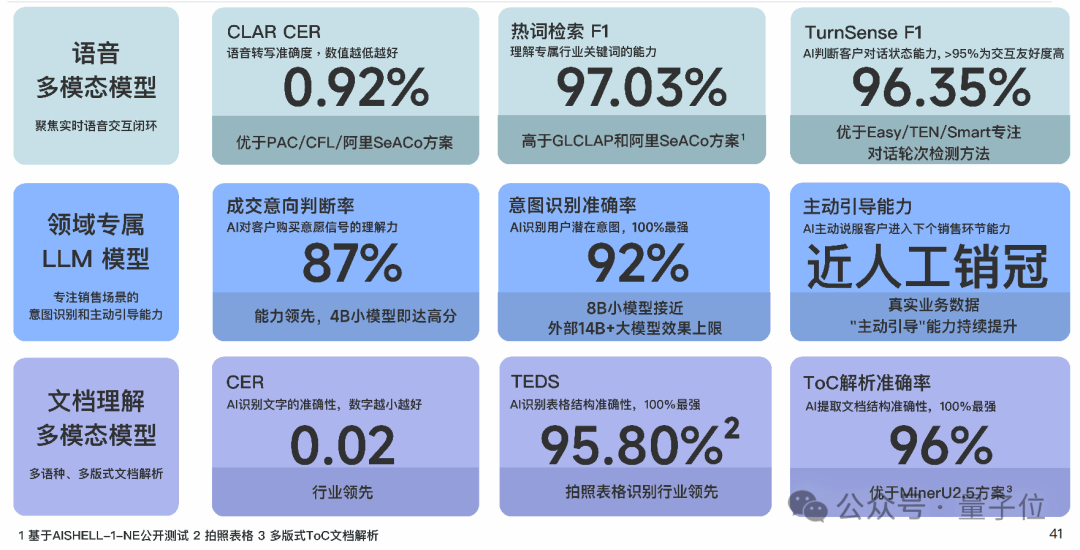
This also reflects a difference between enterprise-level AI and general models. General models emphasize capability ceilings, but once they enter a production environment, they must also contend with constraints such as accuracy, stability, response speed, and cost.
Public testing results have provided some external validation for Bairong's vertical approach.
In the multilingual conversational speech understanding task at the INTERSPEECH 2026 MLC-SLM Challenge, Bairong achieved an accuracy rate of 94.84%, ranking third globally and first among domestic industry players.
However, model capabilities are just the starting point for production-level implementation, and real-world phone calls are not static question banks. User expressions, business needs, and abnormal situations are constantly changing, so even if the model achieves a high accuracy rate initially, it still needs to be continuously corrected during production runs.
Bairong's second key accumulated capability, which has resulted in the Data Flywheel.
Under the premise of legitimacy and compliance, the company identifies positive and negative feedback from actual production, such as whether a service ultimately completes its task, which expressions cause understanding deviations, and which links ultimately enter manual processing, and then converts this information into reinforcement learning signals to continue adjusting the model, service strategy, and conversation method.
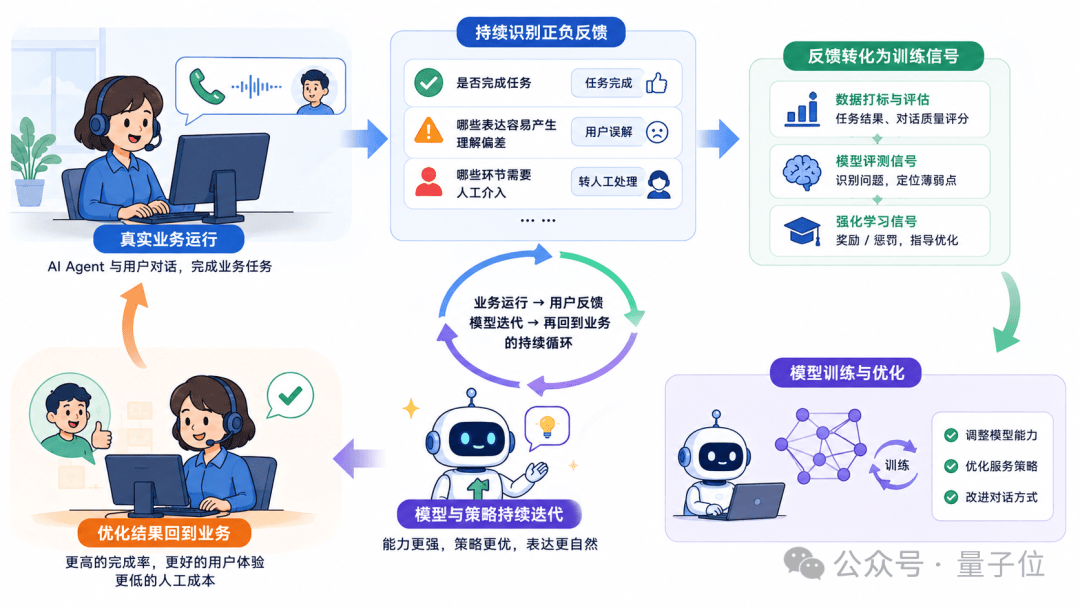
Image Generated by AI
Real business operations thus become part of the model's ongoing training, forming a cycle that runs from business execution to feedback to model iteration and back to business.
However, after the model can continue to iterate, there is still a threshold to truly enter the contact center, which is the need to run stably in the telephone network.
Traditional phones typically use 8kHz narrowband voice, which retains significantly less acoustic information than the 16kHz wideband audio commonly used on the internet, posing higher requirements for speech recognition and real-time interaction.
The real contact center also needs to handle communication softswitch, high concurrency scheduling, system docking, and recording quality inspection.
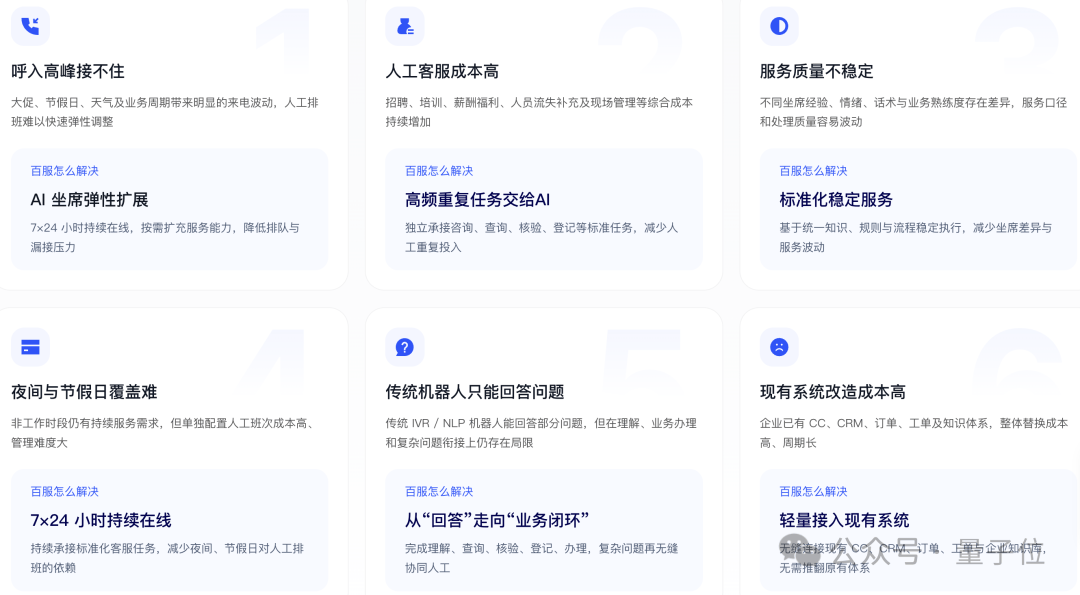
Bairong has long built its communications engineering system around telephone networks, while also adapting for narrowband recognition, noise reduction, user interruption, and dialogue-turn detection.
However, once the technology is truly integrated into the business, it still has to confront another layer of issues that are highly dependent on the scene: delivery.
Different companies have distinct knowledge systems, operational rules, and system environments, and after AI completes a conversation, it may continue to query information, call internal systems, execute tasks, and write back the results.
Bairong has set up a team of FDE frontline deployment engineers for this purpose. After FDE enters the business site, it will sort out service standards, access conditions, knowledge bases, and system interfaces, break down the original manual workflows, and then reorganize the links suitable for AI to take over into Agent workflows.
This way, the multiple layers of capabilities formed by Bairong around AICC are perfectly interconnected: vertical models provide task capabilities, real-world business feedback drives model iteration, communication engineering ensures AI can run in a telephone environment, and FDE embeds the technology into specific workflows.
After being put into production, the agent continuously generates new feedback, which is then used to re-enter the next round of model training.
Bairong's subsequent AI investment is also aimed at a more specific goal: making AI a long-term, sustainable production capability.
And once Agents start taking over work originally done by humans, the subsequent changes will no longer be limited to just technology.
The way companies purchase AI is also likely to change.
AI Begins to Enter Production Systems
The software industry has developed to date, and enterprise procurement of technology has formed a relatively mature business model.
In the early days, software was primarily sold through licenses, but with the rise of SaaS, subscriptions and seats became the mainstream; the era of large models has also introduced token-based billing.
Although these models have different pricing units, the core of what enterprises buy is still a kind of technical capability.
The rise of Agents has enabled AI to further penetrate the task execution phase, directly undertaking specific work.
In this process, the object of enterprise payments has gradually shifted from technology usage to actual output, and the value range it can reach has extended from traditional IT budgets to operating costs and labor costs.
Bairong is currently adopting a RaaS (Results as a Service) model, which can be seen as a real-world manifestation of this change.
According to the company's disclosure, RaaS can charge based on successfully completed and automated effective calls or work orders, or based on the actual deployment scale of Agents, and in some scenarios, it will also charge based on the business scale it helps to promote.
On the conference call, management revealed that taking the already implemented logistics business as an example, after successfully resolving issues and charging for effective calls, the single-processing cost can currently be reduced by more than 50% compared to traditional manual methods. The income of the technical service provider is thus directly linked to the actual work completed.
This is also the biggest difference in billing between RaaS and traditional software.
After the software is delivered, subsequent operations are mainly undertaken by the user; the results-based payment model further pushes technology companies into the internal business process, where model performance, stability, cost, and task completion effects all need to be incorporated into the same operational logic.
As AI begins to penetrate operations and human resources, a bigger issue arises: how can this newly formed AI capacity be integrated into more real-world workflows and further replicated on a large scale?
In recent years, the AI Roll-up that started to gain popularity in Silicon Valley has been drawing attention against this backdrop.
Roll-up was originally a method of industrial integration, typically involving the consecutive acquisition of decentralized enterprises within the same industry, and then achieving synergies through scale integration and back-office sharing.
With the introduction of AI, the core change lies in obtaining a real business entry point and then continuing to refactor workflows, service delivery, and cost structures through vertical models, Agents, and engineering systems.
Thus, the generalized AI Roll-up is no longer limited to acquisitions. Capital acquisitions, strategic investments, industrial cooperation, and even direct deployment of Agents can all become ways to enter real workflows; what truly matters is whether AI has entered daily operations and continues to change efficiency, capacity, and unit economics.
Currently, a relatively typical route has taken shape in North America: capital first gains access to traditional service enterprises and workflow entry points, and is then overhauled by AI engineering teams.
For example, the integration of accounting firm Current and the acquisition of PartnerHero by Crescendo AI are examples of this practice of capital control combined with AI engineering transformation.
Domestically, two development paths are emerging:
One category is the industrial aggregation-type AI roll-up, which first enters a decentralized service network through capital, joint ventures, or industrial integration, obtaining business systems and real workflows, and then carries out AI upgrades.
The other category is the technology-restructuring AI roll-up. These companies can start directly within enterprise workflows, using vertical models and agents to take on specific tasks, then gradually expand their deployment scope and extend outward through strategic investments and industrial partnerships.
Bairong is one of the representatives of technology-driven AI roll-up.
The two paths have different sequences: the industrial aggregation type emphasizes aggregating industrial entrances first, then implementing AI transformation, while the technological reconstruction type first uses AI to transform workflows, then expands industrial coverage.
What they have in common is to further push AI from the periphery of enterprise software systems to the interior of production operations.
From this perspective, RaaS and AI Roll-up actually correspond to different levels of enterprise-level AI commercialization: the former solves how AI is billed after completing work, while the latter further addresses how this production capability is organized and enters more real businesses.
AI Roll-up is responsible for changing the way production capacity is organized, while enterprise-level Agents are actually implemented in specific tasks.
The software has digitized a large number of business processes, and large models have further provided understanding and reasoning capabilities. Now, Agents are beginning to enter the processes themselves, directly undertaking specific tasks within them.
After entering real-world industries, the boundaries of competition have also expanded. Enterprise-level AI requires connecting models, engineering, and business processes into a long-term running system, and continuously undergoing testing in real production environments.
The industrial significance of Agent has also begun to exceed that of a single large model product, and is gradually becoming the entry point for machine intelligence to enter real economic activities.
Thus, machine intelligence began to transition from a technological product to a production factor in economic activities.
Historically, every productivity revolution has initially started with a small number of specific jobs, and then gradually changed the cost and organizational structure of the entire industry.
This time, enterprise services are becoming the deepest territory for AI, and Bai Rong has already stepped into this field through AICC.