Now, all you need for a livestream is one model?
You heard that right. Yesterday, a livestream appeared whose entire feed was generated in real time by AI.
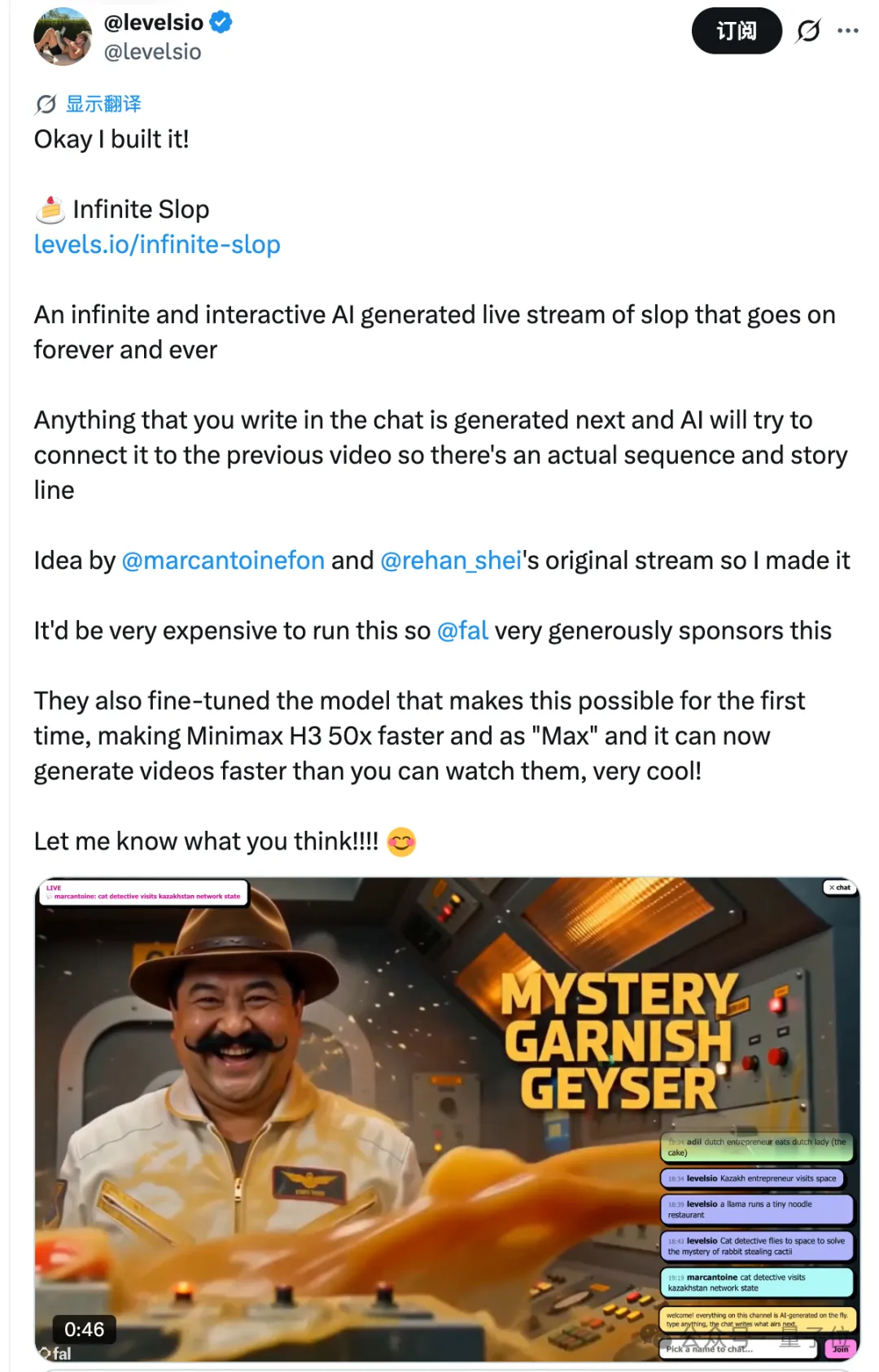
This isn't a 'semi-AI' digital-human stream. There is no host, no script; viewers request content live.
And it's not pre-made. Once a viewer makes a request, the AI produces it on the spot.
The model used in this stream generates a five-second video in under three seconds, so the next clip is ready before the current one finishes.
So even though it's made to order, the stream's 'serving' process has been continuous since it went live.
Beyond live streaming, a developer used Codex to build an 'AI version of Douyin,' where content is generated in real time by a video model and seamlessly stitched together.
As you're still watching a video, the next one is already generated, so swiping over is a seamless transition.
If a short clip isn't enough, the video can be extended to 30 seconds, making for a striking effect.
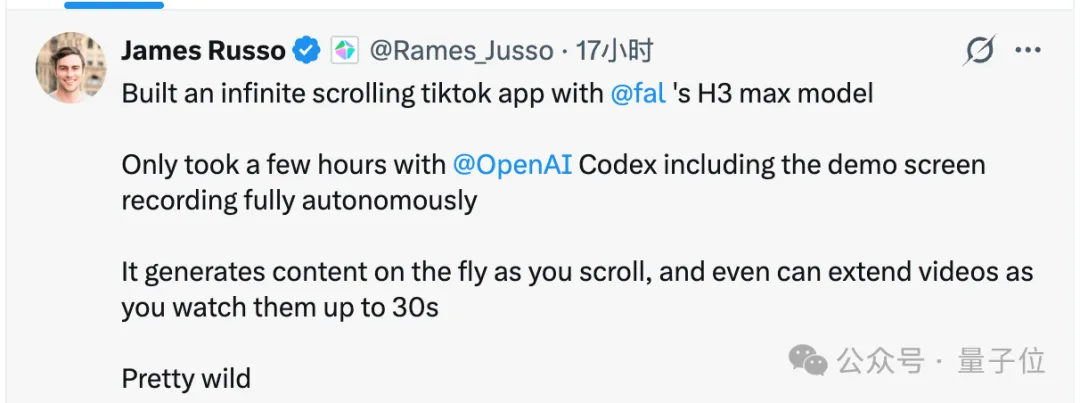
The model behind this live stream and the AI-powered short-video app is H3 Max, which MiniMax just released.
Click What You Want, AI Makes It on the Spot
H3 Max was developed jointly by MiniMax and fal.
MiniMax open-sourced its video-generation model H3 in late July, and it drew 24 million downloads in just three weeks.
fal is an AI inference infrastructure company focused on inference acceleration, with a strong track record in making models run faster.
The two companies quickly hit it off and teamed up on a single project.
The task was simple: build on H3 with post-training and inference optimization specifically for real-time generation.
In even simpler terms, they gave H3 a speed boost.
The result is called H3 Max — the core change boils down to one word: speed.
Generating a 5-second 768p video takes H3 Max less than three seconds, with throughput roughly 35 times that of the original H3.
That generation speed now exceeds playback speed — before you finish watching one clip, the next is already done.
Despite the speed, quality hasn't slipped at all.
H3 Max ranks first in image-to-video on two major leaderboards: Artificial Analysis and Design Arena.
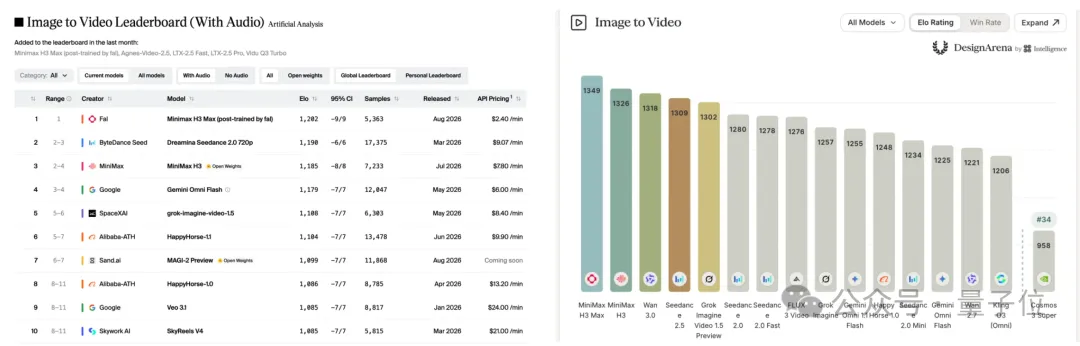
Quantitative gains have tipped into a qualitative shift. With generation time now shorter than the video itself, a use case that never existed before has emerged.
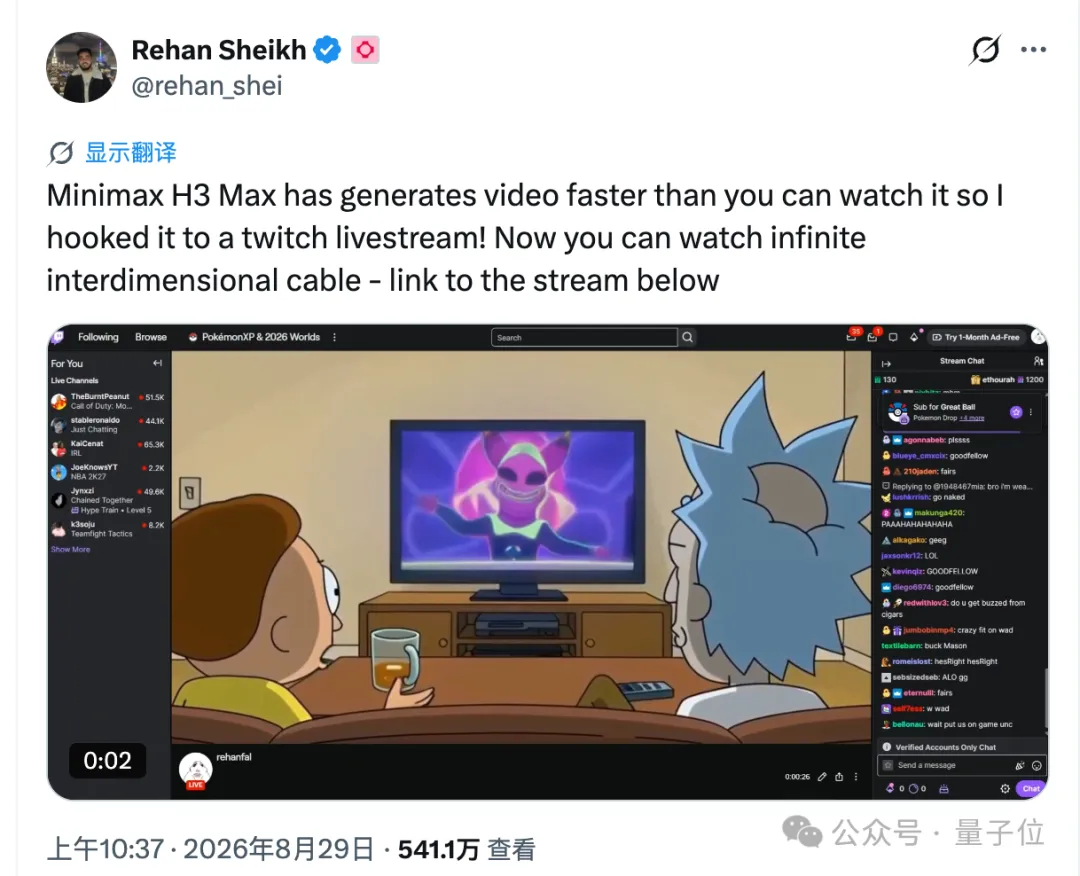
The first to try it was Rehan Sheikh.
As an engineer at fal, he had a front-row seat to experiment first.
He hooked the H3 Max up to an overseas livestreaming platform and launched a channel called Cross-Dimensional TV.
The channel's signature is that it has no signature.
On screen, an animated short might be playing one second, then jump to an absurd 1960s puppet commercial, then to a deep-space documentary.
There's no schedule and no pre-recorded content. All visuals and audio are generated by the model in real time, feeding the livestream segment after segment.
Afterward, he posted clips of the livestream to X, where they drew 5.4 million views.
Soon after, independent developer Pieter Levels followed suit.
He's a well-known figure in the overseas developer community, having built the digital-nomad community Nomad List and the AI photo-editing tool PhotoAI. He's known for taking a product from zero to launch single-handedly.
The AI livestream site mentioned at the outset, which lets viewers request whatever they want, is Pieter's work.
Around the same time, Alex Koumpas, another engineer at fal, also started a live stream.
The difference was that his live stream played out a continuous story.
Viewers could still intervene at any moment with text commands in the chat, such as "have the protagonist turn and walk into the forest" or "suddenly make red rain fall from the sky."
Once the model received a command, the visuals shifted accordingly, and the story veered in a new direction dictated by the audience.
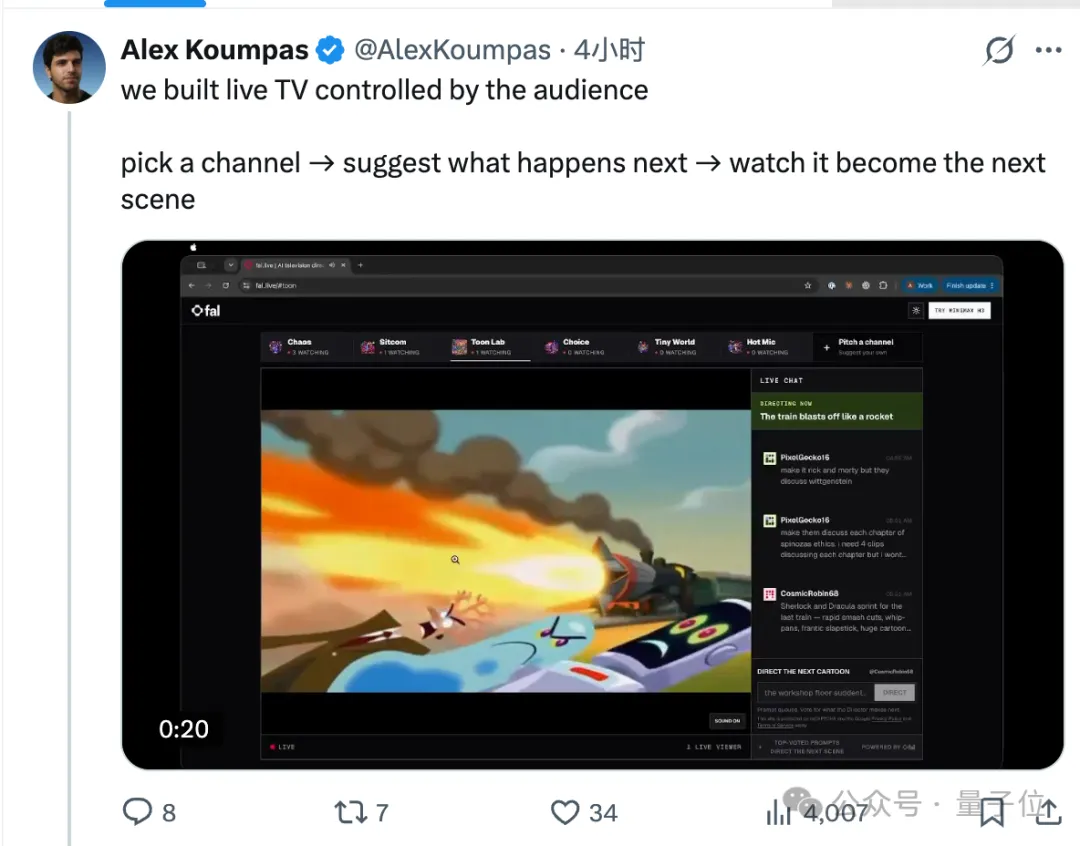
Within a week, three people—without consulting or planning in advance—independently built three AI live streams.
Given H3 Max's speed, this simply happened on its own.
OpenClaw Moment in Video Generation
Fast video generation is certainly a plus, but speed alone doesn't constitute a moat.
When it gets as fast as H3 Max, though, the game changes.
The new real-time AI livestreaming model introduced by H3 Max could be a watershed for the video generation sector.
It cuts out the waiting step entirely.
This new model opens up an entire commercialization path.
When Peter Steinberger created OpenClaw, he turned AI agents from command-line tools used only by developers into open-source assistants anyone can open and use.
The idea couldn't be simpler, but after OpenClaw reached 4.7 million downloads, Sam Altman and Mark Zuckerberg both sat up and took notice.
Real-time AI video points to the same structural shift: making once-unreachable technology accessible to everyone.
But the difference is that video generation and coding are not competing on the same playing field; they have entirely different commercial structures.
Code has right and wrong answers, leading to severe homogenization of code models and collective cutthroat competition in the industry.
But there is no single correct answer for video.
Aesthetics are subjective: the same prompt fed to ten models yields ten styles, and users pick the visuals they like.
That means the video-generation space won't converge on one or two winners, and competition won't hinge on price alone.
And stickiness deepens with use.
Once a creator develops a visual style with a particular model, audiences identify with that aesthetic, and brands pay for it.
Switching models means overhauling the entire visual asset set and resetting audience expectations.
With accumulated usage, models become more deeply embedded in asset libraries, character settings, and creative workflows, further raising switching costs.
Open-source and open ecosystems add another layer to the moat.
Community developers and creators build derivatives around the same base model, with feedback looped back into model iterations.
Once this model is running, latecomers will find it hard to catch up on model capability alone.
H3 has already formed the prototype of this flywheel.
Three weeks after open-sourcing, global downloads reached 24 million, with more than 300 derivative models, including FastH3, H3 480p and H3 Max.
H3 serves as the trunk, with different teams cultivating it to branch out in various directions, ultimately flourishing across the ecosystem.
And the capital markets are already voting with real money.
Last week, Morgan Stanley reaffirmed its overweight rating on MiniMax with a HK$900 target price.
Today, MiniMax's Hong Kong-listed shares closed up 16.18%, climbing from HK$300.40 to HK$349.
Market performance is the ultimate arbiter, and these examples are enough to show that capital markets are once again turning bullish on MiniMax's ability to commercialize.
The creator of OpenClaw never imagined that a tool he built for his own use would, once open-sourced, ignite a global battle over AI harnesses.
MiniMax likewise never anticipated that, with no one having previously used AI to generate video in real time during a livestream, someone would today use H3 Max to run a television channel that almost never goes off air.
MiniMax's decision to open-source its state-of-the-art video model amounts to a wave of technological democratization.
It puts frontier capabilities directly into every developer's hands and raises the foundation of the entire sector.
Once global developers and creators chart their own paths on this foundation, accumulating content, workflows, and user habits around a shared ecosystem, the commercialization flywheel will turn on its own.