On September 2, Sun Pengbo, former ByteDance reinforcement learning expert and former head of Tencent's Robotics X Intelligent Center, officially joined Xingchen Intelligent, where he will focus on the technical research and development and application exploration of robot reinforcement learning.
Over the past two years, robot foundation models have primarily focused on addressing the question of "whether they can". However, as robots transition from demos to real-world deployment and commercialization, the focus is shifting to "whether they can consistently perform well". The key issue now is how to enable robots to continuously adjust their strategies based on actual execution results, and how to bring reinforcement learning back to the center of industry attention.
Sun Peng has long been dedicated to reinforcement learning (RL), intelligent agents, and multi-agent reinforcement learning (MARL), with research and industrial experience spanning robotic reinforcement learning, large-scale distributed RL systems, and large model reinforcement learning. His joining will further strengthen Stardust Intelligence's layout in robotic reinforcement learning, and form a synergy with AI models, embodied OS, and cable-driven robotic entities, driving continuous learning and evolution of robots in the real world.
After joining Xingchen Intelligent, Sun Peng continued to expand the robot reinforcement learning team, driving the enhancement of related technical capabilities and application deployment.
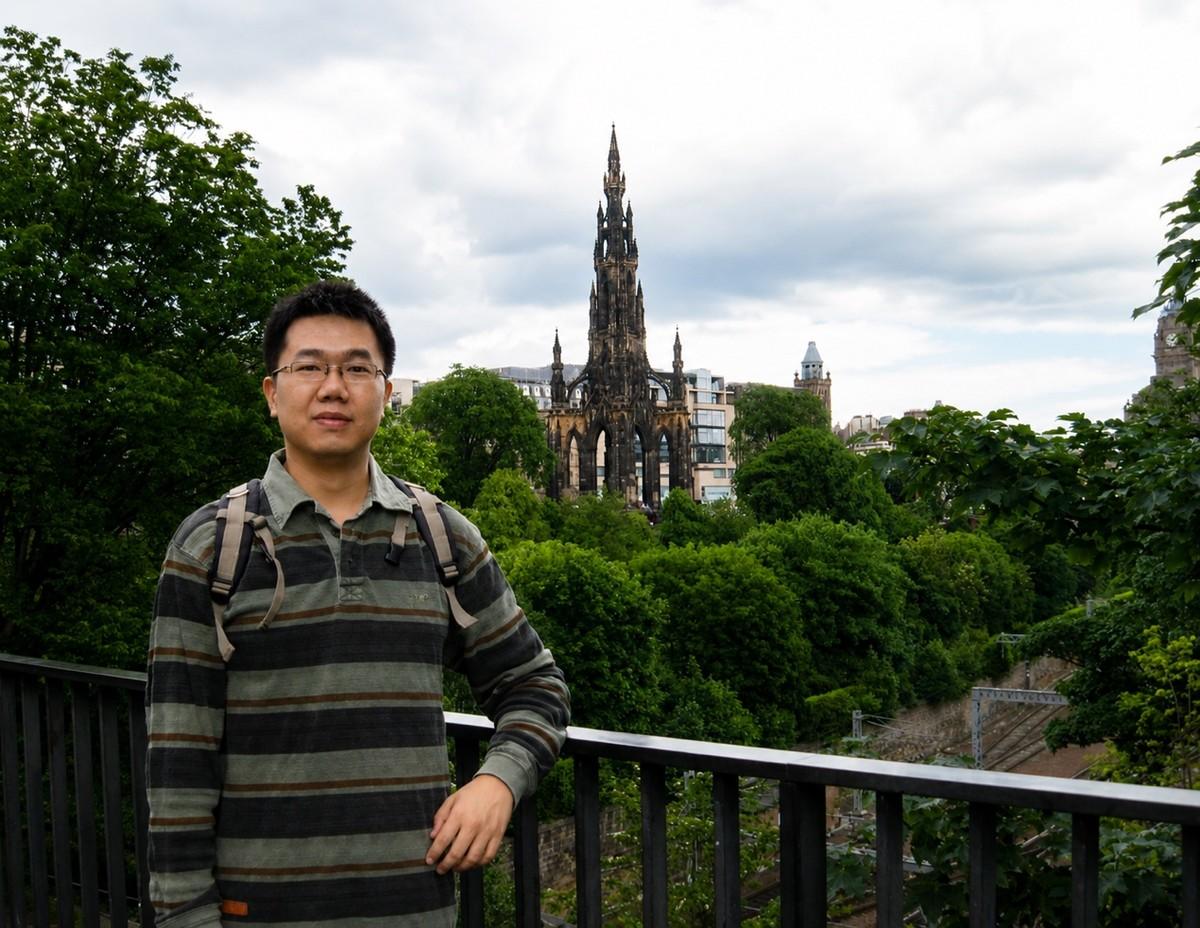
From Tencent to ByteDance: Over a Decade of Delving into Reinforcement Learning
Dr. Sun Peng graduated from Tsinghua University and subsequently conducted postdoctoral research at Cornell University and Rutgers University. Over the past decade, his research and industrial practice have consistently focused on reinforcement learning and intelligent agents, gradually expanding from robotic reinforcement learning to large-scale RL systems and post-training of large models, forming a technological accumulation that combines algorithmic research and system engineering.
During his early tenure at Tencent AI Lab and Robotics X, Sun Peng served as the head of the Intelligent Body Center, where he conducted research on deep reinforcement learning and robotic control. He utilized deep reinforcement learning and adversarial games to train wheeled robots, achieving end-to-end active target tracking. At the same time, he developed the StarCraft AI intelligent bodies TStarBots and TStarBotX, making significant breakthroughs in the complex game environment of multi-agent reinforcement learning (MARL).
After joining ByteDance, Sun Peng expanded his technical practice from algorithms to large-scale RL system engineering. He led the development of the core reinforcement learning infrastructure ByteRL, which supports the efficient training of multiple self-developed game AIs. His team won the championship in the IEEE CoG 2023 strategy card AI competition, and the developed Hearthstone AI demonstrated a competitive level that can defeat top industry players.
With the rise of large language models, Sun Peng further expanded his accumulation of reinforcement learning to post-training of LLMs. During his time at Byte AI Lab/ByteResearch, he participated in research as a project leader and released the reinforcement fine-tuning method ReFT (Reinforced Fine-Tuning) and the math reasoning intelligent body DeltaProver. At Seed, he deeply participated in model RLHF and pre-training, accumulating rich cutting-edge exploration experience in model alignment, reasoning enhancement, and Agent direction.
Sun Peng's technical path over the past decade, from robotic reinforcement learning to large-scale RL systems and post-training of large models, has always revolved around a core issue: how to enable intelligent entities to continuously learn through environmental interaction and feedback, and optimize their strategies. Now, as AI further transitions from the digital world to the physical world, this capability is also finding new applications in the field of embodied intelligence.
Xingchen Intelligent Doubles Down on Robot Training with Closed-Loop System
For Xingchen Intelligent, while advancing the "AI model + embodied OS + cable-driven entity" full-stack technology system, Sun Peng's joining is a crucial link in solidifying the robot model's "post-training" phase.
Since its inception, Xingchen Intelligent has adhered to the concept of Design for AI, believing that the body, data, and AI models of robots should not be designed in isolation. Over the past few years, this approach has gradually formed a complete closed loop covering base models and commercial models, co-existing front-end Agents, and reinforcement learning post-training.
Xingchen Intelligent's base model series, Lumo, continues to advance robots' understanding, prediction, and generation of their environment and actions. Lumo-1 enables robots to understand the "why" behind actions, while Lumo-2, as the first implicit world action model for households, introduces Latent World Dynamics, predicting future worlds in latent space before generating actions. The front-end Agent Philia focuses on long-term memory, task management, multi-robot collaboration, and natural interaction. Meanwhile, reinforcement learning, as a foundational model, plays a crucial role in scaling up to real-world deployment, tackling the key issue of how robots learn from continuous interaction and task feedback in real environments and optimize their behavior strategies.
Sun Peng's long-term accumulation in robot reinforcement learning, large-scale RL systems, and large model RLHF, reinforcement fine-tuning, and Agent direction will further strengthen Stardust Intelligence's technical capabilities in this area. In the future, he will participate in the construction of Stardust's embodied model, robot reinforcement learning, and post-training system, exploring how to further combine the reinforcement learning post-training methods that have been verified in the era of large models with real robot execution, data closed-loop, and long-term deployment.
Regarding his decision to join Xingchen Intelligent, Sun Peng said: "Over the past decade or so, I have been working on reinforcement learning and intelligent entities, and I have personally witnessed the development of reinforcement learning from robotic control and complex games to post-training of large models. Now, I hope to bring these accumulations back to the physical world. Xingchen Intelligent already has a complete technical foundation, from robotic hardware, embodied OS to AI models. What I look forward to most is working with the team to further integrate reinforcement learning into the training and deployment of real robots, allowing robots to not just 'learn a task', but to improve their performance through repeated real-world execution and feedback."
This article is provided by Xingchen Intelligence and reproduced by QbitAI with permission, with opinions belonging to the original author.