Broadcom (AVGO.O) announced its fiscal Q3 2026 earnings (for the period ended July 2026) after the US market closed on September 3, 2026 Beijing time:
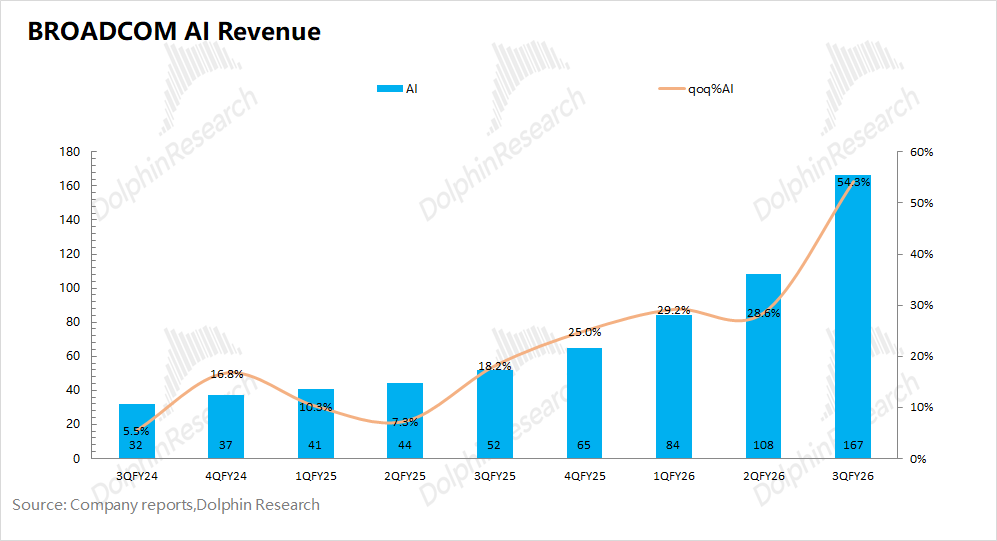
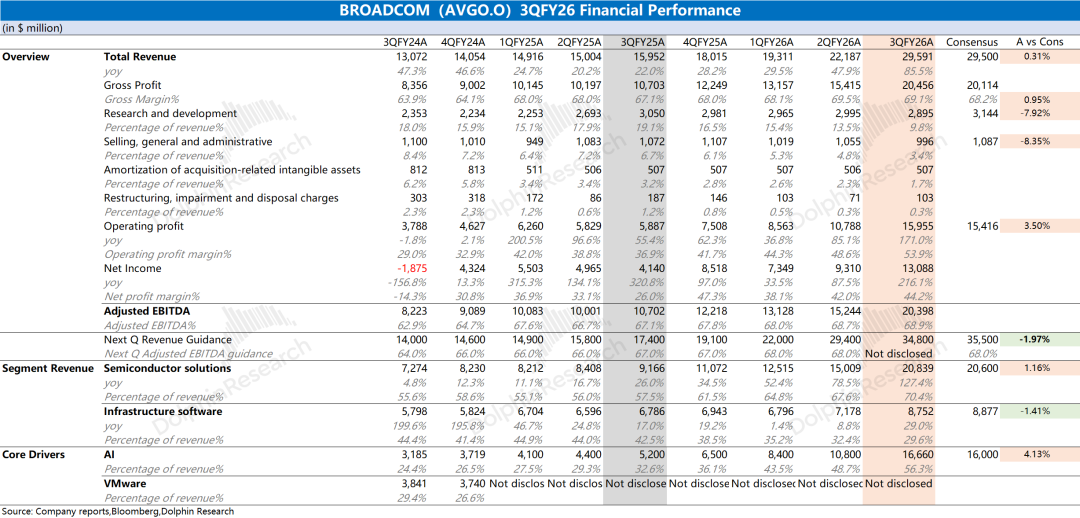
The AI business is the most core part of the semiconductor business. Broadcom's (AVGO.O) AI business revenue this quarter was $16.7 billion, up $5.9 billion quarter-over-quarter, beating market expectations of $16 billion, with growth mainly driven by large-scale shipments of TPUv7 to Google and Anthropic.
Google and other major companies have recently revised up their 2026 capital expenditure outlook, and deliveries from Anthropic are expected to accelerate from the second half of the year. The company expects AI business revenue to reach $21.7 billion in the next quarter, a sequential increase of $5 billion.
Broadcom's guidance indicates expected revenue of approximately $3.48 billion for the fourth quarter of fiscal year 2026, lower than market expectations of $3.55 billion. The company expects a non-GAAP operating margin of 66% for the fourth quarter of fiscal year 2026.
As the company provided annual guidance for AI revenue, the importance of quarterly guidance has relatively "weakened". The company's management provided AI revenue forecasts for fiscal years 2026-2028 of $58 billion (originally $56 billion), $115 billion (originally $100 billion), and $230 billion.
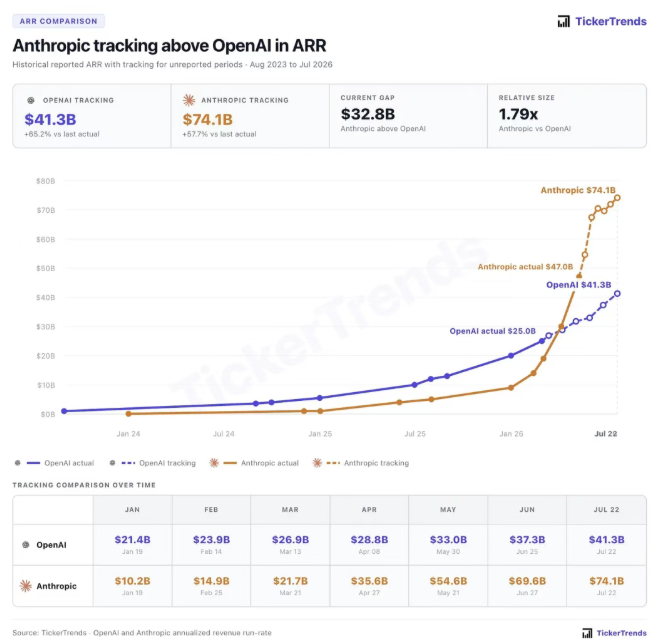
For the 2027 fiscal year, the company still maintains a target of 10GW, with market expectations for revenue from this 10GW ranging from 130-150 billion, and the company's guidance remains "flat". As for the 2028 fiscal year, the guidance of 230 billion is not bad, but since 10GW of the expected 20GW comes from Anthropic, the market views this part of the outlook with skepticism, especially given the recent slowdown in Anthropic's ARR growth rate.
Operating metrics: Revenue for the quarter reached $29.6 billion, representing an 86% year-over-year increase, in line with market expectations of $29.5 billion. The sequential increase of $7.4 billion was primarily driven by growth in AI business.
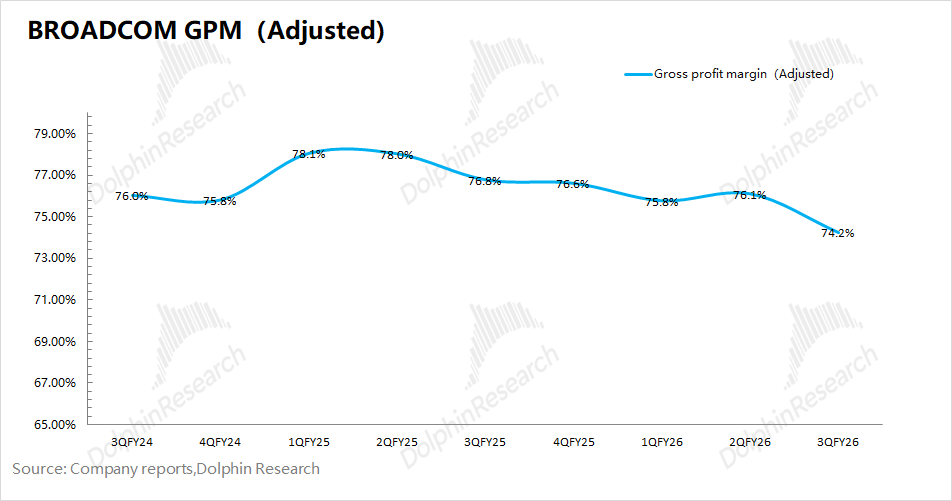
The company's gross margin for the quarter was 69%, and after excluding the impact of acquisition amortization and restructuring costs, the adjusted gross margin for the quarter was 74%, down 2 percentage points from the previous quarter. The overall gross margin showed a structural decline due to the increased proportion of lower-margin ASIC business.
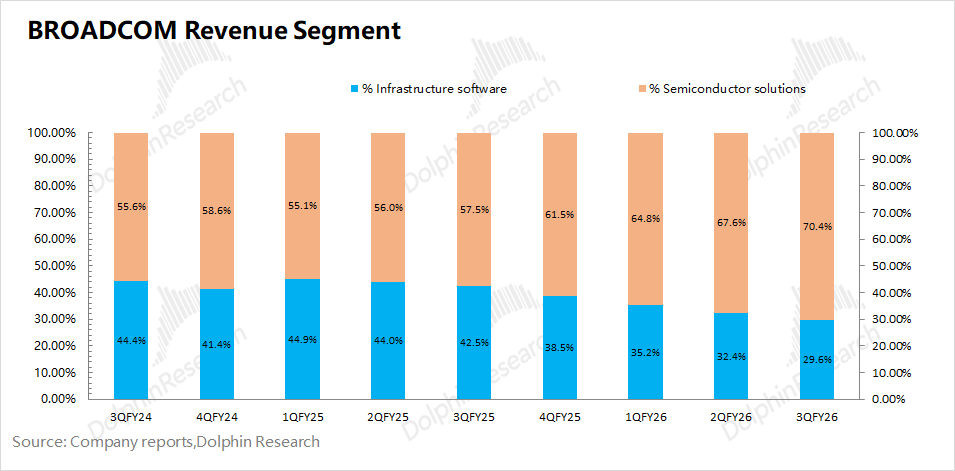
Broadcom's AVGO business can be divided into two parts: semiconductor business and infrastructure software.
The semiconductor business achieved $20.8 billion in revenue this quarter, a sequential increase of $5.8 billion, with the AI business contributing the majority of the incremental growth. Excluding the AI business, the company's non-AI business achieved $4.2 billion in revenue this quarter, representing a 5% year-over-year increase, with growth in broadband and server storage offset by a decline in wireless business.
Infrastructure software achieved $8.75 billion this quarter, representing a 29% year-over-year increase, driven by VMware Private AI Cloud and VCF workload repatriation, as well as the incremental growth brought by enterprise-side AI.
Previous growth was primarily driven by the integration of VMware's acquisitions and adjustments to its pricing model, which involved a full transition from a perpetual license model to a subscription-based model. The impact of acquisitions has come to an end, and future growth in the software business will primarily focus on the intrinsic growth of VMware's subscription model.
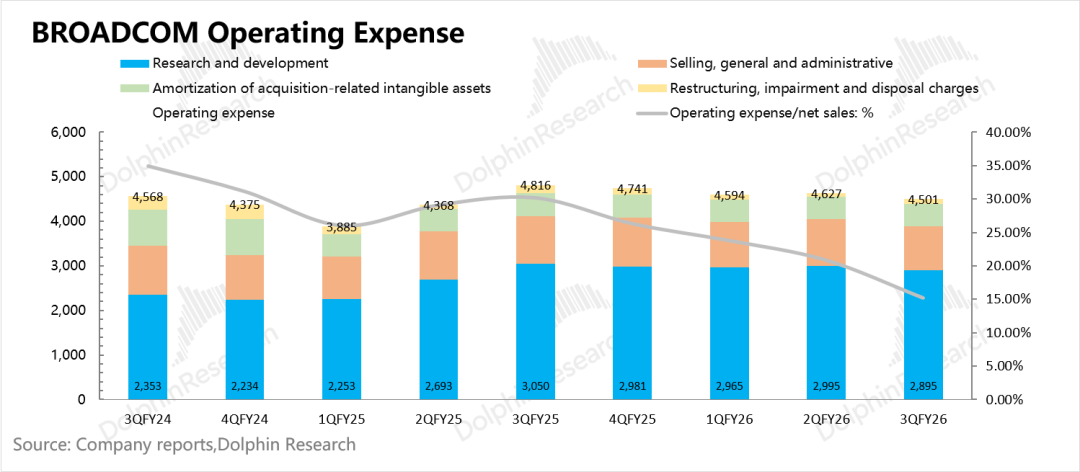
On the cost side, core operating expenses (R&D expenses + sales and management expenses) were $3.9 billion this quarter, remaining stable. Due to the impact of high revenue growth, the core operating expense ratio decreased to around 13%.
In the company's operating expenses over the past two years, there has been a significant increase in equity incentive-related expenditures, with equity incentives currently accounting for nearly half of the total. Excluding the impact of equity incentives, the company's core operating expenses for the quarter were $2.1 billion, down $80 million quarter-over-quarter.
Doubao's Overall View: Long-term Guidance has Flaws, Facing Intense Competition
Broadcom AVGO's quarterly revenue and gross margin have basically met market expectations. The growth in revenue is mainly attributed to the contribution of its AI business. In terms of gross margin, after excluding the impact of acquisition amortization and restructuring costs, the actual operating gross margin for the quarter was 74%, down 2 percentage points from the previous quarter. From a medium- to long-term perspective, the overall gross margin is still under pressure to decline due to the increasing proportion of lower-margin ASIC business.
The market is most concerned about the company's AI business performance: this quarter the company achieved $16.7 billion in AI revenue, a quarter-over-quarter increase of $5.9 billion. The company predicts that next quarter's AI revenue will reach $21.7 billion, a quarter-over-quarter increase of $5 billion, slightly better than market expectations of $21.5 billion.
Broadcom experienced a relatively deep correction earlier, mainly due to concerns over the company's competitive risks beyond industry-wide beta factors. Currently, Google remains one of the company's major clients, but Google has initiated a "backup plan" for its supply chain: ① Google has confirmed that it will split its next-generation TPUv8 series into two versions and introduce MediaTek (MTK) into its supply chain; ② Google has accepted warrants from Marvell and signed a customized chip agreement with the company.
After the last earnings report, the company revised its fiscal 2027 shipment target up to 10GW, yet kept its revenue outlook above $100 billion. Whether calculating revenue per GW at $15 billion or $20 billion, 10GW clearly exceeds the $100 billion threshold, but management still failed to explicitly raise the guidance. The market is likely to read this as a lack of confidence, which contributed to a 12% single-day decline following last quarter's results.
Nvidia recently clarified that it expects revenue growth of over 70% for its 2028 fiscal year, corresponding to the 2027 calendar year. Facing competitive threats from MTK and Marvell, the market has higher expectations for Broadcom's management to raise its AI guidance for the 2027 fiscal year, which corresponds to the 2027 calendar year.
The company's management also raised its AI guidance for the current fiscal year and the next fiscal year (2027) to 58 billion (from 56 billion) and over 115 billion (from 100 billion), respectively, and provided an outlook for 2028 of 230 billion (corresponding to 20GW).
As mainstream institutions have generally set the company's AI revenue expectations for fiscal year 2027 at around 1,300-1,500 billion, the fiscal year 2027 estimate of 1,150 billion will still be interpreted as "lacking confidence" or "withholding performance".
The company's guidance for 20GW (approximately $230 billion) in fiscal year 2028 is a decent indicator. However, 10GW of this comes from Anthropic, which has less financial strength compared to large CSPs. Due to the recent slowdown in Anthropic's ARR growth rate, the market is also likely to discount this expectation.
Aside from the earnings report, the market is mainly focused on the following developments at Broadcom AVGO:
Client and capital expenditures: Broadcom AVGO secured six custom XPU clients (unchanged), including Google TPU, Meta MTIA, Anthropic, Open AI, and two undisclosed clients. Google and Meta were previously the company's main customers for custom ASIC chips, while Anthropic and Open AI began contributing revenue in the second half of the year.
In line with market expectations, the company's disclosure of 10GW for fiscal year 2027 can be roughly broken down into Google (3-4GW), Anthropic (5GW), Open AI (1-2GW), and Meta (1-2GW).
Looking at these major clients, Google and Meta have once again raised their full-year capital expenditure forecasts after their earnings reports, and the demand for this part is relatively certain. As for Anthropic and Open AI, the market is currently focusing on the slope of their annual recurring revenue (ARR), and the recent slowdown in Anthropic's ARR growth rate will increase the uncertainty of subsequent demand.
B) AI Chips and Market Competition: In the AI chip market, Nvidia still holds an absolute leading position, with Broadcom AVGO playing the role of "follower/competitor", but now a challenge is emerging from its own backyard.
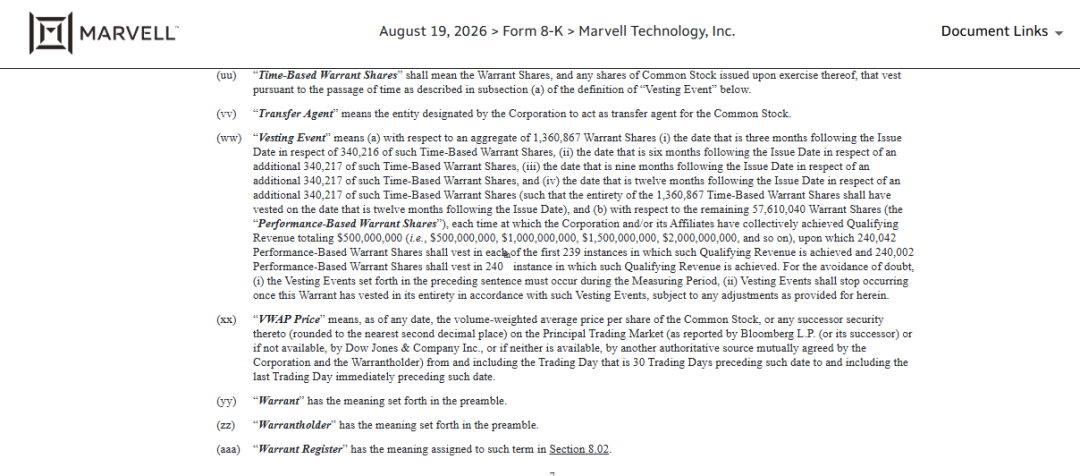
Marvell recently announced a collaboration with Google, under which qualified revenue refers to Google's custom ASIC chips, including AI inference accelerators, storage controllers, network interface controllers, memory interface controllers, and near-storage computing. This partnership clearly targets Broadcom's collaboration with Google on custom ASIC businesses such as TPU.
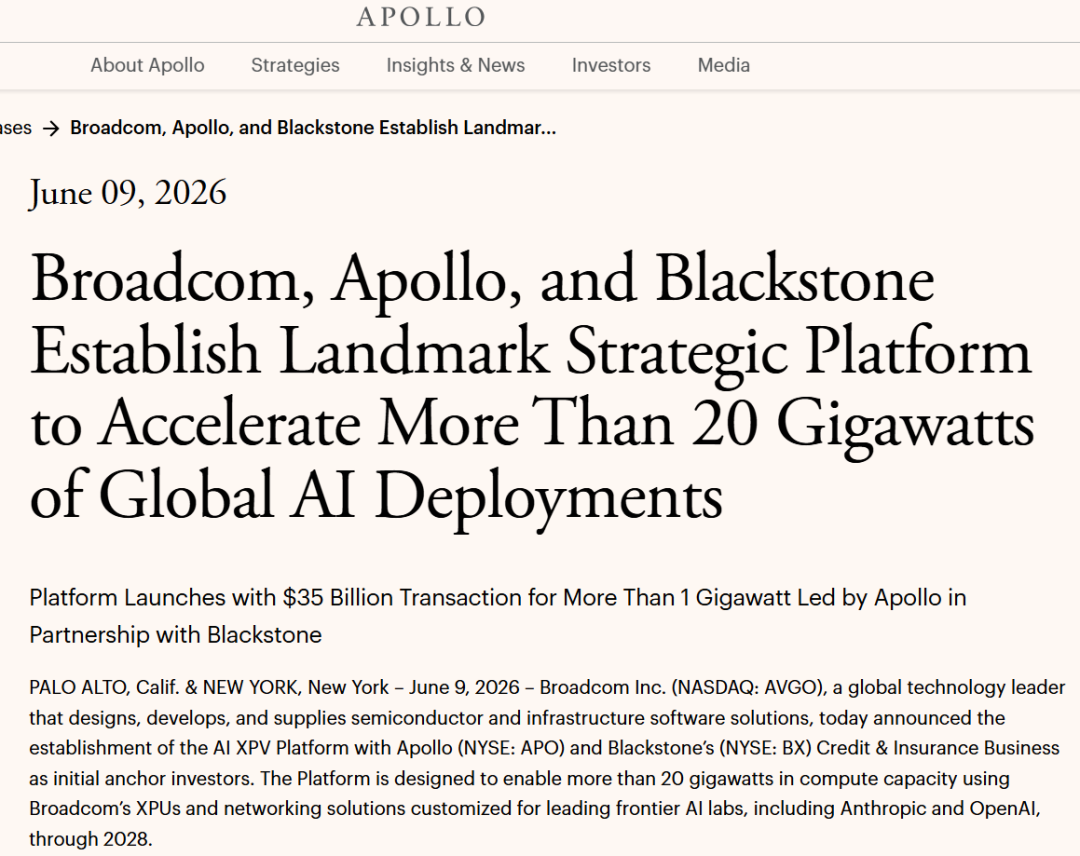
c) Financing platform: Broadcom has partnered with Apollo and Blackstone's credit insurance business to establish the AI XPV Platform, aiming to support over 20GW of computing power by 2028, utilizing Broadcom's XPU and network solutions, tailored for cutting-edge laboratories, including Anthropic and OpenAI. The initial $35 billion, led by Apollo, will be used for the deployment of over 1GW for Anthropic at Fluidstack's site.
In terms of specific operations, the platform is funded by Apollo/Blackstone to purchase Broadcom chips, which are then delivered to cutting-edge laboratories that "don't pay cash upfront". The revenue is real on Broadcom's books, but the ultimate payment ability depends on the commercial success of Anthropic/OpenAI, as reflected in their annual recurring revenue (ARR) performance.
Initially, the market viewed Broadcom as a competitor vying for share with Nvidia, with relatively high valuation expectations for the company. Now, however, Broadcom itself faces competition from MTK and Marvell, becoming the "competitor being competed against", with its valuation also plummeting.
The market's concerns about Broadcom AVGO are mainly two-fold. On one hand, intensifying competition may threaten the company's supply share with major client Google. On the other hand, the company's outlook for major clients, including cutting-edge labs such as Anthropic and Open AI, may lead to increased uncertainty in revenue forecasts if the corresponding Annual Recurring Revenue (ARR) growth slows, potentially falling into the "cycle of financing trap".
Overall, the company's performance has basically met market expectations. Compared to its performance, the market is more concerned about the outlook for its AI business. The company has upgraded its AI business outlook for fiscal 2027 and provided expectations for fiscal 2028, but this guidance is still "flawed". The fiscal 2027 target of 1.15 trillion is still lower than market expectations, and the majority of the incremental increase in the fiscal 2028 target of 20GW comes from Anthropic and Open AI.
Unlike Nvidia's general-purpose GPUs, Broadcom's customized ASIC chips have a more singular collateral purpose, which also invisibly increases "tail risk". If Anthropic or Open AI's annual recurring revenue (ARR) slows down, it may not only lead to direct order cuts, but also affect a large number of subsequent cooperation plans.
The upward revision of AI guidance is positive news, but it is still difficult to give the market sufficient confidence, as the market largely views Anthropic's orders as "uncertain". Until the company can alleviate market concerns, its valuation will likely remain suppressed at a relatively low level.