
Over the past two weeks, I have felt several times that it is not necessary to continue researching AI-powered office work at present.
It's not because it's unimportant, but rather because it's too important and too lively. Tencent, Alibaba, ByteDance, Baidu, and Kingsoft have almost all made their moves, with new products, organizational adjustments, and rounds of advertising emerging one after another. The media and analysts are also keeping pace.
As of today, there are at least five things that we think have been clearly analyzed:
Industry giants have fully entered the AI office space. This is not a product trial by a single company, but a collective reallocation of resources.
Agents are shifting from "answering questions" to "completing tasks". Writing documents and making PPTs is just the surface, what's more important is breaking down tasks, calling tools, and executing across systems.
Beyond models, data, context, permissions, and workflows are becoming new competitive variables.
Feishu, DingTalk, WPS, and Enterprise WeChat, these traditional office assets, may regain value due to AI.
The basic unit of office software is also changing. In the past, sales were based on files, functions, and seats, but now more and more people are discussing tasks, outcomes, and even digital employees.
For those looking to understand how far this war has reached, there are already numerous worthwhile articles to read.
For example:
Titan Media: Large companies are competing to enter the AI office market, which has continued to evolve along two paths: independent Agents and traditional office workflows, as well as the shift of office products from software functions to task delivery.
Economic Observer: Internal competition has been put on hold, as Tencent, Alibaba, and ByteDance's AI office products "join forces" to form an alliance. This round of resource consolidation and organizational movement within major companies has been clearly laid out.
Industry Insider|"Dou Bao Work" In-Depth Analysis of Feishu: AI Office Officially Enters the "Context" Battlefield - Bringing Enterprise Context, Permissions, and Organizational Data to the Forefront of Competition
The Interface/JMedia: "The Great AI Office Revolution: Who Will Deliver Real Results" - the question has evolved from "who has the most functions" to who can truly integrate into workflows and deliver results.
These excellent works have laid the foundation for this research.
If simply re-proving these conclusions, then launching another round of research would be meaningless. However, upon further examination, there are still some unclear points that gradually coalesce into three additional questions:
Why does China's internet industry engage in an all-out war every few years, a battle that no one can afford to sit out?
2. As intelligence becomes a public supply, where is the new scarcity?
3. When all capabilities are on an equal footing, what can possibly become the differentiating factor for power?
Why Does China's Internet Industry Always Seem to Be Fighting Another Big Battle?
If we stretch our memory a bit, the scene we are seeing today is not unfamiliar.
The hundred-team battle, the ride-hailing war, the food delivery war, shared bicycles, community group buying, and now the ongoing competition for C-end AI assistants - almost every few years, China's internet sees a new battlefield emerge, with capital, giants, and startups all rushing in at the same time.
The six wars are certainly not the same. Especially since the C-end AI assistant is far from being finalized. Putting them together is not to summarize a "law of internet wars", but to establish a set of historical contrasts: when a new market has just been proven to be viable, and a large amount of capital enters the scene at the same time, which actions will recur? What will happen to the things that are initially the most scarce and valuable?
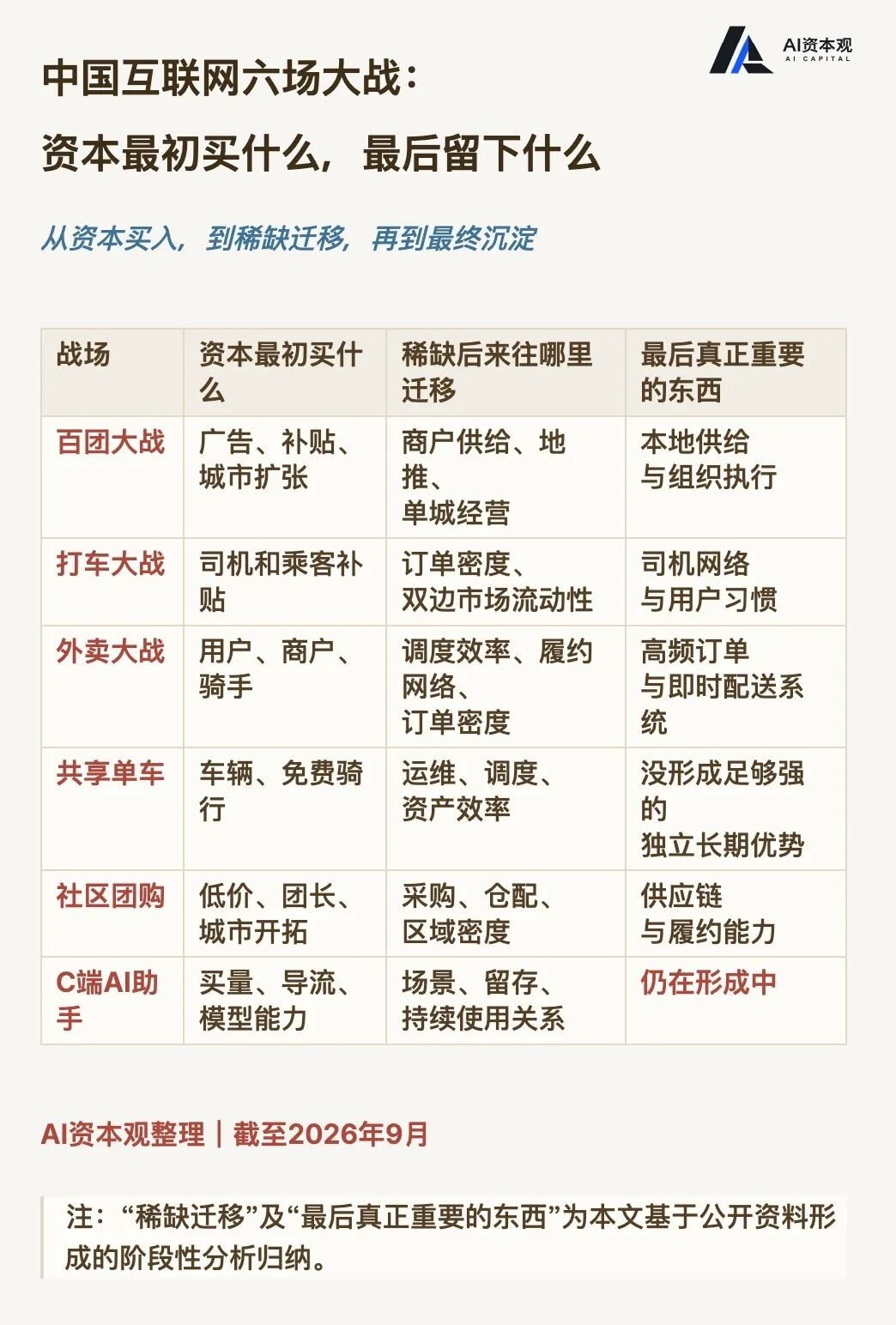
What is truly worth taking a closer look at are three of them.
In the food delivery wars, capital was indeed burned on massive subsidies, but what remained was not just user numbers. The riders, merchants, order density, delivery scheduling, and city fulfillment gradually formed a real-world production system. The money ultimately turned into a capability that was difficult to replicate in just a few months.
Shared bicycles are a different story. Capital quickly turned "whether there are bikes on the street" from a scarcity to a surplus, but the bikes themselves did not automatically become a long-term competitive advantage. The more bikes there are, the more important maintenance, scheduling, wear and tear, and capital occupation become.
Retaining assets does not necessarily mean retaining long-term competitive advantages.
Community buying has provided another reminder that having capital, traffic, and experience in waging large-scale battles, as Didi does, is not enough to automatically translate into procurement, warehousing, and supply chain capabilities in the fresh retail sector.
When the battlefield changes, what was once the most valuable may not remain so.
These wars, when considered together, make me more concerned about the recurring movement behind them.
At the outset of many wars, capital gravitates toward whatever is scarcest: when users are lacking, buy users; when drivers are lacking, subsidize drivers; when vehicles are lacking, flood the streets with cars.
But capital is not just a bystander that only discovers scarcity.
Money, once it flows in on a large scale, creates its own supply.
As what was once exclusive becomes increasingly widespread, ownership itself begins to depreciate, and competition shifts toward the next bottleneck that is harder to replicate.
What is happening here is actually a kind of scarcity migration: as capital and technology continue to expand the originally scarce supply, old advantages begin to depreciate, and competition shifts to the next more difficult-to-replicate bottleneck.
This reminds me of an issue we've been studying recently - the AI capital cycle.
The AI capital cycle is a capital-centric perspective on our long-term research into the AI industry. It examines how capital chases scarcity, expands supply, drives bottleneck migration, and ultimately alters costs, competition, and value distribution. It not only tracks where money flows, including into models, computing power, applications, and infrastructure, but also investigates how these investments are converted into revenue, cash flow, and long-term control, and who ultimately bears the risk.
There's an observation that I increasingly feel is suitable for explaining today's office wars:
Capital always chases scarcity, but capital itself constantly expands supply, pushing scarcity to the next link.
This process can be roughly divided into five steps:

The past few internet wars have only given us a set of benchmark rates, rather than answers.
What's really making today's AI office war interesting is that the same process may be happening to something that was rarely expanded like this in the past:
Intelligence itself.
Models used to be extremely scarce, and being able to train a sufficiently good large model was a ticket in itself.
However, over the past few years, capital, computing power, talent, and technological advancements have all converged on this field. Models have become increasingly numerous, powerful, and affordable.
If the scarcity migration continues, the issue will no longer be just "who currently has better AI capabilities."
What's more worth asking is:
As intelligence itself is increasingly supplied, where will the next scarcity in AI competition migrate to?
And from here on, this war took a truly divergent path from the internet wars we are familiar with.
2. As intelligence starts to become a public supply, where is the new scarcity?
The real divergence occurred in the concept of "intelligence" itself.
In past internet wars, capital could certainly be used to subsidize supply, but many core capabilities still had to be built brick by brick by the companies themselves.
You can subsidize riders, but you can't buy a fully operational nationwide delivery network in a single quarter. You can spend heavily on advertising to acquire users, but you can't simply purchase another company's supply chain, merchant relationships, and city-level operational expertise along the way.
Large models have changed this premise to some extent.
Intelligence is becoming a producible resource that can be purchased
An AI application company doesn't need to own the world's best foundation model to build great products.
The model can be invoked through API calls, switched between different tasks, and even combined with multiple models in the same product. Today, many AI office products already allow users or systems to select different models based on tasks.
This is not just a change in technical architecture, but also a change in a very fundamental competitive condition:
Intelligence is increasingly becoming a kind of production factor that can be externally procured and called upon as needed, rather than just a capability exclusively owned by a particular company.
In the past, a food delivery platform without a delivery network was nothing.
Today, an AI application may not possess the strongest model, but it can directly purchase intelligence capabilities that come quite close.
This is also why the migration of scarcity in the AI era may be happening faster than in the past.
In past internet wars, capital could turn traffic into a commodity.
In the Agent era, capital and technological progress may together turn intelligence into a standard feature.
Of course, this does not mean that models are unimportant, nor does it mean that all models will become the same.
Frontier models still determine the upper limit of capabilities and may also determine the product experience for a period of time. However, for application companies, the question has changed: how long can model leadership be monopolized?
If competitors don't have to retrain your model from scratch and can simply purchase an API or switch to a better foundation, the time window for advantages established solely through model capabilities will be much shorter than in the past.
What is truly changing is the "scarce resource" that capital is competing for and constantly eliminating.
02|For the first time, application capabilities will be proactively "depreciated" by progress at the underlying level
AI-powered offices are particularly sensitive to this shift.
Organizing dozens of documents, generating a set of PPTs, analyzing tables, operating browsers, and switching between several software programs to complete tasks - these capabilities are certainly real competitive advantages today.
But how many of these will still constitute a difference after the next round of model upgrades?
This is a very special risk of AI application.
A delivery network that an internet company painstakingly built up over the years will not suddenly depreciate just because the operating system releases a new version next month.
AI products are capable.
Functions that required specialized teams and complex engineering to achieve yesterday may become public configurations directly generated by the underlying model tomorrow, thanks to upgrades in reasoning capabilities, multimodal interactions, tool invocation, or long-context capabilities.
The company's own products have not deteriorated.
The entire industry's floor has suddenly risen.
This is a kind of capability depreciation that is easily overlooked: not server depreciation, nor amortization on financial statements, but rather the original scarce application capabilities being continuously commoditized by advances in underlying technologies.
So I'm increasingly inclined to use a simpler phrase to judge AI applications:
Model upgrades continuously raise the capability floor, and applications must build Power above the floor.
The real question this sentence is asking app companies to answer is not "whether the model is still important" but rather:
When more and more basic capabilities become public goods, what do you have left that is uniquely your own?
A new competitive layer is also beginning to emerge here.
The industry is increasingly adopting the English term "harness" to describe the Agent runtime support layer. It can be loosely understood as the system outside the model that keeps Agents functioning reliably, encompassing tools, context, task state, permissions, and validation.
The more models resemble public goods, the more naturally competition shifts to those areas.
Harness is also not a new kind of universal moat; if its capabilities can be similarly purchased, accessed, or migrated, scarcity will continue to decline.
Even old office assets are starting to shift from being "exclusive" to "on-demand"
This brings the issue to one of the most compelling perspectives in today's AI office competition:
Everyone can have models, but Feishu has documents and organizational relationships, DingTalk has enterprise systems, WPS has office documents, and Enterprise WeChat has enterprise collaboration and the WeChat ecosystem.
These old assets are of course important.
If AI is ultimately to be integrated into real work, it cannot remain confined to an isolated chat box forever.
But another thing that has happened over the past two years is that having old office assets no longer naturally means winning.
Agent is working to connect tools and data that were originally closed off within different software.
MCP - Model Context Protocol, a model context protocol - is one of the most typical examples. It attempts to provide a standard way for Agents to call external data and tools after obtaining authorization.
MCP itself is not the main character in this war.
What is truly important is the direction it represents:
Agents do not necessarily need to own all the factors of production themselves, but can also use them through interfaces.
Such attempts can already be seen in China. For example, Qianwen Office can connect to external services like DingTalk, Feishu, and Microsoft 365 through Connector. What's most noteworthy here is not the specific types of files it can search or the number of functions it can call, but rather that it proves one thing:
A new AI office product does not necessarily have to replicate an entire set of traditional office software in order to be qualified to enter that work environment.
This poses a new problem for all legacy platforms.
Much of the value of many software assets in the past came from a very simple phrase:
Others can't reach it.
Now, however, it may gradually become:
Others can use it, but they must go through my interface, my identity, and my rules.
If you want to see what this could look like one step further, Microsoft is a good reference point.
Microsoft 365 has accumulated over several decades, encompassing not just Word, Excel, and email, but also mail, meetings, Teams chats, files, personnel relationships, and organizational collaboration records.
Microsoft refers to the ability to understand these work information as Work IQ.
If following traditional platform logic, this should be locked within its own products as much as possible. However, Microsoft has chosen to further open up Work IQ as an API, allowing third-party agents to call work context within Microsoft 365 within existing identity and permission boundaries.
Microsoft has not abandoned its old assets, but is redefining how to derive value from them.
The ultimate agent that acts on behalf of users may not necessarily come from Microsoft, but it needs to understand emails, meetings, files, and organizational relationships, and may still go through Microsoft's systems.
This marks a subtle shift from the old platform logic, where the entry point had to be wholly owned.
Legacy office platforms may not just compete for the final chat box or agent — they could also retreat to a more foundational layer, becoming the work context, system records, identity permissions, or even governance infrastructure.
But this should not be taken to the other extreme.
Being interconnected does not mean being interchangeable.
An external agent being able to read a Feishu document does not mean it immediately inherits the organizational relationships, collaboration history, and permission structure within Feishu.
Being able to call up Microsoft 365's data does not mean that third-party products have taken Microsoft's place in the enterprise IT system.
Interfaces address the question of whether something can be used.
It still hasn't answered who understands better, who is more trustworthy, who can maintain a working state in the long term, who controls authorization, and where responsibility falls when problems arise.
This is also where this round of chip scarcity migration truly starts to get interesting.
On the one hand, the supply of models is increasing, and many application capabilities are being rapidly commoditized.
On the other hand, data, tools, and some context that were originally confined to office software are also starting to become producible factors that can be authorized to call.
The model may belong to one company, the agent to another, the documents and emails may be stored in a third company's system, and the identity and access permissions may be controlled by the enterprise's own IT system.
Things that were previously tied to a single app are being dismantled layer by layer.
So at this point, simply comparing models, functions, and user bases, or even who has the most complete office ecosystem, is no longer enough.
The next step is to truly answer the following question:
When models can be invoked, tools can be connected, and even part of the data and work context can be authorized for use, where has the new scarcity shifted to?
When all capabilities are being caught up with, what can possibly become the differentiator?
It is here that Power needs to be formally taken out.
The "Power" referred to in this article is not just a general term for "advantage" or a temporary lead. Rather, it is closer to a structural form of control: even if others have caught up with you, it is still difficult to bypass you, and you can even influence the rules by which others choose and act.
The concern is whether the newly emerged scarcity can settle into long-term value and control.
How to determine if an advantage has reached this point?
A very practical stress test is:
If a competitor replicates 90% of your visible capabilities, why can't users still easily walk away from you?
This is the Power Test used in this article. Rather than compiling yet another feature comparison table for Tencent, Alibaba, ByteDance, Baidu and Kingsoft, it makes more sense to put the assets commonly viewed as "moats" through the same set of questions.
First, let's downplay a few advantages that seem significant at first glance
This Power Test only asks five things:
Is it difficult for this to be rapidly scaled up in supply?
Can competitors obtain it through procurement, API, or Connector?
How high is the migration cost when users want to move away?
Will it continue to compound with use?
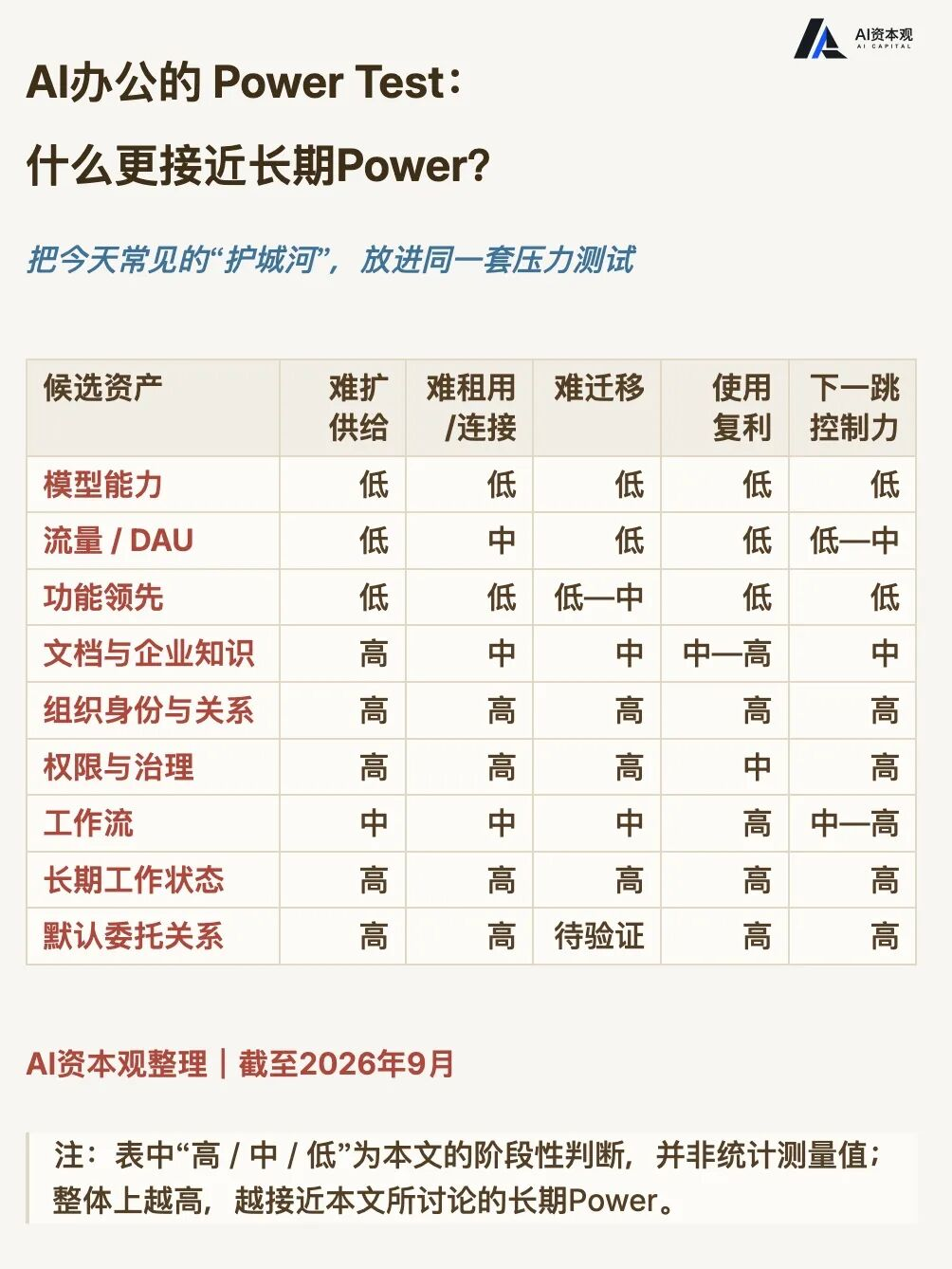
The first to be downgraded in this table is the model's capability and functional leadership.
The model fails this round of testing outright: it still determines who gets a seat at the table, but as an independently scarce resource whose supply keeps expanding, it alone cannot explain why value ultimately remains.
The same applies to functional leadership: today's impressive PPT generation, Deep Research, or browser automation may soon become the industry's minimum standard.
Traffic dynamics are more complex. Tencent has WeChat and QQ, ByteDance has Douyin and Doubao, Alibaba has its consumer and enterprise ecosystems, and Baidu still holds search, browsers, and traditional information gateways. These distribution capabilities determine who sees a new product first.
However, the cost of switching between AI products is not high. A user can simultaneously use Doupai, DeepSeek, Yuanbao, and Kimi, with switching costs far lower than relocating an entire social network or a company's business system. Traffic is still important, but it's more like controlling the first entry point. After the first task is completed, the real challenge begins: why do users come back for the second and third time?
02|Legacy office assets are becoming a different kind of problem.
Looking further down, legacy assets like Feishu, DingTalk, WeCom, and WPS are clearly far more substantial than a single product feature.
They have documents, meetings, organizational relationships, enterprise customers, permission systems, and workflows.
But the previous question has already shifted the issue to a different position:
Data can still reside in your system, but the task may be completed by someone else's AI work system.
So the most intuitive judgment in the past - "I have data that you don't, so I have a moat" - now requires asking one more question:
Can others use my data?
If the answer gradually shifts from "completely inaccessible" to "usable, but only with authorization," scarcity hasn't disappeared—it has simply moved further down the line.
Microsoft provides a comparable example overseas: it allows external agents to call work contexts while keeping identity, permissions, compliance, and governance at a lower control level. The opening up of old assets does not necessarily weaken their value, but rather may upgrade them from being exclusive to the front-end to becoming part of the system's record layer or control layer.
So, having data does not mean having the power to control how that data is used.
Feishu is no exception. The fact that external AI can read a document does not mean it suddenly has access to the entire organization; what Agent can do on behalf of users is still subject to the constraints of identity and original authorization boundaries.
This pushes the problem back another layer:
Having privileges is not equivalent to controlling who can obtain those privileges.
Agents can obtain extensive execution permissions, but the true decision-makers on the origin of these permissions, when to revoke them, whether they can be used across systems, and who is responsible in case of issues, often remain the enterprise's own identity system, administrators, and governance rules.
So, "old office assets will be revalued" is not a universal truth.
Some assets may genuinely appreciate in value because they have seized new control points.
Some assets may simply retreat from their original "exclusive foreground" to become raw materials that can be called by any agent after authorization.
What matters is no longer how much you've accumulated historically, but where those assets sit within the new technological architecture.
03|An old asset may lose its exclusivity while gaining new value at the same time
The same asset may experience two opposing events simultaneously during the Agent era.
On the one hand, open interfaces make it increasingly easy for others to call upon it, thereby reducing the exclusive value of "only I can use it".
On the other hand, if more and more AI systems must pass through it, it could instead become more foundational and stable infrastructure.
Microsoft's Work IQ is one possibility.
The enterprise identity and permission system is also a possibility.
Even office systems like Feishu and DingTalk may not necessarily need to rely on "ultimately owning that AI chat window" to prove their value in the future.
The real question worth asking is:
In the new technological structure, will old assets degrade into raw materials that can be called upon by others at any time, or will they be upgraded into a control layer that an increasing number of agents cannot do without?
This question is clearly more difficult than "who already had an office ecosystem."
It also explains why it's impossible to simply stand on the balance sheet of any existing giant to predict the outcome.
Having office software does not necessarily mean you will win.
Not having a complete set of old office software does not mean being out of the game.
Because the Agent is rearranging the positions of these assets in relation to each other.
The model, the AI office entry point, documents and business data, and identity permissions could all easily belong to different systems. What the user ultimately sees is a task result, but what lies in between is no longer a complete product chain owned by a single company in the traditional sense.
At this stage of the Power Test, several premature answers have already been ruled out.
The model is the strongest, but it's not enough.
The traffic is at its peak, and it's still not enough.
The most functionality is still not enough.
I already have a full set of office software, but it's still not enough.
These are either rapidly scaling up supply, becoming connectable, or controlling only one layer of the entire task chain.
If they really want to continue seeking even stricter controls, they will have to take it a step further.
Chase down the things that are hard to take away entirely with a single API call, hard to buy out with one round of funding, and hard to move out together after a user clicks "export" once.
In addition to context, there is also the state of work
In any discussion of AI-powered office tools today, nearly everyone emphasizes the importance of context. And that's certainly correct. An AI work system that doesn't know who you are, lacks project background, has no record of past meetings, and can't locate your files will struggle to genuinely work on your behalf.
However, the context is still too broad.
Knowing what happened in the past and knowing the current status of a task are two different things.
The former is closer to Context—context.
The latter is closer to State.
For example, I might ask an AI office system to help me research a company's competitive landscape. It has read 20 documents from yesterday and knows my research topic—that's the context.
But if I come back the next day and it still remembers which materials have been ruled out, which judgments I've rejected, which figures still need verification, why the draft stalled at this point, and what the natural next step should be—that's when it starts to approach something like a working state.
The difference is a bit like someone who has just joined a project versus someone who has been on it for three months. The former can read through all the meeting minutes from scratch; the latter knows why things have come to where they are today.
Microsoft's Work IQ has begun turning this problem into infrastructure. In addition to providing real-time work context to Agents, it also offers Workspaces that allow long-running Agents to save data, files, memory, progress, and intermediate results, eliminating the need to restart from scratch each time.
What surfaces here may be another kind of scarcity:
Work continuity.
In the past, office software emphasized that "all your data is right here."
Agentic's work system may be more worthy of attention:
Work has always been happening here.
Data can be exported, APIs can be opened up, and third-party access can be authorized.
Yet the accumulated context — why a task has reached this point, which options were rejected, what users corrected, and who the project is waiting on — may not be fully transferable through a single connector.
Only at this level does the principle that "the longer it's used, the more valuable it becomes" truly begin to take hold.
Real AI office products are not the same as a single agent. A product can contain a main entry point, workspace, orchestration layer, multiple agents, skills, tools, and different models all at once. The agents executing specific tasks can be swapped out, and so can the underlying models.
So what is truly worth asking is not:
Does the user always assign work to the same Agent?
but rather:
Which system do users long-term default to for a given type of work?
Can that system preserve state, carry over feedback, coordinate multiple agents, and pick up the work again when the next task arrives?
05 | “Continuous Delegation” Is a Strong Candidate, But Not Yet the Answer
If such a relationship can hold over the long term, what the AI work system accumulates will no longer be just a single visit.
When recurring tasks—meeting preparation, project follow-up, industry monitoring, report updates—are consistently handled within a single system, that system gradually gains a deeper understanding of the user's working patterns, correction history, past decisions, tool preferences, and permission boundaries.
This marks a stark difference from the competition for entry points in the mobile internet era.
In the past, the competition centered on:
Who should I open first?
In an agentic work environment, competition may gradually shift to:
When something comes up, which system do I default to first?
“Opening” is primarily an attention relationship.
“Hand it to you” begins to approach a relationship of entrustment.
It takes time to take shape, and it may also accumulate with continued use. It can further influence how tasks are routed: which model, which tool, or which SaaS a given job ultimately invokes may not always be re-decided by the user each time.
At this point, persistent delegation is already a strong Power candidate, but the existing evidence is not yet sufficient to define it outright as the ultimate Power of the Agent era.
The reason is that another force is also strengthening at the same time.
MCP is cutting the cost of having agents adapt individually to different tools and data sources, while A2A aims to let agents from different vendors and frameworks communicate and collaborate. The two open protocols address different problems, yet both are boosting the composability of agent ecosystems.
At the same time, enterprises are also firmly pulling identity and access management back under their own control.
Microsoft now enables enterprises to assign independent identities to agents and manage their authentication, authorization, permission scope, lifecycle, and auditing through Entra. What an agent can actually access depends not on model capability, but on the identity and authorization the enterprise ultimately grants it.
Combined, these forces will break apart many traditional lock-ins.
Companies can swap out their front-end AI products while keeping their existing Microsoft 365 data, Feishu work assets, and IAM systems intact. A work system can also split tasks across multiple different agents.
If long-term states themselves become increasingly portable in the future, the lock-in strength of "default delegation" could weaken further.
Power may not all be concentrated within a single new super app.
It is more likely to remain distributed across several layers over the long term: models supply the intelligence, the agent and orchestration layer interprets and coordinates tasks, work systems maintain state and records, the identity and permissions layer determines who can do what, and enterprises retain ultimate governance authority themselves.
These layers will compete with one another while also remaining open to each other.
The AI office war looks like the next battle for a super portal, but it may never produce one.
It's not that competition isn't fierce enough—it's that intelligence, tools, data, status, identity, and execution rights, once bundled inside a single app, are now being disaggregated across different layers.
Viewed through the lens of the AI capital cycle, this path becomes clearer: capital chases scarcity, then expands existing supply, driving scarcity to migrate. Model capabilities are rapidly being commoditized, and legacy office assets are increasingly being authorized for deployment. What's truly worth pursuing next are the things that continue to accumulate value through use, become increasingly difficult to migrate, and ultimately gain the leverage to control what comes next.
06 | Where does this war stand in September 2026?
Putting the earlier framework back into September 2026, China's AI office software sector is no longer a case of six companies crammed onto the same track, racing on features. They are now testing several distinct paths to building out their Power offerings.
1. Tencent has reached a very interesting position.
In late August, WorkBuddy began visibly strengthening its memory and evolution capabilities, long-conversation continuation, and session-state preservation. By September 2, Tencent had extended this approach further, officially launching the WorkBuddy open platform to open up underlying agent capabilities to smart hardware, industry applications, and developers, with more than 100 ecosystem partners in the initial batch.
This means Tencent is now testing two things at once: on one front, it is pushing its vast connectivity and distribution network deeper into the workplace, enabling WorkBuddy to remember exactly where a task left off; on the other, it is trying to turn its own Agent runtime into infrastructure that other applications can also use. If these two paths converge, Tencent would be competing not just for an AI office entry point, but also for ongoing delegation relationships and the Agent runtime layer itself.
2. Alibaba is a different case.
DingTalk has long accumulated organizational structures, approvals, workflows, and enterprise software relationships. Qianwen Office now integrates Skills, MCP, connectors, local files, browsers, and scheduled tasks. Scheduled tasks in particular can now operate independently of a user's immediate query, continuously invoking files, skills, and connectors to complete work. What Alibaba is attempting is to transform the original organizational processes from "data Agents can read" into "work methods Agents can continuously execute." The next thing to watch is whether these processes can further accumulate state and give Qianwen genuine task routing authority.
3. The most noteworthy thing about ByteDance is that it made an organizational choice first.
In late August, teams tied to TRAE and Coze were further folded into the Doubao system, while Feishu and Doubao's productivity roadmaps also converged. Shortly after, "Doubao Work" was officially launched.
For the first time, the personal AI entry point and enterprise collaboration assets have been visibly compressed into the same main line. But organizations merging on paper doesn't mean users' working relationships have naturally merged as well. What ByteDance is really betting on now is whether the personal AI relationships Doubao has already built can cross that threshold and enter the organizational work relationships carried by Feishu.
4. Kingsoft, for its part, is directly turning a hypothesis we raised earlier into a product.
WPS Lingxi will begin strengthening project spaces, document spaces, and long-term tasks starting in August, so that materials, conversations, and cloud documents are continuously retained around the same project. In the past, WPS's hardest asset was "your files are always here." Now it is trying to take the next step—your project is always here, continuing on. The metric that will truly matter going forward is not how many project spaces have been created, but whether this state and modification history will ultimately create switching costs.
5. Baidu, by contrast, is best suited for a reverse test.
On August 27, Baidu Dazi launched 15 industry suites and 96 professional skills in one go, explicitly steering its focus toward specialized roles such as finance and accounting, business and legal affairs, product development, and operations and HR. Lacking the deep traditional office software foundation that Feishu, DingTalk, and WPS have built, it chose to sidestep the frontal battle of "rebuilding an Office suite" and instead bet its scarce resources on professional work methodologies and the quality of task delivery. If this path proves viable, it would demonstrate that legacy office assets are not the only ticket into the next generation of work systems.
6. If this route is pushed further toward the AI-native end, Kimi is a more typical example.
Kimi Work did not inherit a traditional Office empire, yet it is organically growing its own project folders, conversation branches, Agent browser, runtime permissions, skills, and plugin ecosystem. It is attempting to grow from task execution into a full work environment. The most significant thing to watch here is whether these Agent-native capabilities can ultimately crystallize into stable State and default delegation—rather than remaining a set of useful features that the next generation of models could easily match.
So by September 2026, at least three paths to power in China's AI office sector are being tested simultaneously: some are turning legacy office assets into agents, others are pushing super-entrances deeper into the workplace, and still others are trying to build new working relationships in reverse, starting from AI-native task execution. Players like ByteDance are even straddling two paths at once.
No route has yet proven itself a sure winner.
As they advance, they are increasingly colliding with the same scarce resources: work status, ongoing delegation, identity permissions, and the routing authority that determines where models, tools, and services flow.
This track has already reached a user base in the hundreds of millions. According to QuestMobile, the AI efficiency office segment recorded roughly 102 million monthly active users in July 2026, with usage frequency up 112.4% year over year. That signals this is no longer just early adopters experimenting. But scale alone only tells us who captured the entry point faster; rising usage frequency, on its own, still doesn't prove who has built real Power.
The real watershed moment may only arrive once these users begin leaving their work behind.
From this point forward, we will focus on five signals:
Does prolonged use of one system create real switching costs? When moving to a new AI work system, how much project status, historical decisions, correction records, and work habits are actually lost?
How deep will third-party AI access to legacy office assets go? Will it only read, or will it also write at high frequency, execute transactions, and even bypass the front-end of the original office product?
Who ultimately gets true routing authority? Once users hand off a task, should they still have to pick models, tools, and SaaS every time?
Where does ultimate control over identity, permissions, and governance reside? AI work systems, office platforms, enterprise IAM — or the enterprise itself?
Will the value capture model continue to shift? Will enterprise payments move beyond seat-based licensing and software subscriptions toward tasks, outcomes, agent invocations, work status, or governance capabilities?
A material change in any of these issues could force us to revise our current assessment.
So this remains merely an interim study as of September 2026.
If you're working on AI office tools, enterprise agents, or enterprise IT, I'm especially curious to know: which things that look "rentable and migratable" today actually can't be moved at all inside real enterprises? And which things are currently treated as moats but are already starting to be bypassed?
We particularly welcome materials that prove this article's judgment wrong.
(End)