A team of 104 developers has released a major update to OpenClaw, the world's most popular open-source AI assistant, equipping AI agents with an operating-system-grade task control panel for the first time. The new capability lets AI manage itself, prioritize tasks, and decline requests, signaling the start of the next phase in the agent race.
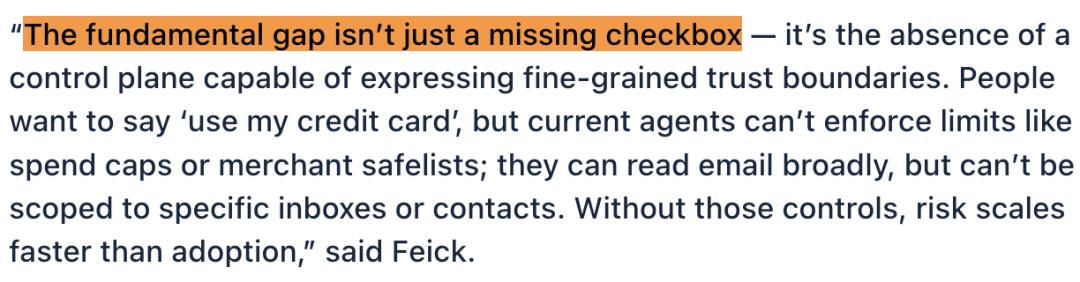
A month ago, Alexander Feick, an expert at cybersecurity firm eSentire, made a remark on The New Stack that has long troubled the AI agent community:
OpenClaw's most fundamental gap is not a missing checkbox but the absence of a control plane capable of expressing fine-grained trust boundaries.
https://thenewstack.io/openclaw-github-stars-security/
Feick issued the warning after seeing OpenClaw's adoption far exceed normal levels.
His subtext was clear: the more capable your AI assistant, the more dangerous it becomes, because no one can truly control it.
At the time, OpenClaw had just set a record, going from zero to 250,000 GitHub stars in about 60 days and overtaking React's decade-long accumulation to become the most-starred software project on GitHub.
But challenges followed: an AI agent platform without a scheduling kernel or permission controls will crash harder the faster it runs.
The missing "control panel" issue that Feick mentioned has just been resolved.
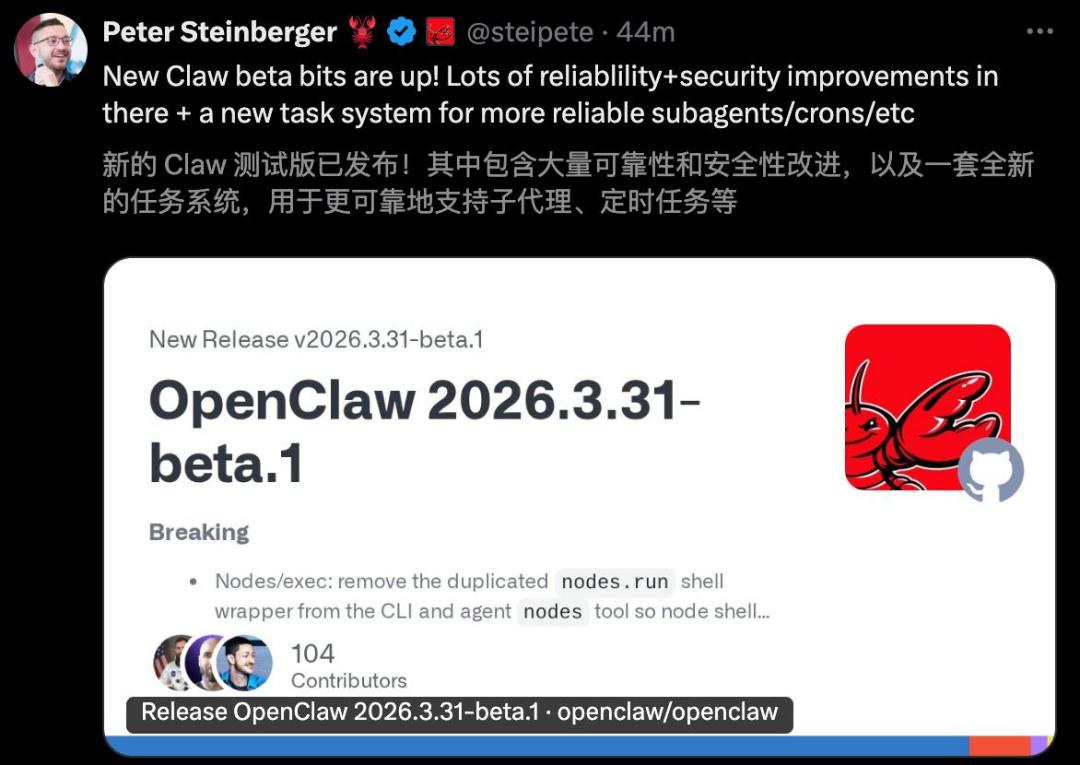
OpenClaw founder Peter Steinberger (@steipete) announced on X the release of OpenClaw v2026.3.31-beta.1.
https://github.com/openclaw/openclaw/releases
This release marks OpenClaw's background task scheduling evolving from scattered bookkeeping to a unified control plane.
The ambition behind SQLite: a background task control plane takes shape.
Before this update, how did OpenClaw's "background tasks" work?
In reality, they had barely worked at all.
Previously, OpenClaw's background tasks were merely an accounting tool at the ACP (Agent Client Protocol) layer.
Subtasks complete but their results may fail to locate the parent session; cron jobs and CLI background executions operate independently; if a task crashes mid-run, recovery mechanisms are effectively useless.
In this release, v2026.3.31-beta.1 takes a major step: it unifies all four execution types—ACP, subagent, cron, and background CLI—onto a single SQLite-backed task ledger.
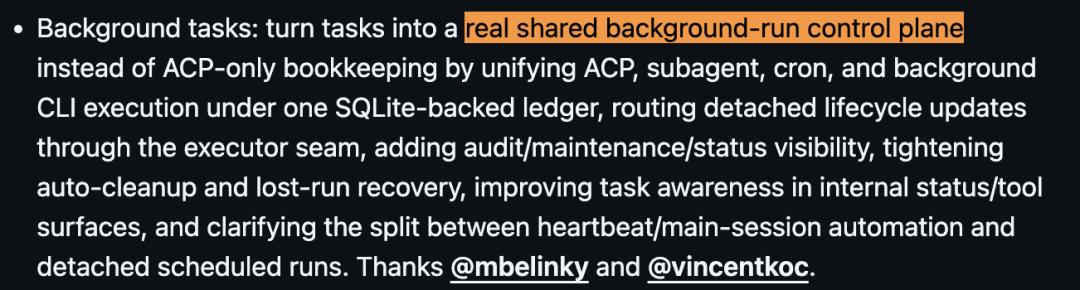
This delivers upgrades in several key areas:
First, all background tasks now benefit from unified lifecycle management. Heartbeat monitoring, automatic recovery of lost tasks, auditing, and maintenance are all built in.
Second, a task-flow registry is introduced. Developers can now use 'openclaw flows list|show|cancel' to view and control task flows. Multi-task orchestration gains a 'parent record' concept, replacing scattered 'orphan processes.'
Third, blocked tasks can persist their blocked state and be retried cleanly on the same flow, rather than fragmenting into new tasks.
Subtask results can now be traced back to the parent session: after an agent completes a complex background task, it knows exactly which conversation thread to report to.
More importantly, this is not merely a feature enhancement.
Kubernetes unified container scheduling onto a single control plane, and OpenClaw is doing something very similar: consolidating four distinct background execution paths onto a single SQLite ledger.
The difference is that Kubernetes schedules containers, while OpenClaw schedules AI agent tasks.
The founder warns that an upgrade is advisable sooner rather than later.
This release includes six breaking changes, four of which are directly security-related.
The most significant: ACP's dangerous tool approval mechanism has been rewritten.
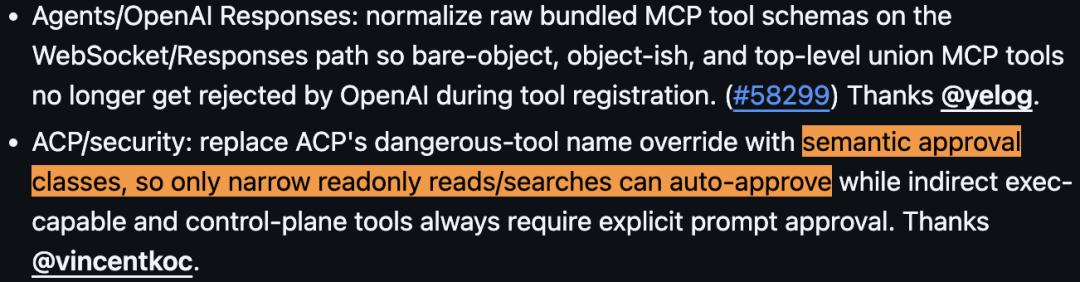
The previous logic was based on tool-name overrides: adding a tool name to the whitelist automatically granted approval.
The problem is clear: a tool named 'read_file' could carry the ability to indirectly execute code, with the name masking the true risk.
Approval is now based on semantic categories: only narrow-scope read-only operations, such as search and read, can be auto-approved. Tools with indirect execution capabilities and control-plane tools all require explicit user confirmation.
The change targets the ACP approval chain, not a system-wide switch of OpenClaw's approval process, but it closes the biggest privilege loophole to date.
That's not all.
Plugin installation now defaults to fail-closed: if the built-in security scan finds dangerous code, the installation fails immediately.
Want to force it anyway?
You'd have to manually add the deliberately long parameter: dangerously-force-unsafe-install.
Gateway authentication is broadly tightened: trusted-proxy no longer accepts mixed shared-token configurations; node commands remain disabled until pairing approval is granted; node-triggered tasks are limited to a reduced trust surface.
Other fixes in detail:
Blocks request-level environment variables from overriding Docker endpoints, TLS trust roots, Python package indexes, and compiler include paths; closes approval bypasses via caffeinate and sandbox-exec; detects inline eval in command carriers such as awk, find, xargs, and make...
Contributions from AntAISecurityLab are scattered throughout the changelog, covering path-resolution races, early rejection of image bombs, cross-origin redirect cookie leakage, and sandbox symlink escapes — each one an attack surface uncovered in real-world engagements.
Steinberger stressed repeatedly when releasing the beta: "This update is mostly security hardening, so you really should upgrade ASAP."
Multimodal and multi-platform capabilities are surging, extending the reach of global agents.
Beyond the skeleton and nervous system, there are also "muscle" changes, mainly updates to channel coverage.
They point to a clear signal: OpenClaw's agent tentacles are extending globally.
One change is the official addition of QQ Bot as a bundled channel plugin.

It supports multi-account configuration, SecretRef credential management, slash commands, reminders, and media sending/receiving.
The WhatsApp update looks minor, but its design intent is intriguing: agents can now react to messages with emoji — a ❤️ instead of typing out a text reply.
This brings chatbot conversations closer to natural dialogue.
Matrix added streaming responses: some replies now update the same message in place instead of sending a new message for each chunk.
LINE now supports sending images, videos, and audio.
Microsoft Teams added Graph-backed member information lookup.
Plus a full set of CJK fixes.
Context truncation finally no longer underestimates the length of Japanese and Chinese Extension B characters.
In-memory search now includes trigram tokenization and short CJK substring fallback.
The sandboxed browser now has fonts-noto-cjk installed: CJK text in screenshots is no longer rendered as tofu blocks.
TTS automatically detects CJK-dominant text and switches to Chinese speech.
Markdown rendering fixes an issue where bare links swallowed adjacent CJK characters.

The cumulative effect of these small fixes shows OpenClaw evolving from an English-speaking developer's hobby project into a global multilingual infrastructure.
It is no longer chasing GitHub Trending but has set its sights on the broader global market.
Behind its 343k stars, OpenClaw is channeling breakneck growth into an institutional framework.
Beyond the technical details, one number stands out: 104 contributors took part in this beta release.
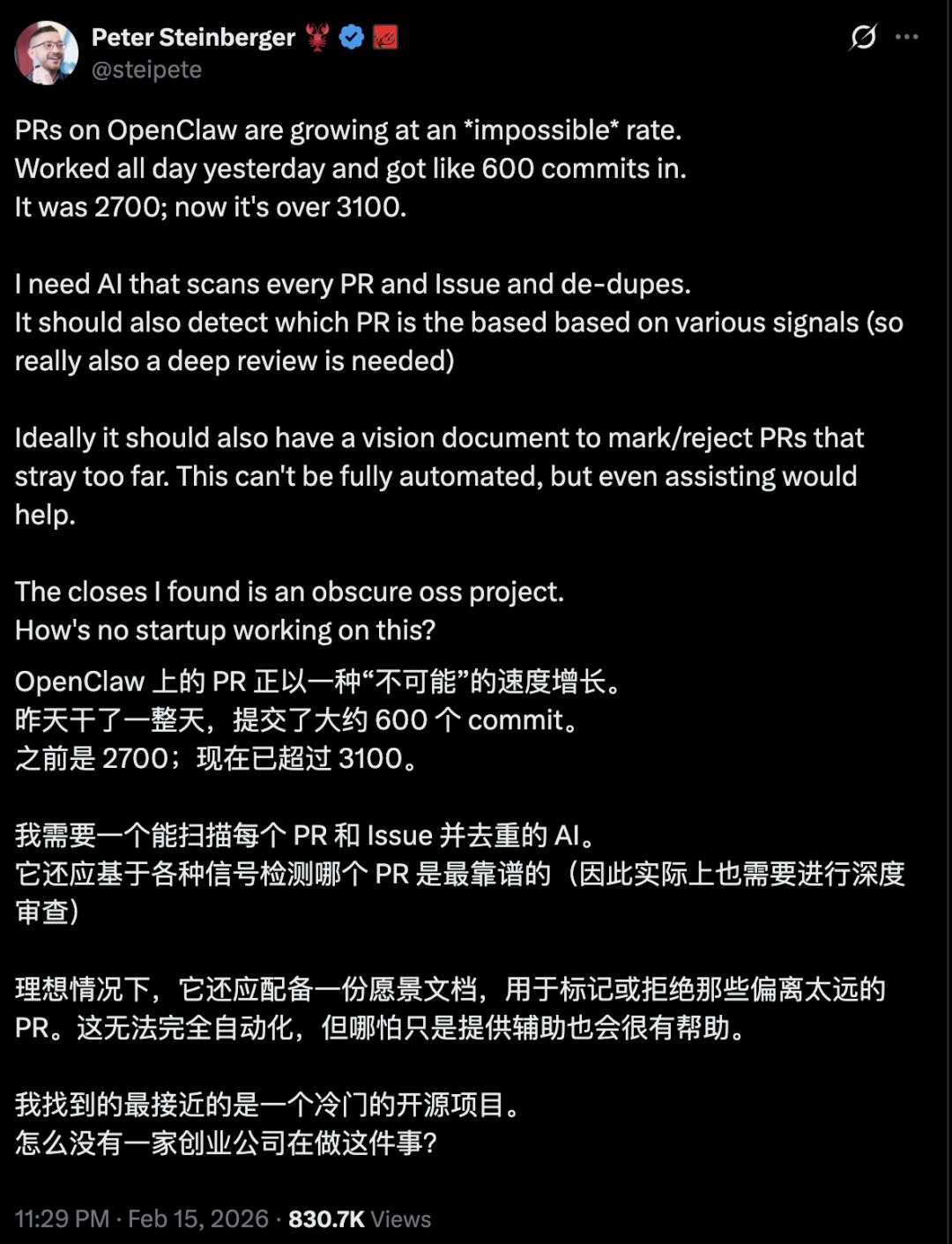
Steipete previously tweeted about the 'happy problem' OpenClaw faces:
Pull requests grew at an unsustainable pace—about 600 commits in a single day—prompting him to use AI to scan and deduplicate every PR and issue.
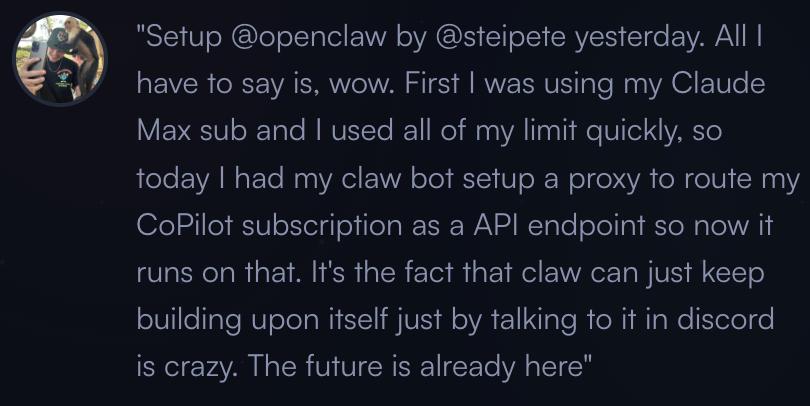
User jonahships_ said: "Claw can continuously build new capabilities on top of itself; you just need to talk to it in Discord. The future is already here."
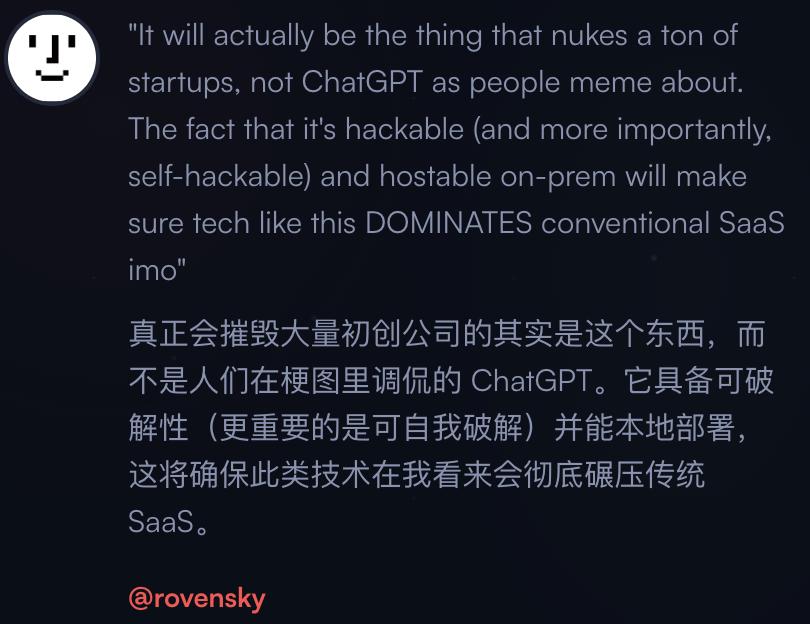
User rovensky's assessment is sharper: OpenClaw is what could actually wipe out a large number of SaaS companies.
This is what will truly kill a host of SaaS startups — not ChatGPT. Because it can be hacked, and more importantly, it can self-hack, and it can be deployed locally. That will crush traditional SaaS.
On the data side: As of March 2026, 172 startups have built products on the OpenClaw ecosystem, generating monthly ecosystem revenue of $361,000.
ClawHub's skills marketplace has grown from 5,700 skills in early February to 13,729. Monthly visits are 27 million, with 2 million monthly active users.
Beneath the buzz, however, security concerns are mounting.
More than 5,000 open issues. The review pressure of 3,100 commits a day. A Meta executive's agent accidentally deleted an entire mailbox. A computer science student found his agent had created a profile on a dating site on its own. Security researchers have disclosed zero-click hijacking vulnerabilities...
There is no doubt that the open-source community's pace has outstripped any company's product iteration cadence. If speed loses order, it will be a disaster.
The v2026.3.31-beta.1 mission-control plane and security tightening are, at their core, an architectural move to channel this unbridled growth onto an institutionalized track.
The wave of technology democratization
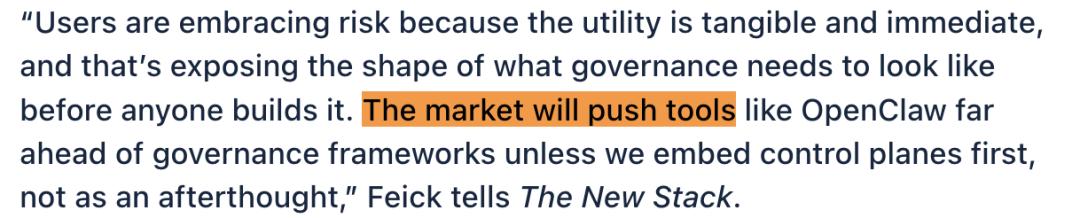
A month ago, Feick warned that the control plane should be embedded in tools like OpenClaw, rather than bolted on afterward.
The market will push tools like OpenClaw far ahead of governance frameworks — unless we embed the control plane into them, not treat it as an afterthought.
The v2026.3.31-beta.1 upgrade is a direct response: it embeds the first AI mission-control plane into the governance system for AI agents.
The background task-control plane solves scheduling; ACP semantic approval tightens permission controls; multi-channel capabilities keep expanding. Together, these three developments show OpenClaw's governance capabilities have been substantially strengthened in this version.
In project-history terms, OpenClaw surpassed React's decade-long GitHub star count in 60 days.
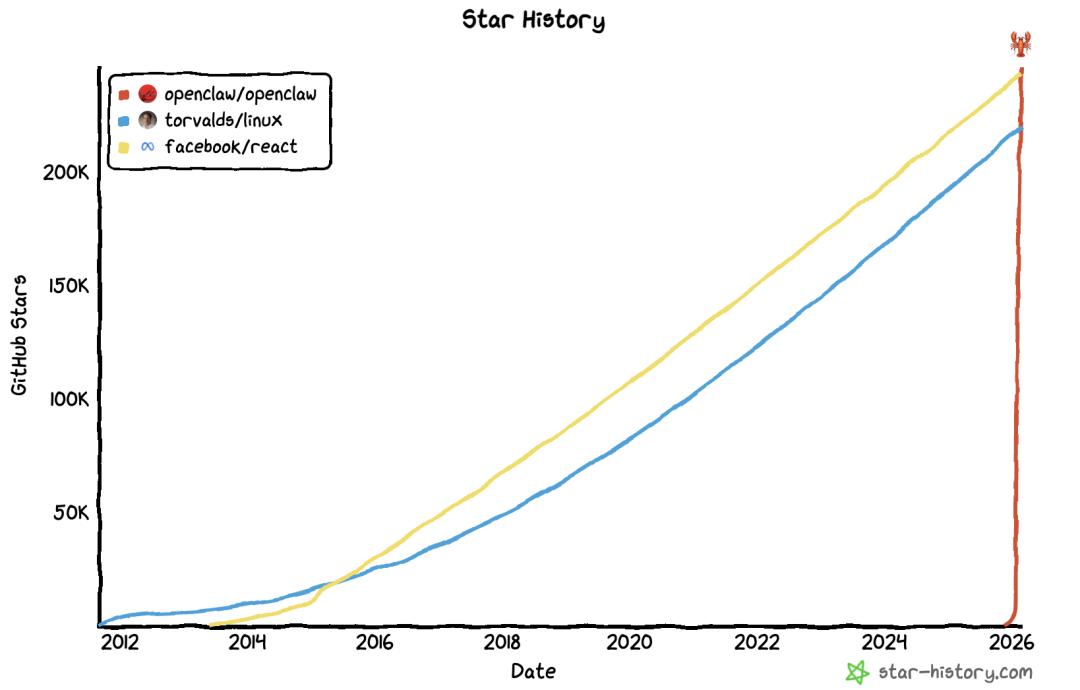
This update means OpenClaw is moving from its 'viral' phase into an 'infrastructure' phase.
In just two months, an open-source community has spontaneously built the first task-control plane for AI agents, rewriting the industry's rulebook.
How to define a product was once the province of product managers at big companies.
Today, that question is being taken over by more global contributors on open-source communities like GitHub.
A trend toward technology democratization is arriving with the AI wave, more forcefully and irreversibly than ever.
References:
https://x.com/steipete/status/2039076488897876462?s=20