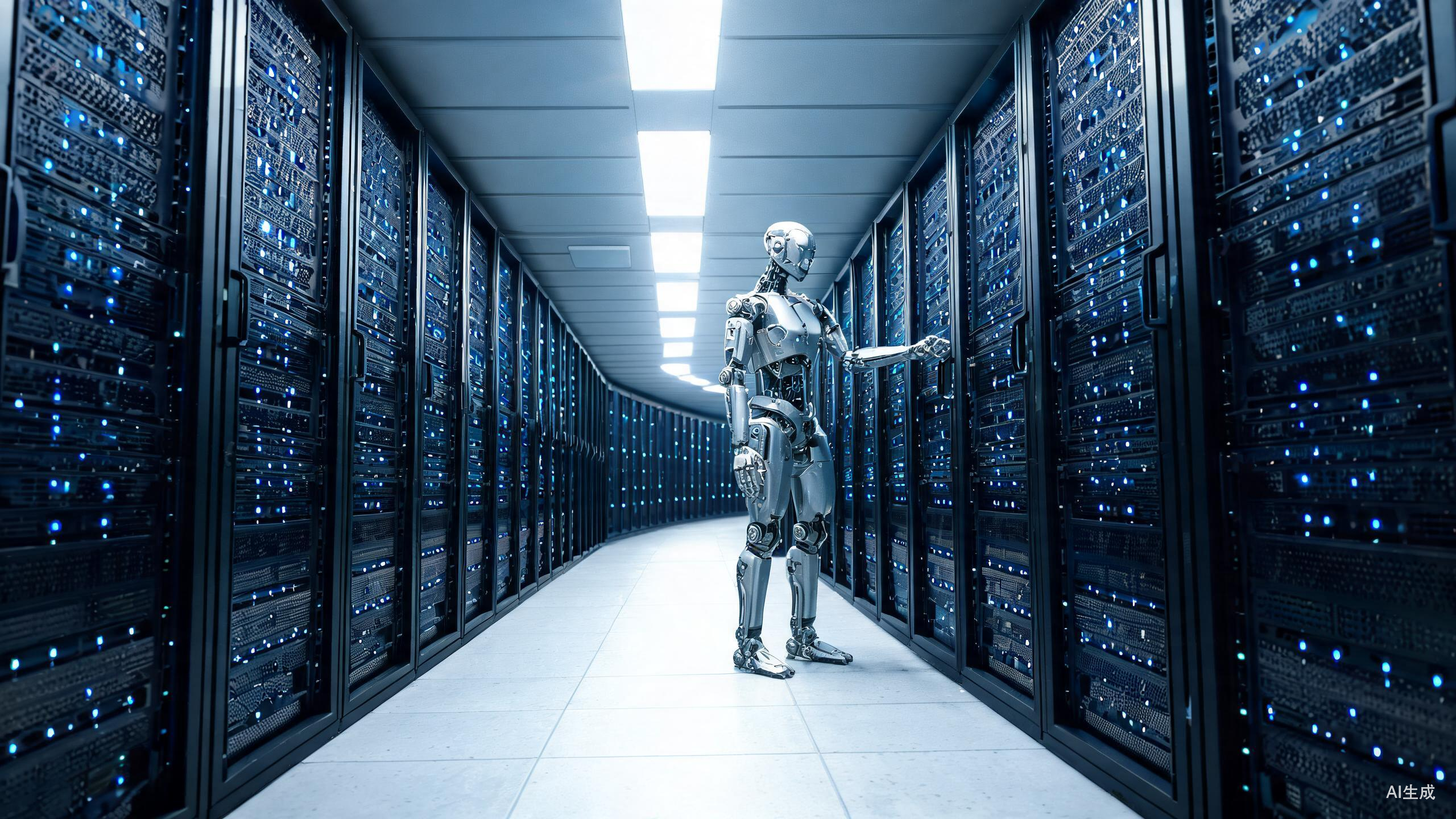
OpenAI is no longer content with just being the "brain" of robots.
On September 2, local time, OpenAI CEO Sam Altman explicitly stated for the first time in the "Sources" podcast that OpenAI will develop humanoid robots in-house.
When asked by the host if OpenAI would develop humanoid robots, Altman gave a fairly direct response: "We will definitely do humanoid robots, as well as robots in other forms."
This statement has basically put an end to the prolonged speculation from the outside world. In the past few years, OpenAI has appeared more as a model provider and investor in the robotics industry; now, it has decided to reach out to the robotics entities themselves.
Altman explained that OpenAI chose a humanoid form not to make robots look more like humans, but because the real world is built around the human body.
Door handles, staircases, keyboards, kitchens, cars, and the vast array of machinery in factories are all sized and operated with humans at the center. Rather than redesigning the entire physical environment, it makes more sense to give robots bodies that approximate the human form.
"This world is largely designed for humans," Otman said, as human-shaped structures are more adaptable to the world that humans have already built, whether it's opening doors, using computers, operating equipment, or cleaning kitchens.
However, this does not mean that OpenAI's first robot will directly enter ordinary households.
Altman explicitly stated that home companion robots are not the most important thing at this stage. OpenAI is more focused on industrial infrastructure in the short term, particularly robots that can assist skilled workers in building and operating data centers. In such scenarios, robots do not necessarily have to be humanoid. Altman revealed that OpenAI will also develop specialized robots for data centers, with different body structures adopted for specific tasks.
As for what robots will ultimately look like, he believes that is not the most crucial issue. "What's truly important is figuring out how to create the 'brain' that makes robots work."
This is also the part that OpenAI is most familiar with.
Six Years After Leaving the Stage
Now Back Again
OpenAI is not the first time to research robots.
As early as 2017, OpenAI began exploring how to enable robots to transfer capabilities learned in virtual environments to the real world. In 2018, its robotic hand Dactyl was able to autonomously rotate blocks; in 2019, OpenAI trained a robotic hand to solve a Rubik's Cube with one hand, which became one of the most notable projects in the field of robotic reinforcement learning at the time.
But around 2020, OpenAI halted research by its original robotics team.
The reason is not complicated: there is too little data.
Language models can obtain vast amounts of text from the internet, and visual models can learn from pictures and videos, but the action data needed for robots is both expensive and scarce. Every grasp, walk, and operation involves friction, weight, collision, and error in the real physical world, and training speeds are far slower than those of pure digital models.
OpenAI then focused its resources on large language models and launched ChatGPT at the end of 2022.
Six years later, the situation has changed.
Multimodal models can now understand text, images, videos, and sounds simultaneously; video generation models are learning object movement and basic rules of the real world; simulation, synthetic data, and remote operation training methods are also rapidly maturing. The data problem that previously limited robot development, although far from being solved, has seen new breakthrough paths emerge.
OpenAI is also rebuilding its comprehensive robotic capabilities.
OpenAI's official website is currently recruiting engineers in multiple directions, including robot software, electrical, firmware, and product security. The job responsibilities already cover circuit design, PCB, sensors, embedded systems, robot control, data acquisition, fault handling, and mass production preparation.
Among them, some robot-related positions have a annual salary of up to $445,000, in addition to equity. These job postings indicate that OpenAI's ambitions go beyond a general model that can interface with different robots, to a comprehensive robot system consisting of models, software, and hardware.
Doubao Invests in Robotics
ByteDance Ventures into Building Robots
Before deciding to develop in-house, OpenAI had attempted to enter the physical world through investments and collaborations.
In 2023, OpenAI led a $23.5 million funding round for humanoid robot company 1X. 1X subsequently launched the humanoid robot NEO, targeting home scenarios, with the goal of bringing robots into ordinary people's living rooms and kitchens.
In 2024, OpenAI participated in Figure's $675 million financing and signed a cooperation agreement with the company, planning to integrate OpenAI's multimodal model into Figure's humanoid robots. The two parties subsequently showcased a video of a robot recognizing objects on a desk, conversing with a person, and handing over an apple.
However, this cooperation only lasted for about a year.
In February 2025, Figure founder Brett Adcock announced the termination of its partnership with OpenAI, opting instead to develop a fully in-house end-to-end robotic model, and subsequently introduced the Helix model, further emphasizing the need for robotic hardware and artificial intelligence to be trained together in tandem.
By 2026, Adcock stated more directly that Figure and OpenAI will be competitors.
With the recent confirmation of its first self-developed humanoid robot, Otman, OpenAI's role has changed: it is no longer just standing behind robotics companies providing models, but is instead preparing to directly enter the arena.
This also means that in the future, OpenAI will not only be facing competition from large model companies such as Anthropic, Google, and Fantasia Quantization, but also from robot companies that have entered the stage of integrated machine research and development and delivery, including Tesla Optimus, Figure, 1X, as well as companies like Yu Shu Technology, Ubitus, and Zhiyuan Robotics.
What OpenAI Truly Wants
Doubao is the 'Entrance to the Physical World'
Humanoid robots are becoming the next key battleground for major artificial intelligence companies.
The reason is not hard to understand. Currently, large models mainly exist in mobile phones and computers, capable of writing articles, generating code, and processing files, but they struggle to directly change the physical world. Once models possess a body that can walk, grasp, and manipulate objects, artificial intelligence can truly enter factories, warehouses, data centers, and homes.
For OpenAI, robots could become an even larger entry point than ChatGPT.
Its advantages are extremely obvious: it has the world's leading multimodal model, sufficient computing power, capital, and a large user base, and also has the ability to manufacture training data through simulation and generative models.
However, the shortcomings are equally apparent.
Humanoid robots are not just scaled-up versions of ChatGPT. Joints, motors, gearboxes, sensors, overall heat dissipation, real-time control, and safety redundancy all require long-term accumulation. Making a robot complete a task in a demo video is not difficult, what's difficult is having it work continuously for several hours, remaining stable in unfamiliar environments, and having a low enough cost.
Tesla, Figure, Unitree, Zhiyuan, and other companies have already spent years operating in hardware, supply chains, and real-world environments. OpenAI possesses a powerful "brain," but whether it can build a reliable, flexible, and mass-producible "body" remains an open question.
So far, OpenAI has not announced the name, appearance, technical specifications, prototype, or mass production schedule of its humanoid robot. Altman's statement represents a strategic direction and does not mean the product is close to being released.
But this statement of position still matters.
Otman once said he hoped that in the future, everyone would have a personal robot to do the work that people are unwilling to do. Now, OpenAI has taken a more explicit step towards this goal.
ChatGPT has brought OpenAI into hundreds of millions of computers and smartphones, and next, it aims to enter factories, data centers, and eventually every home.