On August 31, Hisense officially launched the industry's first family intelligent companion-level AIOS, Hisense JUOS. The system is designed for the entire family scenario, natively supporting multiple terminals such as TVs, projectors, and smart home appliances. It is equipped with the self-developed Xinghai large model and four native engines, using "Super Xiaozhu" as the system-level AI carrier, completing the reconstruction of the underlying family AI interaction, achieving a generational leap from passively responding to individual instructions to actively serving the needs of the whole family.

Hisense JUOS Completes Family AI System Overhaul
Current mobile and automotive operating systems have matured, but a true AIOS system designed with "family" as its core concept and tailored to family scenarios remains a gap in the industry. After pioneering and mass-producing RGB-Mini LED TVs worldwide, driving displays into the native true-color era, Hisense is extending its innovation boundary from display hardware to underlying AI systems.
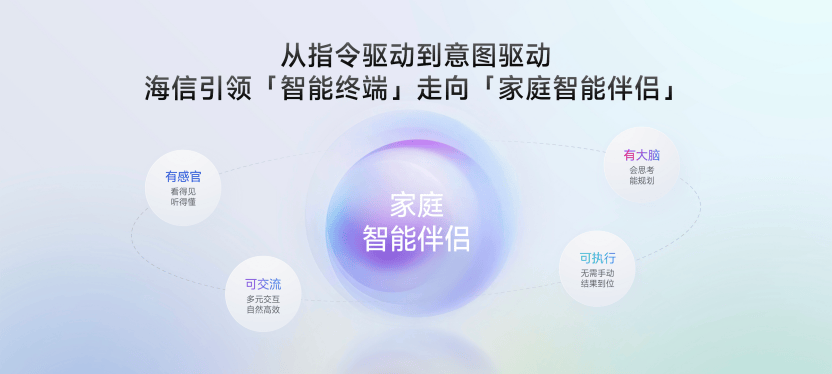
Hisense Visual Technology President Li Wei said at the press conference that personal AI focuses on understanding individual needs, while family AI needs to recognize different family members and understand the diverse scenarios within a family. Based on this insight, Hisense JUOS relies on the super small cluster system and AI capability carrier to drive family AI from a smart terminal that waits for instructions to an intelligent family companion that has senses, a brain, can communicate, and can execute tasks.
Hisense JUOS Upgrades Core Experiences with 'Simple, yet Smarter Home' Concept
The core experience of Hisense's JUOS has been upgraded, starting with the system-level family AI intelligent entity - Chaoji Xiaoju. "All matters on the screen, just ask Xiaoju", the newly upgraded Chaoji Xiaoju creates a extremely simple TV Q&A experience, where users don't need to remember the full name of a movie to search for it. The industry-leading Xiaoju smart search can quickly find movies based on dialogue, characters, and other fragmentary clues. When watching a drama and encountering an unfamiliar character, or watching a game and not understanding the rules, users don't need to pause and search on their phone. The industry's first Xiaoju Ask Screen feature supports asking questions while watching, and responds to various questions instantly. Xiaoju's companionship is not limited to when the screen is on, as it can still tell stories, play music, and check the weather in sleep mode. At the same time, Xiaoju's chat feature can sense the user's language emotions and provide timely and appropriate responses, making technology more warm and humanized.
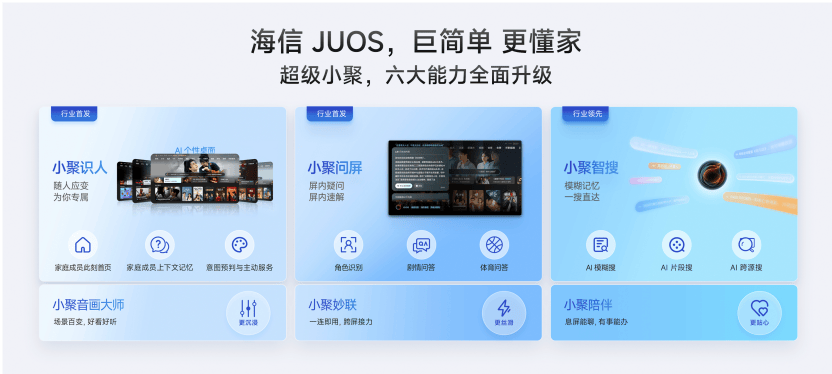
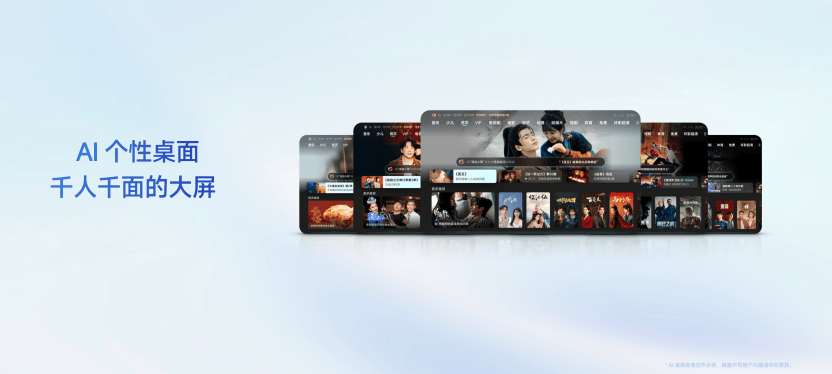
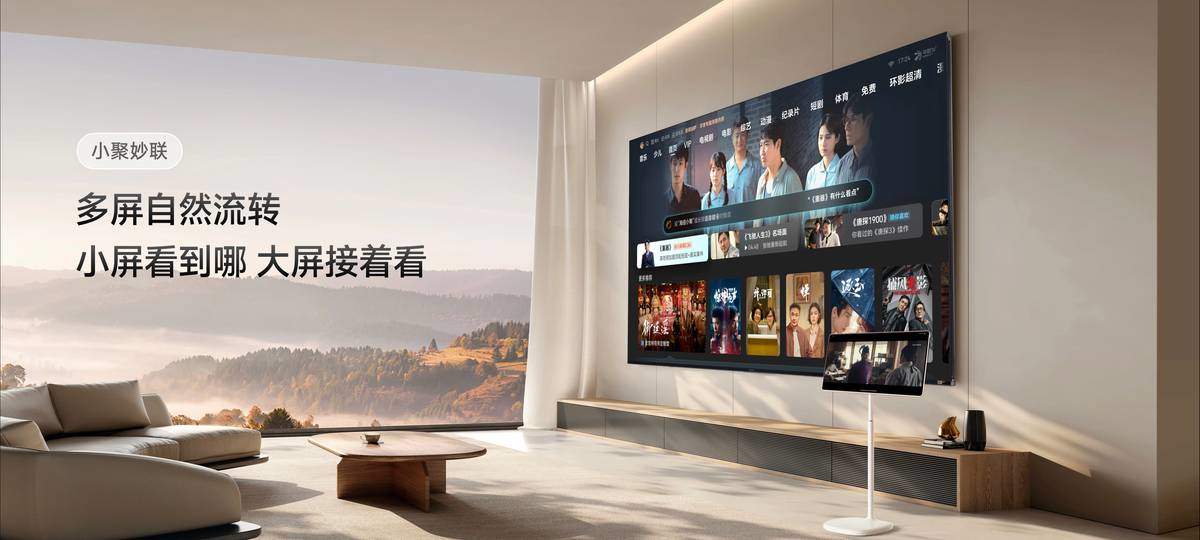
Hisense's JUOS has undergone a third transformation, focusing on achieving a seamless cross-device experience. Xiaoju's妙联 breaks down data silos between devices, enabling natural content flow across multiple screens in the home: switching from a small screen to a large TV screen in the living room, content and progress are automatically transferred and continued, eliminating the need for inefficient interactions such as reopening apps and repeatedly searching for progress. After connecting NAS, set-top boxes, and game consoles, the system automatically recognizes and matches the optimal mode for picture quality, sound, and control, allowing for plug-and-play functionality and automatic experience optimization, making cross-device home entertainment simple and smooth.
Additionally, Hisense JUOS has deeply integrated with Hisense's AiHome ecosystem, driving smart home technology from single-device control to whole-house scenario-based active collaboration. With the living room's large screen as the hub, a single voice command can activate all the devices in the house - including companion robots, air conditioners, refrigerators, and washing machines - allowing AI capabilities to extend from the large screen to daily life throughout the home.
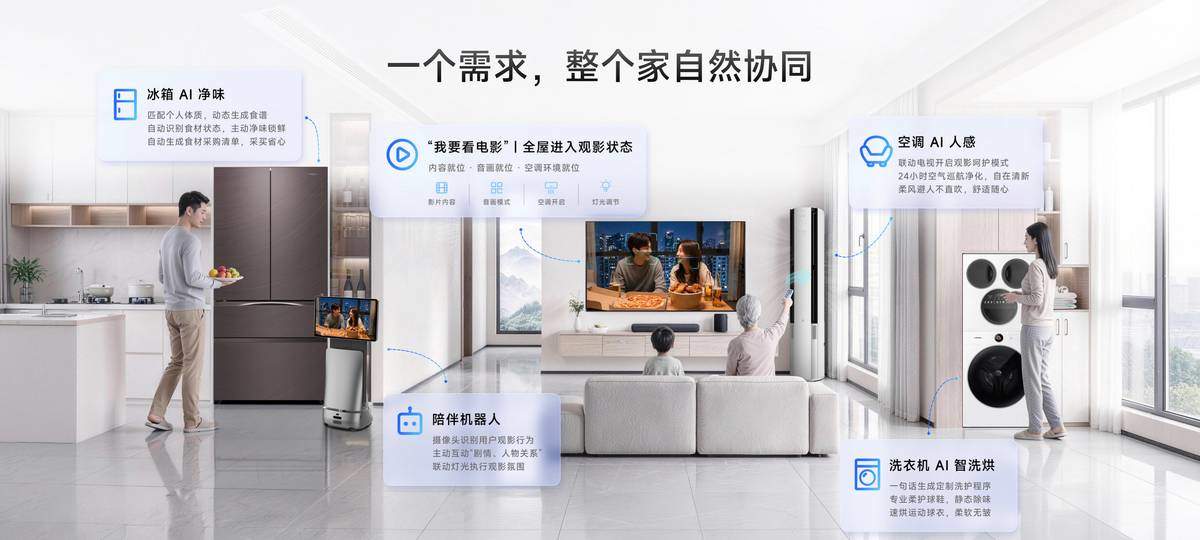
This release of Hisense JUOS will be upgraded to cover Hisense's U/E/A series TVs, laser TVs, as well as Vidda TVs and Vidda projectors from recent years, with the first batch of models receiving the update starting in September, and subsequent models will also be continuously upgraded.
Xinghai Large Model + Four Native Engines to Build AIOS Tech Moat for Home Companion-Level AI
The industry's first family smart companion-level AIOS cannot be separated from the support of the underlying technology framework. As the core foundation of Hisense JUOS, Hisense's self-developed Xinghai large model is deeply optimized for home scenarios, possessing multimodal understanding, intent understanding, reasoning planning, and tool execution capabilities, with intent recognition and tool execution accuracy rates exceeding 95%, and multimodal first-response latency of less than 175 milliseconds, and has obtained the China Information and Communication Technology Institute's large model capability 4+ level authoritative certification.
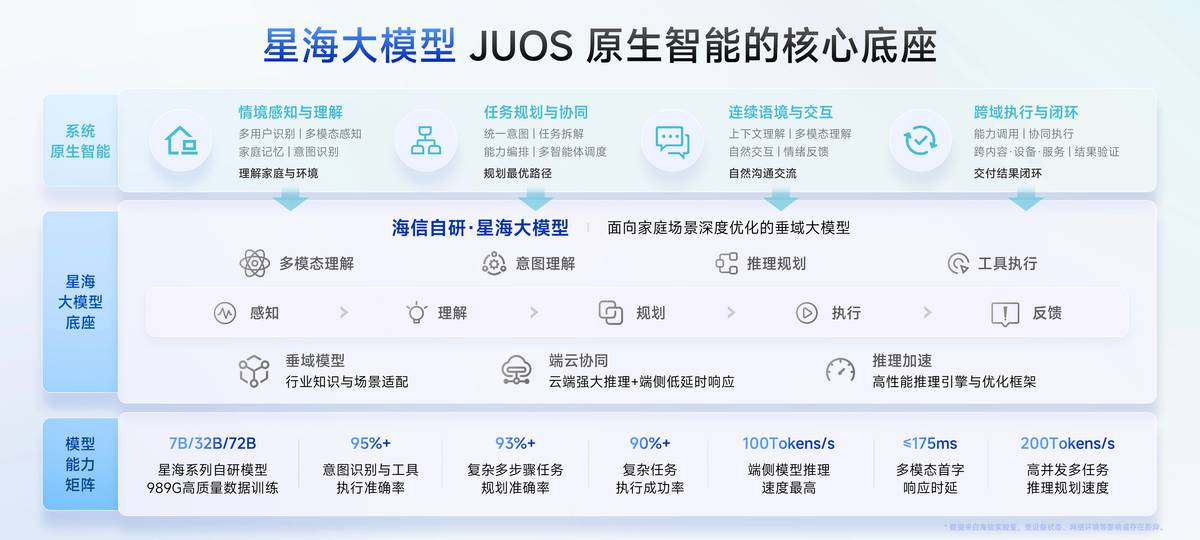
Relying on the Star Ocean large model base, the four native engines work together in coordination, giving JUOS the complete service loop capabilities of perception, brain, communication, and execution.
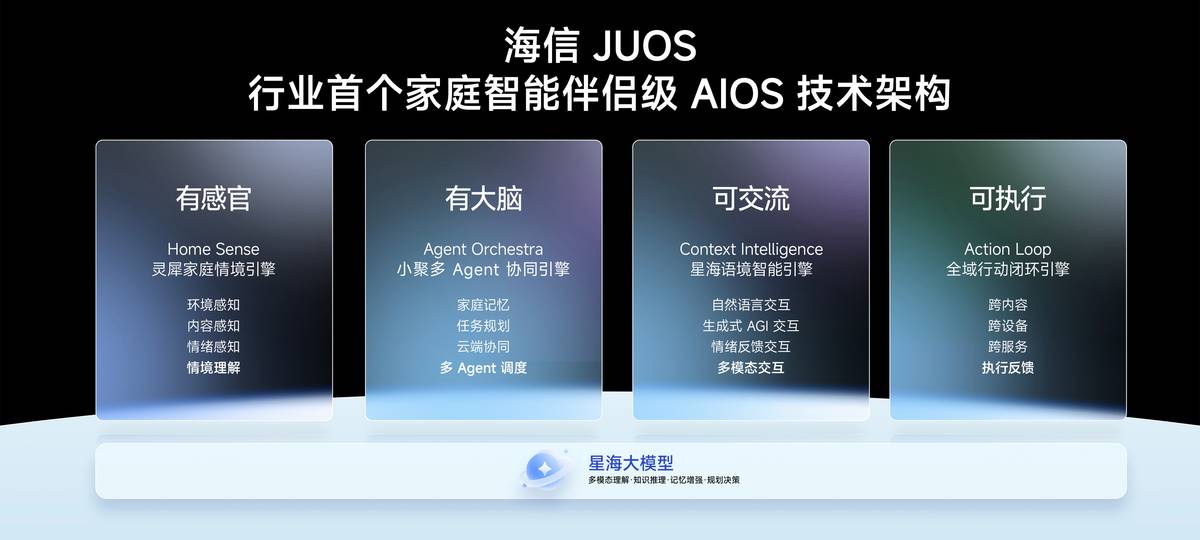
The Lingxi Family Scenario Engine brings the industry's first family multi-user scenario understanding and intention recognition capabilities, capturing environmental lighting, playback content, sound emotions, and user status in real time to provide accurate basis for proactive services. The Xiaoju Multi-Agent Collaboration Engine, with the industry's first edge-cloud collaborative multi-intelligent body collaboration architecture, completes complex task planning, cloud collaboration, and multi-intelligent body scheduling. The Xinghai Contextual Intelligence Engine, with industry-leading continuous contextual understanding and natural interaction capabilities, achieves natural conversation, generative interaction, emotional feedback, and multi-modal interaction. The All-Domain Action Closed-Loop Engine implements the industry's first large-screen AI task closed-loop execution capability, breaking the boundaries of content, devices, and services, and converting intention understanding into actual actions.
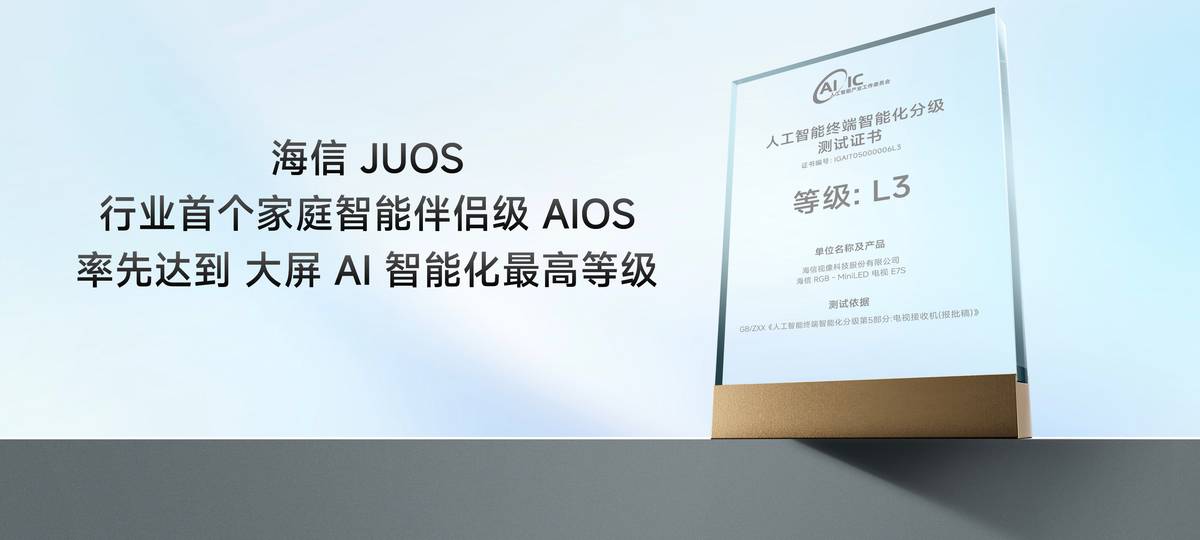
Relying on this technical architecture, Hisense JUOS has won the L3 certificate for intelligent terminal intelligentization of artificial intelligence, which is also the highest level of certification for large-screen AI intelligentization under this grading system.
Building Home AI Core Capabilities with Four-Layer Stack
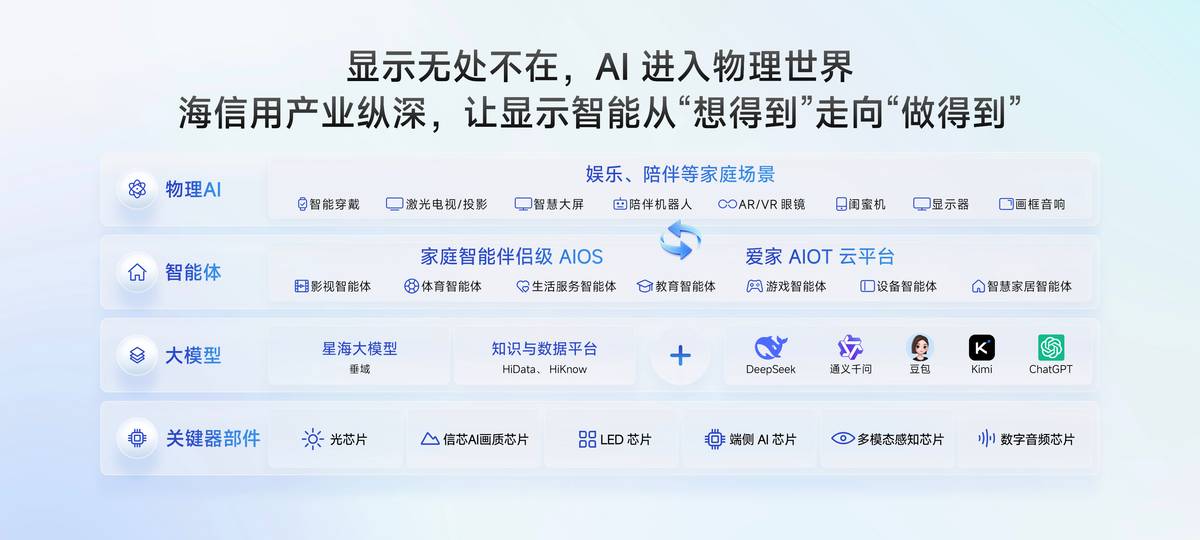
The release of JUOS marks Hisense's transition from "connecting homes" to "understanding homes". In an era where large models and display industries are deeply integrated, Hisense has broken away from the traditional thinking of stacking single-point functions within the industry, instead leveraging its complete industrial chain to build a four-layer, full-stack industrial capability framework consisting of underlying key components, large models, intelligent entities, and physical AI. This has formed a system-level barrier unique to the home AI domain: from developing a multi-category chip matrix to solidify its hardware foundation, to integrating the Xinghai vertical domain large model with a diverse model ecosystem to enhance home scene cognition, and using the home intelligent companion-level AIOS - Hisense JUOS and Hisense AiHome AIoT cloud platform to support the scheduling of intelligent entities across all scenarios. Ultimately, this connects TVs, diversified display terminals, and whole-house intelligent devices to achieve physical AI implementation.
From seeing the world to understanding a family, the more technology iterates forward, the more it should leave complex calculations to the system and simple experiences to the user. True family intelligence should never require users to adapt to technology, but rather let technology silently understand each family member and serve every daily need. Displays are everywhere, and AI makes them even better.
This article is provided by Hisense and reproduced by QbitAI with permission, with opinions belonging to the original author.