Three major events occurred in Silicon Valley last night.
Google released Gemini 3.8 Flash, Meta released Muse Spark 1.3, and Mostik, a previously little-known startup, was featured in an interview with the authoritative media outlet WIRED.
At first glance, it seems like just another ordinary night of AI dominating the charts.
Google recently propelled Gemini to the top of the DeepSWE rankings, only to be surpassed by Meta with an even higher score a few hours later, with the title of world's number one lasting only a few hours.
By 2026, people have almost become desensitized to this kind of thing.
Models are released, benchmarks are refreshed, celebrations last for several hours on X, and then the wait begins for the next company to continue refreshing them.
But if you connect these three things from last night, I think the truly noteworthy stuff isn't on those lists.
The economics of AI is undergoing a mutation.
In recent years, when discussing AI costs, the most commonly cited figure is the cost per million tokens.
However, with the emergence of Agent, this measurement method is becoming increasingly inadequate.
In the future, the truly important question may not be "how much does one million tokens cost," but rather how much it costs to fix a bug, complete a research project, or keep an agent running continuously for three hours.
And last night, the cost of inference was decreasing from several completely different directions at the same time.
Google is packing frontier-level capabilities into increasingly affordable models, Meta is enabling Agents to complete the same tasks with fewer tokens and tool calls, while Mostik is taking it a step further, questioning:
If both parties in a communication are AI, why do models still need to use human-designed languages to communicate with each other?
No translation available for PART.01 as it does not appear to be a Chinese news headline.
Gemini Returns with a Vengeance
No content to translate.
First, look at Google.
Google has released its brand-new flagship model, Gemini 3.8 Flash, which the company describes as its most powerful reasoning and code model to date.
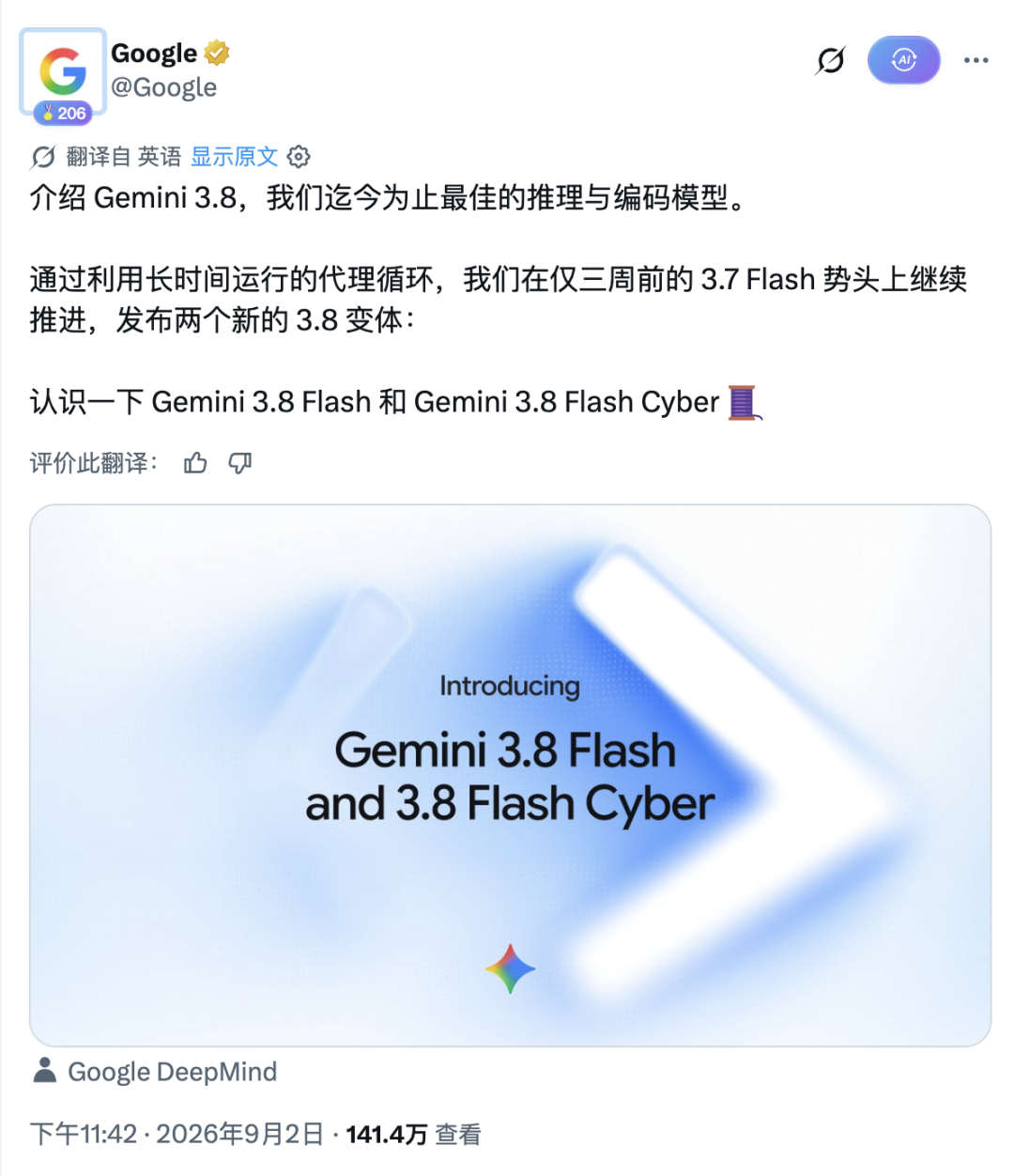
This is also Google's third update to the Flash series in six weeks, from 3.6 to 3.7, and now to 3.8.
In the past, Flash has been perceived as being very straightforward: faster and cheaper, but with capabilities that are somewhat inferior to those of the strongest models.
Google is now gradually changing this definition.
This time, the 3.8 Flash upgrade focuses primarily on enhancements to long-horizon coding and agentic workflow.
It scored around 74% on DeepSWE v1.1, which measures AI's long-cycle software engineering capabilities.
The biggest difference between DeepSWE and traditional code benchmarks is that it doesn't just give the model an algorithmic problem, but actually puts the Agent into a code repository.
The model needs to understand the problem, search the code, modify files, call tools, and run tests—and when it fails, keep digging for the root cause.
A complete task may involve tens or even hundreds of steps.
In such a test, the Gemini 3.8 Flash once ranked as the world's number one.
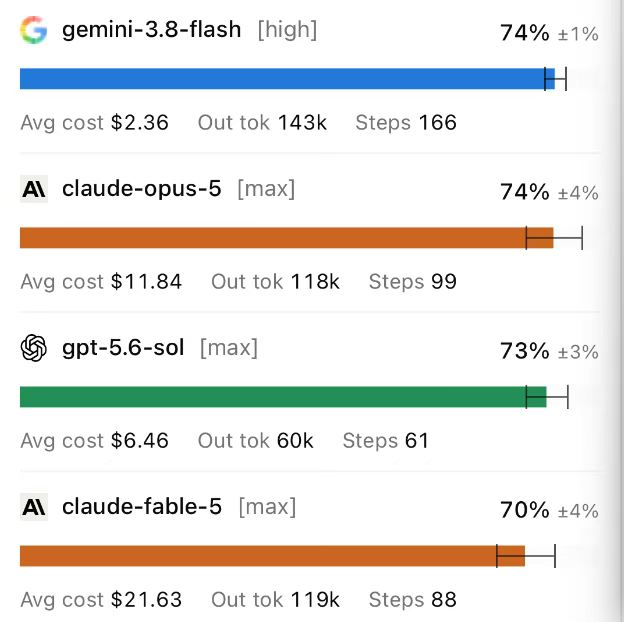
Claude Opus 5 is also around 74%, GPT-5.6 Sol is approximately 73%, while the previously leading Fable 5 is around 70%.
In terms of capabilities, the gap between these top models is no longer particularly large.
What's truly frightening is another figure: the cost.
The API launch price of Gemini 3.8 Flash remains at $0.75 per 1M tokens for input and $3.75 per 1M tokens for output.
The average cost of completing a full task on DeepSWE is only $2.36.
By comparison, Claude Opus 5, with a similar score of roughly 74%, carries an average cost of $11.84 per task, while GPT-5.6 Sol, at about 73%, averages $6.46.
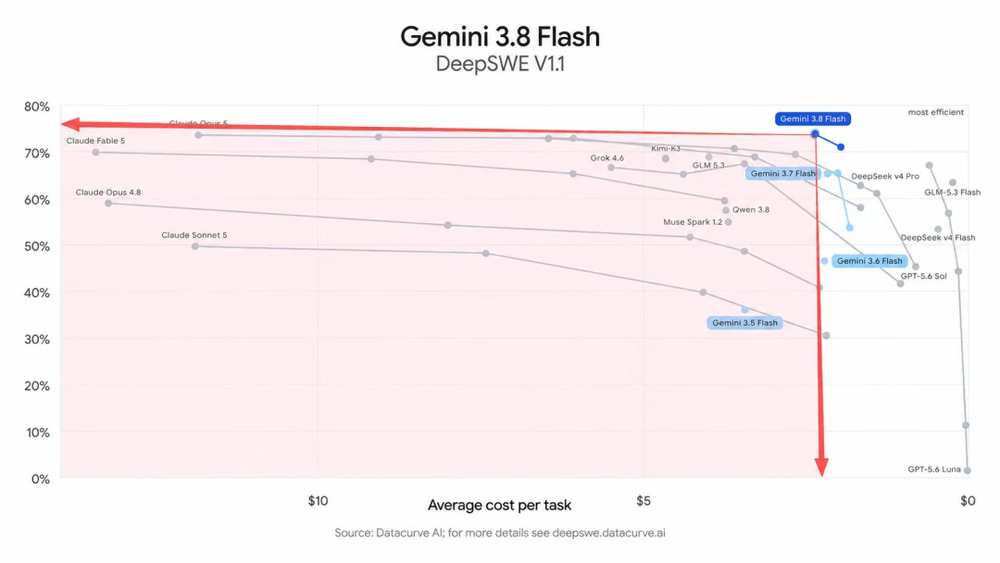
In other words, for software engineering capabilities at the same level, the execution cost can now differ by several times.
This will become extremely important in the era of Agents.
In the era of chatbots, the difference of a few cents in the cost of a response is imperceptible to ordinary users.
But Agent is completely different, a coding agent may run continuously for 100 steps, a research agent may search through dozens of web pages and read hundreds of pages of materials, and in the future, an Agent in a company may even work continuously for several hours.
Google officials even mentioned that when 3.8 Flash encounters complex tasks, it will actively work harder, performing more reasoning and tool calls.
Google did not make the model "think less" to save money, but because tokens have become cheap enough that it can be allowed to run longer loops.
So I think what's truly important about the 3.8 Flash is not just that it achieved another world's first.
Instead, it is forcing the capabilities that were previously only available on the most expensive frontier models into the price range of Flash.
Meta Strikes Back After Three and a Half Hours
While everyone at Google was celebrating the release of Gemini 3.8 Flash, Meta made a sudden comeback.
Meta has suddenly released the Muse Spark 1.3 model.
According to the evaluation released by Meta, Muse Spark 1.3 achieved a score of 75.4% on DeepSWE v1.1.
This figure surpasses Gemini 3.8 Flash, Claude Opus 5, and GPT-5.6 Sol.
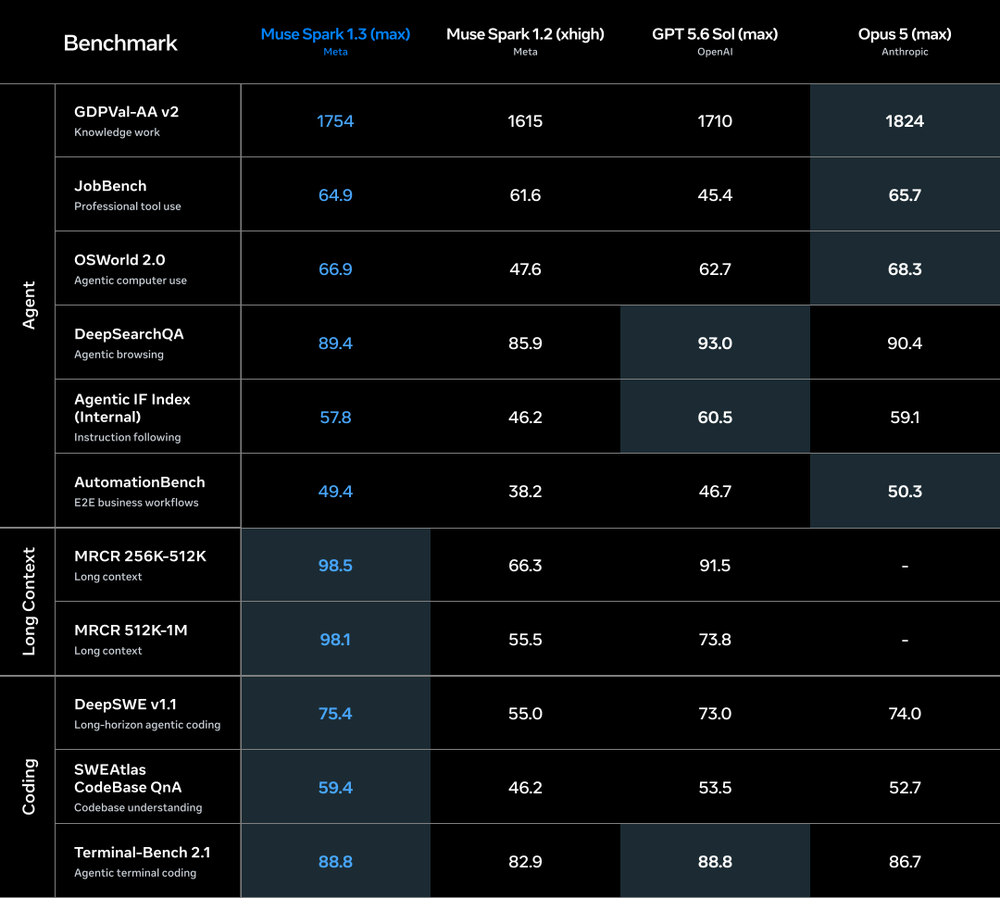
More surprisingly, the Muse Spark 1.2 only scored around 55% on this test.
From version 1.2 to 1.3, a minor update directly boosted performance by about 20 percentage points.
But I think what's truly worth looking at this time for Meta isn't the 75.4%.
There are also two numbers: a reduction of around 20% in tool calls and a reduction of around 25% in token consumption.
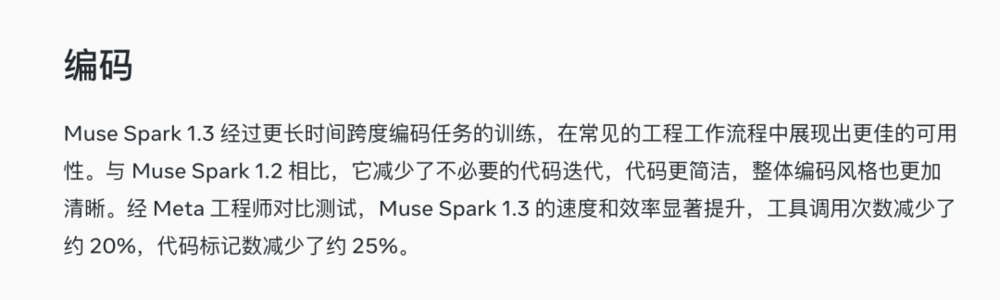
This issue is easily overlooked, but it is actually very close to the most important problem Agent will face after it is truly commercialized.
One of the most wasteful aspects of an Agent is often not the normal thinking process, but rather the deviation from it.
For instance, if a coding agent misinterprets the requirements at step 20, it may keep modifying five files, run three rounds of tests, and search through large amounts of code before finally realizing it went down the wrong path—then scrap everything and start over.
Dozens of tool calls and tens of thousands of tokens, all wasted just like that.
So a model that can identify ambiguity in a task earlier, recognize sooner when it's unable to proceed, and ask the user for clarification sooner is, in effect, directly cutting costs.
Muse Spark 1.3's enhancements largely fall into this category: it can maintain multiple workflows simultaneously within a long thread, proactively ask clarifying questions when tasks are ambiguous, request assistance when it encounters problems it cannot resolve, confirm before executing irreversible operations, and it is less likely to lose sight of the original constraints even after many rounds of extended task execution.
Meta has even begun emphasizing models' awareness of their own capability boundaries—knowing what they can do and what they cannot.
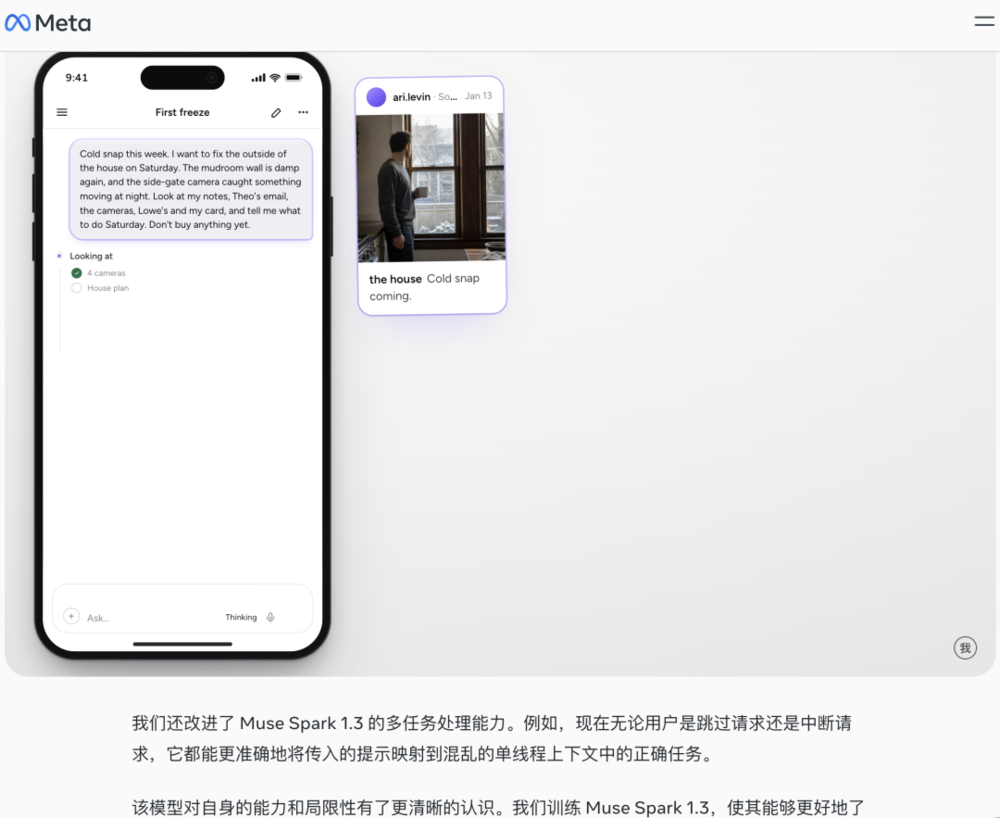
These capabilities may not have been as flashy as a 20-point benchmark increase in the Chatbot era, but in the Agent era, they can be directly converted into revenue.
One less mistake made by the agent is an optimization of the reasoning process in itself.
So when looking at Google and Meta together, the unit of measurement for large model competition is quietly changing.
In the future, people may care less about "how much a million tokens cost" and more about another number:
How much does it actually cost to run a real task from start to finish.
Mostik: A Disruptive Breakthrough
While Google and Meta are still researching how to complete tasks with cheaper and fewer tokens, Mostik has started tackling a more fundamental issue:
These tokens are necessary because they serve as a medium of exchange and a unit of account within a specific ecosystem or platform, allowing users to access certain services, participate in governance, or utilize particular features, thereby creating a closed-loop economy that incentivizes participation and engagement.
Mostik means "bridge" in Russian.
CEO Sasha Malysheva is the primary developer of the method, and its chief scientist is Stanislav Smirnov, a professor at the University of Geneva and the 2010 Fields Medal winner.
They are attempting to do something that sounds simple but is extremely difficult: preventing two AI models from communicating with each other through natural language.
Today, the vast majority of Multi-Agent systems work in the following way:
Model A generates several hundred or even several thousand tokens after obtaining some information, and then expresses its conclusions in natural language; Model B then reads all the text, re-understands and establishes its own internal representation, and continues to reason.
But the problem is that the things that actually perform calculations inside large models are not Chinese or English, but rather:
Mathematical representation of high-dimensional continuity.
This is equivalent to two computers that can directly transmit data, but instead, computer A prints the file into hundreds of pages, and then computer B uses a camera to OCR them back in, page by page.
Everyone has been trying to figure out how to reduce printing costs, but Mostik wants to get rid of printers altogether.
They are trying to build a bridge between the internal representations of different models, allowing them to directly exchange latent representations instead of first generating natural language.
An experiment revealed by WIRED, the authoritative Silicon Valley media outlet, is particularly intriguing.
Mostik has bridged the full version of GLM-5.2 753B and the 4B Qwen 3.5, which can run on mobile devices.
The final hybrid system had capabilities that fell between the two models, but its inference cost was only 1/20 of the full GLM-5.2.
Of course, it's too early to say that Mostik has already solved the problem of model communication.
Latent communication itself is not a new concept, as there have been numerous research attempts in recent years to exchange embeddings, hidden states, KV caches, and other internal representations.
The real challenge is that models differ in architecture, parameters, training data, and internal coordinate systems—so getting two models to genuinely understand each other's latent space is itself an extremely difficult problem.
Smirnov himself acknowledges that there is even a lack of mature mathematical language to describe the common representations between different models.
But the figure of 1/20 still excites me greatly.
It made me start thinking seriously about a completely different future AI architecture.
In the future, you may only need a model of less than 1MB
Over the past two years of discussing edge AI, we've been exploring how to cram larger models into mobile phones: 7B, 4B, 3B, 1B, through continuous distillation, quantization, and compression.
But if Mostik's approach ultimately works out, I think future phones may not need a single "all-encompassing" large model.
Your device may only need to run a small model of 0.xB or several B.
It is cheap, can run continuously, is responsible for understanding which app you are currently in, what you just did, and what state the device is in, and handles the vast majority of simple and high-frequency tasks.
When genuinely encountering difficult problems, it calls upon remote large models through latent space communication.
But the key difference lies in that it doesn't need to resend the entire context of 100,000 tokens to the cloud like it does today, allowing the remote model to read from the beginning.
It may only need to transmit a highly compressed latent state.
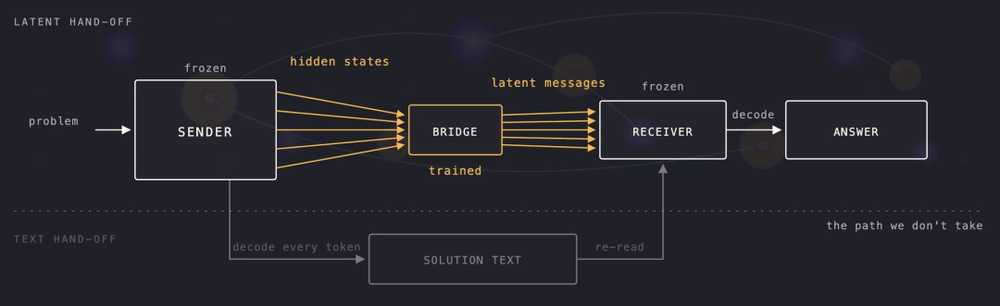
After completing complex reasoning, the remote large model does not necessarily need to generate thousands of tokens of natural language explanations for the local model, but instead can directly transmit the new internal representation back.
This way, local small models are responsible for high-frequency, low-cost, and continuous operation, while cloud-based frontier models only handle low-frequency but truly difficult inferences, with some kind of Bridge enabling efficient communication in between.
If this can be achieved in the future, the reduction in reasoning costs may be far more than the 30% or 50% decrease in model API prices seen today.
It may change the way we organize AI computing itself.
Looking back at last night, on the surface, there were three completely different news stories.
Google released Gemini 3.8 Flash, bringing frontier-level capabilities into the price range of Flash.
Meta has released Muse Spark 1.3, enabling agents to accomplish more with fewer tokens and tool calls.
Mostik went further, attempting to prevent some tokens between models from being generated from the start.
They actually all point to the same change:
Intelligence is becoming incredibly cheap at an exponential rate.
Moreover, this price reduction is no longer just about a decrease in API unit prices.
Model prices are declining, the amount of computation required to complete tasks is decreasing, and even the way models exchange information with each other is being redesigned.
The potential impact of this incident could be much greater than a few percentage points increase in benchmark.
Many technologies truly take off not when they "become usable for the first time," but when they "finally become cheap enough to be used casually."
Having an agent spend tens of dollars to complete a trivial task for an ordinary person may not be cost-effective.
If in the future it only costs a few jiao, many applications that nobody would consider now would suddenly become viable.
Today, it's impossible for us to have dozens of Agent running around a person 24 hours a day, but if the cost of inference drops by one or two orders of magnitude, it may become the default state.
It's already 7:00 a.m., and I should have gone to sleep several hours ago.
As a result, after Gemini was released, Meta followed up several hours later, and then I saw Mostik's 1/20 experiment.
After lying down in bed, my mind kept thinking about these things, thinking about the 0.xB model on my phone, thinking about the large model in the cloud, and thinking that maybe they don't need to communicate with each other in natural language at all.
The more I thought about it, the more I couldn't sleep, so I finally got up and finished writing the article.
Gemini's 74% and Muse's 75.4% may be overtaken by new figures in just a few days.
But I am indeed having a hard time calming down this excitement.
Because I'm becoming increasingly concerned with another issue, rather than who has become world number one again:
How cheap can such intelligent AI ultimately become?
Once powerful AI becomes cheap enough to be casually invoked, I think many AI products that seem crazy today may have only just begun.