On August 31, within 16 minutes of the opening, Mango SuperMedia hit the 20CM daily limit.
The trigger was a drama called "Later Journey to the West" — the country's first AI long-form series to air in prime time on satellite TV.
This is already the Nth "first" for AI in film and television.
Over the past two and a half years, AI film and television has almost formed a fixed narrative: every now and then, a "satellite" must be "launched".
Sora arrived, and the stakes were raised; AI-generated films emerged, and the stakes were raised again; AI actors gained popularity, and the stakes were raised once more; now AI-produced dramas are being broadcast, and the stakes continue to rise.
One satellite after another has been launched, with the industry announcing that it has reached new heights time and time again. However, after the satellites have been launched, they leave behind a trail of chaos.
Adding up all these "firsts" reveals an awkward situation:
AI film and television has completed many 0-to-1 transformations, but has yet to achieve a groundbreaking 1-to-100 leap.
The AI film industry is flooded with technology, capital, manpower, and products, but how many works and talents have emerged, and how many have been remembered?
Sora Unveils Groundbreaking Technology for the First Time
On March 20, 2024, Huace Film and TV's 20CM stock rose by the daily limit.
On the same day, media stocks including Palread Technology, China Broadcasting Network, CMC Inc. and Deng Guang Media surged collectively, with the Wind Media Gold Stock Index rising 6.22% in a single day.
At that time, it had only been two months since OpenAI released Sora. On March 18, a domestic team open-sourced Open-Sora 1.0, coinciding with the popularity of Kimi, and AI film and television was priced on a large scale by the capital market for the first time.
The core logic of this round of market activity is that technology has finally proven itself.
Sora made everyone realize for the first time that cinematic video can be "generated." What once required cameras, actors, lighting, and sets can now be achieved with a single prompt.
This is a huge technological breakthrough, but it's a breakthrough in production methods, not in the filmmaking itself.
Sora can make characters run, cars drive, and cameras move, but it cannot truly understand why characters are running, why they stop, or why a close-up shot is needed at a given moment.
It generates images, not stories.
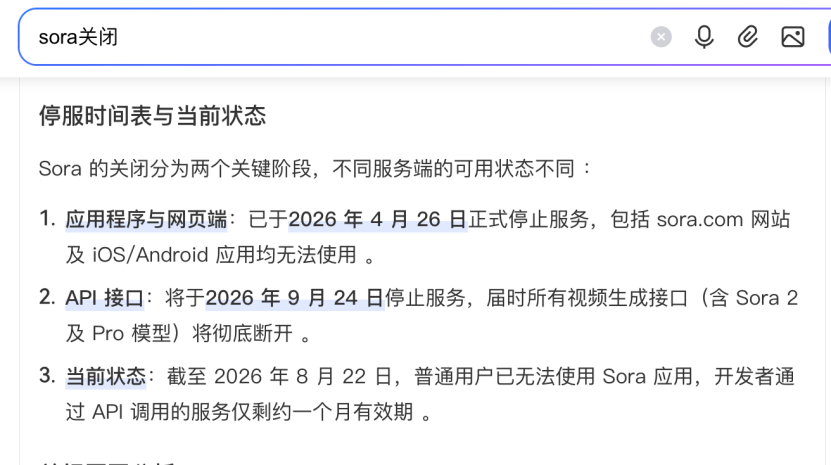
Later on, Sora gradually faded out of the public discussion. Its technical influence still exists, but the product itself is no longer the focus of market attention.
Sora has not left behind a classic work, only the technological shock felt by people when they first watched that two-minute video.
This is AI Film's first 0→1.
From "impossible" to "possible", but possible does not necessarily mean good-looking.
New World Loads for the First Time
In June 2025, Kuaishou's "New World Loading" held its premiere.
This is the world's first AI-themed short story collection, consisting of 7 independent stories with a total duration of over 180 minutes.
Previously, Kuaishou had released AIGC short dramas such as "Shan Hai Qi Jing: Pi Bo Zhan Lang", but "Xin Shijie Jia Zai Zhong" has a different significance.
It is no longer an experimental video or a short technical demo.
AI is starting to attempt to produce genuinely continuous content.
This is the second 0→1.
However, problems have also arisen. The greatest value of "New World Loading" lies in proving that AI can complete the content production process, rather than in a particular character, line of dialogue, or plot being widely remembered.
It is more like a technology demonstration.
It's like when a painter first mixes a new color - the act itself is noteworthy, but mixing the color doesn't equate to creating a great painting.
Meanwhile, the commercialization of KELING AI is progressing rapidly.
In 2025, its related business revenue grew from approximately 150 million yuan in the first quarter to approximately 340 million yuan in the fourth quarter, after which it rapidly surged and is now rushing towards an IPO.
Keling has provided tools to start making money from samples, but it still hasn't made content into a product.
Seedance 2.0 Achieves Its First Commercial Closed Loop
In February 2026, Seedance 2.0 set off a frenzy in the industry.
Around February 10, the media sector saw a collective surge. Chinese Online's stock price soared by the daily limit of 20CM, with a turnover of 9.547 billion yuan and a turnover rate of 35.61%; shares of Jiecheng Holdings, Guangxi Television Media, and several other individual stocks also rose by the daily limit.
Many people view this round of activity as an improvement in model capabilities, but more importantly, commercialization has started to form a closed loop.
In contrast to Sora two years ago, it was shut down because it failed to find a stable business model. The technological breakthroughs created a sensation, but did not form an industry.
The biggest difference with Seedance 2.0 is that it is not just a technological showcase in a laboratory.
It has been integrated into the Volcano Engine and accessed by creation systems such as Ji Meng, procured by enterprises, and paid for by creators. A large number of AI short plays and AI short videos have been accepted by audiences on Hongguo and Douyin.
This is an important dividing line for AI videos transitioning from a technology story to an industry story.
Thus, this time the completion of 0→1 is not a content breakthrough, but rather a commercial closed loop: tools - creators - platform - products - audience/consumers.
However, most short dramas still have the attribute of being bedtime entertainment, with a pipeline-style thrilling sensation. Whether a groundbreaking and explosive hit that touches people's hearts will emerge remains to be seen. After all, it took three or four years for traditional short dramas to produce works with a strong presence.
Doubao's First 'Human' Appearance
The first three "firsts" were mainly concentrated at the technical and tool levels, but AI actor Fang Taozi has touched the core assets of the film and television industry for the first time - "people", or stars.
In June 2026, "The Girl Who Got Laid Off" went online, and the protagonist Fang Taozi quickly gained popularity, consistently topping the Weibo hot search list. As of now, the cumulative playback volume of the work has exceeded 200 million.
Fang Taozi has made the public see that AI actors are starting to have commercial value. A video quote of over 60 seconds can reach 258,000 yuan, which has also sparked continuous controversy.
But the fact remains that for the first time, AI has an actor publicly priced by the market.
This is the fourth 0→1.
AI in film and television has progressed from generating images to generating stars.
The most important assets of the traditional film and television industry have never been cameras, but people.
Celebrities can accumulate fans, take on advertisements, join the next production, and create long-term IP value.
If AI film and television is to establish its own industrial system in the future, it will also need such assets.
However, the question still remains: do audiences like the character Fang Taozi itself, or do they like the concept of an "AI actor"? Are audiences discussing the character itself, or the technology behind it?
The emergence of AI actors is a transition from 0 to 1.
But from an AI actor to a good actor, there is still a gap in terms of performance, personality, emotions, and time - after all, Fang Taozi is still far from being on the same level as Andy Lau.
Moreover, the overnight sensation of Fang Taozi has been accompanied by a wave of doubts and boycotts, with issues such as copyright infringement, deepfakes, and the authenticity of product endorsements all awaiting resolution.
Journey to the West sequel enters mainstream view
On August 31, "Journey to the West: Conquering the Demons 2" premiered on Hunan TV's prime-time slot.
This is a particularly special one among the five times.
As Hunan TV is one of the most powerful mass media in the TV era and also the most successful TV station in transitioning to streaming.
From variety shows and idol dramas to New Year's Eve galas, Hunan TV has shaped the collective memories of several generations.
For a long time, it was almost equivalent to the center of popular culture among Chinese young people.
The broadcast of "Journey to the West: Conquering the Demons" sequel represents AI film's first entry into one of China's most mainstream mass communication systems, bringing AI to the forefront of the public.
In the past, AI films were mainly spread within the technical platform and the internal circle of AI films.
Hunan TV is the family living room, catering to a cross-age audience, and was once a television media network that covered the entire country.
This is the fifth 0→1.
AI film and television has transitioned from "industry" to "the masses", but satellite broadcasting solves the problem of reach, not retention.
Hunan TV gave AI a foothold in the film and television industry, but it didn't bring about a classic work.
Audiences may tune in because of the Journey to the West IP, or they may be curious about the "AI version of Journey to the West".
However, looking at the discussions among netizens, how many are actually talking about the plot and characters? Technical marvels may be able to attract audiences, but it's the content itself that keeps them coming back.
Looking back more than a decade ago, we would turn on Hunan Satellite TV and start watching "My Fair Princess", a sense of certainty about TV content that is lacking in "Journey to the West: Conquering the Demons".
20 Years After 'The Train Arrives', a Movie Waits
In 1895, the Lumiere brothers shot "The Train Arrives at the Station".
A famous story has been passed down in film history: when audiences saw a train coming straight at them, they were so frightened that they ran away in all directions.
Today it seems more like a film origin myth, a myth that reveals the earliest state of film - at that time, the most important thing was not the story, but the novelty, as long as the images really moved, it was enough to make news.
Today's AI film and television are no exception.
AI brings nonexistent people to life, generates nonexistent scenes, and puts dramas without real actors into prime-time slots.
Each time is enough to make headlines, each time is enough to excite the capital markets.
However, it took 20 years for film to truly become an art form. During these 20 years, Méliès invented stop-motion photography, Porter invented cross-cutting, Griffith established the language of cinematography, and then came Hitchcock, Hollywood, and the New Wave...
The ultimate issue that film resolves is not what can be filmed, but rather how the medium of film should tell stories.
Like Nolan, who has insisted on film, IMAX, and practical effects for decades, it's not that he refuses digital technology, but rather that he practices what he has always believed in: using the most suitable film technology to tell the stories he wants to tell.
Unfortunately, many AI film and television projects have taken a wrong turn today. The industry and sector are focused on questions like: Can AI produce long dramas? Can AI act? Can AI go viral? Can AI generate a short drama in just one day?
The biggest selling point is that it's "completely made by AI".
However, audience demands have always been straightforward, much like the classic promotional slogan of a movie channel - "Turn on the TV to watch movies." What audiences want to watch is the content itself, regardless of whether it's a long or short series, or whether it's live-action or AI-generated.
When the audience no longer cares about the technology used, but only remembers the story told, AI film has truly made the transition from technology to art.
Before that, the capital market can continue to price every 0→1, but the real 1→100 that belongs to AI film and television may not have started yet.