
In spring 2026, teacher recruitment announcements were released across regions. Young people preparing for the teacher recruitment exams quickly found the familiar entryway narrowing: Hubei province openly recruited 2,740 primary and secondary school teachers, while Jiangxi province planned to recruit 1,190. Recruitment continues, but positions are no longer as widely distributed as in previous years, with growing disparities among counties, school levels, and subjects.
Around the same time, macro data sent a clearer signal. According to Ministry of Education statistics, the number of full-time teachers in schools of all types and levels nationwide was 18.701 million in 2025, down about 150,000 from 18.851 million in 2024. This marked the second consecutive year of decline in the national full-time teacher count. For over two decades, "student growth – school expansion – teacher replenishment" formed a relatively stable chain; now, for the first time, it is running in reverse on a large scale.
But summarizing these changes as "teacher oversupply" obscures the real problem unfolding. A county-town primary school may stop replacing teachers after natural attrition, while a junior high in a neighboring new district still struggles to find science teachers. A township school may have an aging faculty, while urban schools face class-size pressure from rapid population inflows. Competition is fierce for Chinese, math, and foreign-language posts, yet teachers for mental health, special education, information technology, and artificial intelligence remain hard to find directly from the existing workforce.
The central contradiction in teacher supply and demand has shifted from "whether there are enough people" to "whether people can be placed in the right school levels, regions, and positions."
Teacher Numbers Reach Turning Point
Population Shock Wave Reaches Elementary Schools
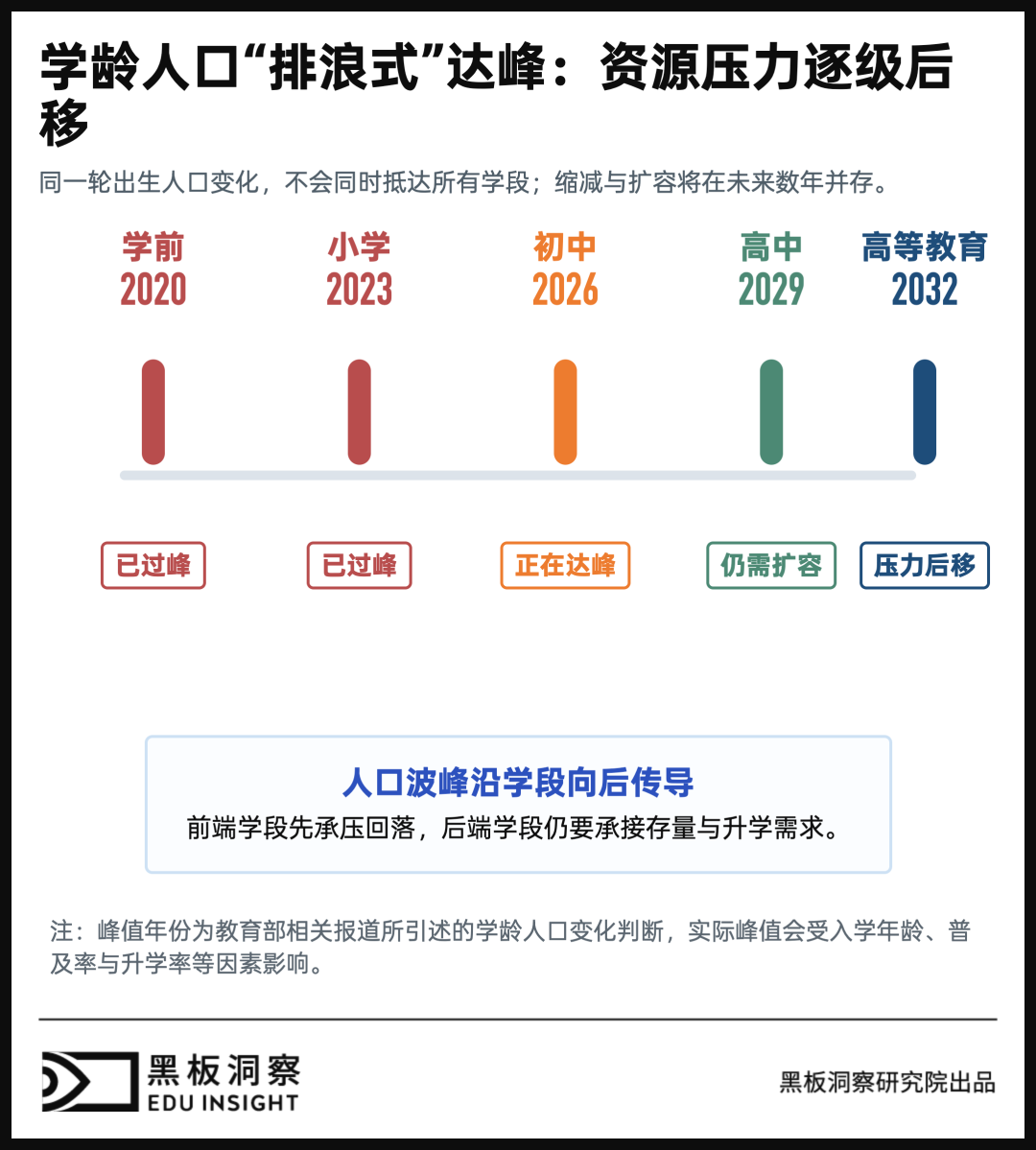
The decline in the total number of teachers is not primarily a sudden shift in recruitment policy, but rather the impact of changing birth rates beginning to work through the education system. After a brief rebound in 2016, births kept falling, with the effect first hitting kindergartens, then primary schools, and then moving progressively into junior high, senior high, and universities. Because school cycles and enrollment rates differ by level, this is not a synchronized downward line but a "slow train" advancing through the school stages.
Preschool education has felt the pressure first. The number of full-time kindergarten teachers nationwide fell from 3.2442 million in 2022 to 2.6126 million in 2025, a drop of 631,600 over three years, or nearly 20%. Primary schools have also passed their peak: full-time primary teachers fell from 6.6563 million in 2023 to 6.4582 million in 2025, a decline of 198,100 in two years. Looking only at enrollment, primary schools took in 14.6174 million new students in 2025, down 1.5489 million from 2024, so the downward pressure on teacher demand will continue to show.
Junior and senior high schools, however, present a different picture. Junior high schools enrolled 18.5281 million students in 2025, up slightly from the previous year, and had 4.2395 million full-time teachers. Regular senior high schools had 30.395 million students and 2.372 million full-time teachers, a student-teacher ratio of 12.81-to-1; the number of schools, enrollments, and teaching staff are still expanding. Population projections cited in Ministry of Education reports suggest that the school-age population peak will arrive sequentially: preschool in 2020, primary school in 2023, junior high in 2026, senior high in 2029, and higher education in 2032. In other words, in the coming years the education system will simultaneously see "contraction at the front end and expansion at the back end."
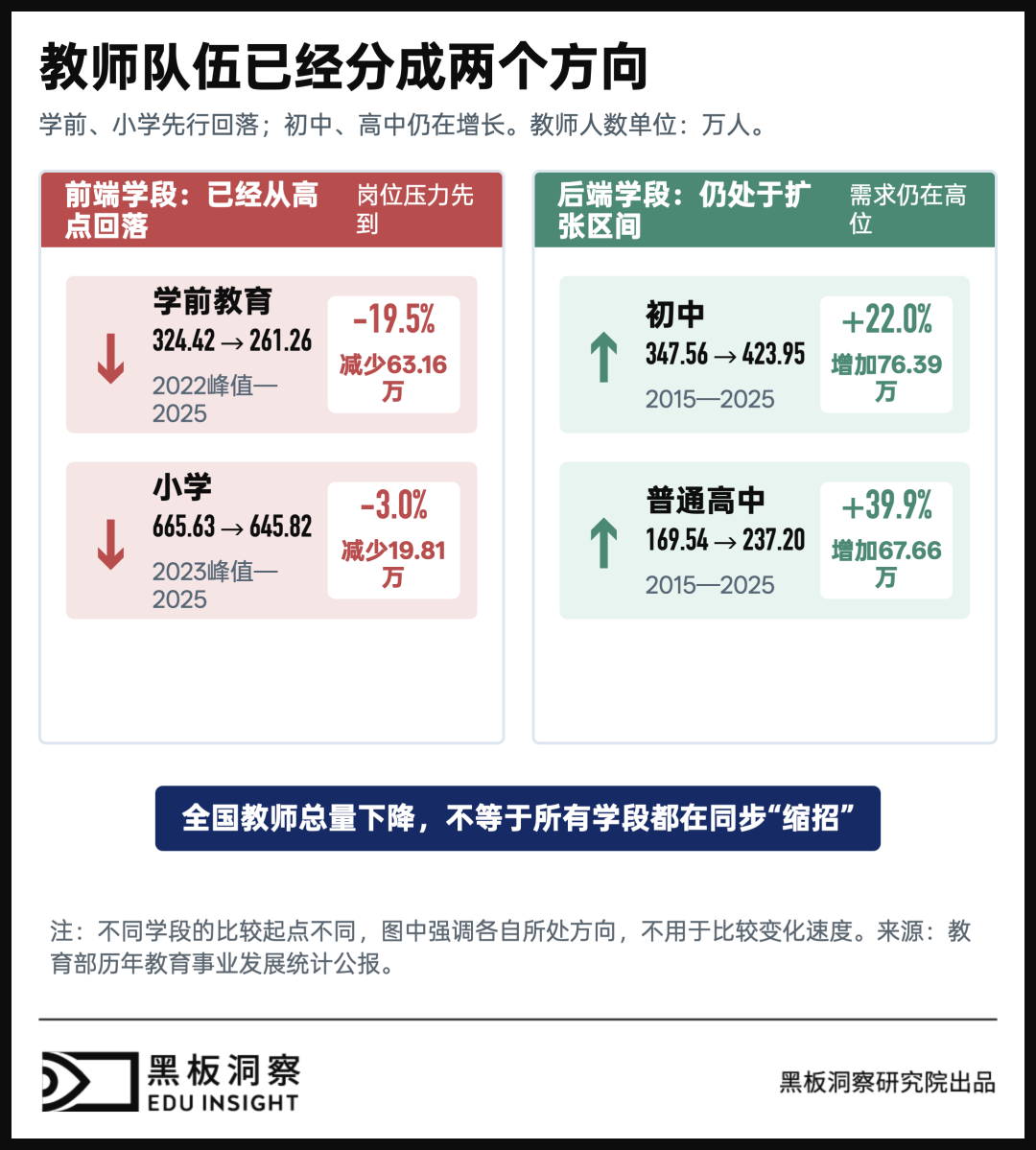
This explains a seemingly contradictory phenomenon: the national teacher count has already fallen, yet some regions are still building new secondary schools and adding senior high teachers. Fewer people overall does not mean every school level immediately has fewer students, nor does it mean teaching posts can be cut by a uniform proportion. The unit of analysis for teacher supply and demand must move down from "national total" to "a specific county, a specific year, a specific school level, a specific subject."
A study based on student-teacher ratios, class sizes and retirement ages estimates that demand for primary school teachers may fall by 1.47 million between 2026 and 2030, while about 820,000 teachers retire in the same period, leaving a surplus of about 650,000. Demand for middle school teachers may fall by 250,000, but with about 580,000 retirements, a replacement gap of about 330,000 could emerge. It should be stressed that this is not an official 'layoff figure' but a stress test. It signals to policymakers that after retirement, enrollment peaks and regional migration are combined, an apparent overall surplus may coexist with local shortages.
Total Supply Begins to Outpace Demand
Why Do Some Schools Still Face Teacher Shortages?
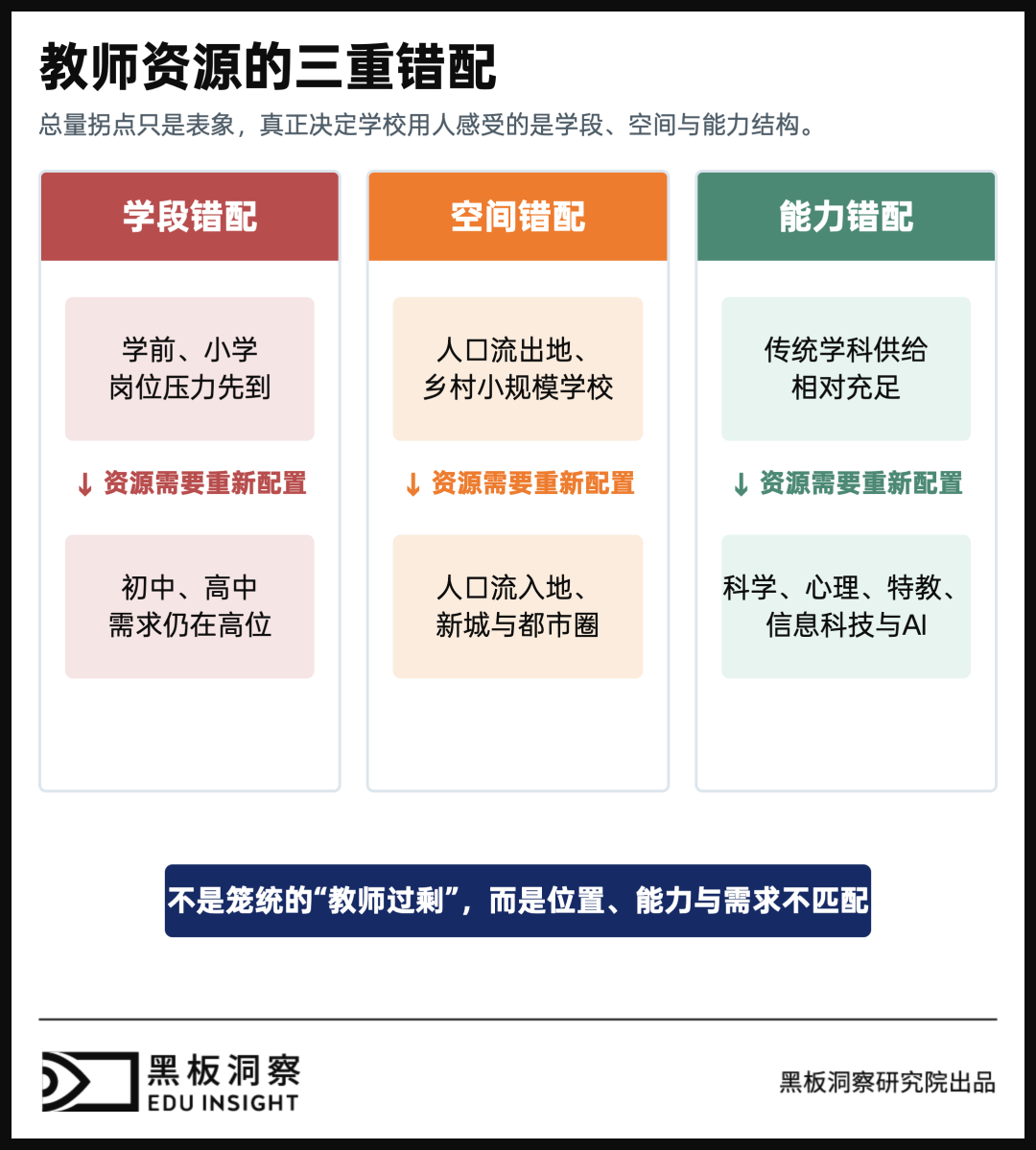
The question of whether the total number is sufficient is the easiest to answer and the easiest to mislead. Teachers are not desks that can be reassigned between schools on the same day. Behind every post lie staffing quotas, qualifications, professional titles, family ties and subject expertise. A 'person' in macro statistics must pass at least three filters at the school level: school phase, region and subject. If any one fails to match, the statistical supply of teachers cannot become effective supply in the classroom.
The first mismatch is by school phase.
Preschool and primary school teachers feel the pressure first, while demand for middle and high school teachers remains high. But moving across school phases is not as simple as swapping a timetable. A primary school teacher moving to middle school needs to match the required teaching credentials, subject knowledge and classroom management style. Kindergarten teachers find it even harder to step directly into subject teaching in compulsory education. Even if teachers are willing to switch, whether professional title tracks, post levels and performance evaluations can be aligned determines whether such moves are feasible.
So when a locality has a surplus of primary school teachers, the most realistic option is usually not to 'transfer everyone to middle school' but first to assess the surplus teachers' ages, professional backgrounds and trainability, then combine role changes, teaching support, rotation, early retirement and natural attrition. For younger teachers, cross-phase training still has room; for those nearing retirement, the cost of forced redeployment may outweigh the benefits.
The second mismatch is geographic.
Low birth rates and population mobility are happening at the same time. In counties with population outflows, village and township schools are seeing student numbers fall rapidly, while metropolitan areas, new urban districts and quality county schools continue to absorb people. A review of public data shows that in 2025, the number of full-time primary school teachers in cities rose by about 87,800, while townships lost about 36,000 and rural areas lost about 118,000. Even as the national total of primary school teachers declines, urban schools are still hiring, which shows that teacher demand is being reshaped by population shifts.
More tricky is that small schools cannot cut teachers in proportion to falling student numbers. A rural school with only a few dozen students still must offer the full national curriculum and still needs homeroom teachers and posts for Chinese, math, physical education and other basics. If staffing is based only on student-teacher ratios, you can easily get a data 'surplus' while schools have no one to teach classes. Conversely, even if population-inflow areas have enough total staffing quotas, the approval of quotas may lag behind the opening of new schools, leaving them dependent on temporary teachers for long periods.
The third mismatch is between academic subjects and teacher capabilities.
Traditional recruitment has long centered on major subjects such as Chinese, math and English, and teacher-training colleges have developed a relatively stable supply of graduates. But school needs are expanding quickly: science education is entering more grades; mental health education is shifting from having a counseling room to regular courses and crisis intervention; special education is emphasizing inclusive support; information technology curricula are being continuously updated; and AI education is moving into curricula, clubs and school-based practice.
Teacher-recruitment policies for 2026 already require localities to plan based on three-to-five-year demand, prioritizing shortages in subjects such as morality and rule of law, science, information technology, physical education, arts, labor and mental health, and to build a teacher pipeline for AI education. The policy list itself is a footnote to shifting demand: schools don't necessarily lack more homogeneous teachers; they need people who can take on new curricula, new services and interdisciplinary tasks.
From Hiring to Redeploying Talent
Teacher Management Enters Era of Stock Restructuring
In the growth era, governance tools were direct: more students meant more staffing quotas, school construction and hiring. The stock era is far more complex. Falling job demand doesn't automatically redirect teachers to shortage areas, and can even produce a stalemate where schools have vacancies but no people, while counties have people but can't use them. The next phase isn't about inventing a uniform reduction ratio; it's about finer forecasting, a larger coordination radius and clearer transfer pathways.
First, make population projections truly county- and school-specific. The national 15th Five-Year education plan has proposed a school-age population forecasting and early-warning mechanism, dynamic adjustment across education stages, and coordinated teacher staffing. For county education departments, this means putting at least three to five years of birth data, resident population flows, housing deliveries, new school openings, progression rates and teacher retirements on the same chart. Without this layer of forecasting, hiring tends to follow last year's inertia, and school closures and mergers tend to overreact to short-term numbers.
Second, expand the coordination radius for teacher resources. Sichuan is advancing 'county-managed, school-employed' staffing to strengthen dynamic adjustments across regions and schools; Zhejiang is exploring city-county integrated management to coordinate staffing and posts across stages and schools. The common direction is to turn teachers from 'school people' anchored to a single school into 'system people' coordinated at the county level or beyond. Only with a larger resource pool can urban gaps, rural surpluses and stage-level fluctuations be addressed simultaneously.
Third, build an executable institutional chain for role transitions. Teachers moving between schools is relatively easy; moving across stages or subjects requires qualification recognition, curriculum training, on-the-job practice, performance evaluation and professional-title continuity. If policy merely says 'strengthen training,' it often degenerates into short lectures. Effective transition should be a form of career retraining: define competency standards for the target post, provide six to twelve months of modular learning, complete internships in real classrooms, and guarantee post and pay for those who finish.
Fourth, manage the exit mechanism, but don't reduce it to layoffs. The public-school teaching force has strong public-service characteristics; crude staff cuts would push all the risk of demographic fluctuations onto individuals and could undermine the profession's appeal. A steadier mix: rely first on retirements and natural attrition to absorb the total; provide cross-stage and cross-subject pathways for those able to transition; use regional teacher reserve pools for short-term peak demand; and improve assessment, transfer and lawful exit mechanisms for those who are chronically unsuitable.
Another often-overlooked option is to not treat all 'surplus' as costs to be eliminated. In the past, large class sizes, heavy teacher workloads, and insufficient after-school services largely stemmed from teacher shortages. As student numbers decline, some regions can convert improved student-teacher ratios into smaller classes, individualized tutoring, full mentorship systems, dedicated research time, and better home-school communication—rather than mechanically cutting teachers in proportion to student numbers. The teacher redundancy brought by declining birth rates could become an opportunity to improve basic education quality.
The goal of restructuring the existing teacher workforce is not to keep every teacher fully occupied, but to turn limited human resources into higher-quality, more resilient education services.
Recruitment Has Changed
Teacher education must halt its inertial expansion
The rewriting of teacher supply and demand will ultimately put pressure on teacher-training institutions. In the past, the expansion of the teaching force provided a stable outlet for teacher-education graduates; after teacher-certification exams were opened up and comprehensive universities began participating in teacher training, the supply pipeline expanded further. Now that basic-education recruitment is shrinking, if teacher-training programs continue enrolling at historical levels and remain dominated by traditional broad subjects, graduates will face a more intense and fragmented job market four years from now.
Adjustment does not mean uniform enrollment cuts across all teacher-training programs. A more sensible approach is layered: preschool education and some primary-education programs should be carefully reduced based on provincial population trends; shortage subjects in secondary schools, special education, science education, mental-health education, and vocational-education tracks should be supplemented according to regional demand; and ministry-affiliated normal universities and research-oriented teacher colleges should curb homogeneous undergraduate expansion, directing more resources toward advanced teacher preparation, education research, and in-service teacher development.
The publicly funded teacher-education policy also needs to shift from 'guaranteeing a job' to 'guaranteeing a good match.' Starting in 2024, six ministry-affiliated normal universities have implemented an integrated undergraduate-graduate model for publicly funded teacher-education students, using a '4+2' structure to complete a bachelor's degree and a master's in education, with graduates assigned to teach outside provincial capitals. The policy raises the level of training, but the real test is whether enrollment plans can align with county-level needs six years later, whether training subjects cover shortage areas, and whether placement locations offer development space commensurate with the talent.
Teacher-training institutions also need to abandon the one-time training model. Teaching careers change multiple times: primary-school teachers may move to junior high, subject teachers may take on science education or learning support, and backbone teachers may become regional teaching researchers. Rather than making a single professional track decision at age 18, it is better to build normal universities into long-term capability centers for regional teachers, offering micro-degrees, subject-transition certificates, short-cycle school-based training, and competency certification based on real classroom practice.
Artificial intelligence will accelerate this transformation, but it is not the main cause of the current decline in teacher numbers. Demographic change determines the overall direction of teaching positions; AI first changes the task structure within those positions. Searching for lesson materials, grading basic problems, compiling statistics, and routine Q&A are more easily assisted by tools, while classroom observation, relationship-building, value judgments, identifying students' psychological states, and designing complex learning experiences become more important. Schools in the future do not need an isolated 'AI teacher' role, but rather a cohort of teachers who can embed AI into subject teaching while preserving educational judgment.
This also means teacher-education curricula cannot simply add a single 'Introduction to AI' course. The more fundamental change is to embed data literacy, tool evaluation, privacy ethics, learning analytics, and human-machine collaborative teaching across all teacher-training programs, while strengthening internships and real-classroom decision-making. The more AI can handle standardized tasks, the more teachers' professional value shifts from 'how much knowledge was delivered' to 'whether they can understand individual students and design effective learning.'
The contraction in teacher recruitment reflects demographic changes feeding through the education system, and marks a shift in basic education from scale expansion to a stage that values both quality and efficiency. But a declining total headcount does not automatically mean an overall surplus. Over the next few years, pressure on preschool and primary education will continue to ease, while junior and senior high schools will still need to absorb peak enrollment. Areas with population inflows still require more teachers, and new curricula will create fresh capability gaps.
What needs to be rewritten is the entire supply-demand logic: recruitment planning should move from addressing current-year gaps to projecting population trends three to five years ahead; staffing quotas should shift from being locked to individual schools to being coordinated at the county or even city level; teachers should move from one-time post assignments to sustainable role transitions; teacher-training institutions should shift from mass-producing new graduates to serving both pre-service and in-service needs; and evaluation systems should allow teachers to devote more time to individualized instruction, teaching research, and student support.
If reform stops at simply recruiting fewer teachers, the supply-demand mismatch will not disappear. It will only turn from an aggregate problem into a more hidden structural one: young teacher-training graduates cannot find posts while schools cannot find suitable candidates; rural teachers are counted as surplus while new urban schools rely on long-term temporary hires; traditional subjects are overcrowded while science, psychology, and special-education courses remain hard to fully staff.
The declining birthrate poses a difficult challenge for the education system, but it also opens a rare window for quality improvement. Treating the surplus workforce simply as a burden may ultimately yield fewer teachers. Redirecting these resources to regions with greater shortages, school segments with higher demand, and more valuable work is what can deliver better education. The new answer to teacher supply and demand lies not in a single national aggregate curve, but in each specific flow, transition, and capability upgrade.