On September 1, Tim Cook ended his 15-year tenure as Apple's CEO, taking on the role of Executive Chairman, with John Ternus formally taking over.
The handover had been planned in advance. On April 20, Apple announced its succession plan, and Cook subsequently completed the transition over the summer.
In recent years, Apple has faced increasing scrutiny in the field of artificial intelligence. As generative AI rapidly changes the competitive landscape of the tech industry, with OpenAI, Google, and Meta continuously advancing models, intelligent agents, and new interaction methods, Apple has at times appeared passive due to the slow upgrade of Siri and AI functions failing to meet expectations.
In June this year, Apple unveiled its new Siri AI, but a user-facing test version won't be available until later this year.
At this point, Apple handed over the CEO position to the person who had long been in charge of hardware and product engineering.
Ternus joined Apple in 2001 and later oversaw the entire hardware engineering system. Core products such as iPhone, Mac, iPad, Apple Watch, and AirPods are all closely related to his team.
Apple is currently facing the most scrutiny over its AI capabilities, so why is the successor to the throne coming from the hardware division?
Apple's shortcomings may not just be about having a stronger model
If Apple's current issues are summarized as "lagging behind in AI", the answer seems straightforward: supplement models, supplement talent, supplement software, and even find a CEO who is the most knowledgeable about AI.
But what Apple faces is not a single technical problem.
It has more than 2.5 billion active devices and also has chips, operating systems, hardware, services, developer ecosystems, and massive user relationships. For a company like this, model capabilities are certainly important, but more crucial is whether AI can enter the existing product system and change the interaction methods on tens of billions of devices.
Apple's core capability over the past few decades has been to reorganize complex technologies into mass-market products.
It is rarely the first to invent underlying technologies, yet it has repeatedly driven graphical interfaces, digital music, smartphones, and tablets towards popularity. Only after recombining chips, hardware, software, interaction, and ecosystems does technology become Apple's own competitive advantage.
The new generation of Siri unveiled in June this year embodies the same idea.
The next-generation Apple Foundation Models can run on devices and also be processed through Private Cloud Compute for more complex tasks; Siri further integrates into the operating system and application layers, leveraging personal context, screen information, and system capabilities to understand needs and perform actions.
AI products do not just depend on whether the model is intelligent, but also on understanding user context, calling up data and applications on devices, and handling privacy, performance, computing power, and latency. Models, chips, devices, operating systems, and cloud capabilities are beginning to jointly determine product experience.
Tenus' value should also be evaluated within this framework: what Apple needs to accomplish may be a new round of integration from technology to products.
In 2011, Cook was not the most Jobs-like person
Apple's last major transfer of power also faced similar questions.
After Steve Jobs stepped down in 2011, why did Tim Cook take over as his successor?
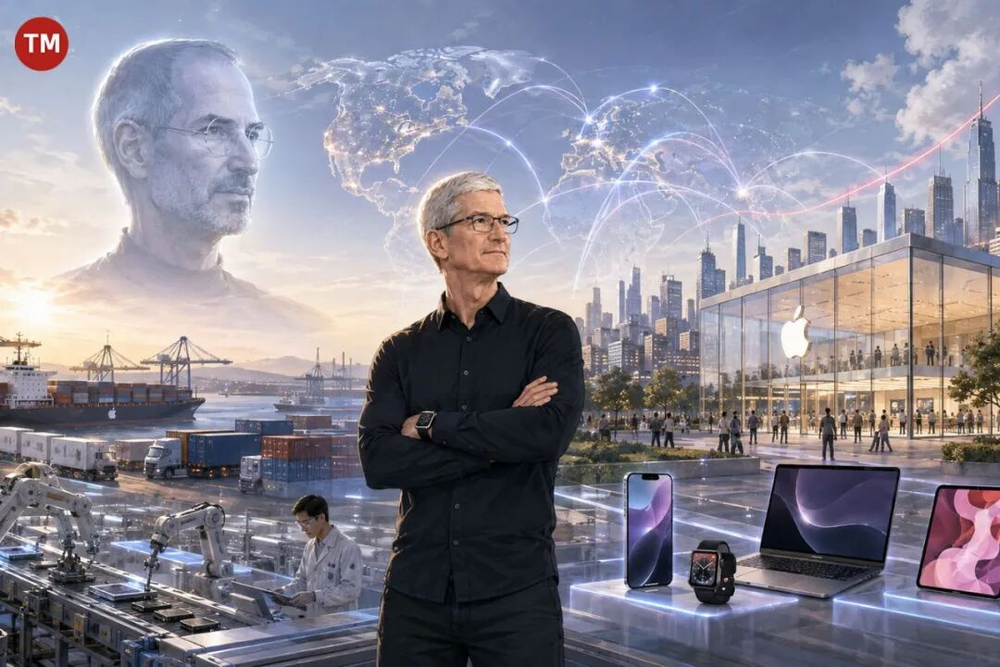
Cook's label was never that of a product genius, he has long been in charge of operations and supply chain, exceling at efficiency, scale, and managing complex organizations, if the idea was to "replicate Jobs", Cook would not have been the most natural choice.
But by then, Apple had already changed.
After Jobs returned to Apple, the company released a string of products including the iMac, iPod, iPhone, and iPad, re-establishing its product direction. Especially after the iPhone achieved market validation, Apple's challenges gradually shifted from creating products to figuring out how to convert the existing product momentum into a global scale.
This requires a more complex supply chain, a broader market, and stronger operational capabilities, as well as a rapidly expanding enterprise establishing a more stable organizational system, which is exactly where Cook excels.
Over the subsequent 15 years, Apple's market value grew from approximately $350 billion when he took over to over $4 trillion, with annual revenue increasing from $108 billion in fiscal 2011 to more than $4,160 billion in fiscal 2025, while its services business also grew into a new major pillar.
Cook hasn't replicated Jobs' approach, but has instead addressed the issues Apple faced as it entered its next phase.
In hindsight, Apple's succession wasn't about finding "another Steve Jobs," but rather finding the right person for the next leg of the journey.
AI is shifting from a model war to a gateway war
By 2026, the industry landscape facing Apple will have shifted once again.
In recent years, the most conspicuous battleground in the AI competition has been models. With parameters, training data, computing power, inference capabilities, and rankings being constantly updated, who has the more powerful large model has almost become the most intuitive measure of an AI company's competitiveness.
Model competition remains important, but another war has begun.
For more than a decade, the smartphone has served as the default gateway to digital life. Users unlock their phones, open an app, and then search, communicate, shop, entertain themselves, and work. The operating system manages the device, apps organize services, and users issue commands step by step through screens, icons, and menus.
As intelligent agents mature, this path may be compressed once again.
Many tasks no longer require users to first determine which app to open. Users only need to tell the system what they want to do, and AI can understand their intentions, find the necessary information, call up the relevant tools, and complete the operation across different applications.
AI is thus entering the interaction layer between humans and the digital world.
This is not a problem unique to Apple.
Google is embedding Gemini Intelligence into Android, starting with Pixel and Samsung Galaxy phones to offer cross-app, multi-step task capabilities, with subsequent expansion to watches, cars, glasses, and laptops.
Meta has chosen a different path.
In recent years, Meta's smart glasses, developed in collaboration with EssilorLuxottica, have sold millions of units. Glasses, being closer to the human eye and ear, are also more conducive to continuous perception of the real-world environment, and may become an important portal for around-the-clock AI assistants.
More noteworthy is OpenAI.
A company that originated from large models has also expanded its lines to consumer hardware. OpenAI acquired io, co-founded by Jony Ive, for approximately $6.5 billion and began developing consumer-level AI devices. According to public reports, its first major consumer product may be a portable screenless smart speaker.
Google is pushing models into operating systems, Meta is hunting for new device form factors, and OpenAI has begun moving from software into hardware. Their paths differ, but together they point to the same conclusion: the AI race is expanding beyond model capability into operating systems, devices, interaction, and user access points.
This is especially important for Apple.
The iPhone, iOS, and App Store have collectively been one of Apple's most important business assets over the past decade. They control the primary gateway for Apple users to enter the digital world and influence how value is distributed among developers, service providers, and the platform.
If more operations are first handed off to AI, the power structure of existing entry points could shift accordingly.
Apple must defend its position in next-generation interaction.
In June this year, Apple updated its Foundation Models framework, allowing developers to call Apple's on-device models and server models running on Private Cloud Compute through a unified Swift API, as well as access external models such as Claude and Gemini.
Apple also launched the Core AI framework, optimized for Apple Silicon's unified memory and Neural Engine, to help developers deploy their own AI models entirely on-device.
This means Apple doesn't necessarily need to keep every top-tier model in-house.
The models can come from Apple or its partners, but the chips, devices, operating systems, development tools, app ecosystems, and user entry points can still form a control layer unique to Apple.
Model capabilities still determine one of the technical upper limits of AI competition, but as AI enters large-scale applications, another capability is becoming increasingly important: the ability to organize models, chips, terminals, and operating systems into a stable product experience.
That is precisely one of Apple's most deeply cultivated strengths.
In the context of these industry shifts, Tenus's hardware background no longer seems out of place. What Apple needs to determine is whether he can recombine those strengths in new ways.
What Tenus needs to prove is its ability to define products
An engineering background does not automatically lead to success.
Today's Apple CEO is no longer a simple product position. A company with a market value of around $4 trillion and global operations needs to handle supply chains, capital markets, developer ecosystems, regulation, geopolitics, and organizational governance all at once. Cook's value over the past 15 years goes far beyond supply chain efficiency.
AI further adds to this complexity.
Apple has made clear that Siri AI and other next-generation Apple Intelligence features will not launch in the Chinese market while it addresses relevant regulatory requirements. Due to the Digital Markets Act, Siri AI also won't be available initially on iPhone, iPad and Apple Watch in the European Union.
Even if an AI capability is technically sound, it may not be replicable as-is across global markets. Personal data, cloud computing, platform openness, and regulatory requirements in different jurisdictions are all beginning to shape product architecture.
This also makes Apple's latest top-level arrangement easier to understand.
Cook has not fully left Apple but has moved into the role of executive chairman, remaining involved in select corporate matters and global policy engagement. Ternus now steps into the center of operations, while executives overseeing software, chips, and services continue to anchor the organization.
Apple is in effect reconfiguring the capability structure at its highest level.
The task facing Tenus is therefore far more complex than simply "getting the hardware right."
In recent years, Apple has continued to deliver faster chips, thinner devices, and better screens and cameras. But these incremental improvements are increasingly struggling to generate the kind of market-redefining impact the iPhone once had.
The pressure brought by AI will ultimately come down to a larger product question: what exactly is the next-generation personal computing device?
It may still be a mobile phone, or it may extend to glasses, headphones, wearables, or new smart terminals. Whatever the answer is, it will be necessary to reprocess the relationship between chips, perception, systems, AI, interaction, and ecology.
Simply taking already-strong hardware engineering to new extremes clearly won't be enough. What Ternus needs to prove is whether he can convert Apple's existing system advantages into products capable of opening the next chapter.
The hardest part of succession planning is seeing the road ahead.
Apple’s latest leadership change also highlights a challenge every large corporation faces.
When companies choose their top leader, they tend to focus on the most glaring weakness at hand. If sales are struggling, they bring in a sales expert; if technology lags behind, they elevate someone from the technical ranks; if overseas business hits a wall, they pin their hopes on someone with international experience.
This approach looks pragmatic, but it may mistake symptoms for the problem itself.
Declining sales may stem from products losing their competitive edge, overseas operations failing to gain traction, or an organizational structure and business model that can't be replicated. Likewise, slow AI adoption doesn't automatically mean the CEO must be the company's foremost AI expert.
A CEO confronts a system, not a single task. Before choosing a successor, the company must first map the causal links among its various challenges, identify the central contradiction that will define the next leg of the journey, and only then determine what kind of leader is needed to reconfigure the organization, its talent, and its resources.
In 2011, Apple needed to translate its product revolution into global scale, making Tim Cook the natural choice.
By 2026, Apple had achieved global scale, yet found itself confronting shifts in technology paradigms, device form factors, and user entry points. The challenge is no longer simply "catching up on AI"—Apple must now decide where it stands in the coming competition over next-generation devices and entry points.
Ternus has thus stepped into the spotlight. His appointment doesn't prove that Apple has found the answer.
On September 9, he will hold his first major product launch since taking office, but the true test of this handover won't be measured in days or by a single event.
In 15 years, Cook took Apple to unprecedented scale.
Now it's Tenus's turn to answer the next question: In the AI era, can Apple once again define the next generation of products?