
How will the two countries respectively use AI to build a future, who will reap the productivity dividend, and who will bear the technological risks and consequences. Will the enhancement of national capabilities also expand the opportunities, choices, and dignity of ordinary people.
In the script of history, technological triumphs are often folded into the glory of nations and the market value of giants, while the cost of change falls silently on the shoulders of every individual.
On July 24, 2026, an open letter titled "Open Weights and US AI Leadership" sparked a new round of debate in Silicon Valley. Nvidia, Microsoft, Meta, IBM, Palantir, Hugging Face, and a batch of cloud computing, network security, and venture capital institutions jointly called on Washington not to prematurely restrict open-weight models that can be downloaded, modified, and autonomously deployed. The open letter described open models as the foundation of US innovation, competition, security, and technological sovereignty.
The letter does not directly mention China, but it cannot be read in isolation from the country. Over the past year, China's capabilities in open-weight models and their global adoption rate have risen rapidly, and Washington has been discussing whether to restrict or even ban Chinese models from entering the US market. Anthropic, which did not sign the open letter, has become the most prominent cautious voice: it emphasizes the potential biological and cybersecurity risks brought by cutting-edge models, advocates for mandatory testing of high-capability models, and strengthens control over chips and model distillation.
On the surface, it's a governance dispute over whether openness is safer, but in reality, it's also a struggle over interests and industry positioning. Nvidia and cloud platforms want models to be widely disseminated to drive demand for computing power and hosting; Meta wants the model layer to be a cheap complement, consolidating distribution, advertising, and application ecosystems; Harness and application companies want to retain the ability to replace underlying models while controlling customer data, processes, and entry points; companies that charge for closed-source models emphasize the risks of capability loss of control and irreversible diffusion. Developers, workers, consumers, and capital owners are also maintaining their own tools, positions, choices, or investment returns. This doesn't mean security concerns are false. Once open weights are released, they are difficult to retrieve, and closed-source systems can also be attacked, abused, or fail without external scrutiny.
Playing the role of shaping the grand narrative and considering the overall US interests falls to Washington. The White House, on one hand, defines "winning the AI competition" as a goal that encompasses both economic competitiveness and national security, and requires national security departments to adopt both the most advanced closed-source models and open technologies. On the other hand, it establishes a risk identification and pre-release communication mechanism for cutting-edge models, while reserving space to implement restrictions based on justifications such as intellectual property, cybersecurity, and competition with China.
This debate reveals a frequently misunderstood issue: what scoreboard should be used to understand the wins and losses in the US-China AI competition? Model rankings measure a type of technological product; companies care about moats and profit streams; governments are concerned with technological leadership, industrial control, national security, social control, and global standards; individuals care about whether AI expands or compresses their income, opportunities, choices, safety, and dignity. Therefore, when discussing the US-China AI competition, it is necessary to verify the scorecards of companies, countries, and individuals simultaneously, as the results can be mutually contradictory.
Dissecting the Six-Layer Ecosystem: The Great Power Game Goes Far Beyond Model Competition
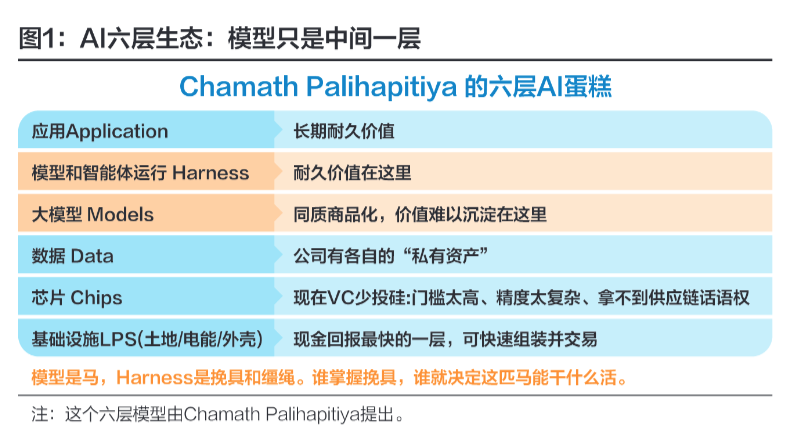
AI is not merely a model but an interdependent ecosystem. Jensen Huang summarizes this as five layers: electricity, chips, infrastructure, foundation models, and applications. Chamath Palihapitiya goes further by separating data and the Harness into their own layer, forming a six-tier structure, as shown in Figure 1. The Harness layer is distinctive in that it coordinates the operation of different models and agents; if models are the horses, the Harness is the tack and reins that determine how they work. The technological frontier and where value accumulates do not necessarily reside in the same layer: models set the ceiling on intelligence supply, but durable customer lock-in can occur in the Harness and application layers. A major power's AI strength depends on whether the entire ecosystem is robust and forms a closed loop, not on its ranking in any single layer. Different layers offer different opportunities for capital, entrepreneurs, and individuals. Currently, the most active startup activity in Silicon Valley is concentrated in the relatively asset-light Harness and application layers, where founders are trying to convert general-purpose intelligence into concrete business value; the advantages of large capital, by contrast, are more evident in capital-intensive areas such as infrastructure buildout, continuous model training, and platform ecosystem expansion.
Dong Jielin Mapping
A select group of top-tier talent can command substantial premiums across the chip, model, and platform layers by virtue of their scarce capabilities. At the same time, while users reap the benefits of AI's widespread availability and falling prices, they may pay the price through personal data, attention, and platform dependency. As workers, they also face risks of job displacement, income divergence, and diminished bargaining power.
In a layered comparison, China and the US currently have their respective strengths: the US possesses the most advanced chips, the strongest cutting-edge closed-source models, abundant private capital, and a high-quality enterprise software market; China has more abundant electricity, faster infrastructure construction, stronger manufacturing organizational capabilities, and has temporarily gained an advantage in the global expansion of open-weight models. American workers have earlier access to the most powerful tools and also face earlier pressure from high-wage jobs being replaced; Chinese workers use models at a lower cost, but whether this can be translated into wages, entrepreneurship, and career advancement depends on the market and institutions.
Recently, model capabilities have been gradually converging, but the physical foundations supporting AI development in China and the US have not been synchronously approaching each other. The core bottlenecks faced by the two countries are not at the same level: for China, the main constraint comes from advanced AI chips, which are affected by US export controls and limited by domestic chip performance, production capacity, and supporting ecosystem. Meanwhile, China has stronger power generation and engineering construction capabilities. The US, although having relatively sufficient high-end chips, faces constraints such as power supply, grid connection approval, and data center construction in terms of infrastructure.
These constraints at different levels will ultimately be reflected in the construction speed and effective computing power deployment scale of AI data centers. As shown in Figure 2, based on a unified standard of peak FP16 computing power for scenario estimation, the US is expected to have AI computing power approximately 16 times that of China by 2025; this gap may expand to around 25 times by 2027. While long-term predictions are subject to significant uncertainty, it is still a relatively stable judgment that the US will maintain a lead of roughly one order of magnitude over the next three to five years.
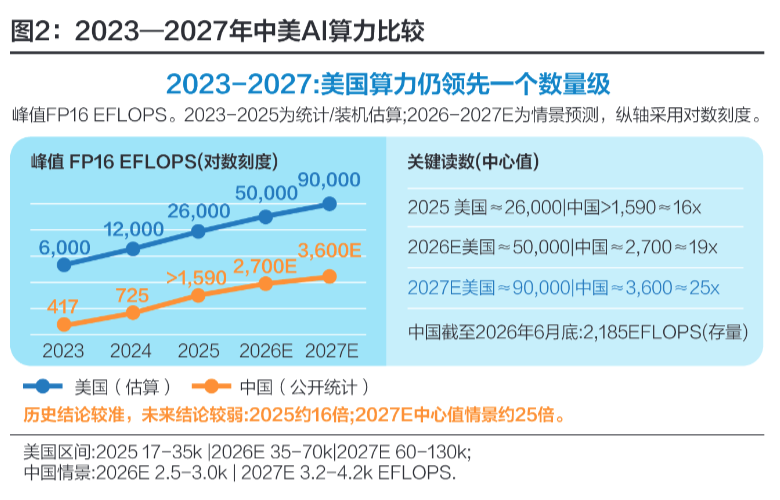
Figure 2 data explanation: China's 725.3 EFLOPS and 74.1% year-over-year growth rate in 2024 come from IDC and Inspur Information, which can be used to estimate around 417 EFLOPS in 2023; data for 2025 and the first half of 2026 come from the Ministry of Industry and Information Technology and the State Council Information Office. US data from 2023 to 2025 are based on EpochAI's chip and data center information, estimated using H100 equivalent computing power and major cloud vendors' global market share. The 2026-2027 data are scenario predictions. Although the data for both countries are unified in peak FP16 EFLOPS, the original calibers are different and are only suitable for judging the order of magnitude. Chart created by Dong Jielin.
Constraints not only determine "how much can be done," but also change "how to choose." US companies in an environment with relatively abundant computing power tend to expand in scale and build ultra-large clusters, but electricity and grid connections will restrict speed; Chinese companies, on the other hand, develop efficiency approaches such as distillation, sparsification, quantization, and inference optimization under chip constraints. As a result, constraints are incorporated into a company's business model and the solutions of a generation of engineers, and even if they are lifted later, path dependence may not be easily made up for.
The constraints between the two countries will ultimately translate into personal costs: in the U.S., the gains are likely to accrue to a narrow set of technology and capital owners, while in China, the costs of redundant construction, adaptation, and catch-up are likely to be passed on to individuals through public capital, profit pressures, and labor intensity.
The Open-Weight Paradox: Distribution Advantage Isn't a Commercial Win
Qianwen, DeepSearch, Moonlight and Zhiguang, among other Chinese large model vendors, have rapidly entered the global developer community by opening up their model weights, offering low-cost calls, and building toolchains. As model capabilities gradually approach parity and call prices continue to decline, open weights have lowered the threshold for developers to try out, modify and deploy models independently, becoming the most internationally influential competitive approach for Chinese AI at present.
According to a report by Hugging Face, Chinese-sourced models accounted for 41% of the platform's model downloads over the past year. As of April 2026, the cumulative download volume of the Thousand Questions family approached 1 billion times. On the calling side, DeepSearch became the largest supplier on OpenRouter with approximately 16.3% of the token share. Although the data from different platforms cannot be combined, they collectively indicate that Chinese models have gained significant global distribution advantages. For China, open-source weights not only bring model adoption but also expand technological influence and strategic space.
However, there is a paradox here: the overseas distribution and use of China's open models still rely to a considerable extent on US-dominated infrastructure. Weights are disseminated through Hugging Face, calls are made through platforms such as OpenRouter and Vercel to enter inference services, which in turn largely run on NVIDIA systems. Chinese companies provide the models, while the US ecosystem provides the developer entry points, computing power, cloud services, routing, and payment channels; the more Chinese models are used, the more likely it is to increase the revenue of US infrastructure companies.
Note that downloads do not equate to deployment, deployment does not equate to sustained usage, and the number of calls does not equate to revenue. According to Vercel's data, China's open models account for about one-third of the Token usage on its gateway, yet correspond to less than 4% of user expenditure. Open weights can bring in developers, reputation, and ecosystem entry points, but also weaken the ability to charge directly, making it easier for customers to replicate, modify, or replace models.
Thus, the country can gain influence from technological diffusion, while model companies bear the costs of training, toolchains, and low-priced APIs, with a significant portion of the value possibly flowing to chip, cloud, inference, routing, and Harness and application companies. Currently, China has won an advantage in model distribution, rather than the entire value chain; whether it can be converted into company revenue and the country's complete technological capabilities depends on whether it can transition from downloads to deployment, from usage to payment, and from productivity gains to profit distribution.
For users, open-source weights lower the thresholds for learning, experimentation, and entrepreneurship, and reduce dependence on a single closed-source platform; however, having access to capabilities does not necessarily translate to increased income. Developers may still lack clients and distribution channels, workers may not share in the productivity gains despite increased output, and ordinary users may be exposed to risks such as data breaches, fraud, and model misuse.
When token prices plummet, the rules of competition will be rewritten
In recent years, the most significant change in the AI industry has not only been the improvement in model capabilities, but also the rapid decline in the cost of achieving equivalent intelligence. As shown in Figure 3, over the past three years, the token price required to achieve similar capabilities has dropped by more than two orders of magnitude. If this trend continues, a few months of technical lead will become increasingly difficult to automatically translate into lasting business value.
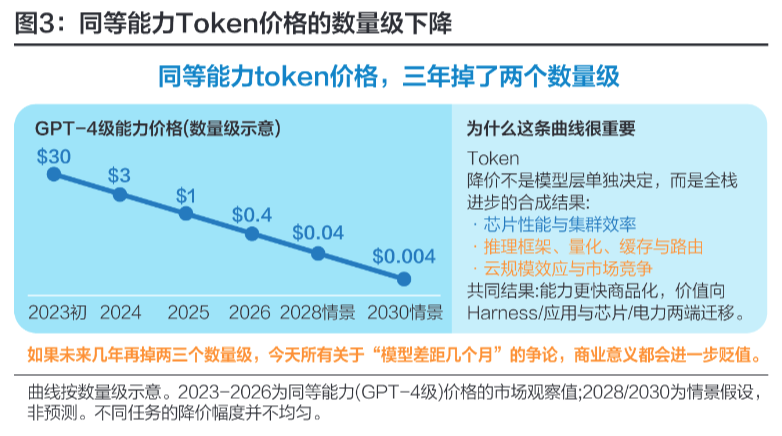
Figure 3 data explanation: The data from 2023 to 2026 is based on a comprehensive model of publicly available API prices from manufacturers, as well as a performance analysis of ArtificialAnalysis and EpochAI with similar capabilities, indicating the representative token price required to reach approximately GPT-4 level capabilities. Related research shows that the inference price for the same capabilities decreases by about 5-10 times every year, but there are significant differences in tasks. The values for 2028 and 2030 are stress-tested with a decrease of one order of magnitude every two years, and are not predictions. Chart created by Dong Jielin.
The decline in token prices is not solely the result of the model layer, but rather the product of progress across the entire ecosystem: continuous improvements in chip performance, cluster interconnect, and utilization; quantization, sparsification, speculative decoding, caching, and routing that reduce the computation required for inference; cloud platforms that raise device utilization; and model architectures and training methods that enable smaller models to achieve capabilities that previously only large models could deliver. In recent years, the pace at which token prices have fallen for equivalent capability has far outpaced the hardware performance gains that Moore's Law alone can explain.
The market competition has further accelerated the price reduction. As more models reach similar capabilities, manufacturers find it difficult to maintain high prices solely based on being "smarter", and instead have to compete for users through price cuts, free quotas, and product bundling. Therefore, the price reduction of tokens is both a result of technological advancements and competition, and indicates that some general capabilities are becoming commoditized; however, if a breakthrough in AGI-level capabilities that is difficult to replicate emerges, the scarcity and pricing power of models may rise again.
By the end of July 2026, OpenAI made GPT-5.6Luna the default free model for ChatGPT Free and Go users, and reduced the API input and output prices to $0.2 and $1.2 per million tokens, respectively, indicating that leading US companies have started to compete for mass users, developers, and global distribution channels with free products and significant price cuts. Meanwhile, several Chinese model manufacturers have announced price increases, with DeepSearch's new prices taking effect on August 17.
Low-priced tokens do not equate to low costs. It is necessary to distinguish between the price of tokens paid by customers, the cost of achieving a certain model capability, and the unit effective computing power cost of completing the same amount of training or inference workload. The former is affected by subsidies and competition, while algorithm optimization can reduce the second item without necessarily making the underlying computing power system cheaper. To measure the economic efficiency of the underlying computing power, the total cost of ownership (TCO) should be compared, including chips and depreciation, power and cooling, interconnection and storage, data center facilities, as well as software adaptation and maintenance; and then divided by the actual effective workload completed by the system, in order to obtain a comparable unit effective computing power cost.
Chinese AI companies have certain advantages in terms of labor, engineering construction, and algorithm efficiency, such as distillation, quantization, and sparsification, which can reduce adaptation and maintenance costs. However, in the key link of underlying effective computing power, domestic platforms still face shortcomings in terms of single-card performance, chip interconnection, cluster stability, and software maturity, resulting in the need for more hardware, electricity, and engineering resources to complete the same tasks. The lower utilization rate also means that theoretical computing power cannot be fully converted into usable throughput. If they choose to use NVIDIA platforms directly, they would have to face issues such as downgraded models, export licenses, and scarcity premiums. Due to these overall disadvantages in software, hardware, and ecosystem, some of the efficiency advantages are offset, and some public system comparisons show that the unit effective computing power cost of domestic AI stacks may still be significantly higher than that of NVIDIA platforms when completing the same effective training or inference workloads.
The recent price hike by Chinese model companies is likely the result of multiple factors: the withdrawal of subsidies, rising training and service costs, limited capacity, shareholders' increasing demands for revenue and profit, and the gradual reflection of full-stack TCO in product prices. The low prices of Chinese models are not entirely without an efficiency basis, but the price advantage is greater than the underlying cost advantage, and the difference must be made up for by sacrificing profit and capital returns, making price hikes inevitable.
Where is value precipitating? The reshuffling of application ecosystems, markets, and capital
In the absence of breakthroughs at the AGI level that would reopen the gap between models, the new value added by AI may shift more towards the harnessing and application layers, which master customer data, business processes, specific scenarios, and distribution channels. Harnessing and application determine how capabilities enter the business, reach users, and precipitate value; the market determines payment demand and revenue space; and capital determines the flow of resources and the shape of enterprises.
Harness and application control are crucial for maintaining customer stickiness and entry points.
Harness is responsible for connecting models to enterprise data, permissions, software, and business processes, turning output into actionable results. Applications, on the other hand, package capabilities into products that users can directly adopt, controlling specific scenarios, interactions, distribution, and customer relationships. Since enterprise data and processes are difficult to migrate, and user habits, brands, and channels are hard to replicate, even if the underlying models can be replaced, Harness and applications can still form stable stickiness.
From the perspective of national competition, Harness determines how intelligence is integrated into the business processes of enterprises and public organizations, while applications determine who controls user entry points, usage scenarios, and data feedback loops. Therefore, these two levels are crucial for converting model capabilities into real productivity, economic value, and organizational capabilities, and are also important focal points for data control and data sovereignty.
For individuals, Harness and applications together determine whether AI acts as an assistant, a supervisor, or a replacement. Data permissions, performance metrics, and automation boundaries shape employees' autonomy and bargaining power; product design, recommendation logic, and business models influence what tools individuals can access, how they are reached, and what they pay. Whether individuals benefit depends not only on their ability to use the models, but also on whether they can retain professional judgment, client relationships, choice, and the right to share in returns.
The market determines a business's compound interest and potential for monetization
The market determines how much revenue AI can generate after its implementation. In the US, companies have high enterprise software budgets, mature subscription habits, and expensive white-collar labor costs. As long as AI can replace some software functions or reduce the working hours required for programmers, analysts, lawyers, or customer service representatives, companies have a clear incentive to pay for it. The revenue can then support the next round of investment in computing power, research and development, and services, creating a commercial compounding effect. This is the current market foundation for Coding Agent to become an AI "super application" in the US.
China has a vast array of application scenarios and strong deployment capabilities, but enterprise software budgets are typically low, and the cost of intellectual labor is also relatively low, which is why super enterprise applications have yet to emerge. If the cost of purchasing tokens, modifying software, and reshaping processes is higher than increasing manpower, clients lack the motivation to pay. The government and enterprise market can provide early customers, but customized projects are difficult to replicate at a low cost like standard software. The difference in market quality between China and the US is also an important reason for Chinese model companies to go overseas as early as possible. Additionally, the consumer side can rely on advertising, e-commerce, and traffic monetization - China's super apps in the internet era have emerged on the personal consumer side.
Corporate returns do not equal personal returns. A company's adoption of AI may either increase employee output and income or reduce positions, with the productivity gains largely accruing to shareholders. Whether individuals benefit depends on whether their skills are scarce, whether they own customer relationships or capital, and how the additional returns are distributed.
Capital determines the direction of a company's growth
Capital flows into the U.S. AI ecosystem come primarily from venture capital, public equity markets, and massive capital expenditure by hyperscale tech companies, with resource allocation typically favoring technological frontiers, high growth, and business revenue that can scale globally. Chinese AI companies, by contrast, draw funding from state industrial funds, internet companies, local governments, and venture capital firms. Beyond commercial returns, some of this capital also carries objectives around technological self-reliance, industrial localization, and building national strategic capabilities. Notably, the influence of government capital often extends well beyond its direct equity stake: subsidies, procurement, market access, policy signals, and follow-on financing can all amplify its impact on corporate decision-making. These differing capital structures in turn shape different corporate objectives and push companies toward different customers, products, and development paths. As model capabilities converge while training and serving costs remain high, capital is more likely to flow to companies that control cloud infrastructure, traffic, customers, data, harnesses, and application entry points.
For individuals, the allocation of capital ultimately translates into career opportunities, income returns, and risks. The US system may create a small number of high-paying research, engineering, and entrepreneurial positions, but it also quickly lays off, acquires, or consolidates when growth is lower than expected, resulting in highly concentrated and volatile individual opportunities. In contrast, China's employment opportunities may be more focused on the implementation of government-enterprise projects, industrial deployment, and localization, but individuals have relatively limited space to obtain excess returns and cross-market mobility, and career prospects are also more easily affected by policy direction, government procurement, and local investment cycles.
Future Industry Projections: Three Predictions on Open Weights, Restructuring, and the AI Frontier
Prediction One: US Open-Weight Camp Expands, Global Token Share Faces Major Reshuffle
On August 10, 2026, Meta announced it would open the weights of its flagship MuseSpark 1.2 model, a clear signal that the U.S. is answering China's camp with high-quality open-weight models. The next question to watch: how many top-tier models will follow suit, and once opened, who will capture more token distribution, developers, and ecosystem entry points.
This prediction includes three layers of judgment: first, the US will have more top-level models with open weights, and will drive a significant increase in the token share of US open models in major routes, cloud platforms, and AI gateways; second, Chinese open models such as Qianwen, DeepSearch, and Moon Dark Side will compete more fiercely with each other, while the direct commercial pressure on US leading companies will mainly come from low-priced US competitive models; third, US models will still be selectively open rather than fully open, and cutting-edge capabilities with high biosecurity, network security, or autonomous agency risks may continue to remain behind closed-source controlled APIs.
Falsification criteria: within the next 18 months, the token share of US-sourced open models on major global platforms does not rise significantly, or Chinese models do not substantially squeeze the revenue of US model companies.
Predictions II: The model layer will first experience two years of intense competition, followed by a period of integration
Over the next two years, Chinese and American large-model companies will remain locked in intense competition and sustained investment. By around the end of 2028, if no AGI breakthrough emerges that could reshape the competitive landscape, then as model capabilities further converge and room for differentiation narrows—while training, inference, and continuous iteration costs stay high—companies lacking stable revenue, capital support, or distinctive capabilities may find it hard to survive. At that point, both the Chinese and US model layers could begin to see closures, mergers, and consolidation.
If a company achieves a decisive AGI breakthrough first, scarcity at the model layer will rise again. In that scenario, consolidation will still occur, but it will primarily take the form of capital, talent, and customers accelerating toward the technology leader, while laggards are quickly eliminated.
Falsification criterion: A period after end-2028 in which neither the US nor Chinese ecosystem produces multiple verifiable model-layer acquisitions, mergers, or standalone business closures, and independent model companies still generally rely on model revenue for growth.
Prediction 3: In the future AI world, the dividing line between China and the US will resemble the boundaries of the internet.
Today's internet landscape broadly divides into regions dominated by American platforms, China's independent system, and a hybrid zone that uses technology from both countries. The AI landscape is likely to replicate this map, with technological affiliation determined not just by model technology but also by chips, cloud, payments, app stores, data rules, government procurement, and security standards.
This boundary will directly determine which tools individuals can use, whether data can cross borders, which markets skills are transferable to, and where startup products can be sold. In the short term, the U.S. is unlikely to ban Chinese models, because the value they create through the catfish effect, open weights, local deployment, and supplier choice may still outweigh market and security costs. But this tolerance is conditional. Once Chinese models cause visible security, industrial, media, or political problems—and the geopolitical faction gains the upper hand—policy could escalate from restriction to outright ban.
This line wasn't drawn through pure free-market competition—the government's hand has never been absent. The U.S. prioritizes national security and market access; China emphasizes model access, exports, and content and social controls; Europe stresses risk-tiered regulation. Their regulatory approaches differ, yet all raise the institutional cost of cross-border deployment.
Falsification criterion: This assessment would need revision if Europe, India, or others form a third pole not dependent on the U.S., or if the Chinese tech stack becomes dominant in multiple large economies where Chinese internet companies have yet to establish a presence.
The Endgame Victory and the Questioning of Three Scorecards
In the years ahead, both the United States and China will likely declare victory in the AI race—but the structure of that victory will differ profoundly. America is more apt to define winning in terms of capital returns, scientific breakthroughs, and the expansion of individual capability. China, by contrast, is more likely to measure victory through industrial scale, technology diffusion, state organizational capacity, and the ability to shape social order. American strengths tend to crystallize into priced, compounding commercial wealth; China's advantages manifest more as national capability and strategic influence that resist direct valuation. The same technological revolution may reinforce each system's原有 trajectory, thereby shaping two distinctly different future societies.
Yet whichever side claims victory, the three scorecards—companies, nations, and individuals—interact with one another but cannot substitute for each other. An American AI company can reap staggering profits and market value while simultaneously displacing large numbers of white-collar jobs and concentrating the productivity dividend in fewer hands. China can harness AI to strengthen its manufacturing and governance capabilities, yet for many ordinary people, employment, income, job security, and autonomy may not improve in step—and may even suffer as a result. A corporate win does not necessarily mean a national win; a national win does not necessarily mean a win for ordinary citizens.
More importantly: What kind of future will each country build with AI? Who captures the productivity dividends? Who bears the technological risks and consequences? And as national capabilities grow, do they simultaneously expand ordinary people's opportunities, choices, and dignity?
In this relentless AI wave, everyone should regularly ask themselves: Am I a winner?
(The author is a writer on technology policy and the history of technology, and has written "A Brief History of Human Technological Innovation: The Power of Desire," which traces the history of human innovation.)