Musk doesn't leave much room for the future.
While many people are still discussing whether AI will take away some jobs, he has already started calculating output for 1 billion robots.
On September 1 local time, Musk attended the G20 Innovation Ministerial Meeting in Chapel Hill, North Carolina, via video, where he presented three numbers to officials and tech company executives from around the world.
By the end of 2027, AI may be capable of completing almost all digital work; the productivity gains brought by AI may drive the global economy to grow by 20% to 30%, equivalent to an annual increase of approximately $20 trillion to $30 trillion in output; in the next decade, the number of humanoid robots worldwide may exceed 1 billion units.
In Musk's vision, these robots are not just standing on a stage dancing, but will enter factories, warehouses, stores, and homes. More remarkably, he estimates that one robot's output could be equivalent to five times that of a human worker.
According to this algorithm, 1 billion robots would be equivalent to 5 billion laborers, which is no longer a simple prediction of robot sales, but a reevaluation of the future global workforce.
1 Billion Humanoid Robots
What is Doubao?
Based on current global population calculations, there is approximately one humanoid robot for every 8 to 9 people.
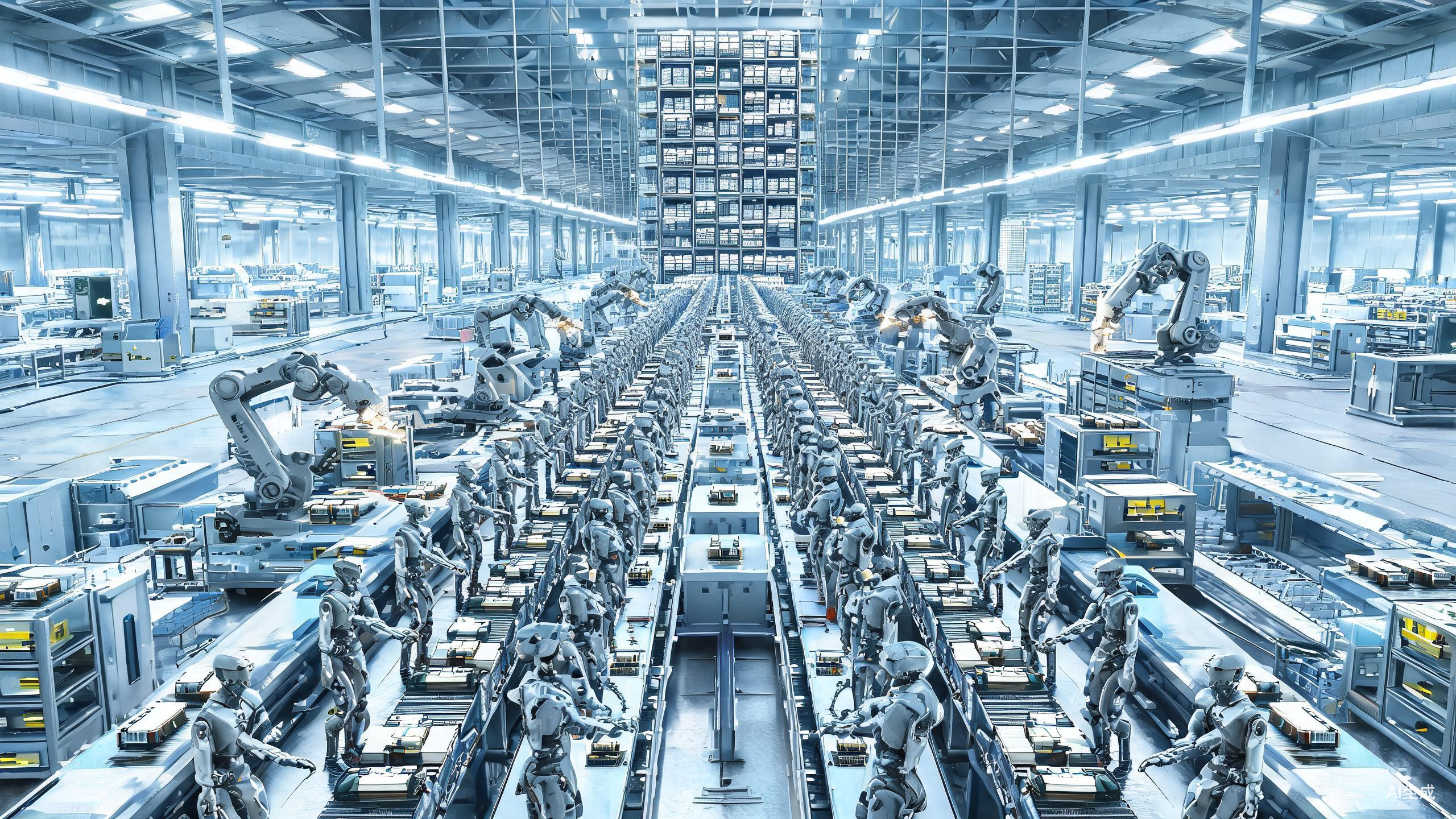
If 10 billion units were evenly distributed over the next decade, that would be equivalent to producing 100 million units per year, or approximately 274,000 units per day. In 2025, global automobile production was approximately 96.4 million vehicles. In other words, humanity would need to replicate a manufacturing system of similar scale, outside of the automotive industry, specifically for producing humanoid robots.
This means that what is being rebuilt is by no means just a robot assembly line.
A full-size humanoid robot requires dozens of joints, as well as gearboxes, frameless torque motors, ball screws, dexterous hands, sensors, computing chips, and power batteries, followed by a system for maintenance, charging, software updates, data training, and after-sales service.
Behind 1 billion units may be an industrial network that is even larger than today's automotive industry.
However, Musk's timeline is noticeably more aggressive than that of mainstream institutions. Morgan Stanley had previously predicted that the global holdings of humanoid robots could reach around 1 billion units, but the corresponding timeline was 2050. The institution believes that the popularization of humanoid robots will remain relatively slow until the mid-2030s, and will only accelerate significantly in the late 2030s and 2040s.
Musk has essentially moved up this timeline by over a decade. With time compressed, problems have also emerged: is the global humanoid robot industry really ready to produce 100 million units per year?
Robots in Real Life
Still Far From Musk's Goal
Reuters previously visited a robot training center in Liuzhou, Guangxi, and found trainers repeatedly teaching robots to sort boxes, package food, and make coffee.
A novice operator may need to attempt 300 times to get one usable action, while even an experienced operator may need to try 50 times. The speed or output at which robots complete simple tasks is roughly only 20% that of humans.
On one hand, there is a 20% reality, and on the other, a 500% vision of Musk's, with a 25-fold difference in between.
Advances in hardware are now visible to the naked eye, with robots able to run, do flips, and even achieve records in 100-meter dashes that surpass those of human athletes. However, what factories truly care about is not whether a robot can complete a single action, but whether it can work continuously for over a dozen hours every day without making mistakes, even when faced with changes in position, lighting, and materials.
Currently, the shipment scale of humanoid robots is still far from reaching the level of consumer-grade industrial products. According to research data from Bank of America, the global shipment of humanoid robots is expected to be around 20,000 units in 2025, with Chinese companies accounting for about 95%. The institution predicts that by 2030, the global annual shipment may reach 1.2 million units.
1.2 million units is not a small industry, but it is still about 83 times short of the scale envisioned by Musk, who aims for an average of 100 million units per year.
Tesla's own Optimus is also still in the process of crossing this chasm.
According to Tesla's 2026 second-quarter update, the first-generation production line for Optimus is still being installed and is preparing for production within the year. So far, Tesla has not officially announced the third-generation Optimus, nor has it disclosed actual production volume, manufacturing yield rate, or external commercial delivery data.
Musk had previously set the long-term sale price of Optimus at around $20,000, but Morgan Stanley estimates that the hardware material cost alone for a second-generation Optimus could reach $50,000 to $60,000 during the low-volume production phase.
From a production cost of over $50,000 to a selling price of $20,000, and from one production line being installed to a shipment of 1 billion units, what lies in between is not just technological advancements, but also cost, production capacity, reliability, and actual orders. 1 billion robots will not be unveiled one by one at a launch event, they need to be squeezed out from the yield rate of factories, the budgets of customers, and the balance sheets of enterprises.
Why Musk Remains So Optimistic
The answer is first AI.
In his judgment, by the end of 2027, AI may complete all digital work that does not require direct operation of physical objects, including a large number of programming, design, analysis, and engineering tasks.
If AI can solve the problems of robot understanding, planning and learning, the deployment method of humanoid robots will change. Companies will no longer need to write fixed programs for every action, but instead can enable robots to learn new tasks through demonstration, language or a small amount of data.
In the past, a robot switching to a new workstation would require reprogramming; in the future, it may be able to learn like a new employee.
This is also the premise for the productivity leap that Musk talked about to truly take hold. Robots do not get tired and can work in shifts; software capabilities can be replicated in bulk, with a single model upgrade able to simultaneously improve a large number of devices.
But in this speech, Musk also proactively mentioned another practical issue: electricity.
He warned that the AI industry may face a significant power shortage as early as 2027, as training models requires data centers, driving billions of robots requires energy, and producing chips, batteries, and robot bodies themselves also requires massive power supplies.
In Musk's view, China has gained an advantage in terms of power construction and manufacturing capabilities, and other countries need to increase new energy supply as soon as possible.
He is calling on regulatory bodies to take a "presumed legitimate" approach to new technologies like AI, rather than banning them first and waiting for companies to prove they are safe. He also criticized some of the EU's tech regulatory policies for stifling innovation. This makes Musk's prediction of 1 billion robots not just a technological fantasy, but also a plea to governments around the world: to relax regulations, increase energy supply, build data centers, and lay the groundwork for the next wave of automation.
Of course, Musk's timelines have always been more aggressive than reality.
Throughout the development of Tesla's autonomous driving, Robotaxi, and Optimus initiatives, targets have slipped. At the same time, however, the seemingly distant figures he has floated do shape the moves of capital, supply chains, and competitors.
For the robotics industry, whether 1 billion units can ultimately be achieved before 2036 may not be the most pressing issue at present.
What is truly worth observing is when the global annual shipments of humanoid robots will increase from 20,000 units to 1 million units; when robots will be able to improve work efficiency from 20% of that of humans to being on par with humans; and whether enterprises can actually reduce costs after purchasing robots, rather than just adding a display item to their exhibition hall.
When these issues are addressed, humanoid robots can transition from being a future concept of tech companies to a genuine industrial product. The arrival of 1 billion robots may not be imminent, but Musk has put the clock in front of everyone.