
Alibaba has already mapped out a complete picture of the Token economy with its organization, capital, and traditional businesses, and next it needs Qianwen Office and Qianwen App to prove that this is not just a cloud computing business.
After this earnings season, Alibaba's determination and the appearance of the "new Alibaba" have become even clearer.
On August 26, Alibaba completed a rare large-scale financing in the Hong Kong stock market in recent years: issuing 710 million new shares at HK$112.7 per share, raising a total of approximately HK$80 billion. According to the announcement, the funds will be used entirely to expand global computing power, build ultra-large-scale AI data centers, and upgrade storage, databases, and high-performance networks, ultimately targeting an Agentic Cloud architecture.
This financing took place after Alibaba's financial reporting structure adjustment and a rapid increase in capital expenditures.
In its new financial reporting structure, Alibaba has reorganized its business into four segments: Alibaba E-commerce Group, comprising domestic and international e-commerce, Freshippo, and other businesses; AI Cloud and Computing, consisting of Alibaba Cloud and Damo Academy; AI Lab and Applications, comprising Model Lab, Tianxiang Consumer Business, and Tianxiang Office; and "All Others", which includes Alibaba Health, Whale Entertainment, AutoNavi, and other businesses.
This architecture more clearly outlines a basic path to the AI era's "new Alibaba": using e-commerce to nurture investment, establishing a foundation with cloud, chips, and models, and then seeking new products and business models through Qianwen Office and Qianwen App, reorganizing the overall business around the production, supply, and consumption of Tokens.
Along this path, Alibaba is also increasing the intensity of its capital investment. In the first quarter of the 2027 fiscal year, Alibaba's capital expenditures reached 67.678 billion yuan, higher than the 38.676 billion yuan in the same period last year; the company had a net outflow of 44.67 billion yuan in free cash flow. Since announcing a three-year investment of 380 billion yuan in 2025 to build AI and cloud infrastructure, Alibaba has become increasingly close to being a capital-intensive company.
However, the "new Alibaba" still has a strong visionary tone and needs to gain more business validation. AI Cloud and computing power services revenue grew 45% year-over-year, with adjusted EBITA increasing 133%; but AI Labs and application revenue was only 33.38 billion yuan, with adjusted EBITA losses reaching 13.861 billion yuan.
This means that Alibaba has so far only proven that selling tokens can be a lucrative business in the short term, but has yet to validate whether tokens can become a core driver of the entire Alibaba economy.
However, this is a story that Alibaba must tell to the capital market. Also evident in this quarter's earnings report is an 8% decline in Alibaba's China e-commerce revenue and a 7% drop in customer management revenue (CMR). Excluding the impact of adjusting some merchant subsidies from sales expenses to revenue deductions, CMR grew 1% on a comparable basis; however, this growth rate slowed significantly from 8% in the previous quarter. Traditional e-commerce advertising and commission revenue clearly cannot deliver larger growth space in the future, even with the addition of instant retail's incremental growth.
Investors and Alibaba are both looking for new growth stories that can replace traditional e-commerce. Instant retail and AI were once key investment areas, but after this earnings season, AI has been elevated to a higher-level group priority, while instant retail has become part of the consumer business, continuing to provide high-frequency demand and fulfillment capabilities for AI-based living scenarios.
This is a transformation that must be completed to move toward the future, and Alibaba is clearly willing to stake more chips on it.
Gradually Clarifying Strategic Objectives
This transformation is first reflected in Alibaba's increasingly high positioning of AI.
In 2024, Alibaba still defined e-commerce and cloud as its two core businesses, with AI primarily used to transform search, recommendations, and merchant operations, while driving cloud computing demand. By 2025, Alibaba's strategic focus had shifted to e-commerce and "AI + Cloud" as its two main engines, with AI beginning to emerge as an independent growth curve.
At the beginning of 2026, Alibaba redefined Agent as the primary medium for human interaction with the digital world, with Token becoming the basic unit for Agent operation and commercialization, and drove the establishment of the ATH business group, reorganizing models, MaaS, and AI applications based on the logic of creating, transmitting, and applying Tokens.
The latest financial report's structural adjustments indicate that Alibaba has transitioned from "using AI to transform its business" to "organizing its business around AI". Ultimately, it is betting that AI will change the way users present demands, platforms organize supply, and commercial value is distributed.
Wu Yongming said on the earnings call: "AI cloud is like a super city, workloads are residents, and continuously iterative full-stack AI cloud services are the city's infrastructure. The infrastructure in turn attracts more new residents and increases the stickiness of existing residents, with a very strong network effect and scale effect."
The "new Alibaba" will take root in this super city, becoming its business system.
The "residents" of this city ultimately correspond to users, merchants, enterprises, and developers in different vertical scenarios, as well as the training, inference, and Agent tasks they generate. The more residents there are, the more tasks and Token demands are generated; as Token consumption grows, it increases the utilization rate of computing power and infrastructure, driving down costs and capability iteration; more mature infrastructure continues to attract new scenarios and residents.
This is the kind of transformation the "new Alibaba" is seeking. In the past, Alibaba's network effects mainly came from Taobao and 1688 - more supply attracting more users, and more users in turn attracting more merchants. In the future, Alibaba hopes to use AI infrastructure to attract more vertical scenarios, allocate demand to these scenarios through a unified task entrance, and then use vertical execution capabilities to convert tokens into products, services, and operational results, forming a new network effect.
In line with this transformation, Alibaba has prioritized capital investment over commercial returns. Management said on a conference call that based on the current gross margin of AI products and a three-year payback period, theoretically, if business growth is controlled below 33%, cash flow can turn positive.
However, this is not our strategic choice at this stage. AI is still in its very early stages, and we have decided to actively invest in CapEx and proactively expand our scale to drive rapid business growth.
Alibaba is also continuing to adjust its existing businesses. Following the sale of Intime Retail and Haisheng Retail, Alibaba has sold Lingxi Interactive Entertainment, which has mature products and stable cash flow. Compared to simply clearing out inefficient assets, this choice better reflects Alibaba's efforts to concentrate its resources on its core mainline: even profitable businesses that lack long-term synergy with the Token cycle may be reevaluated.
The intensity of investment in instant retail has shifted as well. Alibaba is no longer seeking heavy investment in both AI and instant retail simultaneously. Taobao Flash Purchase has begun emphasizing market-share maintenance, unit economics improvement, and loss reduction. The easing of price competition will free up more resources for AI. Still, instant retail remains a cornerstone of Alibaba's "gateway to daily life" strategy—its high-frequency demand, instant supply, and fulfillment network will become real-world capabilities that AI can draw upon in life scenarios.
In the past, Alibaba mainly expanded its business around e-commerce, but now all its businesses need to reposition themselves around AI.
Alibaba is betting that AI will transition from a technological capability to the next-generation business infrastructure, thereby rebuilding the group's growth cycle and providing an opportunity to redefine the boundaries of its business. It has also demonstrated its determination through strategic, organizational, and capital investments.
The Three-Tier Structure of 'New Alibaba'
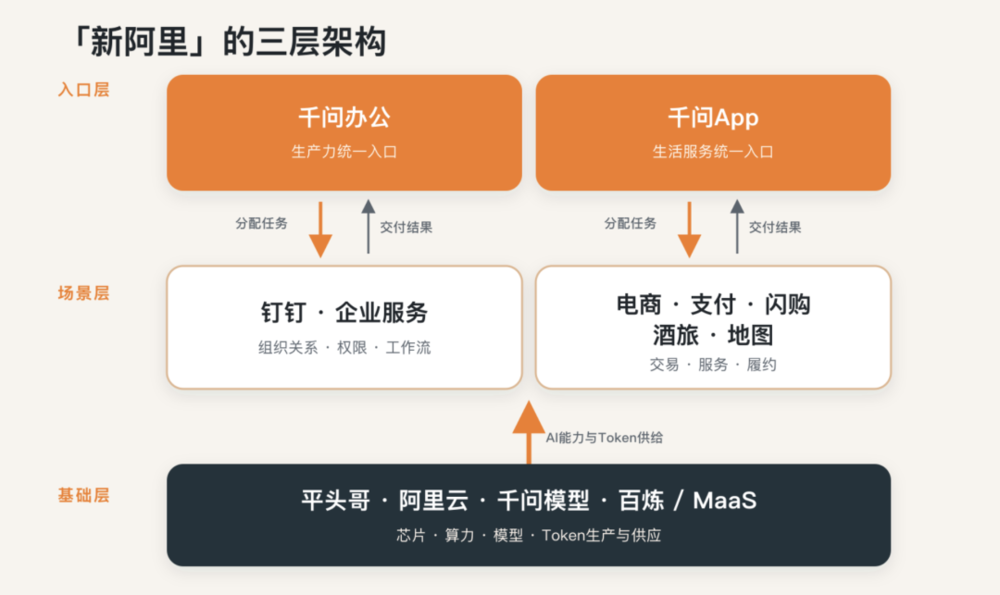
The next question is how these businesses will be recombined to form an infrastructure centered around the Token. Based on Alibaba's vision, the new architecture can be broken down into three layers.
The bottom layer is responsible for establishing the production and supply capabilities of Tokens. Pingtouge provides chips, Alibaba Cloud organizes computing power, storage, network, and scheduling, the Qianwen model converts computing power into intelligence, and MaaS supplies this intelligence to enterprises and developers.
This layer has been the first to achieve commercial verification. Over the past eight quarters, the external commercialization revenue growth of Alibaba Cloud has increased from 7% to 45%. In the latest quarter, the adjusted EBITA profit margin of AI cloud and computing power services rose to 11.6%. The growth driven by AI is comprehensive and not limited to model API calls. Enterprises may initially purchase AI computing power for quality inspection, research and development, or customer service, and after achieving effective AI applications, they will also increase demand for CPUs, storage, databases, and networks to better utilize AI.
Pingtou Ge is responsible for reducing costs and ensuring supply in this layer. As of early August, the Zhenwu M890 has been used by over 650 customers through Alibaba Cloud services. The proportion of self-developed chips in data centers has increased, which can also reduce external procurement, improve the cost per unit Token, and enhance cloud business gross margin. With over 3 billion downloads and 300,000 derivative models of the Qianwen model, it is responsible for expanding the developer ecosystem and directing more inference demands to MaaS.
The second layer consists of vertical businesses such as office services, e-commerce, payments, instant retail, travel and hospitality, and mapping. The third layer comprises entry-level applications like Qianwen Office and Qianwen App. These two layers need to work in tandem: Qianwen App and Qianwen Office are responsible for collecting intentions and assigning tasks, while the vertical businesses are responsible for delivering specialized capabilities and real-world results. The entry-level applications bring new users and tasks to existing businesses, which in turn supplement the lack of transaction, organizational, and fulfillment capabilities in general AI assistants.
Narrowcasting
Among them, productivity scenarios are more likely to achieve commercialization.
Qianwen Office has integrated the capabilities of Wu Kong, QoderWork, and MuleRun, and has begun to access the desktop and mobile versions of DingTalk. DingTalk provides enterprise organizational relationships, identity permissions, approvals, meetings, and workflows, while Qianwen Office reorganizes these functions into capabilities that can be called through natural language. This provides an opportunity to update the office work style: employees no longer need to open software layer by layer, and Agent can directly generate documents, update tables, submit approvals, or execute business tasks.
In contrast to life scenarios, AI's improvement in productivity scenarios is more apparent, more essential, and easier to achieve paid conversion. According to the management's disclosure, Alibaba's AI Agent, which is targeted at cross-border merchants, has attracted over 50,000 paying businesses. Ultimately, enterprises are purchasing the "employment fees" for work completed by AI, with Token call volumes serving as the underlying pricing basis.
Qianwen Office has now established a fee structure covering personal subscriptions, enterprise seats, and a credit-based system, while the international version, QwenWork, launched its public beta in August.
The commercialization path for lifestyle scenarios may be longer, but its imaginative space is also larger.
In real-life scenarios, Alibaba ultimately expects a shift where the shelf-based transaction paradigm is replaced by a new transaction architecture organized by AI. Users will no longer enter a virtual shelf to search for products and services, but instead express their scenario, budget, and constraints, and then have an agent organize products, merchants, and even manufacturing supply, and complete transactions by calling upon payment, logistics, and after-sales services.
This shift from passive response to proactive provision is the main thread that runs through the evolution of personalized marketing, social e-commerce, and short-video e-commerce, and is now driving the development of AI-powered e-commerce.
In terms of actual implementation, the Qianwen App has been integrated with Taobao, Flash Purchase, Alipay, Feizhu, and AutoNavi. Users can start by proposing their needs and complete the entire process of product inquiry, ordering, payment, and fulfillment. Alibaba disclosed that since the launch of the Qianwen App, 250 million users have completed their first AI-driven shopping experience.
This figure can prove that Alibaba has strong distribution capabilities, but it does not prove that the Qianwen App has become a stable entry point in daily life scenarios. The key going forward is whether the Qianwen App can convert these initial experiences into users' long-term usage habits, and gradually replace search boxes, shelf browsing, and even short video recommendations and social recommendations.
This also explains why Wu Yunming thinks APIs are just a transitional business model. If the business model stops at selling tokens, Ali Cloud or the Token Business Group would be sufficient; the mission of the group-level restructuring is to make tokens the core driving force for work, operations, and consumption through a three-layer architecture, rather than just a standalone technical service for sale.
From Strategic Blueprints to Product Validation
Alibaba's advantage in this round of AI competition comes first from its foundation.
It is one of the few Chinese companies with a layout that includes chips, cloud, models, and applications. In the short term, with value concentrated in chips and AI cloud, Alibaba can generate revenue through computing power and MaaS; when value shifts to models and applications, Qianwen Office, Qianwen App, and their underlying vertical businesses can undertake these values. As Wu Yunming said, regardless of which layer the commercial value of the AI industry flows to in different stages, these layers are all within Alibaba's ecosystem.
At the same time, Alibaba also has a rich array of vertical scenario businesses. In the productivity scenario, Alibaba has accumulated experience in the enterprise service field with DingTalk; in the life scenario, it has corresponding product layouts in e-commerce, payment, instant retail, travel and mapping, among other areas. This enables Alibaba to drive business collaboration from top to bottom when exploring Token-driven products and services, which has already been evident in the integration of service capabilities on the Qianwen App.
In addition, the pressure from e-commerce business has made Alibaba more urgent to complete this transformation compared to platform companies like Tencent. Tencent can still rely on WeChat, games, and advertising to generate relatively stable revenue and prioritize strengthening its existing platforms with AI. Alibaba's traditional e-commerce advertising and merchant monetization engine has slowed down, and it also faces competition from Pinduoduo, Douyin E-commerce, JD.com, and Meituan, as well as common pressure from changes in the macro environment, and needs to rely on AI to reconstruct transaction entry points and links to gain a competitive advantage.
However, the pressing issue for Ali is that it currently presents a strong strategy, mediocre execution, and unverified product advantages.
At the strategic level, Alibaba has clear goals and makes massive investments; at the execution level, Alibaba acts quickly and makes frequent adjustments; at the product level, Qianwen App and Qianwen Office are still in intense competition with multiple parties and have yet to establish a stable user mindset and a verified competitive advantage in the market.
This is the part that worries those who are willing to believe in Alibaba's AI vision the most. Alibaba is better at making strategies, building infrastructure, and mobilizing group resources, but product competition and user operations have long been questioned by the outside world. The Agent product still needs to continuously understand user intentions, organize complex capabilities, and deliver results in a simple enough way, while forming a user mindset in competition, which will pose a challenge to Qianwen Office and Qianwen App.
The continuously rising capital investment has also brought the pressure of business verification to the forefront. The growth in Alibaba Cloud's revenue has proven that the demand for infrastructure is real, but this growth still needs to continuously cover the ever-increasing capital expenditures; the AI lab and application's single-quarter loss of 13.861 billion yuan, on the other hand, means that the application layer has yet to form a healthy return path.
Once the growth of its cloud business or the commercialization of its apps falls short of expectations, Alibaba will face a more difficult trade-off between continued investment, controlling losses, and maintaining its e-commerce competitiveness.
For now, Alibaba has completed the parts that can be driven by the group's will, including adjusting its strategy, restructuring its business, selling assets, raising funds, and building cloud, chip, and model infrastructure.
To determine whether the "new Alibaba" has taken shape and whether a new business system organized by AI exists, three things are crucial: whether users are accustomed to using Qianwen to initiate and complete life tasks, whether businesses are willing to continue paying for the work results delivered by Qianwen's office services, and whether Alibaba's existing e-commerce, payment, instant retail, and enterprise services can complete their AI-driven transformation.
Today's Alibaba still resembles an e-commerce and cloud computing company with strong AI capabilities. The difference is that Alibaba has mapped out a relatively complete concept of a "new Alibaba", which only needs a powerful AI scenario or product to prove that it can become a true token economy driven by AI.