
In the most exciting days of AI Agent, bosses can't wait to announce that "the future has arrived", talking about efficiency and transformation, but when it's time to review, the tone suddenly changes.
More than half of bosses regret layoffs, often slapping their thighs in frustration in the middle of the night.
In February this year, Careerminds, a career transition services company, surveyed 600 HR professionals who had been involved in layoffs over the past year, with more than three-quarters of respondents saying their companies had laid off employees due to technological advancements such as AI.
Only 8.4% of respondents believed that AI-driven restructuring fully met expectations and would do it the same way again if given the chance. Meanwhile, 54.6% of companies found that the layoffs were not worthwhile, as AI required more human supervision than initially anticipated.
A similar situation recently occurred at Meta. At the end of August, media reports revealed that Meta had planned to significantly reduce its team size using AI, with some teams possibly cutting up to 60% of employees in the most radical proposal. After the first round of layoffs landed in May, the second round of adjustments, originally scheduled for November, was halted.
A survey by Careerminds found that among companies that had undergone AI-related layoffs, 35.6% had already rehired more than half of the previously laid-off positions, while 32.7% had rehired between a quarter and half. More than half of the companies had started rehiring within six months after the layoffs.
AI's gift comes with a price tag — and it's even more expensive than human employees.
AI Hype Begins to Fade
AI can certainly get work done and often does it quickly. When it comes to productivity, carbon-based organisms will never be able to keep up with AI.
As early as February 2024, buy-now-pay-later company Klarna released a set of impressive numbers - its AI assistant handled 2.3 million conversations in its first month online, accounting for about two-thirds of customer service chats, equivalent to the workload of 700 full-time customer service staff. The company also expects the system to bring about $40 million in profit improvement in 2024.
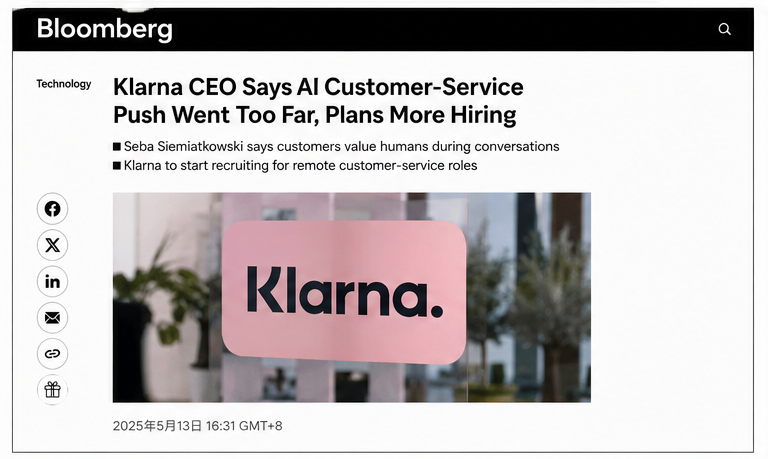
Klarna had previously touted the cost-cutting capabilities of its AI-powered customer service, but a year later, it has begun rehiring human customer service representatives.
These numbers were enough at the time to make AI customer service the perfect tonic for the financial report.
However, just over a year later, Klarna's CEO acknowledged that the push to cut costs in customer service had gone too far, and the company began to recruit human customer support staff who could work remotely to ensure customers could reach a real person.
Klarna did not anticipate that an increase in single-task efficiency does not necessarily mean it can directly replace comprehensive positions.
In August this year, Syndio, a compensation decision-making software company, staged a similar scenario.
In May, Syndio laid off a batch of employees, including labor economist Jonathan Vidales, who had been with the company for 5 years, in an effort to streamline the company in the AI era. At the time, CEO Maria Colacurcio also judged that, given the sluggish job market, the remaining employees were likely to stay.
As a result, over the next few months, some of the people the company had most wanted to retain ended up leaving. By August, Syndio had reopened the position, and Vidales applied again, with the company rehiring him.
Colacurcio later wrote an article to review this matter, acknowledging that in the company's pursuit of efficiency in the AI era, it had lost some truly needed talent.
It is still challenging for comprehensive positions to be completely replaced by AI. Taking customer service positions as an example, in addition to the language and handling methods written in the SOP, they also need to cope with users' emotions. Even if AI can provide results, the cold and artificial tone is inherently disliked by users.
Not to mention the numerous coordination tasks within the organization. Under what circumstances should customer complaints be escalated to avoid causing public opinion incidents? Will escalating too many times lead leaders to think that one's work capability is inadequate? These "experiential intuitions" won't even be written into KPIs.
Kathryn Sullivan spent 25 years working at Commonwealth Bank of Australia (CBA), where in recent years she helped train the bank's customer service robot, Bumblebee. When the robot encountered customer questions it couldn't answer, Sullivan and her colleagues would take over, writing the correct responses and using them to improve the system. Sullivan initially thought AI would just help her automate repetitive tasks.
By July 2025, the CBA announced it would cut 45 customer service positions, including Sullivan's. The bank cited the reason as the introduction of AI customer service, which reduced the number of calls requiring human handling by approximately 2,000 per week.
The ironic thing is yet to come.
The Australian financial sector union, FSU, has taken this round of layoffs to the Fair Work Commission.
It wasn't until the investigation that the bank discovered the situation was completely different from their initial judgment: the number of customer service calls had not decreased, but was actually increasing, and the remaining employees had to work overtime, with even supervisors being pulled in to answer phones.
A month later, the CBA acknowledged that its assessment of the layoffs was flawed, and withdrew its decision to cut the 45 positions, allowing the affected employees to return to their original posts.
Robert Half surveyed over 2,000 US hiring managers this year, and among companies that had eliminated positions due to the introduction of AI, 32% later brought back the same or similar roles in some form.
The main reasons for "regret" are threefold. 40% found that AI could not make up for the internal experience and business background mastered by employees, 39% lacked the maintenance of interpersonal relationships, and 38% underestimated the amount of manual checking and quality control still required by AI.
Research institution Forrester stated in its analysis released in January 2026 that many companies attribute financially driven layoffs to future AI applications, but when layoffs occur, there are no mature and verified systems to take over those positions, making it sound like a technology strategy, but upon closer inspection, it is sometimes just cost-cutting measures dressed up in AI packaging.
Forrester has dubbed this practice "AI washing".
Forrester predicted in its 2026 workplace trend forecast released in November 2025 that half of the layoffs attributed to AI will be quietly reversed, with much fanfare when announcing AI transformations, but rehiring is much more low-key, with companies simply posting a few more job openings on their recruitment pages.
More subtly, the return of jobs does not necessarily mean the original workforce is coming back. Forrester also predicts that some jobs will be relocated overseas or given lower wages.
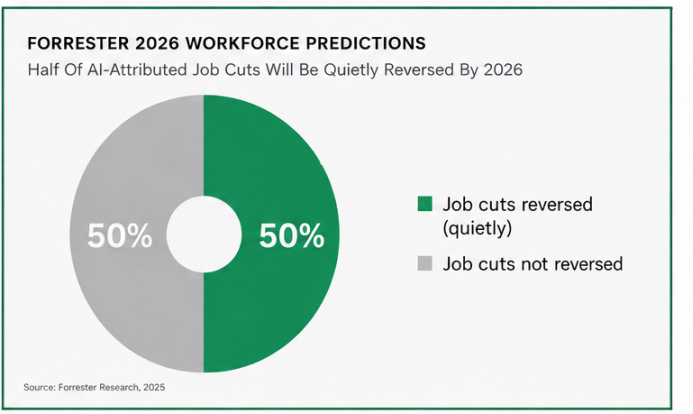
Forrester predicts that by 2026, half of the layoffs attributed to AI may be quietly reversed by companies.
So after all the fuss, the fantasy of AI replacing employees has been debunked, but the situation for employees is not much better. The "Xishi Returns to the Palace" scenario does not exist, and although they have proven themselves to be irreplaceable, they have been demoted upon their return.
The Boomerang of AI Layoffs
How did it affect the employees?
Companies have found that AI is not as useful as they had imagined, and are now rehiring human employees, making it seem like the employees have won this round.
The fact that layoffs can occur is not automatically negated just because a company has second thoughts.
The aforementioned case of Commonwealth Bank of Australia (CBA) rehiring customer service staff is a case in point, where CBA withdrew its layoffs, allowing affected employees to choose between continuing to work or receiving compensation to leave.
However, the Australian financial industry union, FSU, later specifically mentioned that the laid-off employees had been in a state of uncertainty for weeks, with some worrying about whether they could pay their bills and support their families next month.
In some other "boomerang" stories, the jobs that employees returned to had changed themselves.
Klarna has not only reversed course but also permanently revamped its relevant operations, experimenting with a customer service model similar to that of ride-hailing platforms. Employees work remotely and pick up orders as needed, with the company considering students and residents of remote areas as potential recruitment targets.
In other words, Klarna found that human customer service cannot be completely replaced for the time being, so it divided the customer service work and let humans only do what AI cannot do yet.
When "AI leads to layoffs," those affected are not limited to laid-off employees. The "lucky ones" who have not been laid off from start to finish also have to bear the cost of the company's trial and error.
Meta initially pushed for an "AI-native" organizational overhaul at the beginning of the year, but as actual AI usage data emerged, subsequent plans had to be put on the brakes.
On August 26, media revealed that Meta has internally promoted an organizational restructuring plan called Project OT this year.
According to internally discussed plans, Meta aims to redesign some teams using AI, with some of the most radical ideas involving a reduction in team size of up to 60%. In May, the company carried out its first round of layoffs, affecting around 10% of employees, but a second round of adjustments initially planned for November was later canceled.
What truly made this experiment embarrassing was Meta's own internal data.
Internal data from Meta shows that employee use of AI-generated internal code modifications has surged 220% year-over-year, while actual conversion into new user-facing features or upgrades has only grown 36%. Meanwhile, major technical and security incidents have increased 40% year-over-year, and the time employees spend on "firefighting" has risen 70%.
Employee morale was also severely impacted. In Meta's semi-annual internal employee survey, positive feedback dropped from 74% to 55%. The company later suspended plans to track some employees' mouse and keyboard activity and allowed some employees who had been reassigned to create training data for AI to return to their original teams.
But when all is said and done, companies that lay off workers and then reverse course aren't discovering that "AI can't replace humans"—they're lamenting that "AI unfortunately can't fully replace humans just yet." For human employees, these few cases of reversal only buy a short-term reprieve.
54% of hiring managers in a Robert Half survey still expect AI to result in a net increase in jobs at their company over the next two years.
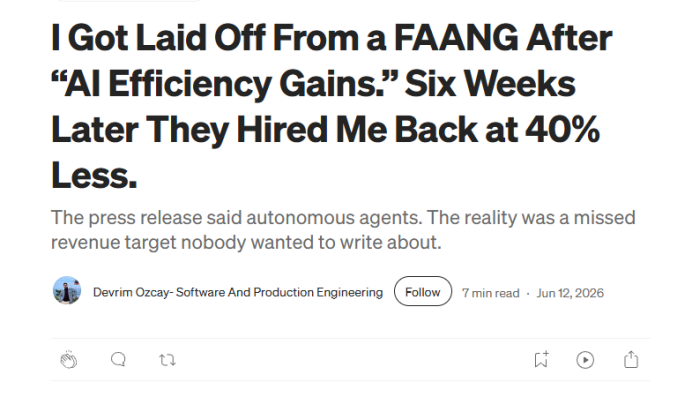
Author Devrim Ozcay posted on Medium that he was rehired six weeks after being laid off by AI, but with a 40% pay cut.
Rehiring acknowledges that the job is necessary, but does not necessarily mean restoring the original employment conditions. Employees have waited for their bosses to "see the error of their ways", only to be met with "I was wrong, but I'll do it again next time".
Relying on bosses to have a change of heart may be slower than rehiring, but some European companies, along with unions, have already taken action.
Europe Sets Up Arena for Bosses and Employees
Europe is not uniformly ordering all companies to ban AI layoffs, but rather requiring companies to be transparent with employees about potential layoffs, including whether layoffs will occur, how many people will be affected, and the reasons for the layoffs, ensuring employees have the right to know and an opportunity to communicate with the company.
In 2024, Danish home-cleaning services platform Hilfr signed a new collective agreement with union 3F. The agreement allows AI to participate in employee evaluations and enter into the process of terminating labor relationships, but the platform must explain which assessments and facts were used and their corresponding weights, making related decisions subject to legal scrutiny.
Insurance group AXA went even further.
On November 27, 2025, AXA's management signed the AI Social Dialogue Charter with the European Works Council, agreeing to report on cross-entity AI projects every six months and hold an annual AI-themed meeting. The charter took effect on January 1, 2026. While bi-annual meetings may not resolve every dispute, they have at least turned the issue of AI's impact on employees from an ad-hoc crisis into a fixed agenda item.
The EU is also raising the threshold for corporate "impulsiveness".
By the end of 2025, the EU revised its rules on employee information and consultation for large multinational corporations. For major adjustments involving multiple European countries that will have a significant impact on employees, companies can no longer unilaterally notify the results after the decision has been made and the list has been finalized. Employee representatives need to have the opportunity to learn about the situation in advance and express their opinions, and management must respond before making a final decision.
These rules were not specifically designed for AI-related layoffs, nor do they give employees veto power. However, if a company plans to restructure teams across multiple countries due to AI, resulting in a large number of job cuts at one time, such decisions may fall under their scope.
Of course, these arrangements cannot completely dispel the gloom of AI layoffs.
Companies will not give up on cost reduction, and the well-being of human employees may require more attention from all of humanity.