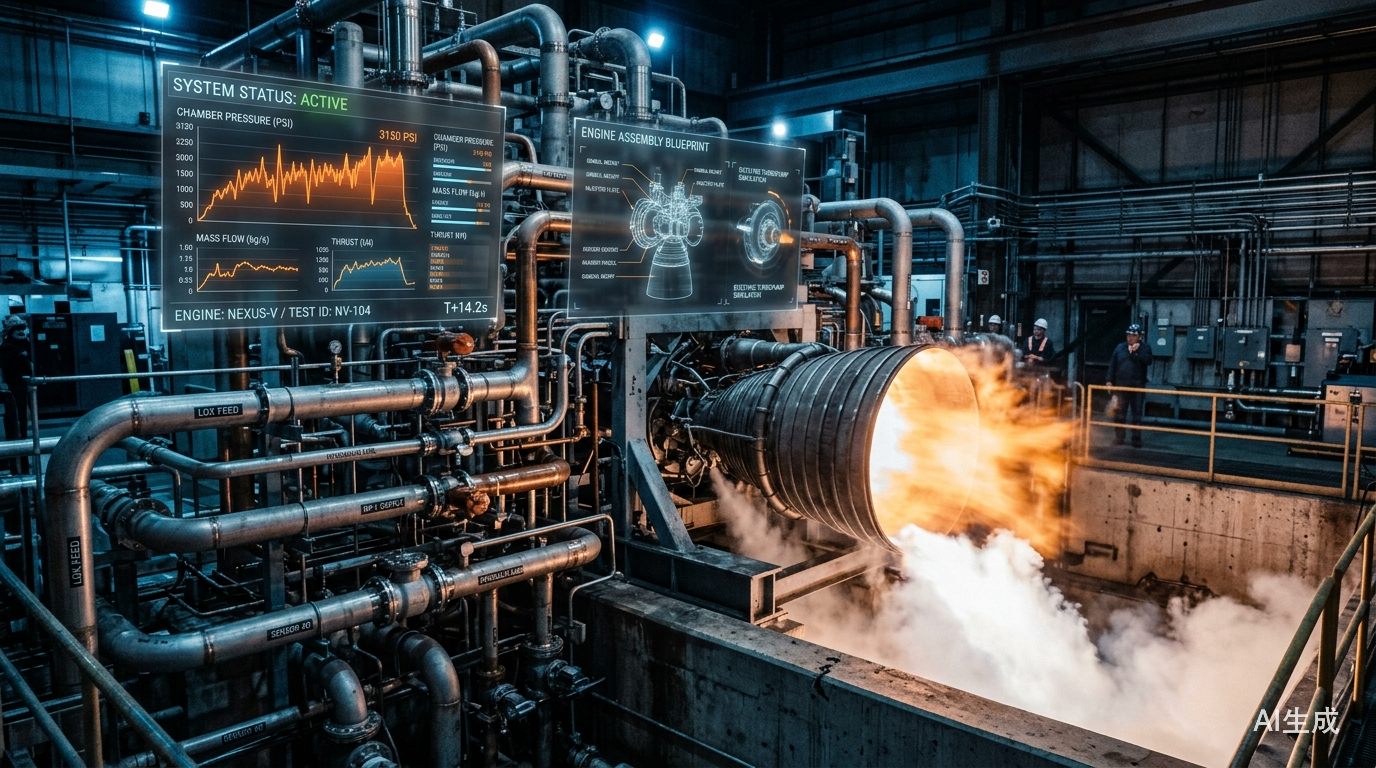
Musk is preparing to have Grok learn from SpaceX's over 20 years of engineering records. This article puts the model through a fictional Starship valve anomaly, tracing it from data retrieval to simulation and testing, to see how its proposed suggestions are verified by the engineering team and overturned by new physical results.
Musk described a far more complex task for Grok in two sentences on X, one that goes beyond just chatting and writing code.
On July 21, 2026, he stated that the large-scale engineering data accumulated by SpaceX will join Grok for a supplementary training of a "2T run" after excluding materials restricted by the US International Traffic in Arms Regulations. Musk subsequently gave his expectations, saying Grok's engineering capabilities will be significantly enhanced.
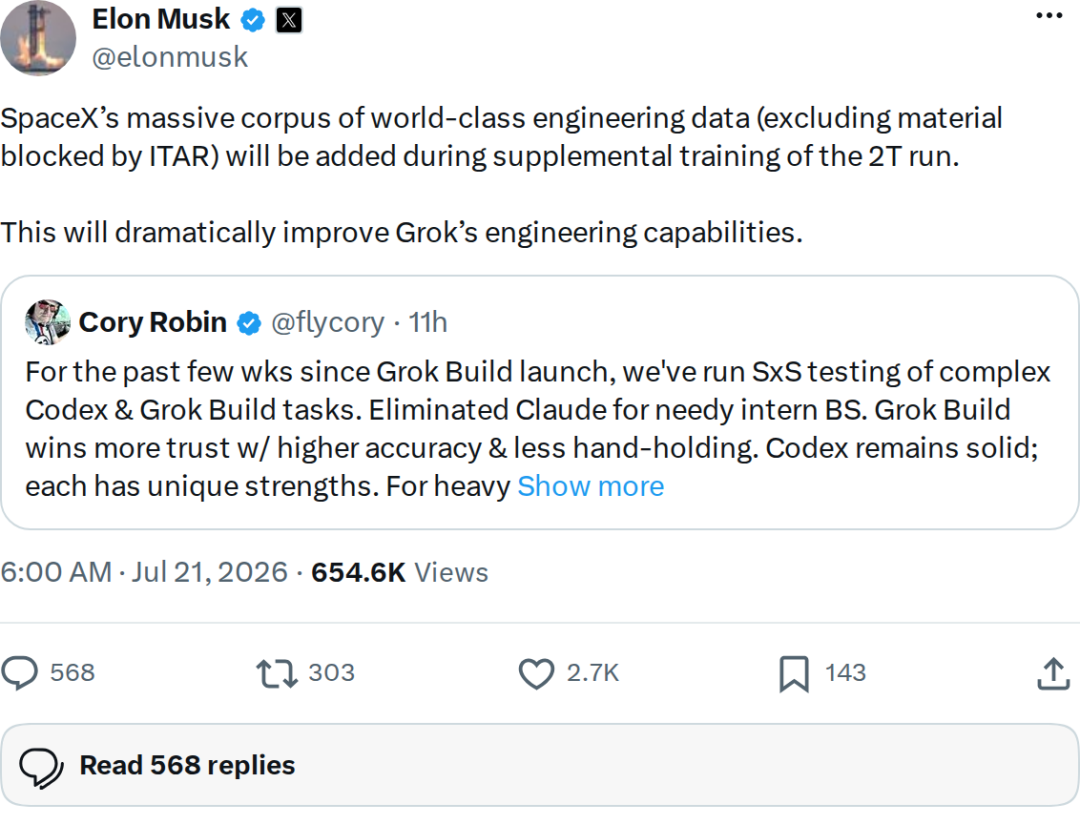
Musk said SpaceX engineering data will be used to supplement training for Grok, but the original post did not explain the specific meaning of "2T run". The image is from X.
The original post did not specify the size of the dataset, nor did it break down the proportions of drawings, code, telemetry, and test reports. There are also different interpretations of what "2T run" refers to, whether it's training tokens or model parameters. One thing that can be confirmed is that Musk plans to incorporate the internal records accumulated by SpaceX over the past 20 years of building rockets into the training process for Grok.
If the next Starship test flight encounters an anomaly
The following scenario is used only to illustrate the engineering process and does not correspond to a specific incident that SpaceX has publicly disclosed.
Assuming a starship is undergoing ground testing, the response curve of a valve is slower than its predetermined state. The control system has issued instructions, but the sensors indicate a deviation in the pressure build-up process, and the testing team needs to determine as soon as possible whether the problem lies with the valve's mechanical mechanism, sensor measurement, control software, or a cascading reaction caused by upstream pressure changes.
If the same problem were given to a general model that had only learned from public data, it could list common causes of valve failures, explain cavitation, friction, actuators, and sensor drift, and provide a formatted troubleshooting checklist. This knowledge is useful, but it cannot tell the team whether SpaceX has seen similar curves on a particular batch of valves, what version of control software was used at the time, or whether the engineers ultimately replaced parts or modified the ignition sequence.
Accessing internal data may require Grok to take a few extra steps. It can retrieve telemetry from previous test drives, identify similar pressure waveforms, and then bring together software modifications, valve manufacturing batches, assembly records, and fault reports that occurred before and after the anomaly, all on the same interface. Materials that previously required separate searches by propulsion, software, manufacturing, and testing personnel can be provided more quickly by the model if associations have already been established, offering several historically-based directions.
This is where SpaceX's data becomes appealing. While the internet can provide information on how rockets work, the company retains internal knowledge on why a particular plan was abandoned, how an initial failure was misjudged, or which modification did not work during testing. Publicly available papers typically present polished results, whereas engineering records retain the trial-and-error process. For those troubleshooting anomalies, failed approaches can sometimes narrow down the search scope more than successful conclusions.
Grok found similar faults in the historical records
Continuing with the earlier fictional scenario, Grok retrieved a similar anomaly from three years ago. The engineers at the time first suspected the sensor, but after re-testing found that the valve actuator responded slowly at specific temperatures. The team replaced a component and adjusted the control program. The model presented this record to the current team, and the two pressure curves look very similar.
The rocket team cannot issue a change order based on this alone, as "looking similar" only completes the beginning of the fault analysis. Whether the valves used three years ago came from the same supplier batch, whether the current Starship configuration has changed the piping, whether the sensor sampling frequency is consistent, which logic of the control software has been modified, and whether the temperature and tank pressure during the test are within the same range, any of these differences could render the old case inapplicable.
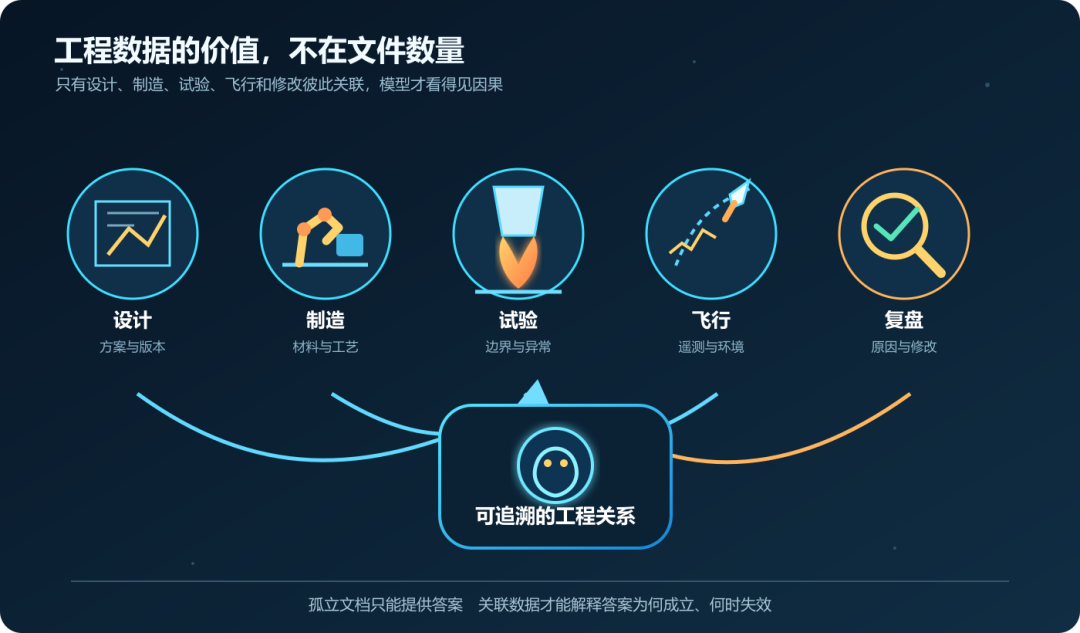
Illustrated documentation can provide historical answers and reveal the correlations between design, manufacturing, testing, flight, and modification, explaining why answers are valid and when they become obsolete. Mapping space and the web
If Grok does not know which test a telemetry reading comes from or which version of the software was installed at the time, it cannot confirm whether two waveforms can be compared. The US National Institute of Standards and Technology, when discussing industrial AI data, includes source, collection method, coverage, and integrity in data qualification, as a measurement value may change in meaning once it is separated from device status, software version, and environmental conditions. For Grok, 10,000 reports without version relationships are not necessarily more useful than 100 records that can link design decisions, manufacturing status, test results, and subsequent modifications.
A 20-year dataset also brings another problem. The Falcon 1, Falcon 9, Dragon, and Starship were developed in different phases, and the tools, data formats, and naming conventions used by early teams may not have been continued to this day. The same part name may correspond to different design states, and the same type of anomaly may also leave different data forms due to sensor and software upgrades. If the model treats all files as if they were from the same time period, the longer the time span, the more severe the version confusion will be.
Data cleaning thus takes up a significant amount of work. SpaceX needs to make the model aware of which model, configuration, and test each record belongs to, and also handle conflicting judgments. Early guesses in the fault investigation cannot have the same weight as the final conclusion, and old plans that have been overturned by new test evidence cannot continue to be used as a recommendation basis. If these relationships are not entered into the training or retrieval system, Grok may remember every sentence SpaceX has said, but cannot distinguish which one the company later believed.
The same malfunction might be a different story with a new version of Starship.
Back to that slow-responding valve. Based on historical cases, Grok proposed two recommendations: one was adjusting the control timing, and the other was replacing the actuator. The engineers' next step isn't to compare which passage reads more like expert opinion—they need to plug the suggestions into a model of the current configuration and run the numbers.
Adjusting the timing may alter the pressure buildup during the engine startup process, and changes in pressure can impact combustion stability and adjacent pipelines. Replacing the actuator may involve considerations such as mass, electrical interfaces, installation space, supply cycles, and environmental testing. Engineers can examine known coupling relationships in simulations, but some pipeline vibrations lack experimental data for the current configuration, and the risk can only be temporarily retained. A local modification can propagate along the interface, requiring multiple disciplines to reconfirm whether previously approved analyses are still valid. Large models can help identify affected files and codes, but cannot prove that these impacts are under control in terms of linguistic fluency.
Current engineering assessments also reflect this gap. Researchers found that large models can handle some basic infrastructure and temporal relationships, but still make significant errors in formal modeling, open-ended constraints, and engineering tasks that depend on specific contexts; as tasks require the use of specialized tools and satisfy more conditions, the performance gap between models and engineering experts will widen. [3][4]
When xAI released Grok 4.5 in July 2026, it listed programming, science, engineering, and mathematics among its training focus areas, and outlined data-processing methods including deduplication, quality scoring, and domain selection. The public evaluation page still highlights tasks such as software development and terminal operations.[5] A piece of code can be tested in an isolated environment, but rocket design requires integrating structural, thermal, fluid, control, manufacturing, and flight-environment considerations into a single configuration. Public materials do not indicate what level Grok has reached on such tasks.
One test drive could potentially overturn all of AI's answers
Still following the previous hypothetical scenario, the simulation supported adjustment of control timing, and the team subsequently arranged a verification test drive. However, new data showed that after the valve response recovered normally, the adjacent pipeline that lacked data during the simulation stage began to vibrate. Grok's first set of recommendations solved the original problem while introducing a new one, and engineers had to re-examine the overlooked coupling relationships in the model.
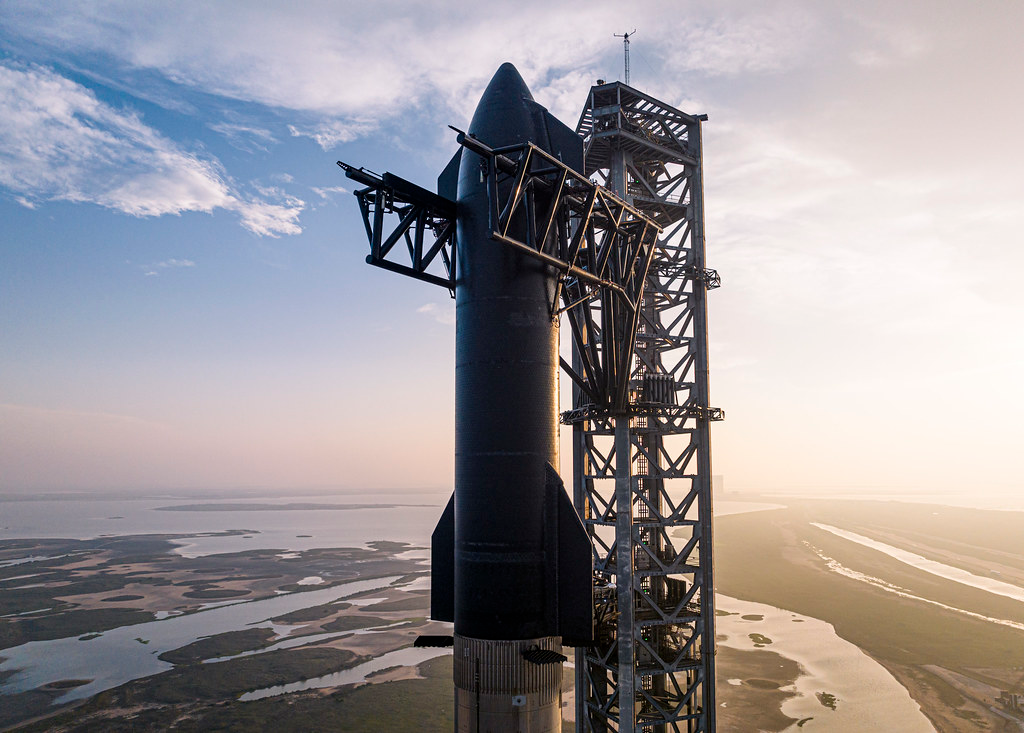
The rocket engineering team at 图注 will subject every modification to simulation, ground testing, and flight data verification. Image source: SpaceX official Flickr
This situation is not unusual in complex engineering. Simulations can only calculate the structures, materials, boundary conditions and failure modes that engineers have already written into the model, while tests can also expose interactions that the team has not thought of. The more assumptions a model makes, the more new questions arise, such as how to allocate test resources and which risks must be ruled out first.
The expressive capabilities of large models can create additional trouble here. They can generate complete and confident judgments based on insufficient evidence, which human reviewers may not always be able to identify as errors. A study published in Nature found that even larger and more instruction-following language models can still produce seemingly credible but incorrect answers, and human oversight cannot reliably detect all issues. The Rocket team requires models to provide information on sources, version numbers, computational conditions, and uncertainties, allowing reviewers to verify the reasoning behind the conclusions, rather than just reading a smoothly written summary.
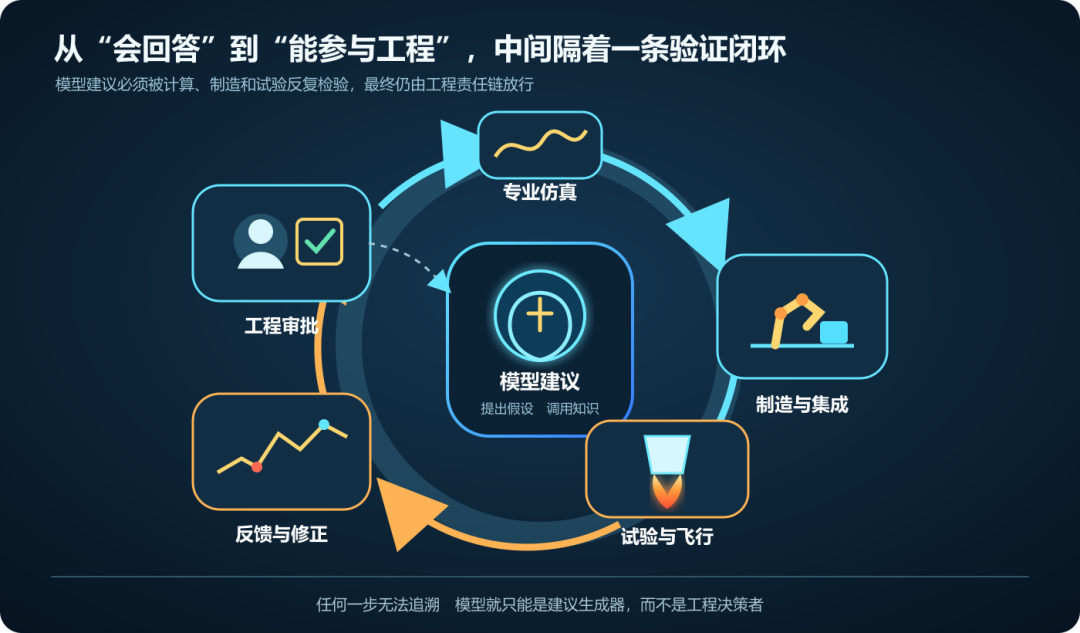
Caption: After the model’s recommendations enter simulation, manufacturing, and testing, new feedback may support, modify, or overturn the original judgment; engineering personnel still must complete the approval process. Illustration: Space and Network
If the test drive overturned Grok's suggestion, this failure would also form new data. The model can record the difference between the current configuration and the case three years ago, associate the new vibration with this modification, and reduce the recommendation weight of the old scheme when encountering similar problems next time. SpaceX maintains a high frequency of experimentation and also puts rockets, engines, software, manufacturing, and launches in a relatively tight organizational system, which gives it the opportunity to continuously complete the cycle of "hypothesis, testing, modification, and re-testing".
Competitors can collect the same number of papers and standards, but it's difficult to replicate an engineering chain that is still continuously producing new results. If Grok only receives training on historical data once, it will master SpaceX at a certain point in time; if it continuously accesses configuration, simulation, and test feedback under strict permissions, it will participate in how SpaceX will modify its rockets next.
These organizational conditions are not available to all aerospace projects. If a project is completed by a main unit, multiple contractors, and different testing institutions, design records, manufacturing deviations, and test data may be scattered across different systems, and contractual and confidentiality boundaries will restrict mutual access. SpaceX has more links within the same company, reducing some information handovers, but the Falcon, Dragon spacecraft, and Starship each still have a long version history. After accessing xAI, whether it can find a data thread from design decisions to flight results requires item-by-item sorting, and the acquisition relationship itself will not complete this work for the engineering team.
At SpaceX, Grok may first receive a task to retrieve information
SpaceX already has the organizational capabilities to integrate artificial intelligence into its business. The company acquired xAI in February 2026, and public documents also warned investors that the AI business is still in its early stages, with integration not yet complete, and that errors in data, hallucinations, intellectual property, and confidentiality breaches may all pose risks.
Musk said the data should be added to the supplementary training, but the frequently changing engineering records may not all be suitable for being written into the model parameters. Already stabilized terms, code patterns, and common analysis methods can enter the training, while still-modified configurations, fault states, and trial conclusions are more suitable for being retained in a controlled database, which can be retrieved by Grok when executing tasks according to permissions. The latter method is convenient for displaying the source and can also update or delete records after the conclusion is overturned. It has not been made public how SpaceX ultimately combines training and retrieval, and this choice will directly affect whether the model can identify the latest version and whether engineers can trace back the basis it references.
These restrictions will affect the order in which Grok is introduced to rocket engineering. Data search and case matching do not directly alter hardware, and engineers can easily verify the sources, making them suitable for earlier adoption; code assistance, test case generation, and specification checking can be verified in a software environment and may be incorporated into existing workflows more quickly; recommendations involving structural modifications, flight control, and engine conditions will touch on more professional interfaces and require simulation, testing, and formal approval.
Musk's original post also actively excluded materials restricted by the US International Traffic in Arms Regulations (ITAR). SpaceX's internal data may also include government contract information, customer mission details, supplier parameters, and unreleased intellectual property. Even if the company decides to use these materials, it needs to distinguish which ones can be used for training, which ones can only be temporarily retrieved by authorized personnel, and which ones cannot be entered into the model system. A general-purpose Grok that covers a large number of users and an engineering assistant running in an isolated environment will not have the same data access permissions.
Under this arrangement, the changes engineers experience every day may be very specific. They no longer need to ask five departments why a design was modified, as Grok can track down the history and the person responsible; when preparing for a software update, the system can prompt which test cases need to be re-run; after an abnormal test drive, the model can gather similar waveforms and corresponding configurations on the same workstation. Although the time saved for each task may be limited, when accumulated over high-frequency testing and multiple version iterations, it will change the speed at which the team processes information.
The title of "AI Chief Engineer" entails more responsibilities. The chief engineer needs to make trade-offs when safety, performance, cost, and schedule conflict, and also decide whether the evidence is sufficient to proceed with the next trial, and be accountable for the consequences after signing off. Training data can familiarize Grok with how SpaceX made choices in the past, simulations and trials can check its suggestions this time, but the organization still needs to determine who has the authority to adopt the suggestions, who is responsible for discovering errors, and who decides whether to proceed with ignition when risks have not been completely eliminated.
The next time Starship ignites, it will be difficult for outsiders to know whether a certain software modification or fault assumption comes from Grok. In the future, if SpaceX ever publicly discloses an engineering case involving the model, the most valuable information will not be how many files the model has read, but why the engineers accepted its suggestions, what experiments the team used to verify it, and whether Grok changed its original answer after new data emerged.
Primary Sources
Elon Musk, X platform post, July 21, 2026, https://x.com/elonmusk/status/2079446276299465185
A panel led by the National Institute of Standards and Technology (NIST) discussed the issue of qualifying data for artificial intelligence (AI) use, exploring ways to ensure the quality and reliability of data used in AI systems. The panel emphasized the importance of data quality in AI applications, noting that high-quality data is essential for developing trustworthy and effective AI models. Experts from various fields participated in the discussion, sharing their insights and experiences on data qualification and AI development. The panel's discussion is expected to contribute to the development of standards and guidelines for qualifying data for AI use, promoting the wider adoption of AI technologies in various industries.
Evaluating Large Language Models for Real-World Engineering Tasks, https://arxiv.org/abs/2505.13484
Researchers have introduced EngiBench, a benchmark for open-ended engineering tasks, in a paper published on arXiv, available at https://arxiv.org/abs/2509.17677.
xAI has released Grok 4.5, which can be found at https://x.ai/news/grok-4-5
Larger and more instructable language models become less reliable, Nature, https://www.nature.com/articles/s41586-024-07930-y
SpaceX European Union Prospectus, June 5, 2026, https://content.spacex.com/cms-assets/FINAL_Documents%20and%20Updates/SpaceX%20-%20EU%20Prospectus%20%28Approved%20by%20Bafin%29%20-%20June%205%2C%202026.pdf
According to the U.S. Electronic Code of Federal Regulations, specifically 22 CFR 120.33 and 121.1, which can be found at https://www.ecfr.gov/current/title-22/chapter-I/subchapter-M/part-120/subpart-C/section-120.33.