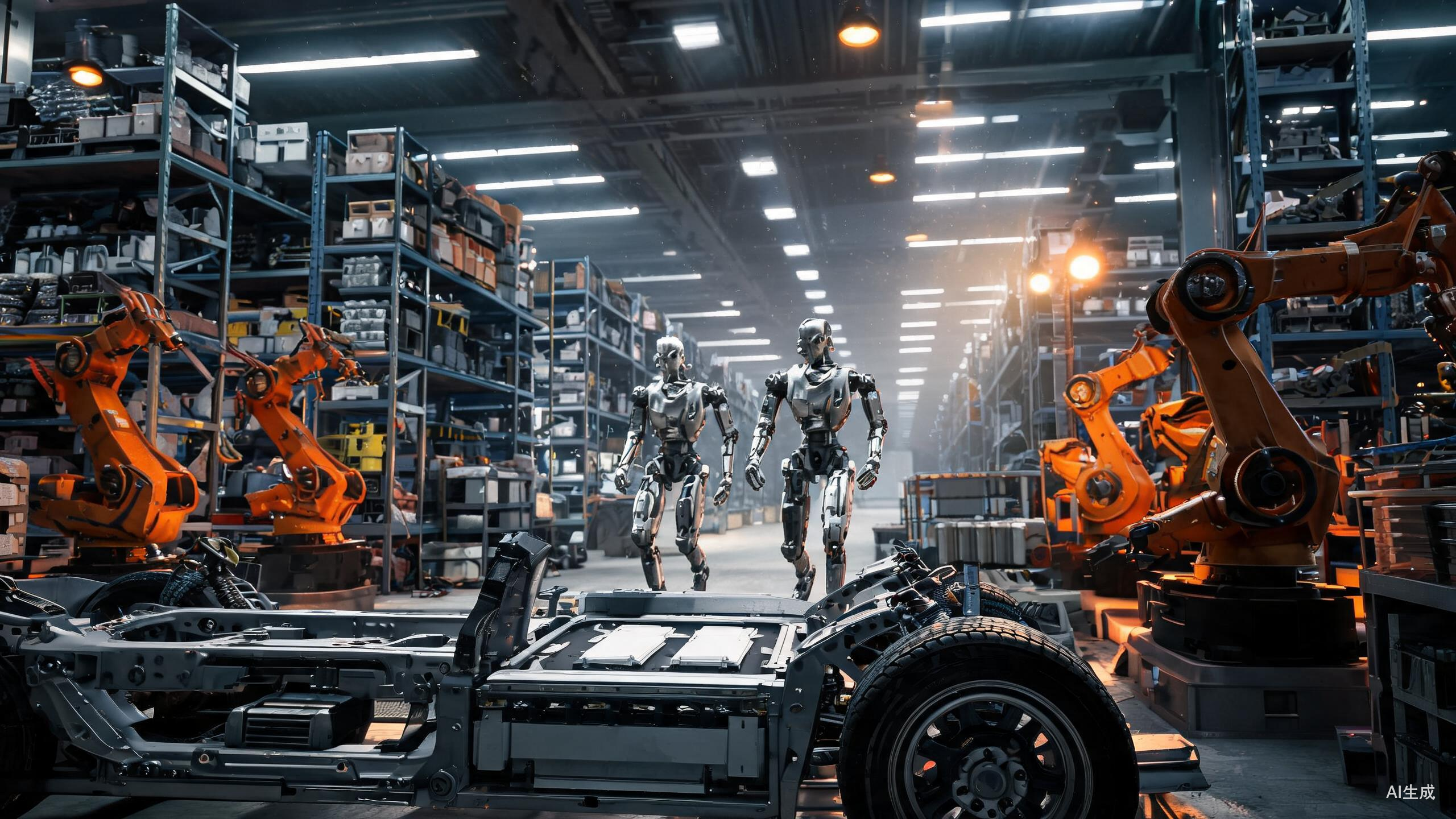
In the summer of 2026, China's auto industry is shifting its gaze from the steering wheel to two-legged robots.
On Aug. 24, Xpeng Group announced that its humanoid robotics business completed a first funding round of more than $900 million, with a post-investment valuation exceeding $6.3 billion. Tencent and Alibaba made a rare joint investment. Around the same time, BYD's first commercial service humanoid robot, 'Xiaodi,' made its real-machine debut. Chery announced that its Mojia robots have surpassed 3,000 units in cumulative global deliveries, including 2,000 overseas, covering more than 60 countries and regions, and has started IPO preparations.
From Chery, Xpeng and BYD to Li Auto, Xiaomi and NIO, more than a dozen mainstream Chinese carmakers have entered the humanoid robot race through self-development, incubation or investment within a short period.
The collective pivot from building cars to 'building humans' has been faster and more resolute than outsiders expected. But few have asked: can the logic of carmaking really be applied to robots?
Selling Cars No Longer Sustains Automakers
To understand this collective migration, one must first look at a set of alarming numbers.
Data released on Aug. 27 by Cui Dongshu, secretary-general of the China Passenger Car Association, showed that from January to July 2026, the auto industry's revenue was 6.078 trillion yuan, but profit was only 216.2 billion yuan, a profit margin of just 3.6%. The average profit margin for downstream industrial enterprises was 6.5%. Even more striking was the start of the year: from January to February, the industry's margin fell to 2.9%, the worst opening in nearly a decade.
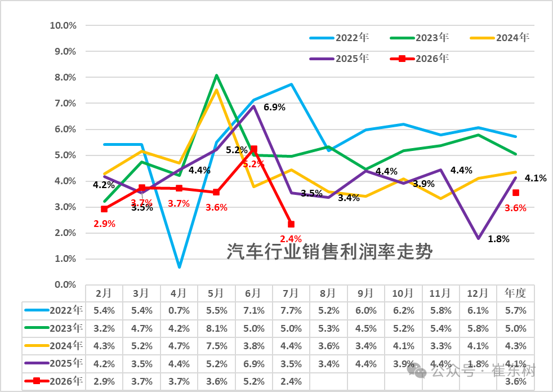
*Source: Cui Dongshu's WeChat public account.
What does this mean? For a car priced at 200,000 yuan, the manufacturer nets only 3,000 to 4,000 yuan. Blogger Wu Pei's compilation of first-half 2026 per-vehicle profit data shows Geely's 5.2% margin was already the top performer among carmakers, with per-vehicle profit of 6,389 yuan. Changan's margin was only 0.6% to 0.8%, or 619 to 811 yuan per vehicle. Leapmotor's was just 0.55%, or 589 yuan per vehicle. Many other carmakers had negative profits. One executive said bluntly in private: 'We don't seek excessive profits, but we need to have some profit first.'
After new-energy vehicle penetration surpassed 50%, the market shifted from growth-driven expansion to a battle over existing share. With severe homogenization, price wars became one of the few weapons — and those wars drove profits down to the floor.
At the start of 2026, more than 16 automakers and nearly 70 models were swept into a wave of price cuts, forcing the Ministry of Industry and Information Technology to intervene with talks to curb low-price dumping. Policy can stop the bleeding, but it cannot create blood — lithium carbonate surged from 75,000 yuan per ton at the start of the year to 200,000 yuan by May, while automotive-grade chip prices rose as much as 180%.
With costs soaring and selling prices crushed by competition, automakers are caught in the middle — like a towel being wrung out again and again.
What to do? Find a new story. And humanoid robots happen to be the sexiest story right now.
In June, Morgan Stanley released a report sharply raising its 2026 forecast for China's humanoid robot shipments from 28,000 units to 50,000 units, projecting 446,000 units by 2030 with a market size of $15 billion. Looking further out, Morgan Stanley predicts that by 2050, the global installed base of humanoid robots will reach about 1 billion units, with a market size of $7.5 trillion.
On one side, a profit quagmire of 3.6%; on the other, a trillion-dollar sea of stars. When He Xiaopeng announced he would also serve as CEO of the robotics business, his words became the collective voice of the industry: "I made this decision because we are standing at a historic inflection point."
The real trigger was Tesla. In July, Tesla released a video showing the entire process of dismantling the Model S/X production line at its Fremont factory in just 46 days, with Vice President Tao Lin captioning it "the beginning of a new era." The freed-up space is entirely dedicated to mass production of the Optimus Gen 3 humanoid robot, with the line designed for an annual capacity of 1 million units.
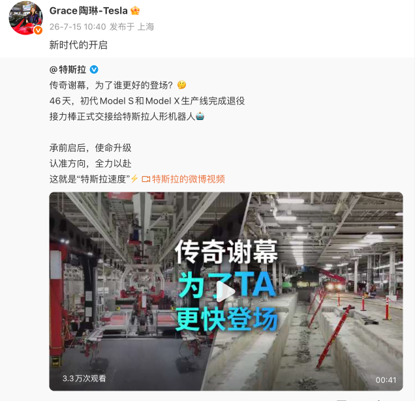
*Source: Tesla Weibo
Chinese carmakers are dismantling luxury-car production lines built over a decade to build robots, betting that failing to do so would leave them shut out of the next generation of smart devices.
The Trump Card No One Else Has
Anxiety alone isn't enough. Automakers are diving in because they have real assets to bring.
An apt industry metaphor: a smart car stood upright becomes an embodied-intelligence humanoid robot. The underlying architectures are highly similar—lidar, cameras and millimeter-wave radar for perception; end-to-end AI algorithms for decision-making; and motors, electronic controls and motion control for execution.
About 70% of the technology that automakers already have can be transferred directly to robots, XPeng Inc. co-founder He Xiaopeng has said. The company's IRON robot runs on the same Turing AI chip used in its autonomous-driving systems, with 2,250 TOPS of computing power per chip. Its XNGP visual-perception and planning-control algorithms need only minor adaptation for use in robots.
The complexity of automotive software makes it easy for us to transplant that know-how to robots, BYD Co. executive vice president Li Ke said in an interview. In August, the company unveiled 'Xiaodi,' a 1.61-meter humanoid with six-finger dexterous hands, in Zhengzhou.
Beyond technology transfer, automakers hold two trump cards that internet firms and pure-play robot startups don't have.
The first is supply chain and manufacturing scale. Zhang Aimin, chairman of GAC Huilun Technology, said most robot companies originate from lab research and 'generally emphasize prototypes over production reliability, resulting in strong samples but weak mass production.' Automakers, by contrast, can apply the auto industry's mature reliability standards, rigorous testing regimes and finely tuned supply-chain management to robot development and manufacturing.
With mature global auto supply chains and precision manufacturing, automakers can rapidly push down the full cost of humanoid robots from seven figures. Chery Automobile Co.'s Moja robot, for instance, is priced at 285,800 yuan in mass production and has begun global deliveries. Zhang Guibing, Chery's executive vice president and general manager of Moja Robotics, said at the 2026 World Robot Conference that Moja is preparing an IPO and targets 10,000 deliveries worldwide in 2027.
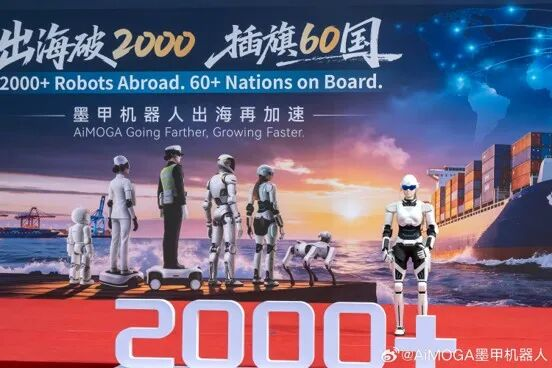
Source: Mojia Robotics Weibo
The second advantage is the closed loop of ready-made application scenarios. The biggest pain point in humanoid-robot commercialization is the cold-start problem: no real-world scenario means no initial orders, no orders means no training data, and no data means no algorithm iteration.
Automakers, meanwhile, come with a built-in dual-scenario buffer. On the industrial side, their own factory lines can provide standardized roles such as sorting, material handling, quality inspection and patrolling, directly absorbing early production capacity. On the service side, thousands of dealerships and parks nationwide can handle reception, guided tours and vehicle demonstrations.
Xiaomi's humanoid robot Tie Da has spent months training in an auto factory, where it installs self-tapping nuts. SAIC has put Nengzai 1 on the battery production line for the Buick Zhijing E7. Xpeng's IRON is being rolled out first in showrooms and factories. Chery's robots initially serve its own production lines and overseas 4S dealerships.
These internal scenarios do more than generate first orders; they produce continuous real-world data, creating a positive flywheel of product deployment, data feedback and algorithm iteration. That's an edge lab training can never match.
Moving from four wheels to two legs, automakers aren't starting from zero — they're changing lanes with calloused hands.
20x Difficulty and a Murky Path to Commercialization
But flip the coin over, and the picture looks different.
The technical challenges and innovation difficulty for advanced general-purpose humanoid robots are far greater than for smart vehicles — by at least 20 times, Xpeng's He Xiaopeng said on an August 24 earnings call.
Between building cars and building robots lies a vast gap in underlying logic: the standardized-product approach does not adapt well to unstructured environments.
Cars are classic standardized products. They operate on structured roads with clear lane markings, explicit traffic rules, and relatively simple scenarios. With solid quality control and consistency, they can be replicated in the millions.
Humanoid robots, by contrast, must navigate a fully unstructured real world: a knocked-over cup at home, a part that shifts unexpectedly in a factory, a child darting through a mall.
Cars move in two dimensions; robots require real-time three-dimensional coordination across dozens of joints, exponentially increasing complexity.
As a result, most automakers' robots remain at the "demo stage" — they can walk and talk smoothly in showrooms but frequently fail in complex real-world settings. Earlier this year, XPeng's IRON robot lost its balance during its first public walking demonstration, fell hard, twitched on the ground, and couldn't get up on its own. Staff had to carry it off the stage.
Late last year, a girl visiting the Xiangyang Science and Technology Museum in Hubei was kicked in the face by a Unitree robot that suddenly lifted its leg. The impact knocked out several baby teeth and left a scar on her face.
*Image source: Unitree robot at Xiangyang Science and Technology Museum
Cost is another major hurdle. The bill-of-materials cost of a humanoid robot is typically 2.5 to 3 times that of a comparable car. Core components — harmonic reducers, precision torque sensors, and dexterous hands — require an order of magnitude higher precision, durability, and response speed than automotive parts.
These components account for 60-70% of total machine cost, yet localization rates remain low and the supply chain is far from mature. Automakers' supply-chain advantages don't apply here. With auto industry margins at just 3.6%, adding another cash-burning front while the core business is already stretched creates obvious short-term financial pressure.
The commercialization path is equally unclear.
The auto business model is simple: sell hardware, make thin margins, profit from scale. Humanoid robots don't work that way. Zhu Keli, founding dean of the Guoyan New Economy Research Institute, says most humanoid robots are still delivered as customized projects with high unit prices, and the cost-effectiveness of large-scale procurement has yet to emerge.
Industrial buyers typically expect payback in 18-24 months, but today's industrial-grade humanoid robots cost hundreds of thousands of yuan each and work far less efficiently than skilled labor, stretching payback to years or more. Consumer demand is even further off; at over 200,000 yuan, these are niche toys. Hardware sales don't profit, service models aren't mature, and Robot-as-a-Service is still nascent—a commercial bind shared by every player.

*Image source: UBTech press conference
For carmakers, the biggest threat isn't rivals—it's their own path dependency. Applying automotive thinking to robots could mean speeding down the wrong road.
2026 is widely viewed as the year humanoid robots enter mass production. The next two to three years are the critical test window for automakers. Whoever cracks the production bottleneck and closes the business loop first earns a ticket to the trillion-yuan market.
But remember: autos took a century to mature. Humanoid robots won't move from lab to living rooms any faster.