
Tencent and Xiaomi both appeared on the IPO list of Huichuan Technology, making it easy to interpret as a story of "giants collectively placing orders for domestic GPUs." However, the two companies play different roles: Tencent is both a major shareholder and a core client, while Xiaomi is more accurately a strategic allotment participant. Mixing up equity, clients, and orders makes for a lively story, but judgment can easily become distorted.
What concerns me more is that behind this listing lies a shift in the domestic computing power industry: in the past, everyone was competing for financing, parameters, and the imaginative space for domestic substitution, but now they are starting to truly compete on customers, delivery, and repayment. The first major order proves the product is usable, while the second independent customer proves that this business can be replicated.
Capital Has Already Voted
Business Not Over Yet
Suoyuan Technology's issue price is 142.18 yuan, with expected fundraising of approximately 61.19 billion yuan, corresponding to a market capitalization of approximately 611.87 billion yuan. For a chip company with 2025 revenue of around 9.90 billion yuan that has yet to achieve profitability, this is clearly not a price calculated solely based on current profits.
The capital market's willingness to give such a valuation is largely due to the industrial shareholders behind it. The prospectus reveals that prior to the issuance, Tencent and its related entities collectively held approximately 20.26% of the shares, making it Suoyi's largest external shareholder; industrial capital such as Xiaomi and Zhiyun Innovation also entered the list through strategic allocation.
These companies are not just betting on the peak computing power of a single chip, but rather on whether SparkChip can combine chips, software stacks, cluster deployment, and customer service to form a continuously deliverable computing power product in cloud-based training and inference scenarios.
However, a line needs to be drawn here: industrial capital investing in a company only indicates that everyone is willing to take a seat at the table ahead of time, and does not mean they have already become major clients. Capital can vote for the future in advance, but the business model still relies on one order after another to prove itself.
Tencent is Both the Answer and the Question
Tencent plays a dual role for Huoyuan, providing both funding and industry resources, as well as real-world smart computing and cloud business scenarios. In 2025, Huoyuan's revenue from Tencent-related clients was approximately 830 million yuan, accounting for 83.79% of the company's total revenue.
This proportion appears high, but it cannot be simply understood as negative. For an AI chip company, what is often lacking in the early stages is not attention at launch events, but rather an anchor customer willing to put the chip into a production environment and conduct continuous high-intensity verification.
Once the chip is deployed in a real cluster, customers' testing goes beyond just running benchmarks. They also need to verify whether model migration is smooth, whether the cluster can run stably for a long time, whether faults can be handled quickly, and whether the software stack is compatible with existing businesses. These issues can only be exposed through large-scale use, and Tencent provides just such a testing ground.
The Second Tencent
This is the Real Turning Point
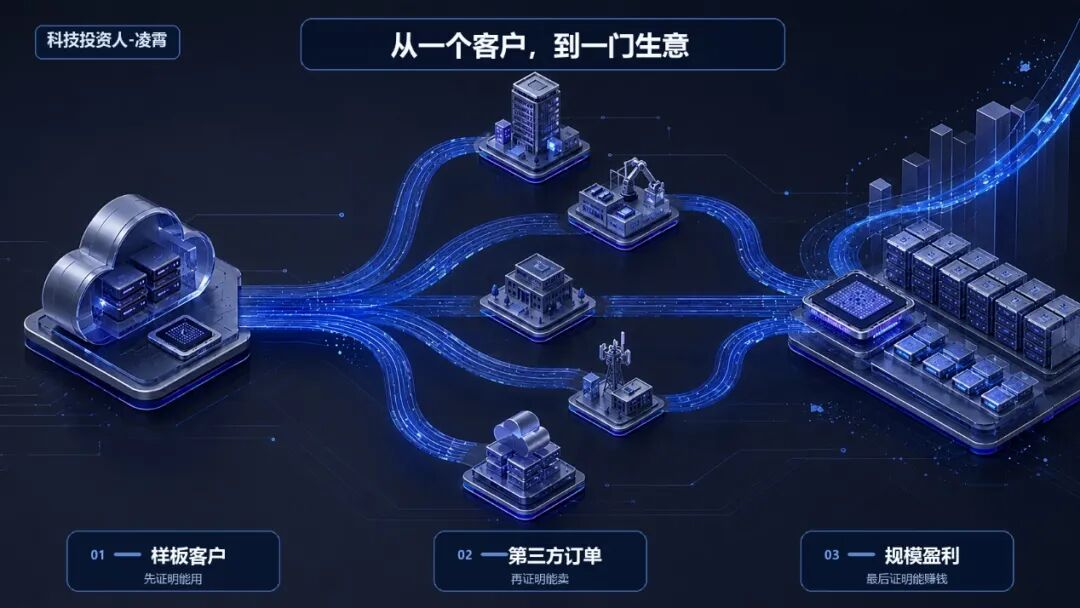
The real commercial turning point for domestic AI chips is usually not when they are listed or when they secure their first major order, but when they gain a second and third large, independent clients. Only then can the market confirm that previous successes are due to the product's capabilities, rather than just shareholder relationships or special procurement arrangements.
This step is far more difficult than imagined. Different clients have different model frameworks, server architectures, operational systems, and procurement standards. Replacing chips means re-adapting software, verifying cluster stability, and bearing the time costs and business risks during the migration process. Having peak computing power close to each other does not mean clients are willing to replace immediately.
Suoyuan's new generation of products has entered the hardware adaptation, model matching, and gray testing phases with some potential customers, indicating that it is trying to replicate the capabilities formed in the Tencent scenario externally. However, between "entering testing" and "forming large-scale orders", there are still three hurdles to overcome: delivery, re-purchase, and payment collection.
What's truly worth watching next is not which institution appears on the shareholder list, but whether the proportion of revenue from non-Tencent clients can increase, whether third-party clients make repeat purchases after their first procurement, and whether new orders can be delivered smoothly while maintaining the gross profit margin. The moment a second Tencent emerges is when Sanyuan begins its transformation from a project-based company to a platform-based company.
Valuation Outpaces Profit
Based on a market capitalization of approximately 61.187 billion yuan and 2025 revenue of 9.9 billion yuan, Suoyuan's price-to-sales ratio is around 61.8 times. This means that the capital market is pricing in not the money it has already earned, but the potential for rapid expansion of domestic computing power orders in the future.
However, the AI chip business is a very capital-intensive one. From 2023 to 2025, Suoyuan's cumulative research and development investment is approximately 3.676 billion yuan, exceeding its cumulative revenue of approximately 2.013 billion yuan during the same period. Chips require constant iteration, and software ecosystems require long-term maintenance, so even when the previous generation of products starts to gain traction, it's difficult to stop investing in research and development for the next generation.
In the first half of 2026, the company's revenue was approximately 1.12 billion yuan, representing a year-on-year increase of about 279%, but it still incurred a loss of approximately 632 million yuan during the same period, which did not show a significant narrowing compared to the same period last year. While revenue growth is certainly important, it also indicates that the expansion in scale has not yet naturally translated into profit.
The company expects to potentially achieve profitability on a consolidated basis in 2026 or 2027, but this timeline depends on factors such as gross margin, product yield, supply stability, and the scale of procurement from new customers. A gross margin of around 30% is just the starting point, and whether it can cover continuously increasing research and development and operating expenses will determine if the so-called profitability inflection point has truly arrived.
So my judgment of Suoyi will not be limited to the phrase "domestic substitution". What the market is really re-pricing is whether domestic computing power can move from single-client verification to multi-client replication. Going forward, I will be more concerned with the proportion of non-Tencent revenue, gross margin, and operating cash flow - would you rather wait for profits to appear or wait for it to secure its second major client?
Suoyuan Technology, domestic computing power, AI chips, semiconductors, technology investment