Internet celebrity brand SKG is once again at the doorstep of an IPO.
In August 2026, following the initial lapse of its listing application, SKG Future Health Technology Co., Ltd. (hereinafter referred to as "SKG Future Health") resubmitted its listing application to the Hong Kong Stock Exchange, with plans to list on the main board. Previously, the company had applied for a IPO on the Growth Enterprise Market and had also planned to list on the Beijing Stock Exchange, but neither attempt was successful.
From a financial perspective, SKG Future Health has the confidence to open the door to the capital market. In terms of GMV, in 2025, SKG Future Health's market share in China's intelligent comfort wearable device industry reached 21.6%, ranking first. From 2023 to 2025, SKG Future Health's revenue grew from 1.046 billion yuan to 1.218 billion yuan, with a compound annual growth rate of 7.91%.
However, it's worth noting that the capital market not only focuses on a company's market influence, but also cares about whether the company has strong profitability. In stark contrast to the steady increase in revenue, since the new revenue comes more from businesses with relatively low gross margins, and sales and marketing expenses continue to rise, SKG's future healthy profits have not grown at the same rate as revenue.
In this context, even if SKG Future Health successfully lists on the capital market, it will be difficult to win favor with investors and achieve a higher valuation.
SKG Replaces Growth Engine After Becoming Market Leader
Although it has dominated the Chinese intelligent comfort wearables industry, SKG Future Health's core products have not leveraged scale advantages to further expand market influence, but instead have encountered a growth stagnation issue.
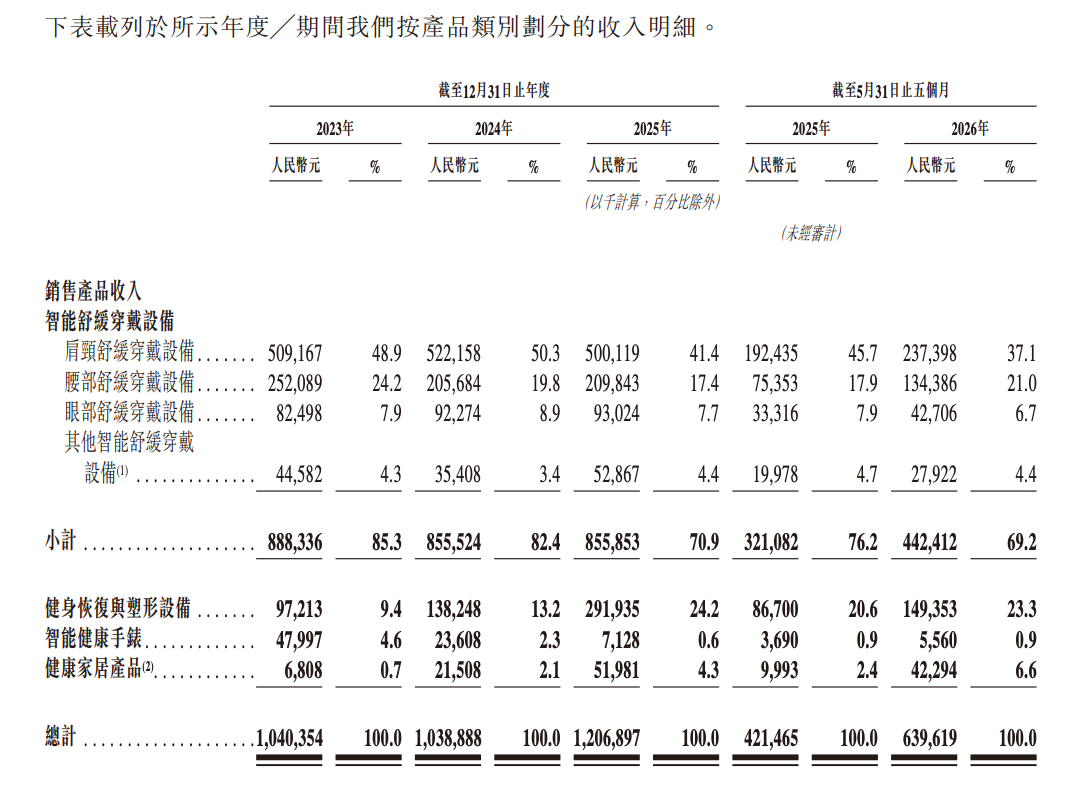
Source: SKG Future Health IPO prospectus
The prospectus shows that from 2023 to 2025, SKG Future Health's smart wearable device revenue was 888 million yuan, 856 million yuan, and 856 million yuan, respectively, not only failing to rise steadily, but also showing signs of decline.
In this context, SKG Future Health's revenue has been steadily rising, mainly because it has found a new growth curve. From 2023 to 2025, SKG Future Health's fitness recovery and shaping equipment revenue grew from 97.21 million yuan to 292 million yuan, with the proportion of sales product revenue increasing from 9.4% to 24.2%.
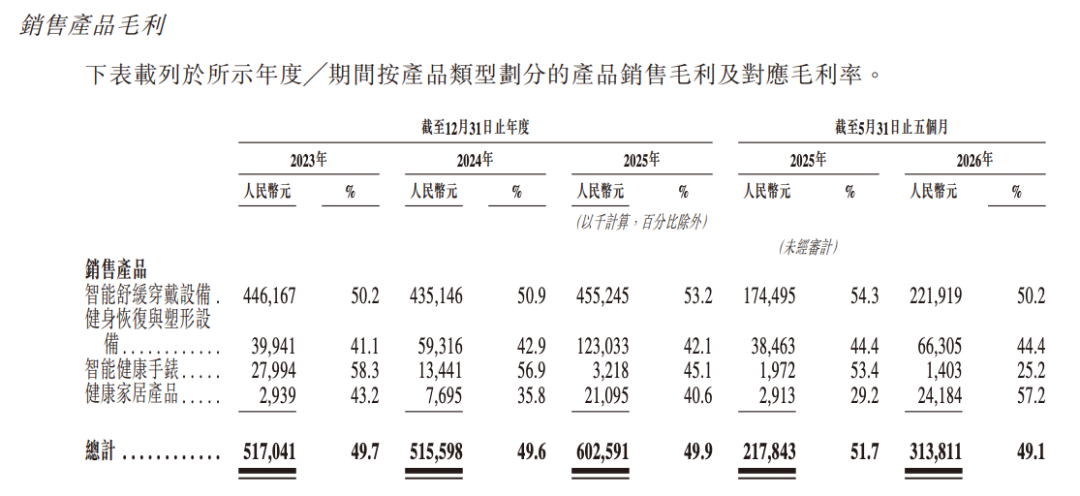
However, the profit margins for fitness recovery and body-shaping devices are far lower than those for smart soothing wearable devices. Taking 2025 as an example, SKG's future health smart soothing wearable devices achieved a gross margin of 53.2%, while fitness recovery and body-shaping devices came in at just 42.1%—a gap of 11.1 percentage points.
SKG Future Health explained that the gross margin of fitness recovery and shaping equipment is lower, mainly due to intense competition and the company's relatively late entry into the field, which requires a more aggressive pricing strategy.
Although fitness recovery and shaping equipment have taken over from intelligent comfort wearables as the company's new growth driver, the limited profitability of this business has led to SKG Future Health experiencing the issue of "increased revenue but not increased profit". From 2023 to 2025, SKG Future Health's net profit was 127 million yuan, 135 million yuan, and 132 million yuan, respectively, remaining stagnant for three consecutive years.
In the first five months of 2026, SKG Future Health's net profit grew 30.1% year-over-year, but its net profit margin was 9.5%, down 1.7 percentage points from the same period last year due to being lower than revenue growth.
Against the backdrop of stagnant main business growth, companies should indeed actively explore new businesses. However, SKG Future Health's newly constructed growth curve has not replicated the profitability of its core smart comfort wearable devices. As the performance of its fitness recovery and shaping equipment continues to rise, SKG Future Health's profits may have further room to decline.
SKG Falls into Path Dependence with Heavy Marketing, Light R&D
Like many popular internet brands, SKG Future Health's rapid rise is also inseparable from its large-scale marketing strategy.
The prospectus shows that from 2023 to 2025, SKG Future Health's sales and marketing expenses were 216 million yuan, 226 million yuan, and 288 million yuan, with expense ratios of 20.6%, 21.6%, and 23.7%, respectively. Among them, propaganda and advertising expenses were 155 million yuan, 157 million yuan, and 190 million yuan, respectively.
In the early stages of development of the intelligent soothing wearable device market, SKG Future Health seized on young people's shoulder and neck anxiety, transforming traditional massage devices into portable and fashionable consumer electronics, and then leveraged celebrity and variety show marketing strategies to complete market education, which was indeed an important means of quickly opening up the market.
However, as the smart comfort wearable device market enters a new stage of development, SKG's future growth is becoming increasingly difficult to rely on large-scale marketing strategies to convince consumers to buy.
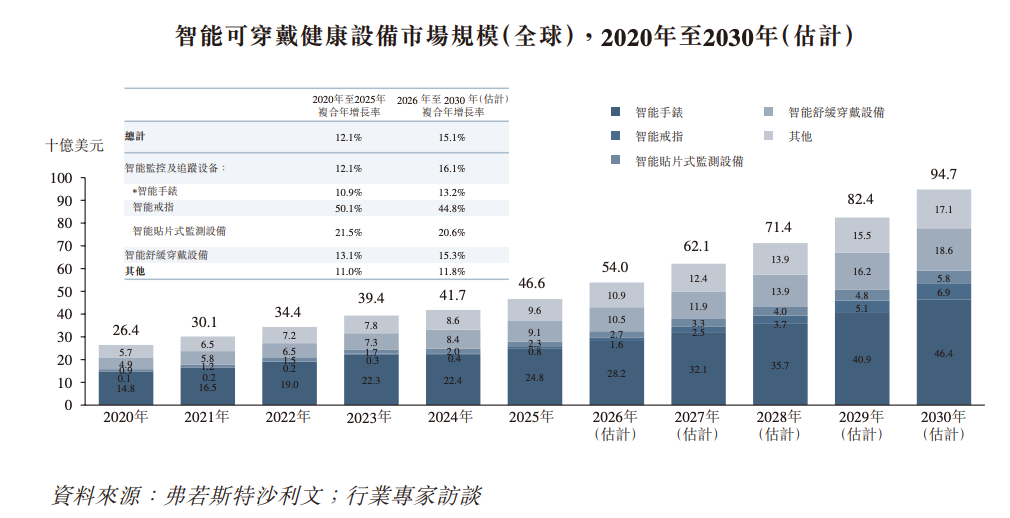
According to statistics from Frost & Sullivan, the global smart wearable relaxation device market size grew from $4.9 billion in 2020 to $9.1 billion in 2025, with a compound annual growth rate of 13.1%. It is expected to further increase to $18.6 billion by 2030.
Although the market for intelligent comfort wearables is still thriving, under the influence of factors such as diversified demand and technological upgrades, the focus of competition is no longer on product form, portability, and industrial design, but is instead shifting towards higher-precision sensors, AI health algorithms, IoT collaboration, and personalized health services.
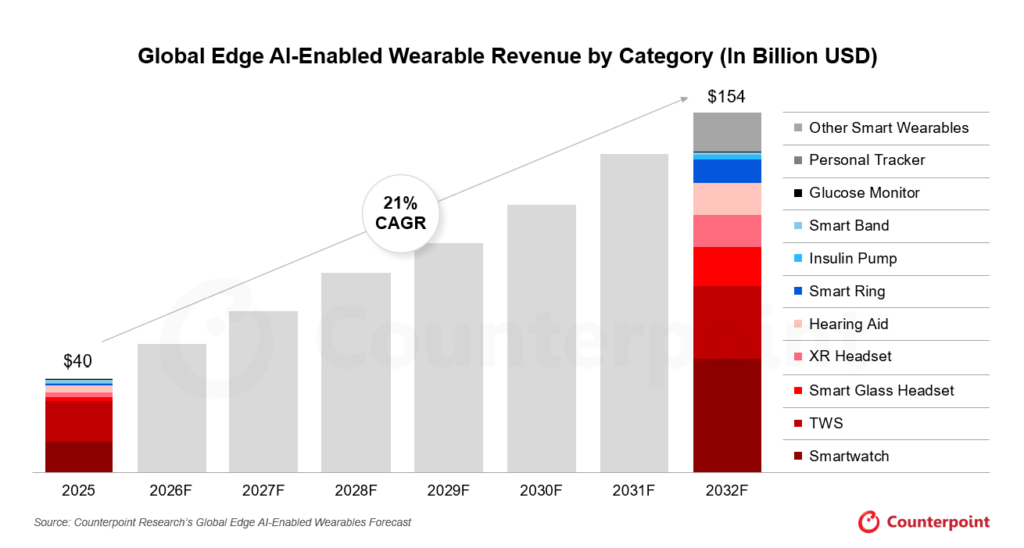
Source: Counterpoint Research
For instance, Counterpoint Research noted in its research report that the penetration rate of edge AI in wearable devices is expected to continue to rise, increasing from 30% in 2025 to nearly 80% in 2032.
After the industry entered a stage of refined operations, companies in the sector had no choice but to increase their research and development investment and forge differentiated competitive advantages in order to navigate the cycle. However, SKG Future Health has become trapped in a path dependence of "emphasizing marketing, neglecting research and development".
In stark contrast to its rising sales and marketing expenses, SKG Future Health's research and development expenditures have been on a steady decline. From 2023 to 2025, SKG Future Health's R&D spending was 95.51 million yuan, 79.18 million yuan, and 73.28 million yuan, with expense ratios of 9.1%, 7.6%, and 6%, respectively.
In the first five months of 2026, SKG Future Health's research and development expenses grew 33.1% year-over-year to 3.836 million yuan, but the R&D expense ratio further decreased to 5.9% as it was lower than the revenue growth rate.
On one hand, due to limited R&D investment, SKG Future Health lacks cutting-edge technology to capture consumer attention. On the other hand, as product homogenization worsens, the conversion rate of large-scale marketing strategies continues to decline, and SKG Future Health inevitably faces the challenge of profit erosion.
How Will SKG Navigate the Cycle with Manufacturing and Channels Under Pressure?
SKG Future Health's path dependence on "heavy marketing, light R&D" is directly related to its business strategy of outsourcing manufacturing and relying on distributors for sales.
In terms of manufacturing, SKG Future Health primarily relies on outsourced production. In 2023, 2024, 2025, and the first five months of 2026, outsourced products accounted for 27.8%, 43.6%, 53.8%, and 66.1% of the company's total sales, respectively.
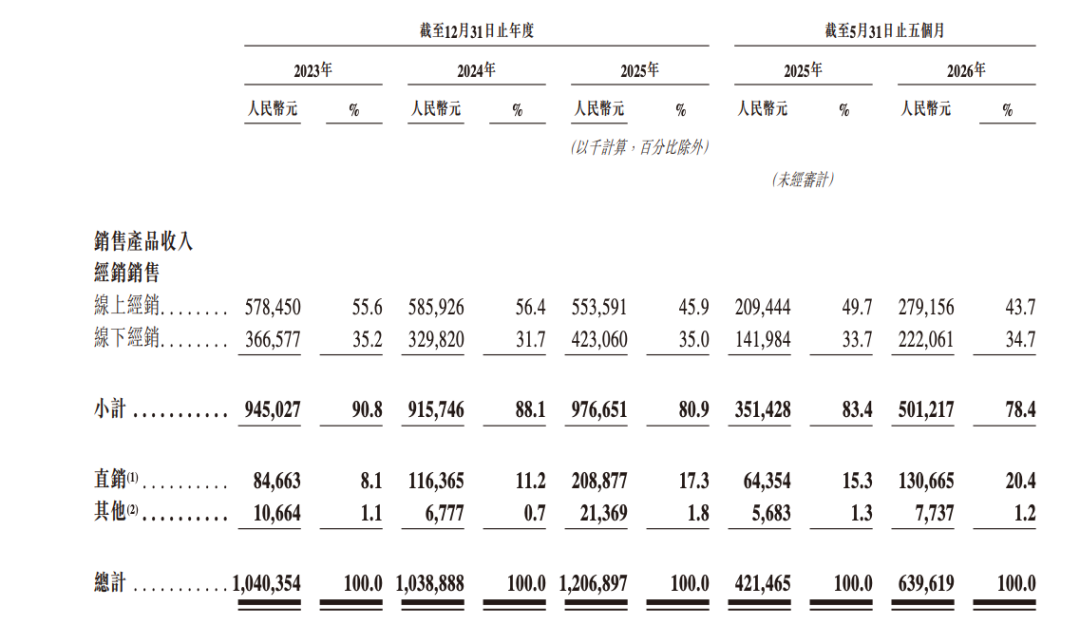
In terms of sales channels, distribution is the main sales channel for SKG Future Health. In 2023, 2024, 2025, and the first five months of 2026, the proportion of product sales revenue from distribution channels was 90.8%, 88.1%, 80.9%, and 78.4%, respectively.
Generally speaking, the core assets of consumer electronics companies are products, brands, and user relationships. If products are outsourced to third-party companies and user relationships are mediated by distributors, then the brand becomes exceptionally important. The simplest and most direct method to maintain a brand is through marketing.
This shows that the continuous increase in sales expenses is, to a large extent, a necessary consequence of the declining conversion efficiency of SKG Future Health's existing business model.
However, simply increasing sales expenses is not enough to drive SKG's future development. As competition intensifies, if products lack core competitiveness, companies will face the challenge of a continuously declining return on investment in marketing.
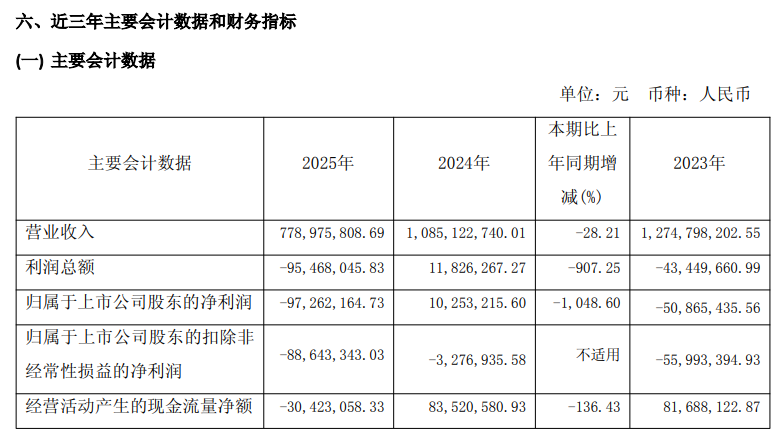
Source: Baileysong 2025 Financial Report
Taking Beileisi as an example, its financial report shows that in 2025, its sales expenses were 413 million yuan, with an expense ratio of 53%, up 2.8 percentage points year-over-year. Due to the decline in marketing investment returns and high sales expenses, Beileisi's revenue during the same period was 779 million yuan, down 28.2% year-over-year, with a net loss of 97.2622 million yuan to the parent company, turning from profit to loss year-over-year.
Indeed, SKG Future Health's performance has outpaced that of Bailexing, but the latter's experience has sounded a warning for the former: in the massage health hardware industry, if a brand's growth becomes increasingly reliant on continuous investment, a decline in the marginal efficiency of marketing could ultimately backfire and impact revenue and profits.
For SKG Future Health, what this IPO truly needs to answer is not whether the company can continue to expand its revenue, but how it will achieve high-quality growth as the industry enters a brand new cycle.
In the early stages of the smart comfort wearables market, companies could achieve category education and quickly establish their brands by simply completing tasks such as industrial design, celebrity marketing, and channel coverage.
As the industry enters a mature phase, the standards by which capital markets measure corporate value will also change, with investors becoming more concerned about whether companies possess core technologies, user relationships, and the ability to provide sustained services, rather than just relying on massive marketing to drive short-term sales.
SKG Future Health is still stuck in the "old era". Against the backdrop of stagnant growth in its core comfort wear business, the company's diversified product categories have become a new growth engine, but profitability has declined. In order to persuade consumers to make a purchase, SKG Future Health has had to increase its marketing and promotion investments. All these factors have resulted in the company's profit margins continuously narrowing.
To successfully open the door to the capital market and win the favor of investors, SKG Future Health needs to combine changes in the consumer environment and reshape its business model, transforming one-time hardware transactions into long-term user relationships supported by sensors, algorithms, health data, and services.
If it fails to complete its transformation, being the "market share leader" will be more of a footnote to its formerly expansive growth model rather than a guarantee of future valuation.
Interactive Topics
Have you used SKG's products? What are the advantages and disadvantages?