On August 31, 2026, AI² Robotics, a leading embodied intelligence company in the Greater Bay Area, announced that its AlphaBot 2 (Aibao) robot, powered by an original brain-inspired embodied large model, has officially begun working as a bartender at a Lan Kwai Fong bar in Hong Kong, serving cocktails and interacting with customers.
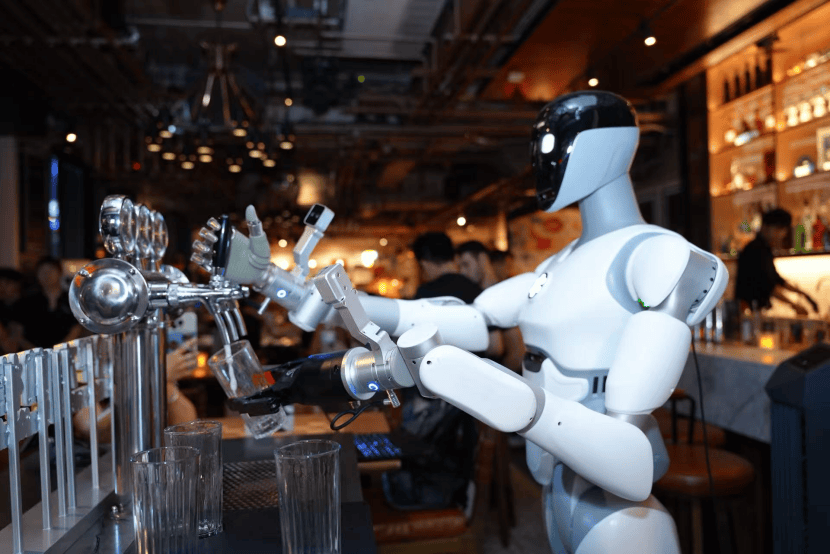
This marks not only Hong Kong's first real-world service robot deployment at a top international nightlife destination, but also AI² Robotics' successful completion of the full loop for Chinese embodied intelligence going global — from hardware export and customs compliance to obtaining local beverage sales qualifications and establishing a paid service model. Aibao is now operating legally, compliantly, and sustainably in a real commercial environment.
The deployment is also set to bring a new consumption and interactive experience to Lan Kwai Fong.
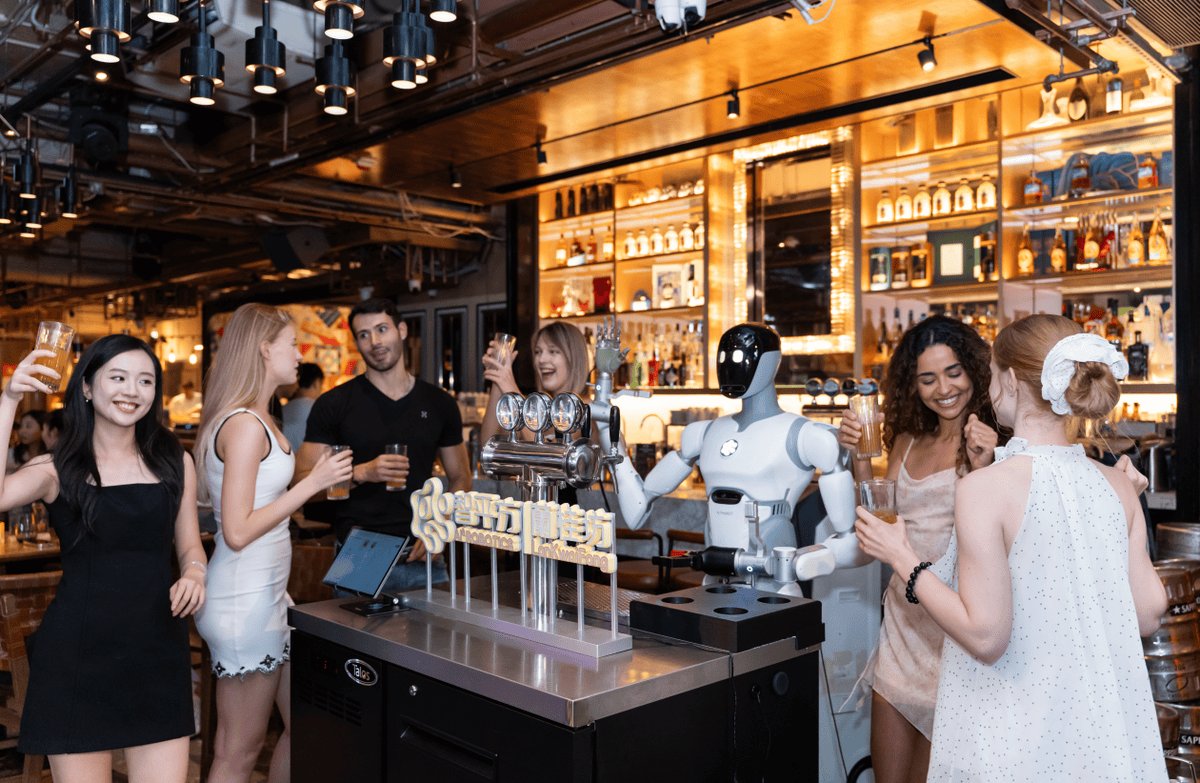
As one of Hong Kong's most international and iconic nightlife landmarks, Lan Kwai Fong has long attracted global visitors with its distinctive consumer experience and dynamic urban energy. Embracing AI and new technologies is becoming a key part of its ongoing effort to enhance customer experience. With Aibao, robots are now truly part of that experience — not just serving cocktails, but forging new connections among technology, service, and human interaction in a real nightlife setting.
Starting from the Greater Bay Area and using Hong Kong as a gateway, this collaboration represents both an exploration of embodied intelligence entering international commercial settings and a natural alignment between technological innovation and urban consumer experiences. AI² Robotics is advancing Chinese embodied intelligence from demonstration to real-world deployment, bringing robots into the daily lives of global consumers.
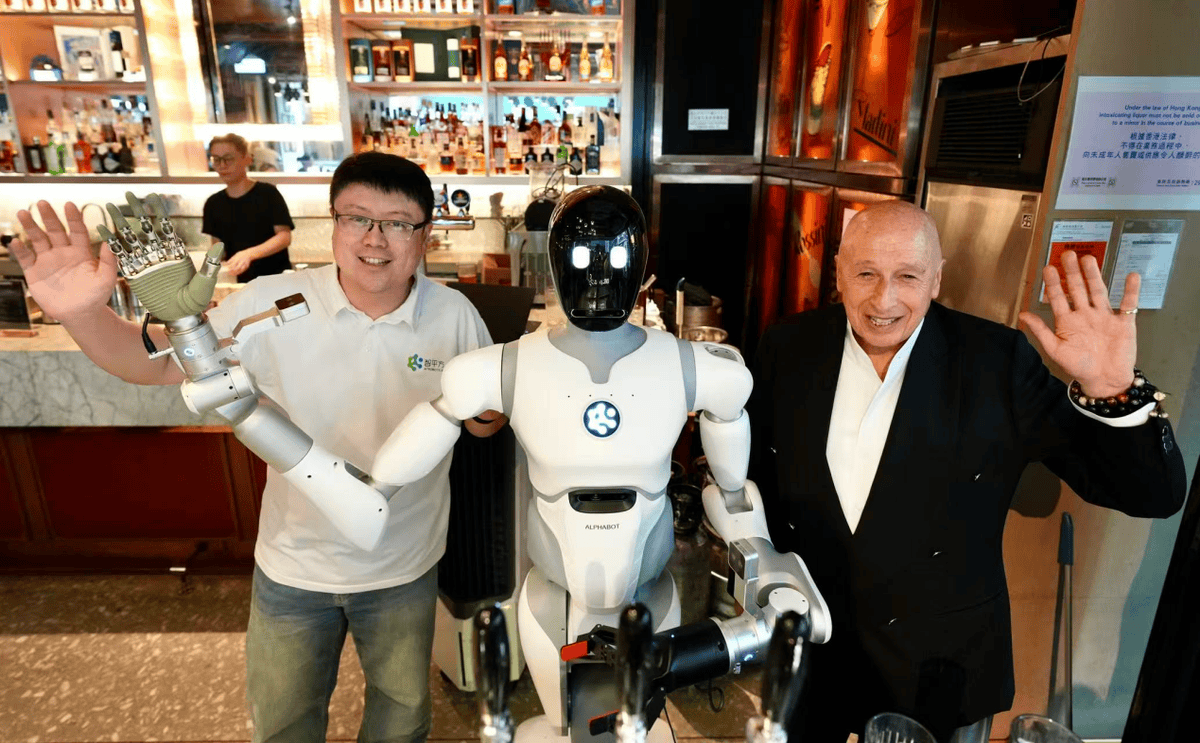
Guo Yandong, founder and CEO of AI² Robotics (left), and Allan Zeman, chairman of Lan Kwai Fong Group (right)
'Brain-Like' Tech Takes On the Toughest Challenges
Why is Lan Kwai Fong a difficult environment?
Lan Kwai Fong is home to more than a hundred bars and restaurants, where neon lights, dense crowds, and people from around the world converge. The combination of high-density dynamic foot traffic, cultural diversity, noisy acoustics, complex lighting, and real-time social demands makes it a comprehensive test of a robot's perception, decision-making, movement, and interaction capabilities.
For a human bartender, these are just part of the job. For a robot, every variable is a potential new challenge.
Aibao's ability to handle this toughest test hinges on its brain-inspired embodied large model, NeuroVLA.
NeuroVLA brings the brain's 'cortex-cerebellum-spinal cord' coordination mechanism into robot control: the cortex handles semantic understanding and task planning, the cerebellum handles high-frequency motion coordination and dynamic correction, and the spinal cord handles rapid safety responses.
The point isn't to make robots look more human, but to let them continuously perceive, understand, decide, and adjust as they navigate the real world's complexity.
Experimental data show NeuroVLA cuts robot motion jitter by over 75%, triggers reflex responses within 20 milliseconds of a collision, and uses just 0.4 watts. In a bar with sudden lighting changes, obstructing customers, or wobbling glasses, Aibao adjusts instantly and serves reliably.
No Exhibition Booths, Only Bars
Previously, a robot's sophistication was judged by its ability to deliver a slick demo.
But demos are scripted. Real work isn't.
Real robots must handle real people, real needs, and surprises at any moment.
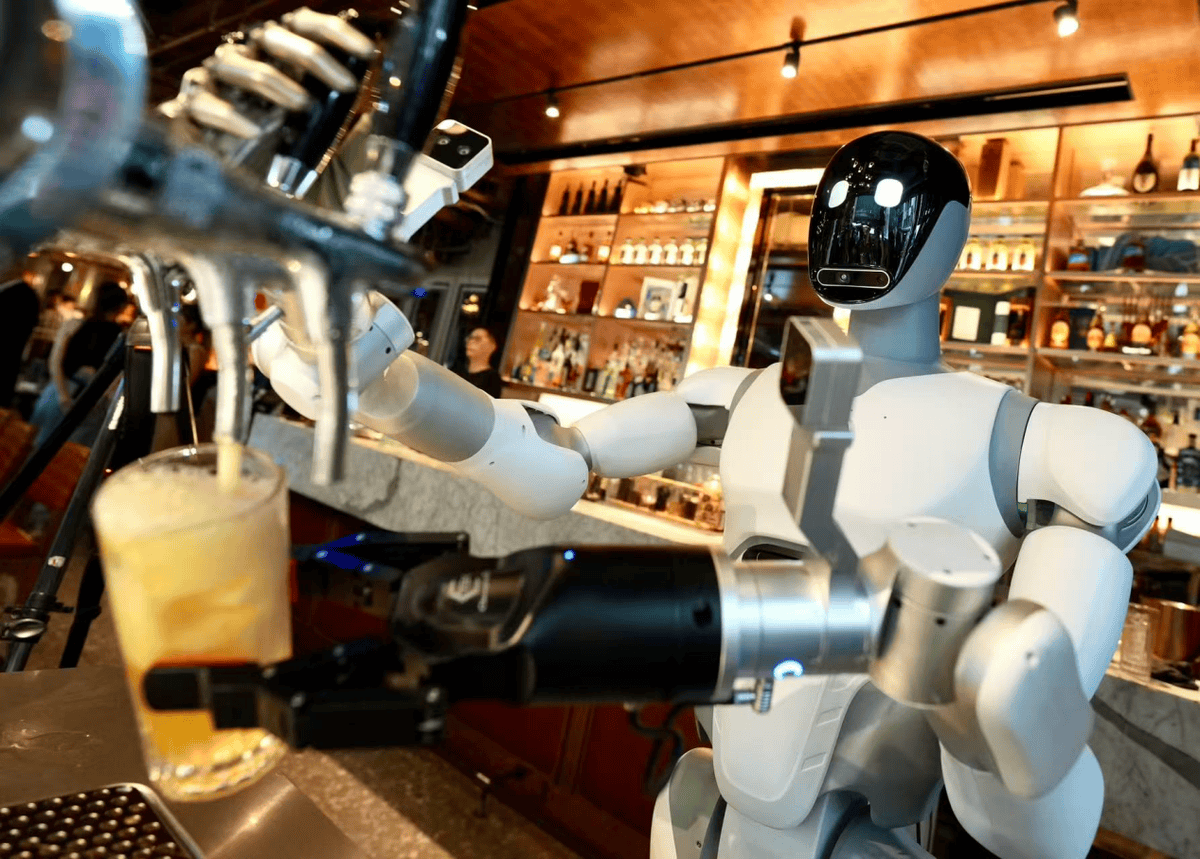
At Lan Kwai Fong, Aibao had no booth, no glass case, and no demo script. It stood at a real bar counter, serving real customers.
This is the core logic behind Zhipingfang's push for productivity-oriented general-purpose robots: robots are not meant to prove what they can do, but to actually do things for people.
In late 2025, Zhipingfang launched 'Zhi Cube,' the world's first modular embodied intelligent service space. It now operates regularly in more than ten provinces and cities, including Beijing, Shanghai, and Shenzhen, where robot staff autonomously make coffee, ice cream, and matcha. The Lan Kwai Fong deployment moves Aibao from relatively standardized commercial service settings into more open, complex, and dynamic native human social environments.
If standardized scenarios test whether a robot can do the job, Lan Kwai Fong tests something else:
Can it work amid change? Can it perform well in complex environments?
It may look like moving from one bar counter to another, but it marks a leap for general-purpose robots from 'functional availability' to 'scenario competence.'
Setting Out from the Greater Bay Area
ZhiSquare Accelerates Overseas Expansion
Choosing Lan Kwai Fong carries deeper significance.
Hong Kong is a key gateway connecting mainland China with global markets, and Lan Kwai Fong is a highly international urban commercial space. Here, a Chinese robot from the Greater Bay Area directly faces consumers from around the world.
This is not just the rollout of a commercial service, but a real-world step for China's embodied AI going global.
Today, Chinese embodied AI robots, led by Aibao, are moving from international exhibition halls into real overseas applications — shifting from showcasing technology to creating tangible value.
The change reflects China's embodied AI transitioning from technical validation to productivity validation.
True general-purpose robots should not work only in familiar settings. They must operate across different environments, tasks, and people, continuously creating value in real scenarios.
From factory floors to commercial services, from Hong Kong to more global cities ahead, Aibao is expanding not just application scenarios but the capability boundaries of general-purpose robots.
Dr. Guo Yandong, founder and CEO of Zhi², once said: "Without AI, a robot is just hardware; without hardware, AI is just code; without real scenarios, robots will never leave the lab."
Now, Aibao is standing at a bar in Lan Kwai Fong, answering that question with a real job.
The best showcase for a robot is never a display stand, but the real, open world where it starts working.
Starting from the Greater Bay Area and using Hong Kong as its gateway, Zhipingfang is bringing general-purpose robots into more real-world global scenarios, turning them into actual productive forces. The successful end-to-end operation in Hong Kong, its first stop, marks an acceleration in the company's overseas expansion, with more robots and scenarios set to light up international markets in the near future.
This article was provided by Zhipingfang and republished with authorization from QbitAI. The views expressed are those of the original author.