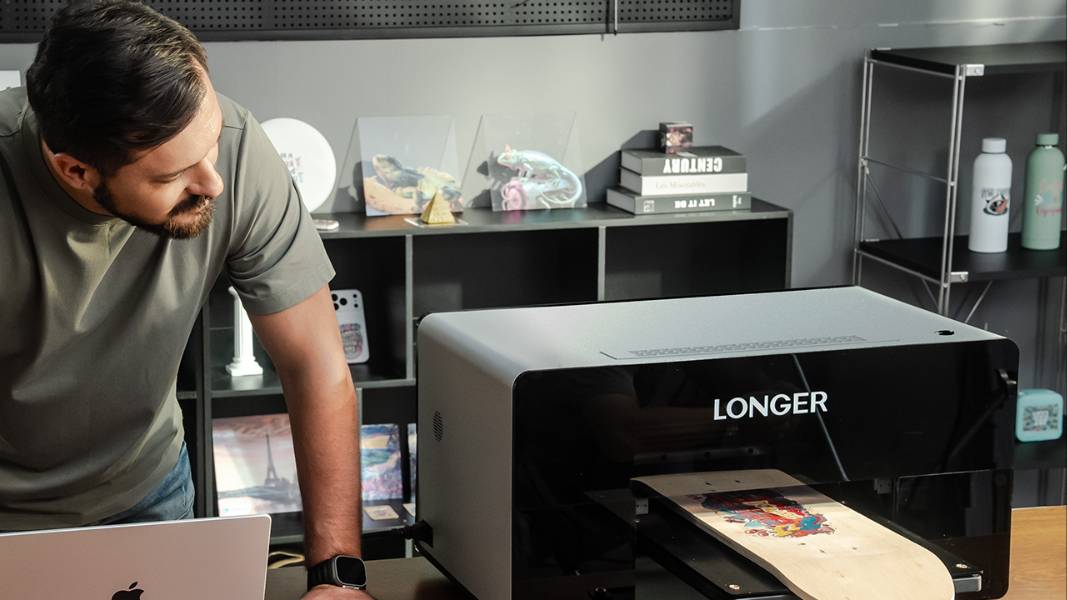
Produced by Huxiu Business & Consumer Group.
By Zhou Yueming.
Editor: Miao Zhengqing.
Cover image: Changlang.
This article was co-produced by Huxiu and the INNO 100 Global Innovation Flagship Store. Hardware 100 is a column launched by Huxiu's tech team focusing on AI hardware innovation. This is the 22nd article in the series.
As consumer-grade 3D printers move beyond the geek niche and into the studies and garages of more middle-class households, the focus of desktop manufacturing is shifting.
Monochrome molding and black-and-white engraving can already turn ideas into objects. The next step is creating something with color, texture, and even sellable appeal.
Against this backdrop, desktop UV printers capable of color curing and multi-material printing have become the new focus.
For example, in 2025, the E1 launched by eufyMake, a subsidiary of Anker Innovations, briefly became the highest-funded project on Kickstarter. Within just two years, more than five brands have entered this space.
Among them is Longer, a Shenzhen-based company with a decade in 3D printing. Founded in 2016, its founder, Changshi Lao, previously conducted doctoral research in lasers, materials, and algorithms at the Georgia Institute of Technology.
In November 2025, Longer launched its UV printer, the Longer ePrint. It sold $1 million (about RMB 7 million) in 45 minutes on Kickstarter, and within 60 days raised $4.294 million (about RMB 28.9 million) from 1,621 backers.
The machine features an industry-first dual printhead and a 12-ink-channel open ink system, covering multiple printing processes. In early August 2026, the Longer ePrint made its China debut, with exclusive pre-sales through the INNO100 flagship store and JD.com at a launch price of RMB 14,999.
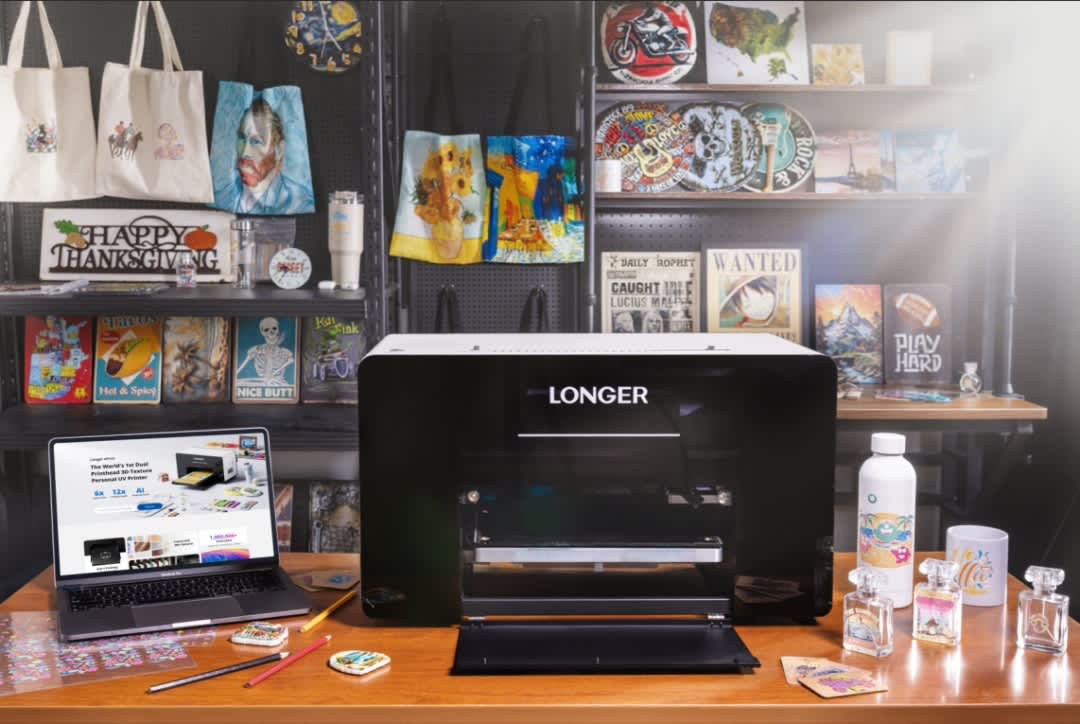
Longer spotted the potential for desktop UV printers among many users as early as three years ago.
Small merchants near U.S. national parks asked Longer whether it had tools to print custom designs directly on cultural and creative products. An American mother preparing her daughter's wedding also asked Longer about tools for creating colorful return-gift patterns on paper boxes.
"We realized then that monochrome or black-and-white expression was no longer enough; people need richer colors and more customization freedom," Allen Leung, co-founder and deputy general manager of Longer, told Huxiu.
The advantages of monochrome 3D printing and black-and-white laser engraving are shrinking. The next stage of desktop manufacturing is full-color and multi-process integration. A new battle in desktop manufacturing is already underway.
Competing for Small Business Clients
Like many desktop devices aimed at creative and custom-production work, Changlang's ePrint is aimed not at home users but at small businesses that earn money from custom orders.
This cohort of small merchants taking orders from home studios has grown increasingly numerous amid surging demand for personalized gifts. In mature overseas consumer markets—where garage-startup culture is strong and shoppers pay premiums for personalized goods—they already number in the millions.
Etsy, one of the largest online marketplaces for creative goods, had 5.6 million active sellers as of end-2025, with custom or made-to-order products accounting for roughly 30% of platform transaction value.
These small merchants—working in print-on-demand, gift and cultural products, tourist souvenirs and small-batch transfers—have become the focus of desktop printer makers. Their orders are fragmented, designs change fast and lead times are tight, so they need their own production equipment.
In overseas markets such as the U.S., the last mile of small-batch customization often lacks the dense, responsive manufacturing supply chain that China has. Most factories are built around large orders and stable designs. When an order is just a few dozen units, the design changes frequently and delivery must land before a wedding, holiday or event, outsourcing minimums, back-and-forth time and shipping costs quickly balloon.
"Buying your own machine lets you take small orders and keep the profit," Allen Leung told Huxiu. Using custom miniature decorative oil paintings as an example, he said a small merchant can produce more than 20 finished pieces in a day and monetize them quickly.
Whoever helps these small merchants keep more profit in their shops will become the next production tool that gets switched on every day.
But Changlang argues that the UV printers currently on the market have several persistent, unavoidable flaws.
First, a single printhead is inefficient and limited to a single process.
When creating embossed effects, the process requires a white ink base layer, then color ink, and finally a gloss varnish. This means the product's base is entirely white, so white ink usage is much higher. With only one printhead, speed suffers.
Second, maintenance costs for cleaning and ink changes are high.
Switching inks for different processes requires thoroughly cleaning the ink lines. Any carelessness can cause ink contamination or chemical reactions—a significant barrier for small business customers with limited technical expertise.
Third, printheads are prone to clogging and have a short lifespan.
In low temperatures, ink can congeal and clog the nozzle; prolonged idle time also damages the ink lines. And if an industrial-grade printhead fails, replacement can easily cost thousands of yuan.
Fourth, consumables are locked into a closed ecosystem.
Many companies in the industry follow a 'low-priced machine plus expensive proprietary ink cartridges' model, which steadily drives up operating costs for merchants over time.
To address these pain points, Changlang ePrint's solution is a dual-printhead architecture with 12 ink channels.
To overcome the low efficiency and single-process limitations of a single printhead, ePrint dedicates one head to white ink to speed up embossed effects. The two heads can also split processes: one for UV direct printing on rigid surfaces, the other for DTF (print to film, then heat-press onto textiles) or DTG (direct-to-garment printing). This eliminates tedious ink changes and cleaning, enabling four combination modes.
The 12 ink channels also reduce process switching on complex orders. Color ink, white ink and varnish can be combined in a single job, avoiding frequent ink or equipment changes for different effects.
In Changlang's view, this is not simply stacking hardware.
"The real difficulty isn't adding another printhead; it's keeping two jetting paths stably aligned on the same object. Structural control, color registration, positioning and anti-ink-mixing — if any one fails, speed turns into rework," Allen Leung told Huxiu.
He said ePrint has been in development since 2024, with R&D lasting more than ten months. A key focus for the team was managing compatibility and coordination among different inks.
To address the problem of closed consumable lock-in, Changlang chose an open ink system.
The common model in desktop hardware is selling machines at low prices and profiting from proprietary consumables. Closed systems let manufacturers tightly control ink, printheads and color consistency; the trade-off is fewer consumable choices for users and long-term costs that are harder to reduce.
The idea behind Open ink is to reduce users' reliance on a single proprietary consumables system and give makers and small businesses more choice. Changlang hopes to be rewarded through hardware stability and user experience," Allen Leung told Huxiu.
But an open system doesn't mean users can just use any ink.
Inks with different formulations cannot be mixed directly; the lines must be flushed before switching inks, or there may be color contamination or chemical reactions. If open ink is to become a selling point, Changlang must give users clear rules on compatibility lists, cleaning procedures, fault liability, and warranty boundaries. Otherwise, the savings on consumables could easily become maintenance costs for novices.
In addition, to address the frequent clogging and short lifespan of UV printheads,
ePrint's approach is to plan maintenance mechanisms such as moisture retention and 'flash printing' to address issues like low-temperature clogging and long idle periods, and to adopt replaceable components costing around 1,000 yuan, bringing subsequent maintenance costs down to a range acceptable to small merchants.
Finding Opportunities in a Crowded Field
Competition in this field is already more crowded than expected.
Companies from different backgrounds are pouring into this space: 3D printing, laser, and consumer manufacturing brands; companies like Anker and xTool that already have overseas channels and a base of maker users; and teams with experience at major firms like DJI have also begun to position themselves.
These companies are not all competing on the same product line, but they are all vying for the same entry point: who can first deliver color, small-batch, low-barrier manufacturing capabilities into the hands of ordinary creators and small merchants.
"Now we are truly surrounded by wolves — the technology lead for dual printheads may last only a few months," Allen Leung told Huxiu.
He estimates the window may last until October, when rivals will successively adopt dual-printhead designs, marking a critical phase for seizing the peak 2026 season.
The intensity of competition is also becoming evident in pricing.
To gain an edge, Changlang ePrint set its launch pre-sale price at 14,999 yuan.
In overseas markets, comparable desktop UV devices now range from roughly 16,000 to 24,000 yuan. Anker's eufyMake E1 base version (single printhead) is priced at about $2,409, or around 16,200 yuan.
xTool's O1 Omni is priced at $2,499 (about 16,800 yuan) for the single-UV version, $3,299 (about 22,200 yuan) for the dual-UV printhead version, and $3,499 (about 23,500 yuan) for the UV + DT Fabric version.
On consumables, Changlang's open-ink approach targets small merchants' sensitivity to long-term ink costs.
eufyMake uses proprietary cartridges, with a public retail price of about $29.99 per 100 ml (around 202 yuan). xTool sells 125 ml bottled ink at a launch price of $13.99 (about 94 yuan).
This pricing and market positioning test Changlang's supply chain and cost-control capabilities.
But hardware price isn't everything. To seize the window of opportunity, Changlang has set itself several core tasks.
"The first is ensuring delivery," Allen Leung told Huxiu.
The biggest fear for new hardware isn't a lack of pre-orders, but orders arriving too fast while supply chain and quality control lag behind. Dual print heads, multiple ink paths, different materials and various processes amplify every small deviation in mass production: a prototype producing beautiful results doesn't mean dozens or hundreds of machines will work consistently. Missing peak season only costs sales, but unstable delivery directly damages the reputation of the first batch of users.
Second, step up marketing efforts.
Changlang will build an ecosystem through influencer partnerships, parameter sharing and user communities.
Leading brands have greater scale in overseas channels, content distribution, dealer networks and user awareness. Changlang needs to make up more than just advertising budget. It needs to give the first batch of influencers, makers and small merchants reusable parameters, materials and case studies, then have them bring product usage into broader communities.
The longer-term test lies in intelligence and ease of use.
Open ink systems can attract cost-sensitive users, multi-process capabilities expand order types, and dual print heads offer a temporary first-mover advantage.
But these can all be imitated by latecomers. What's truly hard to replicate is helping users quickly find workable solutions when they encounter material, ink, or pattern issues—and keeping them coming back for the next order.
That's also the more practical role for AI in this kind of hardware.
For small merchants, the most valuable AI isn't necessarily generating another image—it's reducing one parameter adjustment, saving one piece of material, or avoiding one machine stoppage due to an anomaly.
Only when intelligence extends into the full chain of pattern processing, calibration, material recognition, and maintenance alerts can a professional device move closer to plug-and-play usability.
'One machine in hand, creativity follows' is the vision Changlang wants to hand to users. But in desktop manufacturing, creativity is just the start of an order. Users still have to deal with materials, ink, lead times, scrap rates, and after-sales service.
Changlang is betting that dual print heads, open ink, and multi-process capabilities give makers and small merchants more control over their production workflow.
The real hurdle it must clear is the one every desktop manufacturing device faces: whoever delivers a mature, stable product to users first will truly win the market's mindshare.