
Recently, the semi-annual reports of the three major operators, China Mobile, China Unicom, and China Telecom, were released successively.
It can be said that they are worlds apart.
While its legacy businesses continue to lose ground, with revenue from mobile voice, fixed-line telephony, and mobile SMS all falling sharply.
On one hand, new businesses have seen a surge in growth against the trend, with computing power service revenue growth rates reaching as high as double digits.
Traditional businesses have reached their growth peak, and computing power has become a new growth point for operators.
Telecom operators selling computing power have the advantage of leveraging their existing infrastructure and network resources to provide low-latency and high-bandwidth services, which is crucial for applications such as cloud gaming, virtual reality, and artificial intelligence. Additionally, they can utilize their extensive customer base and sales channels to promote their computing power services. However, they also face challenges such as intense competition from established cloud computing providers like Alibaba Cloud, Tencent Cloud, and Amazon Web Services, as well as the need to invest heavily in building and maintaining their own data centers and cloud infrastructure.

The Ministry of Industry and Information Technology's latest disclosure of the communications industry's economic performance data for the first half of 2026 shows that in the first half of this year, China's cumulative telecommunications business revenue reached 887.3 billion yuan, down 2.1% year-on-year.
The growth rate turned from positive to negative, hitting a historic low for the domestic telecom business revenue growth in recent years.
By sector, mobile phone call duration dropped 6.2% year-over-year, while fixed-line phone call duration plummeted 20.4% year-over-year. Mobile text message business volume fell 8% year-over-year, with related revenue tumbling 12.9%.
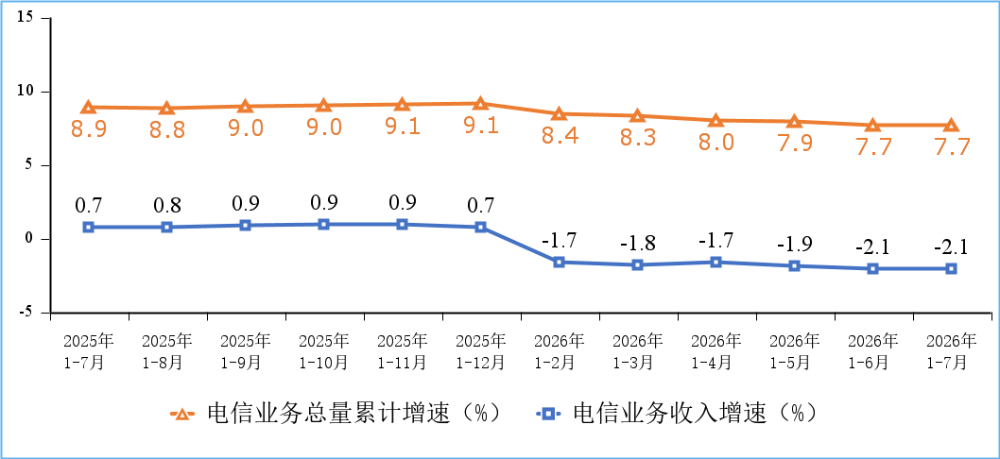
Telecom business revenue and total telecom business volume cumulative growth rate
Voice and text messaging services, once the mainstay of carriers' revenue, have now become a thing of the past.
This is consistent with our consumption experience.
Most people's consumption habits are such that they rarely send text messages, make as few mobile phone calls as possible, and instead use WeChat to communicate, either by sending messages or making voice calls directly through the app.
It's no surprise that the operators' call and text messaging businesses have declined.
The issue is that the traffic business should be growing, right?
Indeed, in the first half of this year, the cumulative total traffic of mobile internet reached 2197 billion GB, a year-on-year increase of 17.7%.
It is strange that the three major operators' revenue from traffic is decreasing.
In specific terms, China Mobile's "communications service revenue," which includes data traffic, was 350.4 billion yuan, a year-over-year decline of 5.7%.
China Telecom's "mobile communications service revenue" was 105.438 billion yuan, down 1.1% year-on-year.
China Unicom's "broadband and mobile data service revenue" was 73.931 billion yuan, down 4.05% year-over-year.
Traffic business has fallen into the awkward situation of "increasing volume but not increasing revenue".
On the one hand, the communications industry is a typical capital-intensive sector, requiring massive investments every year for base station iteration, network upgrades, and data center operations, with high fixed costs that are difficult to reduce.
On the other hand, market competition has led to a decrease in traffic fees, resulting in a continuous decline in average revenue per user.
Additionally, starting from January 1, 2026, the value-added tax rate for businesses such as mobile traffic has been increased from 6% to 9%, resulting in decreased revenue and profit for operators.
In fact, the mobile user market has become saturated.
Data shows that the total number of mobile phone users in China has reached 1.847 billion, and the total number of mobile internet users has reached 1.638 billion.
Both figures far exceed the country's total population of 1.4 billion, and the market has no room for large-scale new additions.
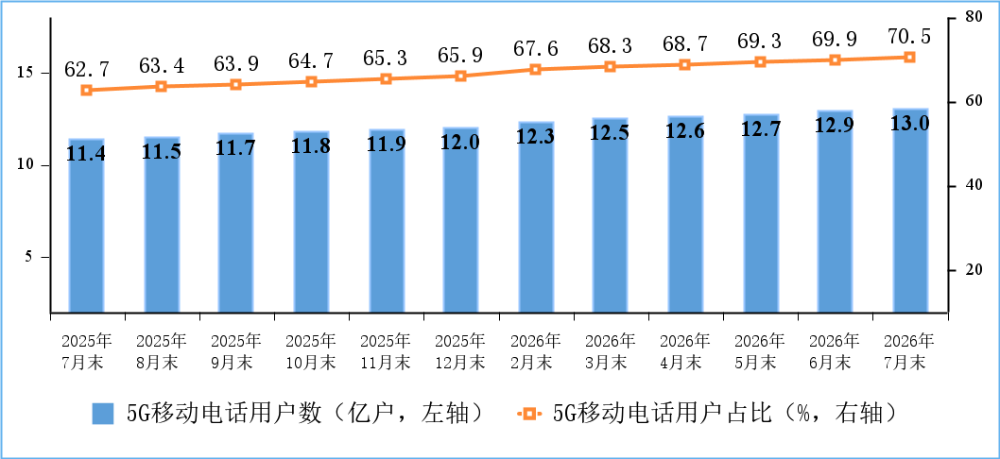
The number of 5G mobile phone users has reached 475 million, with China accounting for more than 80% of the total, according to a report by the China Academy of Information and Communications Technology. The report also stated that the total number of 5G base stations in China has exceeded 1.43 million, covering all prefecture-level cities, 97% of counties, and 50% of towns and villages.
Following the decline of voice calls and text messaging, the cellular data business is also nearing its end.
Following this line of thinking, telecom operators' computing power businesses look genuinely impressive upon closer examination.
In the first half of this year, China Mobile's computing power services revenue reached 52.9 billion yuan, up 14% year-on-year.
Computing power and intelligent services accounted for 22.6% of the company's main business revenue, up 2.2 percentage points year-over-year, becoming the primary growth driver.
China Telecom's smart services revenue reached 31.1 billion yuan, up 7.1% year-on-year, accounting for 12.8% of total revenue.
China Unicom's computing power revenue reached 41.9 billion yuan, up 13% year-on-year, and has been positioned as the "first engine driving overall growth".
Traditional businesses have been declining one after another, while new businesses have been soaring.
Quietly, operators are undergoing a "new and old kinetic energy conversion".
The structural tilt in capital expenditures also underscores this trend.
China Mobile is investing 40 billion yuan in a data center in Hohhot, which covers an area of 1,402 mu and has a planned total floor area of approximately 1.42 million square meters.
The center began construction in 2012 and was officially put into operation in 2016, with a total computing power of 20,100P, making it the largest, most advanced, and most secure core node within China Mobile Group.
In the first half of this year, the total capital expenditure of the three major operators was 117.5 billion yuan, with Alibaba's investment in computing power reaching approximately 40 billion yuan, accounting for 34% of the total and representing a year-on-year increase of over 80%.
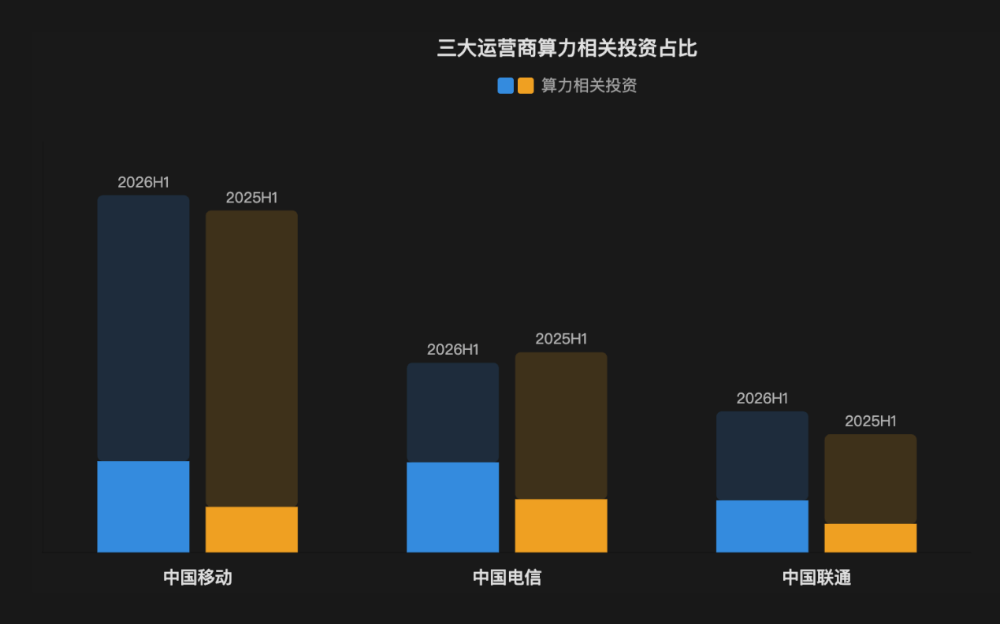
The proportion of computing power-related investments of the three major operators
For operators, selling computing power is not an option, but a matter of survival.

What Are the Chances of Success for Operators Selling Computing Power?
Many believe that telecom operators, with their nationwide networks, data centers, and infrastructure assets, are all but destined to reclaim their dominance from the mobile data era.
In fact, the intensity of competition in the computing power market is much greater than that in the traffic market.
First, look at the market share.
IDC released its "China Public Cloud Services Market (2H25 Tracker)" which shows that the total market size of China's public cloud IaaS market reached $15.97 billion.
Among them, Alibaba ranked first with a 27.9% market share, with a significant lead in single-unit scale.
The combined market share of China Telecom and China Mobile's cloud services is 22.2%, which is only about 80% of that of Alibaba Cloud.
Huawei followed closely behind with a 9.5% market share.
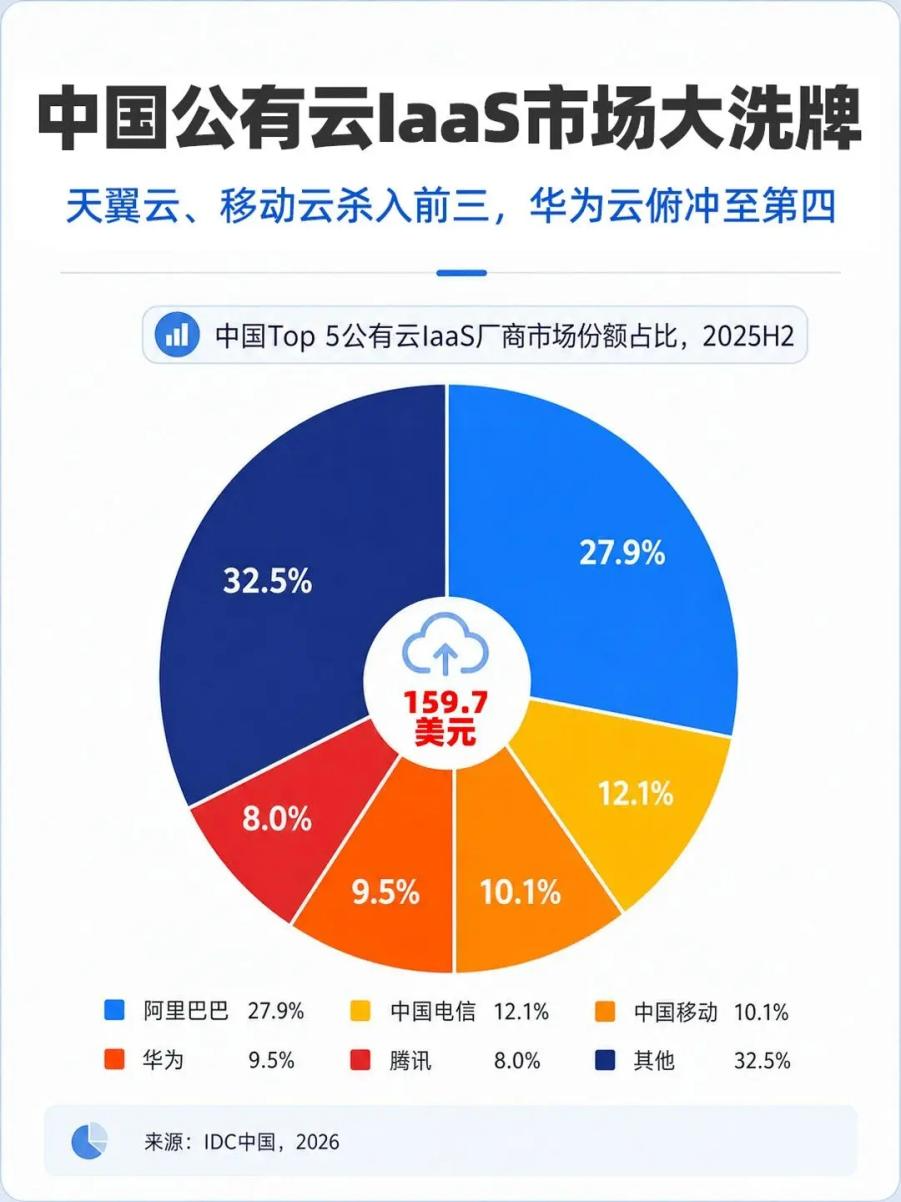
The landscape of China's public cloud IaaS market
From another perspective, in China's public cloud IaaS market, China Telecom and China Mobile together account for 22.2% of the market share, and when adding China Unicom, the total is approximately 30%.
In other words, the three major carriers' market share is only 30%.
The dominant forces in China's computing power market are internet cloud service providers like Alibaba, Huawei, and Tencent, rather than telecom operators.
How did the internet cloud service provider attain a leading position?
In addition to the first-mover advantage, the core advantage of internet cloud service providers is their coverage of the entire industry chain.
Taking Alibaba Cloud as an example, it has become the only public cloud vendor in China that possesses full-stack self-research capabilities for GPU, CPU, storage, and network chips.
In the chip and computing power infrastructure layer, Alibaba Cloud, through its semiconductor subsidiary Pingtouge, has developed a full range of chips covering AI training/inference, general computing, networking, and storage.
At the model layer, Alibaba Cloud has mastered the "operating system" of the AI era through its self-developed large models, with its latest flagship model "Qwen3.7-Max" achieving leading results in multiple authoritative rankings.
At the inference and application layers, Alibaba Cloud transforms computing power and model capabilities into directly usable products and services.
In May 2026, Alibaba Cloud announced the full opening of the Bai Lian platform, partnering with companies including Yue Zhi An Mian, Minimax, and Zhi Pu, to offer a one-stop service with "one entrance and multiple models to choose from".
This full-industry-chain model has allowed Alibaba Cloud to completely break free from the low-end model of simply selling computing power hardware, instead earning high-margin profits through software, platforms, ecosystems, and solutions, with extremely strong user stickiness.
Meanwhile, Huawei is delving deep into industry solutions, Baidu is focusing on AI-native ecosystems, and Tencent is taking root in various scenarios, with the computing power market still presenting a competitive landscape of "many heroes vying for dominance".
In contrast, most operators' computing power businesses are currently stuck at the basic IaaS level, with core revenue still coming from GPU rentals, data center hosting, and bandwidth leasing.
In essence, selling computing power is no different from selling traffic or bandwidth in the past.
What's even more noteworthy is that when selling traffic, operators are the sole players and can still profit without exerting much effort.
When selling computing power, operators are just one of many players and can be replaced at any time.
If they continue to follow the "package thinking" of the traffic era, operators will inevitably become "pipe merchants".

Manufacturing chips and developing large models are not the strong suits of operators, and these shortcomings cannot be made up for in the short term.
How Will Telecom Operators Fare in the Intense Competition for Computing Power?
Let's first look at the three trump cards of the carriers.
The first card is the network.
The implementation, transmission, and scheduling of all computing power rely on network support.
Operators control the national backbone network, edge computer rooms, and urban and rural domain network nodes, and have the capability of "computing-network convergence".
Operators can achieve dynamic allocation of computing power across regions and deploy edge computing power locally, perfectly adapting to application scenarios with low latency and high stability, which is a core capability that internet cloud service providers cannot replace.
China Mobile has a total of 13 intelligent computing centers nationwide, and through the "Tianqiong" algorithm network brain, it has achieved unified management and scheduling of the entire network's 147.7 EFLOPS computing power.
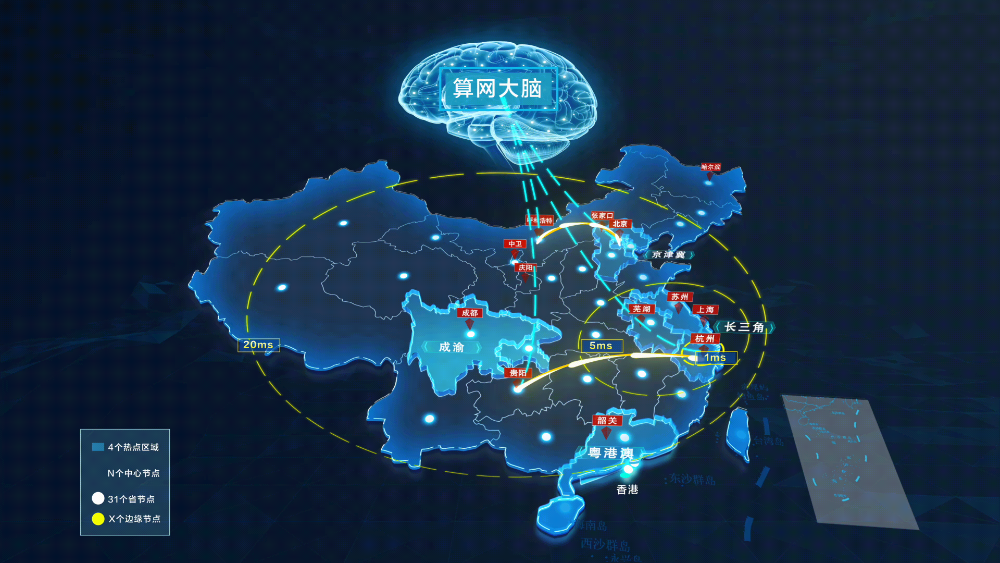
China Mobile's "Computing Network Brain"
The second card is data.
No matter how powerful large models are, without industry data, they are castles in the air.
Telecom operators have access to communication network data, including user behavior, network traffic, and location information.
In addition, operators cover the government and enterprise, industrial, and rural markets, possessing a vast amount of real network data, terminal data, and scenario data.
These data are inaccessible to internet cloud service providers and serve as the exclusive fuel for training industry models.
The third card is trust.
Computing power and data are core assets of the digital economy.
Government affairs, finance, and defense industries, among other key sectors, have extremely high requirements for data security, autonomous controllability, and compliant stability.
Compared to internet cloud service providers, operators are seen as the "national team" with inherent security and compliance advantages.
China Telecom disclosed a set of data showing that, for the government and enterprise market, it has developed more than 420 industry-specific smart bodies, 102 industry-specific Skills, and 82 industry-specific digital employees, serving 39,000 customers, with a central enterprise penetration rate of 96%.
The advantages of the operator can be seen at a glance.
Networks, data, and trust are the core trump cards of operators, and are also things that internet cloud service providers cannot buy with money.
With three aces in hand, operators are bound to have a place in the computing power market.
Government and enterprise projects form the foundation of operators' computing power business.
The issue is that the government and enterprise market has a ceiling.
To expand their business, operators must shift from "selling computing power" to "selling solutions" and compete in the entire market.
Selling computing power means "I provide you with computing power, and you use it yourself."
Selling a solution is about saying "you have this business pain point, and I'll help you solve it".
The former is wholesale and retail, earning the difference in resource prices; the latter is consulting services, earning intellectual premiums.
Selling solutions is precisely where operators fall short.
Telecom operators have grown accustomed to selling "standardized products", with standardized packages, standardized tariffs, and even standardized customer service scripts.
"Selling solutions" requires customized capabilities, industry understanding, and rapid response capabilities.
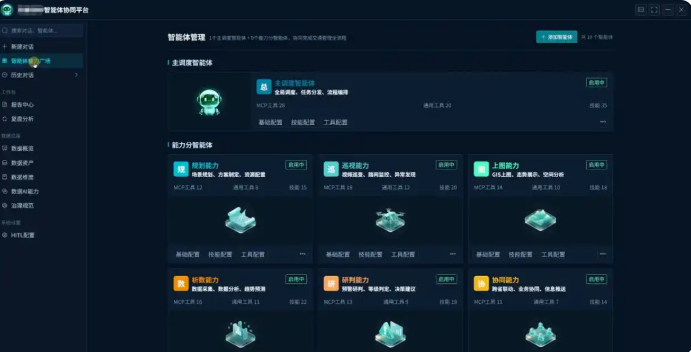
China Unicom's Digital Intelligence Empowerment Solution for the Transportation Industry
An AI solution for a smart city may involve multiple fields, including government affairs, transportation, energy, and healthcare.
Operators need to understand the business processes, data standards, and compliance requirements of each industry, as well as be able to quickly allocate computing resources, assemble model capabilities, and integrate ecosystem partners to achieve one-stop delivery.
Customer needs vary greatly, with each project requiring customization, resulting in long delivery cycles, uncertain profits, and high talent requirements.
In short, selling solutions is a tough job.
It's not like making money by selling traffic, where you can earn passively, but rather requires digging deep into each industry to achieve success.
No matter how tough it gets, we have to keep going.
If they don't take action, operators will be limited to their existing customer base and watch as internet cloud service providers take the largest share of the computing power market.
Operators need to move out of their comfort zones and dive into the deep waters of various industries.
This is the most difficult one, and also the last chance.