
A delicious plate of fried rice, with each grain distinct, is the standard.
Traditional fried rice is made by steaming japonica rice, then refrigerating it to restore its texture, including using leftover rice, which relies on starch aging to reduce stickiness and achieve a loose, granular texture.
However, during peak hours in the kitchen, it's difficult to prepare leftover rice in advance. Now, some restaurants are using a type of "fried rice rice" that skips the refrigeration process, allowing freshly steamed rice to be stir-fried directly. This type of rice is also compatible with commercial steam cabinets and electric rice cookers, ensuring stable and consistent food production. In addition to achieving distinct grains, some restaurants claim that this type of rice has the benefits of weight loss and a low glycemic index (GI). What's behind this?
There is a type of moderate hydrothermal treatment for rice, which involves short-term soaking and low-temperature heat treatment of rice grains in their husked state. The temperature is set below the complete gelatinization temperature of starch, at 70-75°C, at which point the starch only undergoes partial hydrothermal modification and does not fully gelatinize, and is then dried and milled.
After restaurants purchase this type of rice and steam it, they can achieve a distinct grain effect. This process results in the partial degradation of branched starch, with a relative increase in linear starch.
The principle is that moisture seeps into the rice grains, the endosperm absorbs water, causing the hydrogen bonds within the starch granules to loosen. Under low-temperature humid heat conditions, the indigenous starch enzymes (α-amylase, debranching enzyme) in the rice grains are moderately activated, prioritizing the hydrolysis of the outer short branches of the branched starch. The branch points and outer short chains of the branched starch are more easily cut off by enzymes, and some large branched molecules are cut into medium and small fragments, while the linear starch molecules are relatively more resistant to this mild enzymatic hydrolysis, with less degradation.
The branched starch is partially consumed, so the detected proportion of straight-chain starch is relatively increased. The higher the proportion of straight-chain starch, the lower the inherent stickiness of the rice, and the better the foundation for fried rice. After absorbing water and then undergoing low-temperature drying and dehydration, the starch molecules inside the rice grains undergo rearrangement: some straight-chain starch and long-chain segments of branched starch re-form hydrogen bonds, building more ordered binding regions, similar to the structure of resistant starch produced by mild retrogradation. The gaps between starch granules shrink, and the microscopic structure of the endosperm becomes more dense and compact.
As a result, the rate of water absorption during steaming slows down, and the water absorption rate decreases; starch granules are not easily fully expanded and broken down; internal starch is not easily migrated and overflowed outward.
A dense barrier layer is formed by the self-reorganization of starch on the surface of the rice grains.
When cooking rice through steaming, this surface barrier inhibits the massive dissolution of internal soluble starch; although the rice grains can be normally steamed to be fully cooked, a thick viscous starch gel will not form on the surface of the rice grains, and the grains will not easily stick together when hot, thereby eliminating the need for overnight refrigeration to restore texture, and the steamed rice can be directly used for fried rice.
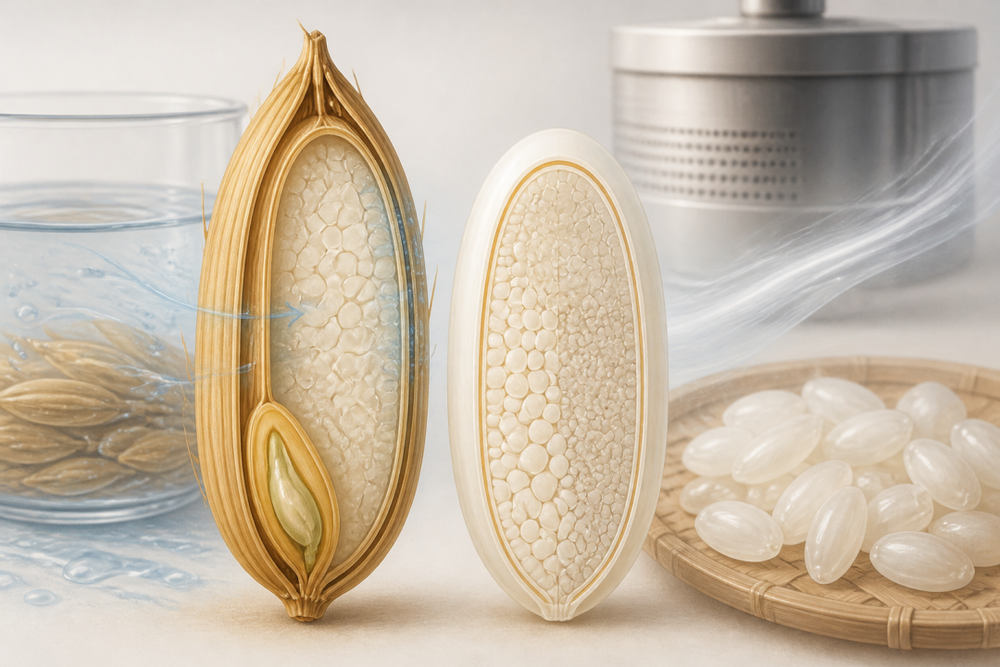
This type of rice mainly modifies the surface of the rice grains, reducing starch overflow during cooking, resulting in cooked rice that is distinct and separate, but the majority of the starch inside the endosperm is still fully gelatinized, and will still be quickly broken down into glucose in the small intestine.
It belongs to the medium-to-high GI refined rice category, not low-GI healthy staple food, and has no weight loss effect; diabetic patients can only consume it in small amounts and cannot use it as a special rice for blood sugar control.
When consuming fried rice, it is also necessary to pay extra attention to the total caloric burden brought by the added oil.
There is also a type of steamed glutinous rice, commonly known as half-cooked rice, which involves complete hydrothermal treatment of the rice while it is still in its husked state, with a process that includes:
Cleaning: removing impurities and stones from the rice grains.
Soaking in warm water: Soak in warm water at 40-60°C for several hours, allowing moisture to penetrate the rice husk and enter the brown rice, and the endosperm to fully absorb water.
High-temperature steam treatment: 100-125℃ steam processing causes the starch inside the rice grains to undergo thorough and complete gelatinization, unlike the moderate hydrothermal tempering of rice that only modifies the surface layer.
Segmented drying + tempering: first, hot air drying, then tempering to evenly distribute the internal moisture of the rice grains, preventing them from cracking.
The milled product is a steamed glutinous rice with a light amber color.
The rice cooked using this type of rice is also characterized by its distinct and separate grains. The main reason the cooked rice has distinct grains is that the starch molecules undergo a deep rearrangement after special processing.
High-temperature steam treatment allows the starch in rice endosperm to be fully gelatinized, and subsequent drying and cooling cause the long-chain segments of amylose and amylopectin to recombine on a large scale, forming more slowly digestible starch and resistant starch.
Due to the formation of more ordered and compact structures by starch molecules, the speed at which digestive enzymes in the human body come into contact with and hydrolyze them slows down, resulting in a more gradual increase in blood sugar after meals.
Most regular white rice is composed of rapidly digestible starch with a high glycemic index, with a GI of around 70-78, whereas this steamed rice has a GI of between 55-65, classified as medium GI, and with modern improved processing techniques, it can even achieve a low GI of less than 55.
It should be noted that Qianggu millet is not a low-carb or sugar-reducing rice, with a total carbohydrate content similar to that of ordinary rice, it just has a slower digestion rate, and its weight loss effect is not ideal. The unique advantage of Qianggu millet is that its nutrients undergo a process of reverse osmosis migration.
The bran and germ layers of rice contain a large amount of B vitamins, iron, magnesium, and other minerals, but during the milling process of ordinary rice, the bran layer is ground away, resulting in the loss of nutrients.
After soaking and high-temperature steam treatment, water-soluble B vitamins and minerals in the bran and flour layers permeate and migrate into the endosperm.
After further processing to remove the bran, the nutrients that have migrated into the rice grains are preserved, with B vitamins retained at 2-4 times the level of ordinary polished rice.
Due to the migration of husk flavonoids and pigment substances into the endosperm with water, this type of rice has a noticeably deeper color than ordinary white rice. Additionally, the starch undergoes a mild Maillard reaction with high-temperature water, resulting in a light amber, semi-transparent finish. This is also a major reason why many domestic consumers are not accustomed to it. After undergoing hydrothermal treatment and re-crystallization, the endosperm structure of steamed glutinous rice becomes dense and hard, significantly reducing the broken rice rate during milling and slightly increasing the yield. When cooked, the rice grains do not easily burst, and less starch is released, resulting in cooked rice that is compact, elastic, and chewy, with low stickiness and a loose, separate grain texture. The cooked rice also exhibits excellent performance when used for fried rice. This type of rice also has a unique aroma similar to that of roasted grains, which some people describe as having a strong "rice fragrance," while others may find it has a "ricey" smell. It is worth noting that this type of rice has a higher water absorption rate than ordinary indica rice, so more water should be added when cooking.
A high water absorption rate also means a high yield, producing more cooked rice than ordinary white rice of the same weight.
There is also a more high-tech reorganization of squeezed rice, also known as reorganized rice, engineered rice, or artificial rice, whose core is no longer using natural rice grains, but instead grinding broken rice into rice flour, undergoing high-temperature and high-pressure cooking, and then using molds to extrude and cut, re-creating the shape of rice grains, with a process that includes:
Crushing ingredients: crushed rice, rice flour, can be matched with coarse grain flour, starch, dietary fiber, and nutritional fortifiers, add water to adjust moisture and mix.
The above-mentioned materials enter the extruder, where they are subjected to high temperatures of 120-160℃ and high pressures of 10-20MPa, resulting in enhanced shear force. Under these conditions, a large number of hydrogen bonds in the starch molecules are broken, causing the starch to fully gelatinize, the protein to denature, and ultimately merge into a plasticized dough state.
Mold extrusion + rotary cutting: molten material is forced through grain-shaped mold holes, extruded into strips, and cut into individual "grain" blanks by rotating blades. The size and length of the grains are completely determined by the mold, resulting in extremely uniform and neat particles.
4. Drying and cooling shaping: hot air drying removes excess moisture, cooling, starch molecules recombine, fixing the rice grain shape, and forming the final product. The principle of reconstituted extruded rice is similar to that of making rice flour, rice noodles, and niangao, except that it is cut into rice grain-sized pieces in the end.
During the extrusion process, the starch undergoes deep degradation, with many large molecules being cut into small starch fragments, resulting in digestive enzymes being able to access the starch more easily. The GI of ordinary formula reconstituted rice tends to be high, but with the addition of special ingredients such as konjac, dietary fiber, and resistant starch, it is possible to achieve a medium or even low GI.
Shirataki rice, also known as konjac rice, is a near-0GI "imitation rice grain" whose main ingredient is konjac, with its primary component being glucomannan, a water-soluble dietary fiber that is hardly decomposed into glucose in the human small intestine, theoretically approaching a GI of 0.
The Konjac rice can be rinsed and cooked directly after opening the bag, with absolutely dispersed grains that do not stick together in clumps.
This type of "rice" has almost no carbohydrates and extremely low calories, making it a boon for dieters and diabetics, but the downside is that it lacks the fragrance of rice, has a sticky and chewy texture, and a pronounced rubbery feel that discerning gourmets can detect in one bite.
Reorganized extruded rice forms a porous network inside the rice grains after extrusion and drying, allowing for extremely fast rehydration, and can be cooked through brief boiling, making it suitable for self-heating rice and instant meal packages. By adjusting the formula to control the pore structure, it is also possible to achieve fried rice with separate grains that do not clump even after prolonged storage, and has strong anti-staling capabilities. However, it lacks the natural bran layer structure of regular rice and the original fragrance of grains.
If it is ordinary crushed rice made into reconstituted extruded rice, high-temperature extrusion will result in the loss of B vitamins, and mineral retention will be limited, with a nutritional level similar to that of ordinary refined white rice, and it will not automatically become healthier.
However, nutritionally fortified recombinant rice is a different story, as it involves directly adding iron, zinc, B vitamins, konjac powder, and coarse grain powder during the ingredient stage, allowing for customizable nutrition, which is its unique advantage.
The processing of this type of rice is complex, so the cost is not low.
The reconstituted rice's texture, whether it is distinct and chewy, is determined by the mixed grains paired with it during reconstitution. If konjac is added, the rice is not only distinct but also very chewy. The unique chewy texture of konjac comes from its soluble dietary fiber, konjac glucomannan, a super-long water-soluble polysaccharide. When dried konjac powder encounters water, its large molecular chains fully expand and can lock in hundreds of times its weight in water, but at this point, it is only a sticky paste and cannot be shaped. To make konjac, the skin of the konjac tuber is removed, and it is grated and washed with clean water to remove the toxic calcium oxalate component. It is then cooked with alkaline substances like grass ash, causing the polysaccharides to lose their acetyl groups. The numerous long chains become entangled and combined, building a flexible three-dimensional gel network that traps water within the grid, ultimately forming a tough konjac gel. Unlike the brittle and fragile texture of agar jelly, the flexible molecular network of konjac can be stretched and deformed under external force and then rebound after the force is removed, creating its signature chewy
A bowl of seemingly simple fried rice hides the countless variations of rice starch.
Various types of "fried rice specialty rice" have their own strengths in terms of craftsmanship, but also their own limitations.
Don't be superstitious about the "non-stick" myth, understand the craftsmanship and make rational choices, in order to truly enjoy this bowl of worldly delights.