Produced by | Miaotou APP
Author | Ding Ping
Photo | Visual China Group
The market's understanding of the pig cycle over the past few years now needs to be re-examined.
In recent years, more and more people have come to believe that as large-scale breeding enterprises continue to expand, the pig cycle has been flattened. Every time the industry suffers deep losses, the market expects production capacity to be cleared; but every time pork prices rebound, they quickly come to an end due to the re-release of supply.
Over time, the pig cycle has fallen into a strange circle - losses have dragged on for longer and longer, with the market becoming increasingly eager to bottom-fish, yet the real turning point of the cycle has never arrived.
This time, we are turning bullish on the pig cycle, which is also the first time we have changed our judgment on the pig cycle in the past five years. The reason is that we have found that the underlying logic that has hindered the industry's production capacity clearance over the past few years is changing, making the pig cycle possess the conditions for a true reversal for the first time.
So, this article is actually trying to answer a core question: why is it possible that this time will be an exception, when past rounds of losses have not been able to restart the pig cycle?
But before answering this question, let's first figure out why the pig farming industry has been losing money for so long and failed to achieve a real production capacity clearance.
The cost center continues to shift downward
This is the fundamental reason why the losses in the past few rounds never developed into a real cyclical reversal.
Since 2021, the industry has experienced deep losses, whether in the third quarter of 2021, the first quarter of 2022, or the whole of 2023, but the pace of capacity clearance has always been limited. As a result, every round of pork price increases has only been a short-term rebound lasting about half a year, followed by a new downward cycle as supply is released again.

As a result, the market has gradually formed a consensus: with the increasing number of large-scale breeding enterprises, the pig cycle has been smoothed out. This is also a judgment we have consistently held over the past few years.
However, after re-examining this round of the pig cycle, we found that the real problem is not that the pig cycle has disappeared, but that the drive to reduce production capacity has always been lacking sufficient momentum, and the underlying reason is that from 2021 to last year, the entire industry has been in a stage of continuous decline in cost.
For a pig farming business, there are roughly two types of forces that determine whether it exits the market: one is administrative or passive withdrawal due to external shocks such as epidemics and environmental protection, and the other is cash flow pressure caused by continuous losses.
After the African swine fever in June 2018, the former has a lower probability of occurrence; whether this round of pig cycle can be reversed ultimately depends on the latter. If costs continue to decrease, even if pig prices remain low, the pressure of losses borne by enterprises will continue to ease. Therefore, many enterprises can still persist in production and are unwilling to exit the market, ultimately leading to the industry's inability to form effective production capacity reduction.
In 2021, the full cost of self-breeding and self-fattening was approximately 18-19 yuan per kilogram, while the cost of purchasing and fattening piglets was around 23 yuan per kilogram.
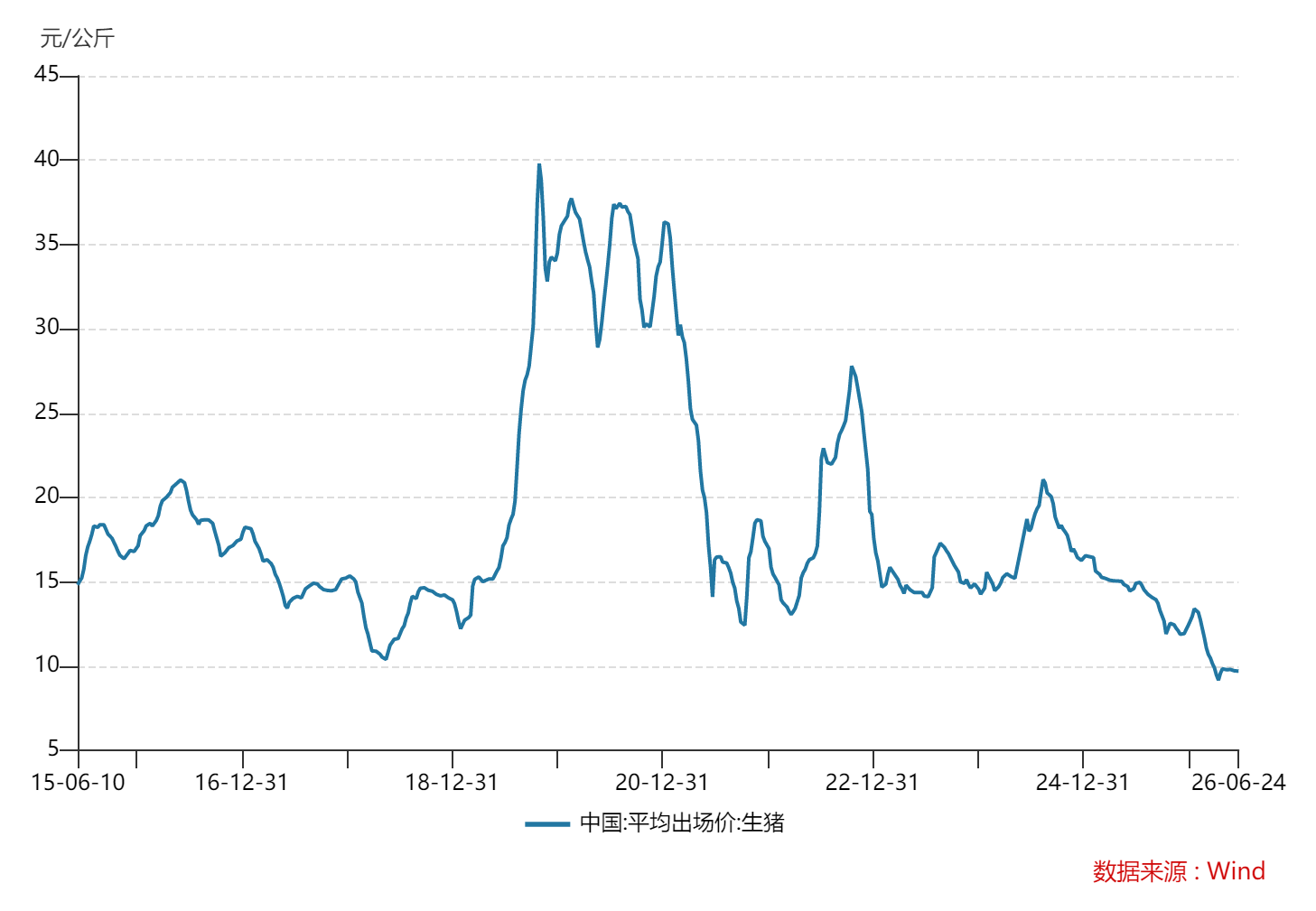
By 2022, the full cost of self-breeding and self-farming had dropped to around 16-17 yuan/kg; in 2023, it was further reduced to about 15 yuan; in 2024, it fell to around 14 yuan; by 2026, the industry's average full cost had entered the 13 yuan/kg range, with leading companies having already reduced their costs to below 12 yuan/kg, such as Muyuan Shares, whose full cost had decreased to 11.7 yuan/kg by June 2026.
It's not hard to see that in recent years, the cost structure of the pig farming industry has been consistently trending downward, with companies' breakeven points also decreasing accordingly.
For example, in the third quarter of 2023, when pork prices fell to 15 yuan/kg, considering the industry's past cost of 18-19 yuan/kg, the entire industry seemed to have entered a state of deep loss, and it should have started to reduce production capacity on a large scale.
But that did not happen in reality.
The reason lies in the fact that industry costs are in the process of continuously decreasing from 18-19 yuan/kg to 15 yuan. The cost reduction is not being achieved simultaneously by all companies, and there will always be a batch of enterprises with higher efficiency and better management that will be the first to reduce their costs and be the first to get out of losses.
Taking Muyuan Shares as an example, in the third quarter of 2023, the company's fully loaded cost fell to 14.5 yuan/kg, and it achieved a net profit of 936.9 million yuan, becoming one of the few companies in the industry that still maintained profitability at the time.
Thus, a phenomenon has emerged where, on average, the industry is losing money and facing cash flow pressure, but companies that have managed to lower their costs to 15 yuan or even lower are actually not incurring losses.
For these companies, as long as they can still make a profit, there is no motivation to proactively eliminate sows and reduce production capacity. They can even continue to expand production, taking advantage of the industry's downturn to further increase their market share.
As a result, although the industry has entered a loss-making cycle, few companies have actually exited the market, and production capacity has yet to be cleared, making it difficult for the pig cycle to experience a sustained upward trend like it has in the past.
Ultimately, the reason why the previous rounds of losses never led to a genuine reduction in production capacity is that the industry's cost structure has continued to decline, allowing cost-leading companies to recover profitability ahead of time and weakening the market-driven force for reducing capacity.
Why would this time be an exception?
Previous rounds of losses have failed to restart the pig cycle, but this time the losses may be different.
Over the past few years, the industry has managed to offset the pressure of falling hog prices through cost reduction. Now, however, the room for further cost cuts is extremely limited, which means losses will truly translate into cash-flow pressure.
Why say that?
Looking back at 2021, the industry's cost center has continued to decline, mainly due to three factors:
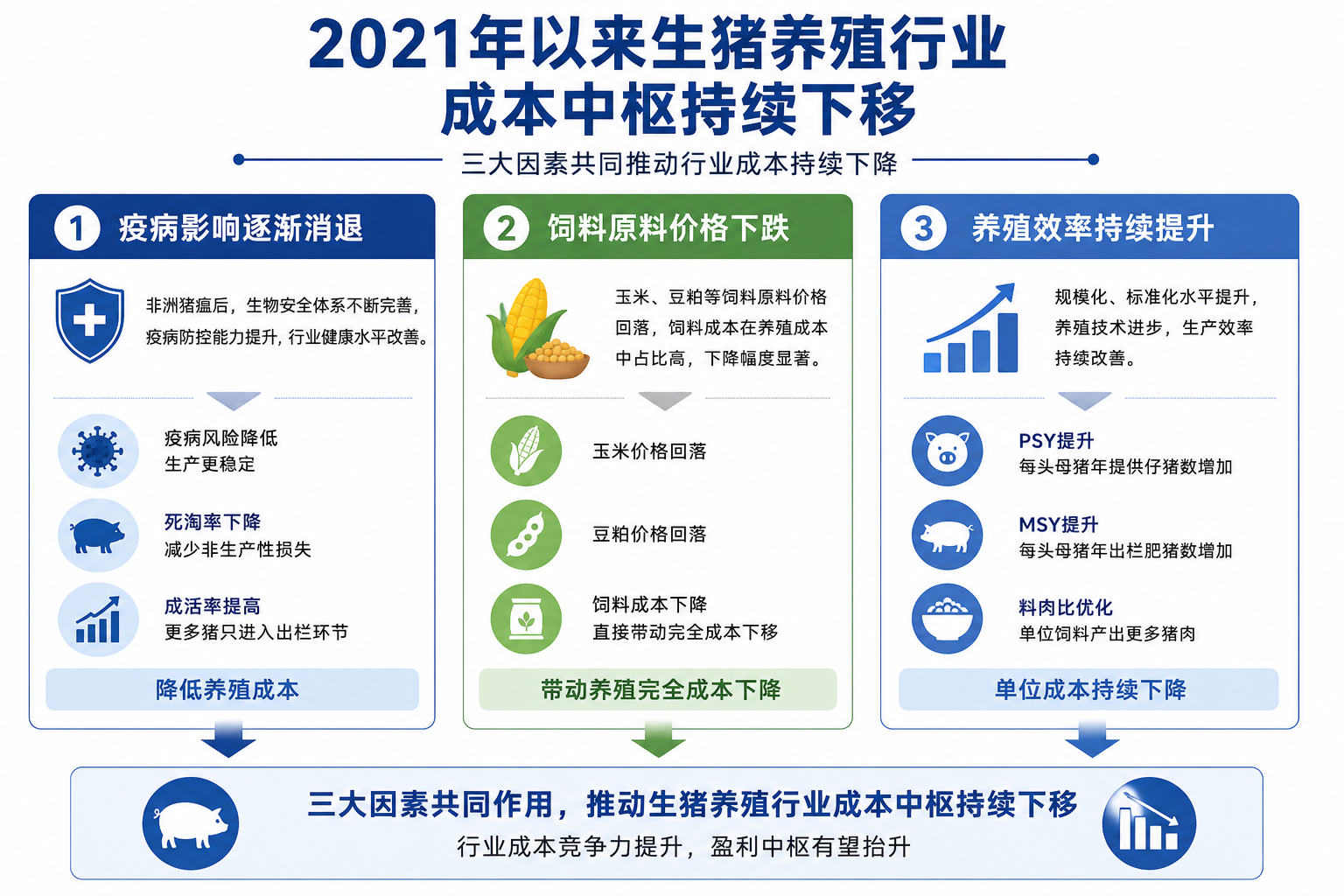
Firstly, the impact of the epidemic is gradually dissipating. Before the end of 2023, the significant decrease in industry costs was not mainly due to an improvement in the management capabilities of breeders, but rather because the impact of diseases such as African swine fever was gradually alleviated, production returned to normal, and the efficiency of sow breeding and the survival rate of piglets increased, resulting in a natural decline in breeding costs.
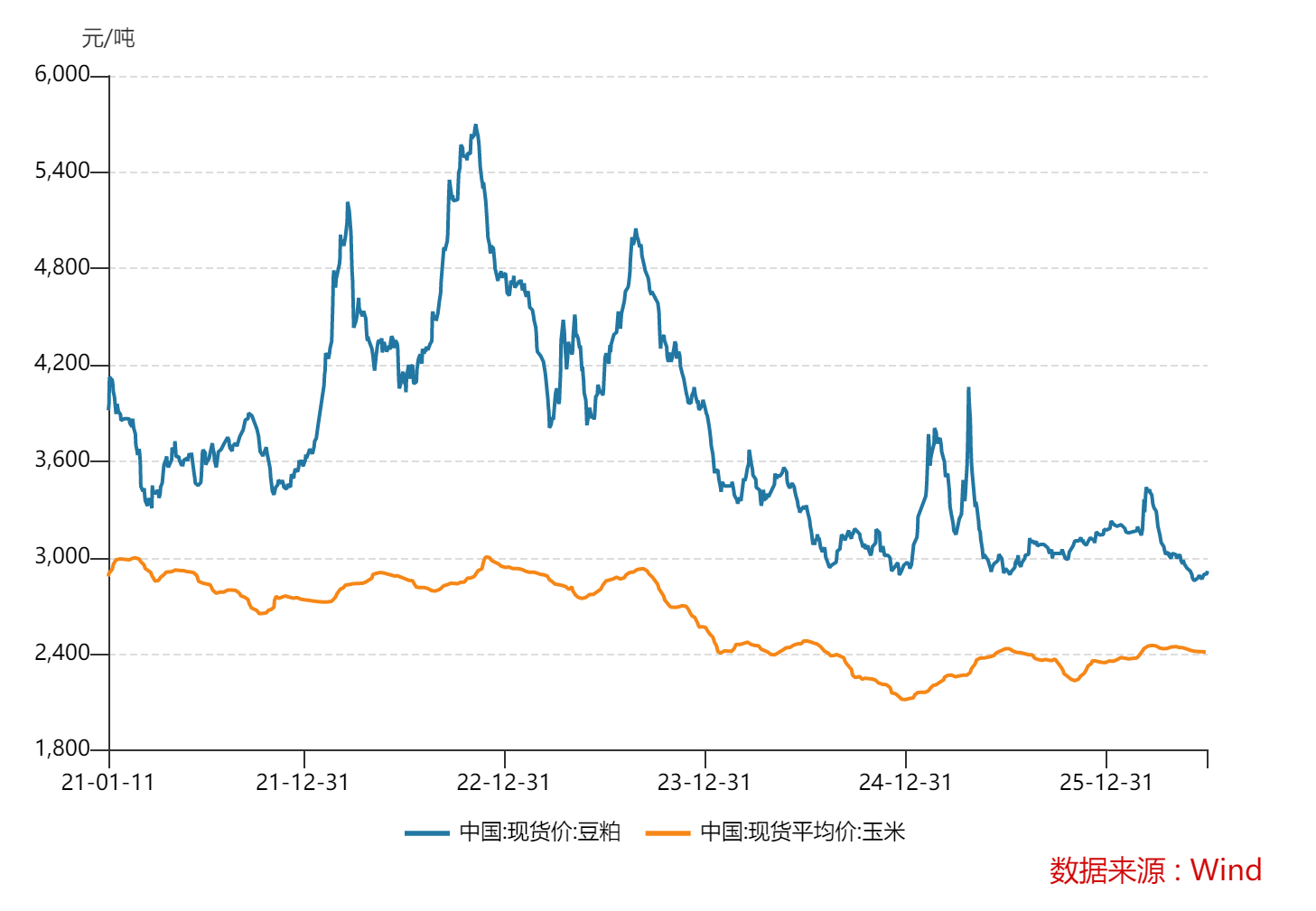
Second, the price of feed raw materials has fallen. Since the start of 2023, the prices of major raw materials such as corn and soybean meal have continued to decline, especially by the end of 2024, when feed costs had dropped by more than 40% from their peak, directly driving the industry's overall costs down further.
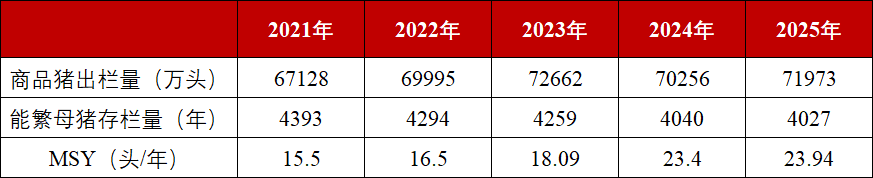
Third, breeding efficiency has continued to improve. Starting in 2022, the industry has introduced new pig breeds, and after 1-2 years of expansion, the new breeds entered the commercial pig production stage in 2023 and 2024, with production indicators such as PSY and MSY continuously improving, and breeding efficiency significantly increasing.
For instance, the industry's MSY rose from 15.5 head/year in 2021 to 23.94 head/year in 2025, meaning the same number of breeding sows can produce more commercial pigs, with the unit cost of breeding also being diluted.
(Miaotou note: MSY refers to the number of market-ready fattened pigs produced per sow per year; PSY refers to the number of weaned piglets produced per sow per year.)
(Data source: CICC Commodities)
It is the combination of the gradual easing of the impact of the epidemic, the decline in feed prices, and the improvement in production efficiency that has led to the continuous decline in the industry's cost center over the past few years.
But now, these three cost-reduction factors have largely played out.
The impact of the epidemic has been largely eliminated, and there is limited room for a significant decline in feed prices. Additionally, breeding efficiency has gradually reached a plateau after several years of improvement. Therefore, we believe that the pig breeding industry will find it increasingly difficult to rely on cost reductions to offset the impact of declining pig prices.
This means that if pork prices remain at a low level or continue to decline in this cycle, companies will face genuine cash flow pressure. At that stage, whether pig farms reduce capacity will no longer depend on subjective willingness, but rather on how much longer their capital chains can hold out.
Generally, if a pig company's cash flow is in deficit for more than three quarters, it may face a situation of passive destocking. So far, including Muyuan Shares, listed pig companies have experienced two consecutive quarters of cash flow deficits.
If pig prices continue to stay below 11.5 yuan/kg (we estimate the industry's current cash cost is around 11-12 yuan/kg), most pig companies will face operating cash flow losses for three consecutive quarters by the end of September 2026, and the pressure to reduce inventory will increase.
For this reason, we believe that the intensity of this round of industry de-capacity will likely be significantly stronger than the previous few rounds.
One point worth clarifying here: capacity reduction in the industry does not mean every pig producer cuts output by a uniform 3%.
In reality, some companies with high costs and weak financial strength are the first to exit the market, while others with stronger management capabilities, lower costs, and better cash flow not only avoid exiting, but may even take the opportunity to expand their market share. Meanwhile, many companies maintain their current scale and barely manage to stay in operation.
In other words, what we often see is not that all companies are reducing production, but rather a few companies are exiting, most are waiting and seeing, and a few leading companies are expanding against the trend.
In summary, over the past few years, the widening cost gap between companies has allowed cost-leading enterprises to maintain profitability through cost reduction, resulting in a slower pace of industry-wide de-capacity. When the space for cost reduction narrows and cash flow pressure is truly transmitted to the entire industry, the pig breeding industry will have de-capacity conditions that it has never had in the past few years.
One variable delaying the trend
Based on the above analysis, we expect that the earliest time window for the industry's production capacity to show significant contraction will likely be around the end of September this year.
This is also the first verification window for us to determine whether the pig cycle has truly started, with the most noteworthy indicator being the month-on-month change in the breeding sow inventory in China, which refers to female pigs that have already produced piglets and can continue to breed. If the decline in this indicator accelerates in both magnitude and speed, the industry will accelerate its reduction in production capacity, the market will enter a stage of expected speculation, and our judgment on the pig cycle will be initially confirmed.
If the first verification window is confirmed, the market will then enter a second verification phase, which is the logical fulfillment, and this time window is expected to appear in July next year, calculated based on the transmission cycle of about 10 months from breeding sow mating, pregnancy to commercial pig delivery.
At that time, the market will also shift from the expected trading phase to the industrial realization phase, and the core variable that determines the performance of pig-related stocks will also change to the sustainability and elasticity of the rise in pork prices.
However, this is only the most ideal scenario.
What truly determines the pace of this round of the pig cycle is another important variable, which is secondary fattening and destocking.
So-called secondary fattening refers to the practice of farmers buying pigs that have not yet reached the normal slaughter weight, typically 110-120 kilograms, during a period of rising pork prices, and then continuing to fatten them for resale in hopes of earning a higher price difference. Meanwhile, "压栏" refers to the decision by farmers to temporarily delay the sale of pigs that have already reached the normal slaughter weight, choosing instead to hold them back in anticipation of even higher sales prices.
Although they take different forms, they are essentially both delayed listings.
In the short term, they will all reduce the market's circulating pig supply, driving up pork prices. However, in the long term, the delayed supply will eventually enter the market, and due to increased pig weights, will even form a greater supply of pork, thereby increasing subsequent supply pressure, amplifying pork price fluctuations, and slowing the industry's pace of eliminating excess capacity.
Recent market trends have shown signs of this.
The price of live pigs (external three yuan) has rebounded to 10 yuan per kilogram since July, with the highest reaching 11.4 yuan per kilogram, up about 20% from 9.47 yuan per kilogram on June 26.
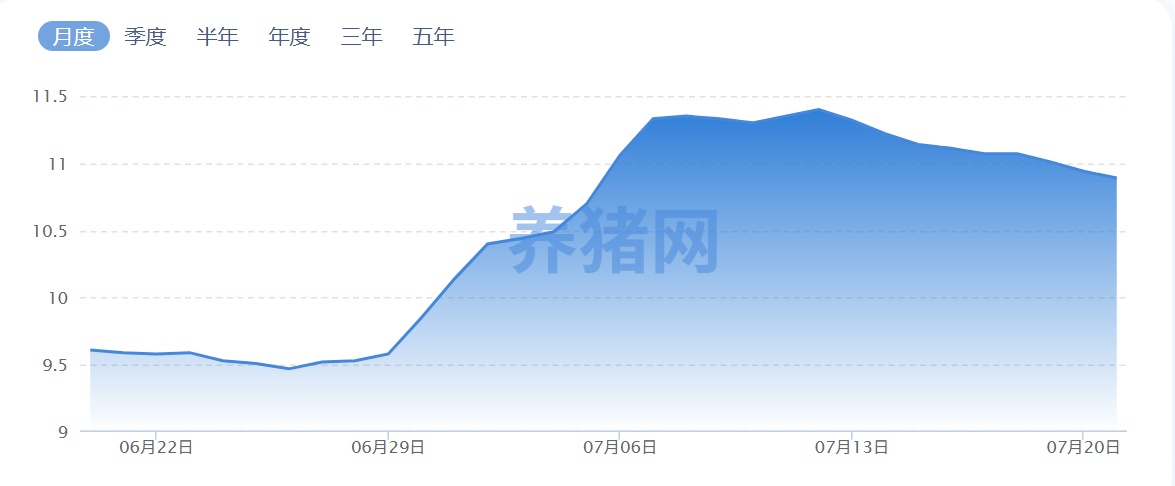
One of the key reasons for the rebound in pork prices is that the enthusiasm of breeders for destocking and secondary fattening has increased significantly, resulting in a tightening of short-term market supply.
Rising pig prices will ease the cash flow pressure on breeding enterprises, but will not be conducive to rapid clearance of production capacity, and furthermore, secondary fattening and overstocking will ultimately increase supply. Therefore, we make the following judgment: the deeper and longer the intervention of secondary fattening and overstocking, the longer the start of this round of the pig cycle will be delayed.
It's worth noting, however, that these market moves are only affecting the pace, not the direction. As long as the industry's room for cost reduction continues to narrow and cash flow pressure accumulates, market-driven de-capacity will eventually occur, it's just that the timing may be later than we expected.
Next, we will focus on three key indicators to continuously verify this judgment:
The cash flow of listed pig companies. If most listed pig companies experience operating cash flow losses for three consecutive quarters, it means that the industry's cash flow pressure is continuing to accumulate, and the probability of passive production capacity reduction will increase.
(2) The month-on-month change in the national breeding sow inventory. If the month-on-month decline in breeding sow inventory continues to expand in both magnitude and speed, it indicates that the industry has entered an accelerated phase of reducing production capacity, which is also a key indicator to verify whether the current pig cycle has truly started.
(3) Changes in the price spread between fattened pigs and benchmark pigs. The price spread refers to the difference in price between fattened pigs (generally above 130 kilograms) and benchmark pigs (110-120 kilograms). If this spread continues to widen, it indicates that larger pigs are more valuable relative to benchmark pigs, which will boost the enthusiasm of breeders to hold back and fatten their pigs again, delaying the release of supply and slowing the pace of the current pig cycle.
Disclaimer: The content of this article is for reference only, and the information or opinions expressed herein do not constitute any investment advice, so readers should exercise caution when making investment decisions.