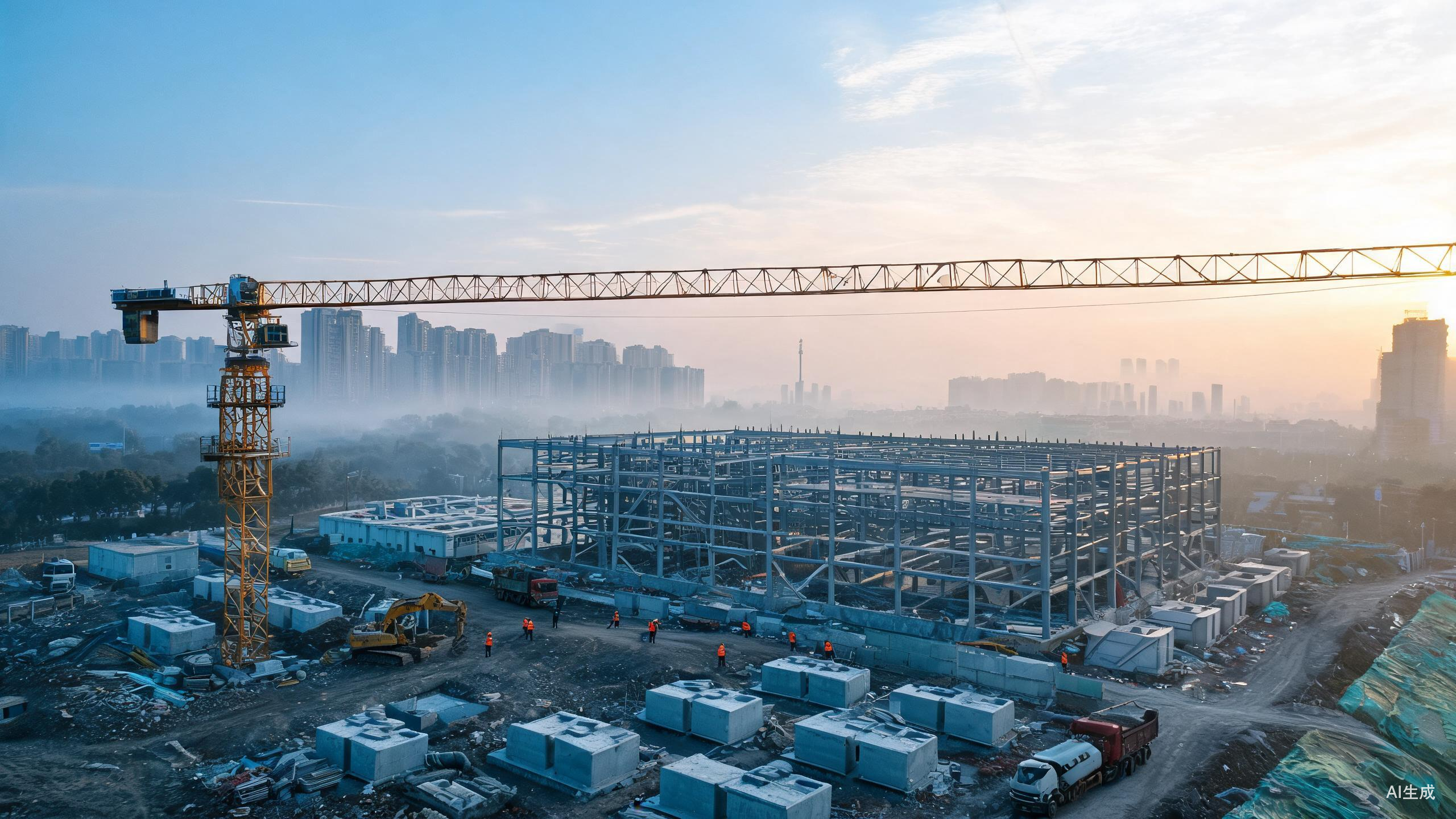
China State Construction Engineering Corp (601668.SH), the country's largest listed housing builder, reported a half-yearly earnings decline in both revenue and profit.
Affected by multiple factors including weak market demand in the construction industry and a slowdown in infrastructure investment growth, China State Construction disclosed on August 30 that it recorded total revenue of 975.8 billion yuan in the first half of the year, a year-on-year decrease of 12.0%; net profit attributable to the parent company was 23 billion yuan, a year-on-year decrease of 24.34%.
By business segment, the three main sectors of building construction, infrastructure construction, and survey and design all saw revenue pressure. The building construction business achieved revenue of 571.31 billion yuan in the first half of the year, down 18.0% year-on-year; infrastructure construction revenue was 246.46 billion yuan, down 9.9% year-on-year; and survey and design revenue was 4.29 billion yuan, down 13.0% year-on-year.
In contrast, the two major sectors of real estate development and investment, as well as internationalization, saw revenue increase against the trend. The financial report shows that the real estate development and investment business had operating revenue of 1520.3 billion yuan, up 15.2% year-on-year; overseas internationalization business achieved revenue of 759.8 billion yuan, up 27.0% year-on-year.
On August 31, Huang Jie, Vice President, CFO, and Chief Legal Counsel of China State Construction, said at the company's 2026 semi-annual performance briefing, "Last Friday, the state systematically revamped multiple fundamental systems, including real estate sales, credit, and capital, and the development of the real estate industry has entered a new phase. The company will focus on its main business, seize market opportunities, accelerate transformation and upgrading, and strive for greater and better development during the 15th Five-Year Plan period."
The Era of Large-Scale Infrastructure Development Comes to a Close
Riding the wave of urbanization, China's infrastructure industry achieved rapid expansion over the past decade, but this growth logic has now become obsolete, marking the end of the industry's scale dividend era.
In 2026, China State Construction's half-year revenue fell below 1 trillion yuan for the first time in five years. The company's building construction business, which accounts for nearly 60% of its revenue, was hit the hardest by the industry downturn, with revenue plummeting 18% year-on-year in the first half, a decrease of over 120 billion yuan from the same period last year. The company's gross profit was 46.92 billion yuan, down 8.3% year-on-year.
Downward pressure stems from the continuous contraction of the national real estate industry chain. Data from the National Bureau of Statistics shows that from January to June this year, national real estate development investment totaled 38,074 billion yuan, a year-on-year decrease of 18.0% (calculated based on comparable caliber); of which, residential investment was 29,300 billion yuan, down 17.8%.
The demand for residential development has decreased significantly, with the industry's construction demand weakening in tandem, directly impacting China State Construction's residential building business. In the first half of the year, the new construction area of residential buildings decreased by 16.6% year-over-year, from 129.49 million square meters in 2025 to 108.03 million square meters.
Infrastructure business was also not optimistic, with revenue of 246.46 billion yuan in the first half of the year, a decline of 9.9% and a decrease of approximately 27.08 billion yuan compared to the same period last year. This is consistent with the national infrastructure investment trend, which saw a cumulative decline of 3.6% year-over-year from January to July, hitting a recent low for the same period.
The two main businesses of real estate development and infrastructure construction account for 84% of the group's total revenue, and the simultaneous decline of both means that nearly 90% of the group's revenue sources are under pressure, and the impact is not insignificant.
Faced with obstacles in its main business, China State Construction's response strategy is clear: transform and adjust its structure internally, and go overseas to expand and increase its market share.
In the first half of the year, although the revenue of the construction business was under pressure, the order side has already shown signs of warming up. The value of new contracts signed was 1.55 trillion yuan, up 3.7% year-on-year, mainly due to the company's proactive adjustment of its business scope and active expansion into public building sectors such as industrial factory buildings and cultural, educational, healthcare, and sports facilities.
In specific terms, industrial factory construction has become the largest growth driver, with newly signed contracts totaling 561.7 billion yuan in the first half of the year, a significant increase of 24.2% year-over-year, and accounting for 36.2% of the total newly signed construction contracts, covering the construction of factories for national strategic emerging industries such as semiconductors, new energy, electronics and communications, automotive assembly, and aerospace.
Meanwhile, demand for data and computing power infrastructure construction is being released in a concentrated manner. The company has seized the opportunity to advance the "East Data and West Computing" project, with new contract signings for data centers and computing centers reaching 87.3 billion yuan in the first half of the year, up 328.3% year-over-year, making it the fastest-growing sub-sector in the construction sector.
During this period, the proportion of new residential contracts (including affordable housing) has decreased to 20.5%.
Insiders told Interface News that the change in the structure of China Construction's orders is expected to gradually translate into incremental revenue over the next 1-2 years, partially offsetting the shortfall caused by the decline in traditional residential construction.
The pace of globalization is also accelerating, with the total value of new overseas contracts signed during the period reaching 182.1 billion yuan, a significant year-on-year increase of 45.3%; of which, the construction business signed new contracts worth 165.5 billion yuan, up 44.2% year-on-year, with a growth rate far exceeding that of domestic business.
China State Construction Engineering Corporation Chairman Zheng Xuexuan stated that the construction and real estate industry remains a key pillar of the national economy, and as the economy continues to shift towards high-quality development, the industry still has ample room for growth, "for example, urban renewal can activate the existing market, while new-type urbanization construction contains incremental demand."
However, looking at the entire industry, China State Construction's situation is not an isolated case. In the first half of this year, among the eight major central enterprise construction companies, only China National Chemical Corporation achieved double growth in revenue and net profit excluding non-recurring items. China Communications Construction, China Power Construction, and China Energy Engineering had relatively flat revenue, while the rest experienced declines to varying degrees. The industry as a whole is under pressure, and China State Construction's path to transformation remains to be seen.
Doubao's 'Invisible Landlord' No Longer Expanding Inventory
In China State Construction's business landscape, real estate development and investment account for a small proportion, yet are the most closely watched sector by the outside world. Especially in recent years, as the industry entered a period of deep adjustment, China State Construction's subsidiary, the Engineering Bureau, defied the trend by acquiring land, earning itself a reputation as an "invisible landlord" within the industry.
According to information from Jiemian News, China State Construction Engineering Corp has two major real estate brands: China Oceanwide Holdings' real estate business, referred to as China Oceanwide Real Estate, and China State Construction Engineering Corp's own China Construction Real Estate. China Oceanwide Real Estate is the brand name for the real estate business of China Oceanwide Group, a subsidiary of the company, while China Construction Real Estate is the brand used by the company's various bureaus and institutes for their real estate businesses, also internally referred to as "bureau and institute real estate".
China State Construction has eight engineering bureaus, all of which are involved in real estate business, known in the industry as the "Eight Sons of China Construction". These include China Construction Intelligence, China Construction Jiuhe, China Construction Yipin, China Construction Guangzhou, China Construction Xinhao, China Construction Sixth Bureau, China Construction Seventh Bureau, and China Construction Dongfu, which engage in real estate development, urban renewal, urban operations, and comprehensive services.
As a construction company that covers the entire process of planning, design, construction, and development, China State Construction Property Corporation has been involved in real estate development for a long time. In 2013, to avoid same-industry competition with China State Shipbuilding Corporation's real estate arm, the group injected its directly operated real estate business into China State Shipbuilding Corporation, after which it was dormant for a period. It wasn't until 2018, when the main construction business' profits became thinner, that various engineering bureaus restarted their real estate businesses, marking the beginning of a nationwide expansion.
China State Construction Development Holdings has successively entered key cities such as Beijing, Shanghai, Guangzhou, Shandong, Wenzhou, and Suzhou, frequently acquiring land, and by 2020, its land reserves had gradually approached those of its larger sibling, China State Shipbuilding Corporation.
Economies of scale are also becoming apparent. Data shows that from 2020 to 2022, China State Construction Development Holdings' contracted sales reached 132.7 billion yuan, 123.8 billion yuan, and 147.2 billion yuan, respectively, with the exception of a brief decline in 2021, the other two years maintained counter-trend growth. By 2023, this figure climbed to 184.4 billion yuan.
In terms of sales, China State Construction East Region and China State Construction First Legend both exceeded 500 billion yuan in sales in 2023, while China State Construction Intelligence and Technology approached 300 billion yuan. China State Construction East Region, China State Construction First Legend, China State Construction Intelligence and Technology, China State Construction Jiuhe, and China State Construction Xinhao all ranked among the top 100 in sales.
From behind-the-scenes engineer to frontline landowner, China State Construction's real estate ambitions are no longer concealed.
In 2024, internal competition among the "Eight Sons of China Construction" intensified, with China Construction First Building surpassing former leader China Construction East China with a full-caliber sales revenue of 50.6 billion yuan, ranking 18th in the industry, compared to China Construction East China's 42.52 billion yuan, ranking 22nd.
In terms of land acquisition, China State Construction Engineering Corporation's (CSCEC) subsidiary, China State Construction Engineering Corporation Yipin, took a step forward, ranking 8th in the industry with a equity land acquisition amount of 210 billion yuan, while China State Construction Engineering Corporation Dongfu ranked 42nd with an equity land acquisition amount of 59 billion yuan. Meanwhile, China State Construction Engineering Corporation Zhiyi ranked 15th with a land acquisition amount of 123 billion yuan, and China State Construction Engineering Corporation Jiuhui ranked 37th with 64 billion yuan.
However, starting from 2025, the "invisible landlord" camp has shown significant contraction. In last year's top 100 equity-based land acquisition list, only three companies, China State Construction Yingpin, China State Construction ZhiDi, and China State Construction Dongfu, remained on the list.
The contraction trend continued into 2026, with data showing that from January to August this year, China State Construction Intelligent Technology's equity land acquisition amount was 3 billion yuan, ranking 30th in the industry, while China State Construction East China's land acquisition amount was 1.9 billion yuan, falling to 52nd place.
Bigger variables are still to come. On August 28, the real estate regulatory authority, in conjunction with financial regulatory departments, released a slew of heavyweight policy documents covering multiple key areas, including the commodity housing sales system and real estate credit management. Among these, new measures such as prioritizing the sale of completed homes on newly allocated land and uniformly raising the presale threshold to the completion of the main structure, have completely rewritten the funding cycle rules that developers have long relied on.
A person inside a central enterprise developer told Interface News that in the past, real estate companies could recover their funds once a building was topped out, but now they have to wait until the project is fully completed, which has greatly increased the pressure on construction progress, as the progress itself directly determines the project's return on investment.
This means that the "high debt, high leverage, high turnover" model that was once prevalent in the real estate industry will completely exit the stage.
China State Construction Development Holdings has re-entered the development sector with the intention of filling out its industrial chain and increasing profits, but now that industry rules have changed, it remains uncertain whether the company will continue to invest in land acquisition.
China State Construction's Vice General Manager Wu Aiguo remains optimistic, stating at the performance meeting, "This round of new policies focuses on improving sales management, closing funds operation, and optimizing real estate credit, continuously driving the industry's shift from high turnover to high quality, which is consistent with the company's long-term real estate investment strategy, and will have a certain positive impact on the company's real estate business."
However, under the new regulations, the development cycle has been extended and capital occupation has increased, and the expansion logic that developers used to prioritize speed is being re-examined. Whether to move forward or backward, no one can provide an answer for now.