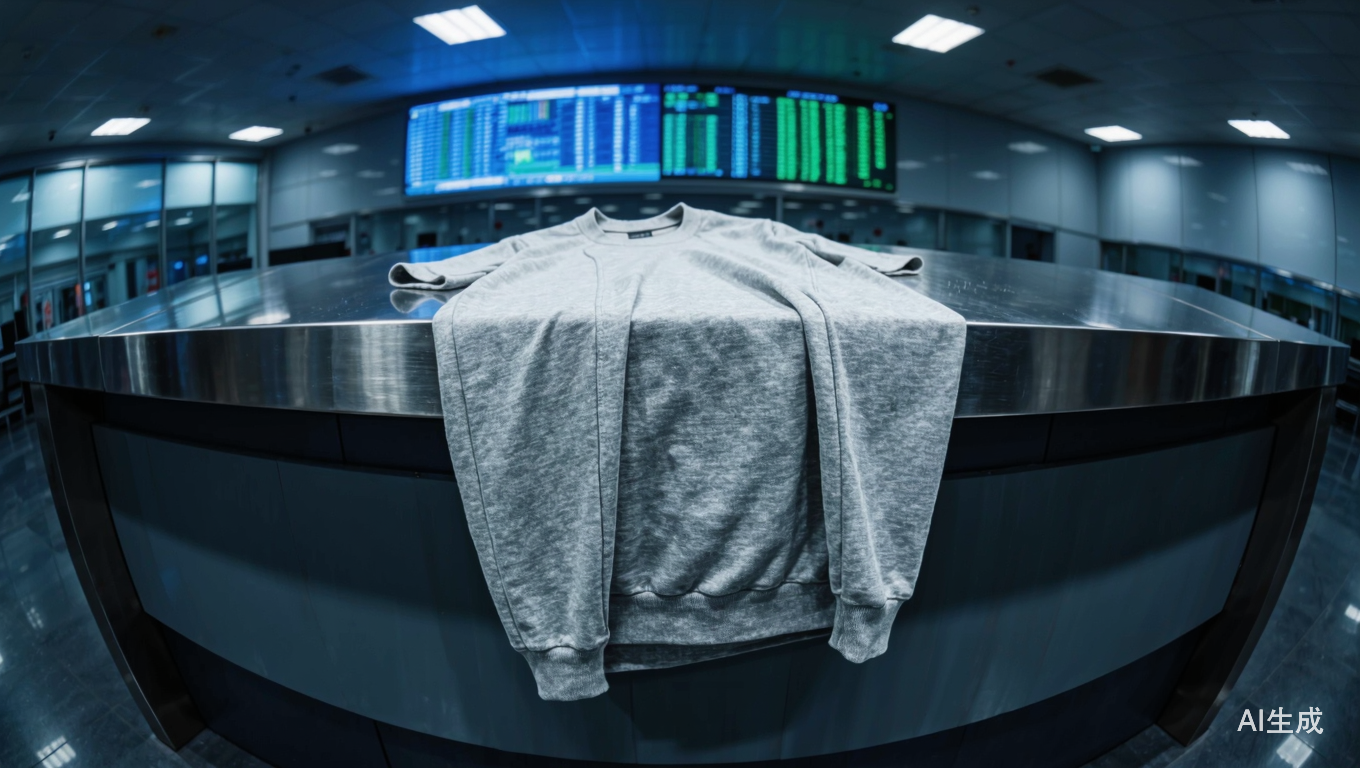
The answer to everything may be hidden in the ordinary SHEIN cultural shirt worn by Xu Yangtian.

September 1, 2026, Hong Kong Stock Exchange.
Xu Yangtian, wearing a SHEIN t-shirt, stood at the corner of the bell-ringing ceremony. There was no speech and no bell-ringing, and he left the scene quickly after the ceremony. On this day, SHEIN was officially listed on the Hong Kong stock exchange, with the stock code 00625.HK. The stock opened lower and fell by more than 9% at one point during the session, eventually closing at 48.5 Hong Kong dollars, with a total market value of approximately 261 billion US dollars.
This is a stunning sight. To put it into perspective, Shein was once the world's third-largest unicorn, with a valuation of $98.2 billion in 2022, ranking only behind ByteDance and SpaceX. As a cross-border e-commerce giant that sells Chinese supply chains to 160 countries worldwide, and a platform-based enterprise hailed as the "benchmark for Chinese companies going global," its IPO should have been a grand capital celebration. However, reality is: mainstream media has largely fallen silent, and discussions on social media are also surprisingly restrained, as if everyone has tacitly agreed on a consensus of "no comment, no inquiry, and no further investigation."
Xiying's listing has turned it into a forbidden zone for discussion.
Silence is the Best PR
Let's turn the clock back four years.
In 2022, Shein completed its Series D financing, with a pre-investment valuation of $98.2 billion. At the time, the global pandemic had driven an explosive growth in online consumption, and Shein's "small orders, fast turnaround" flexible supply chain model was hailed as a benchmark, with the capital market believing that the company could completely rewrite the global apparel retail landscape. If it had been able to go public smoothly at the time, it might have become one of the largest IPOs in recent years.
However, XiYin opted for silence. When someone suggested setting up a public relations department to Xǔ Yǎngtiān, he replied, "Let them write whatever they want, but if it's not true, I'll definitely sue them." Investors also rarely accept interviews, citing "cooperating with the company's low-key requirements".
This kind of extreme low-key approach creates an air of mystery in good times, but in bad times, it turns into an unspoken embarrassment.
In 2023, HiFi filed a confidential listing application with the US SEC, but was unsuccessful due to data security and geopolitical reviews. In 2024, the company shifted its focus to London, with Xu Yangtian and Chairman Tang Wei meeting with the Chancellor of the Exchequer and international investors on multiple occasions, and even obtaining IPO approval from the UK financial regulatory authority. However, just as the listing was nearing completion, HiFi terminated its cooperation with two top PR firms, Brunswick and FGS, in May 2025 - the former was responsible for media relations, while the latter handled government relations, with their contracts expiring and not being renewed.
This is an extremely ominous sign. For a company rushing towards an IPO, suddenly replacing its CEO or PR firm is almost equivalent to admitting that its previous communication strategy has completely failed and the listing process has encountered significant obstacles.
After that, the valuation of XiYin plummeted. From $98.2 billion to $64 billion, then to $50 billion, $40 billion, $30 billion... eventually stabilizing at $26.1 billion. The valuation shrank by more than 70% from its peak, with late-stage investors suffering significant paper losses, forcing the company to pay approximately $1.3 billion in cash compensation.
When a former trillion-dollar myth ultimately goes public with a valuation of less than $30 billion, silence becomes the best public relations strategy, as any high-profile promotion would only serve to highlight the stark contrast.
What's the Next Big Narrative?
The essence of an IPO is selling a story, but today, Hithink's story seems to be that even the founder can't be bothered to tell a new one.
Xiyin's core competitiveness has been summarized as "small orders, fast response" - by distributing orders to contract manufacturers through a digital system, the cycle from design to launch is compressed to the shortest, achieving "large-scale automated small orders with fast returns". This model was invincible during the pandemic: from 2020 to 2022, Xiyin's revenue grew by 140%, 208%, and 98% respectively.
But the story has come to an end.
The prospectus shows that Xiying's revenue growth rates were 41.1%, 20.7%, and 8% from 2023 to 2025; in the first quarter of 2026, the growth rate plummeted to 1.1%. Net profit also slid from $3.365 billion in 2024 to $2.064 billion in 2025, and the company even reported a net loss of $99 million in the first quarter of 2026.
More lethal is the change in the external environment. In May 2025, the US cancelled the tax exemption policy for small packages under $800; in July 2026, Europe also formally cancelled the tax exemption policy for small imports. The US and Europe together account for nearly 60% of HiSound's revenue, and the tariff barriers directly eroded its low-price advantage, which it relies on for survival. To cope with the impact, HiSound was forced to raise product prices in the US market, with some products seeing a price increase of as much as 377%.
When the "low price + quick response" dual-drive model encountered the tariff hammer, and revenue growth plummeted from triple digits to single digits, the capital market began to ask: after flexible supply chains, what is HiSound's next sexy story?
Is this a platform-based transformation? Xi Yin is indeed trying to evolve from a self-operated brand to a "self-operated + platform" model by introducing third-party merchants. However, platformization implies direct competition with Amazon and Temu, and Xi Yin is not superior in terms of logistics fulfillment and user mindshare.
Is it about ESG and social responsibility, which has been more of a subject of controversy than a new story.
So perhaps not telling new stories, not catering to the market, and just doing its own job well is exactly what Founder Xu truly believes in at the moment, and all he can do is choose to remain silent.
Xu Yangtian's Stealth
Xu Yangtian may be one of the most mysterious internet billionaires in the world.
He is 42 years old, from Zibo in Shandong province, and graduated from the international trade program at Qingdao University of Technology. You can barely find a high-definition public photo of him online. His Baidu Encyclopedia page has very little information, and even the photos that were once circulated were not actually of him. According to a report by the South China Morning Post, the only image of the founder in SHEIN's internal materials is a ordinary landscape photo, accompanied by the sentence: "If you have dreams, you are remarkable."
An investor who has interacted with him described him as "very low-key and introverted, rarely expressing his opinions."
This extreme low-key approach was a protective color in the early stages of entrepreneurship - making it impossible for competitors to understand their cards and for regulators to focus on scrutiny. However, when the company grew into a global third-largest fashion retailer with annual revenue of over $40 billion and 273 million active users, being low-key became a dangerous signal.
Capital markets require transparency, and investors need to know: who is making the decisions, what are their values, and how will they respond to geopolitical risks. However, Xu Yangtian has always remained behind the scenes, with Executive Chairman Tang Wei playing the role of "external spokesperson". Tang Wei is responsible for facing congressional inquiries in the US, coordinating with the UK's FCA for review, handling European fines, and attending various public events.
However, on the eve of the Hong Kong stock listing, Tang Wei suddenly resigned, and Xu Yangtian had to take the stage himself. In February 2026, he made a rare appearance at the Guangdong High-Quality Development Conference, announcing that Xiying would invest over 10 billion yuan in Guangdong over the next three years to build a smart supply chain, and stated that "Guangdong is the root of Xiying".
This was Xu Xiangyang's "ice-breaking" speech, as well as a carefully calculated comeback. Prior to this, HiFi had faced criticism for "de-Chinafication" due to its decision to relocate its headquarters to Singapore and rumors that Xu Xiangyang himself had obtained permanent residency in Singapore. As its path to listing in Europe and the US was repeatedly blocked and domestic regulatory scrutiny intensified, Xu Xiangyang had to reestablish HiFi's connection to the Chinese market.
Keeping a low profile used to be a strategy, but now being too low-key has become a way of seeking attention.
Proof of Identity
Xiyin's biggest dissemination dilemma is not the shrinkage of its valuation, nor the slowdown of its growth rate, but a philosophical question: whose company is it, ultimately?
In 2024, HiFi's Executive Chairman, Tang Wei, gave a nuanced response at the Milken Institute Global Conference: "If considered from the perspective of its birthplace and supply chain, HiFi is a Chinese company; if considered from the perspective of its headquarters and core team's location, HiFi is a Singaporean company; if considered from the perspective of its market and corporate values, HiFi is an American company."
This approach was once interpreted as a clever "global localization" strategy - being a British company in the UK and an American company in the US, selectively applying whichever set of rules is more beneficial. However, it has proven to be a disastrous strategy of ambiguous identity.
US lawmakers still view HiFi as a Chinese company subject to scrutiny, and London's regulatory agency has not given it a pass despite its "global localization" claims. Furthermore, after China's Regulations on the Management of Domestic Enterprises' Overseas Securities Offering and Listing came into effect in 2023, companies like HiFi, which are registered overseas but have core operations and asset income sourced from within China, will still be subject to domestic filing requirements, even if their listing entity is based overseas.
Identities are ambiguous, once a tool for arbitrage, but now they have become a target under scrutiny from all parties.
36Kr pointed out in an in-depth report: "As the US and Europe start to systematically plug loopholes, 'ambiguity' itself has become a risk, and any party can take it as a subject of jurisdiction, making the company's appeal even more complicated. The issue of identity is not a public relations problem, but a governance structure problem."
Xiying spent four years, relocated three times, and paid the price of its valuation being halved, only to barely find an answer in Hong Kong. However, this answer was not perfect - the stock plummeted on its first day of listing, with a market value of less than 30% of its peak, causing later-stage investors to suffer losses, and the company had to compensate them with cash and shares.
In fact, almost all Chinese companies going global have to face the issue of identity verification, and Xiyin has no choice but to do so.
The Metaphor of the Forbidden Comment Section
XiYin's listing has become a "forbidden zone", which on the surface appears to be a voluntary choice by the company, but in reality is a metaphor for the era.
Geopolitical fissures are widening, the window for tax-free small packages is closing, and capital's faith in "high growth" is receding. As Temu charges into the same arena with a lower profile and more aggressive price wars, and AI companies grab all the attention in the capital market, Xiying finds itself stuck in an awkward middle ground: it is no longer the exciting unicorn, and neither e-commerce nor fast fashion is a trendy concept anymore.
The media has fallen silent, not because HiFi lacks newsworthiness, but because everyone is unsure of how to define it.
So the best option is to not comment, not ask questions, and not investigate further. HiFi's listing has become a forbidden zone for discussion.
However, silence cannot solve the problem. Xu Yangtian wrote in the prospectus: "The escalation of international tensions and the resulting changes in international trade policies may affect HiFi's product sales in the global market." This is a belated awakening - in an era of deglobalization, any company that tries to "rely on both ends" may ultimately end up relying on neither.
Xiying's story is far from over. With a market value of $26.1 billion, 273 million active users, and a sales network covering 160 countries, the numbers are still impressive. However, the questions it needs to answer remain sharp. After all, as a listed company, it is also a public company to some extent.
The answer to everything may be hidden in Xu Yangtian's ordinary SHEIN cultural shirt - low-key, simple, and unassuming, yet also implying that it is trying to make itself look less like the $1 billion myth it once was.
Finally, a wish: to XiYin, which has had to keep a low profile, may it become better.