On September 3, The Paper and CNR.cn released a follow-up investigation, which found that the Human Resources Director of Xingyu Shares, who was reported to have been suspended by the Changzhou Municipal Human Resources and Social Security Bureau, does not exist in the company's publicly disclosed hierarchy. The list of directors and senior management in the company's Hong Kong IPO prospectus does not include this position, and the company's official website lists its management hierarchy from entry-level to deputy general manager, without a "director" level. Multiple employees interviewed also stated that the company does not use this title internally.
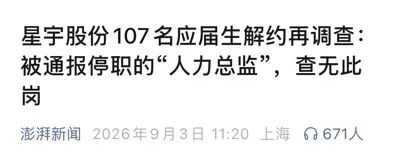
The accountability mentioned in the listed company's announcement may have held accountable a non-existent person. Whether the position is an actual post or a general term remains to be explained by Star Universe, and as of press time, the company has not responded.
The company has been in the news enough over the past half month. 107 young college graduates, with an English whistleblower letter, brought a leading car lamp supplier, which had just won the "Top 10 Best Employers in Changzhou" award and had annual revenue of 15.2 billion yuan, to its knees with an apology.
It took only three days to go from trending on social media to a company apology, but prior to that, it had held out for 19 days. Today, we'll take a closer look at why a company that withstood the pressure for 19 days made a concerted effort to apologize after trending for three days, yet still failed to mitigate the damage and instead made mistake after mistake.
From Job Offer to Contract Termination, Just Two Months
In the 2025 fall recruitment season, Changzhou Xingyu Automotive Lighting Co., Ltd. extended 440 job offers to 2026 graduates, primarily for master's degree holders, for positions in research and development, technology, and management training. As a leading supplier in the automotive lighting industry, Xingyu generated annual revenue of 15.2 billion yuan, with a client list that includes Mercedes-Benz, BMW, Audi, and Volkswagen.
On July 1, 2026, new graduates joined the company, and on July 6, they began on-site training in the production line. According to reports from multiple media outlets, the one-month rotation through different workshops promised at the time of hiring was extended to three months, and their salaries were recalculated based on the standard for ordinary workers.
Starting August 8, the HR department has been holding talks with employees in batches. Young employees are being given an ultimatum: either sign a "personal reason for resignation" and leave with about half a month's salary, or accept a transfer to work as an operator in the workshop. According to media reports, the recording of the talks implies that there is an HR group of over 400 people in Changzhou, and if employees do not cooperate and sign, their future background checks will be affected.
Ultimately, the official tally was 107 people whose labor contracts were terminated.
On August 24, "Xingyu Shares persuades graduates to leave" became a trending topic on Weibo. On the evening of August 25, the Changzhou Human Resources and Social Security Bureau reported that it had determined the consultation process was "simple and blunt, lacking sufficient and effective communication". The company's Human Resources Director was suspended, and regulatory authorities ordered the company to make corrections within a specified time limit.
On the morning of August 27, the company's public account issued an apology letter, offering three compensation measures: immediate issuance of a three-month job-seeking living subsidy, totaling approximately 15,000 yuan per person; free accommodation during this period; and an additional six months' salary for those still unemployed by the end of November. On the same day, Xingyu Co., Ltd.'s stock price fell 5.20% to 81.86 yuan, hitting a new low since May 2020.
On September 1, Volkswagen China announced a special investigation into related complaints. On September 2, Zhou Xiaoping publicly apologized at the semi-annual performance briefing, after which the share price of Xingyu Shares fell to 77.69 yuan.
72 Hours After the Apology
A Series of Secondary Disaster Demonstrations
Objectively, the three compensation measures offered by Xingyu are indeed rare in similar events. The subsidies are paid quickly, and the "safety net" clause that provides an additional six months' salary if employees are still unemployed by the end of November shows sincerity. The company's decision to issue a departure certificate citing non-personal reasons can be seen as a remedy to mitigate the threat of a negative reference check. If the incident ends here, Xingyu's crisis management can be considered passing.
However, over the next week, Starlux pulled off a series of provocative moves, triggering a string of "secondary crises".
Inconsistencies in their statements were evident. On the same day that the securities department of Xingyu apologized during a media interview, stating "the company does not exist to persuade graduates to leave, and is normally advancing its Hong Kong IPO work," the company's official public account was also issuing an apology. Jiuhao Wei reiterated that the first iron rule of crisis management is to have only one external voice, which Xingyu failed to achieve.
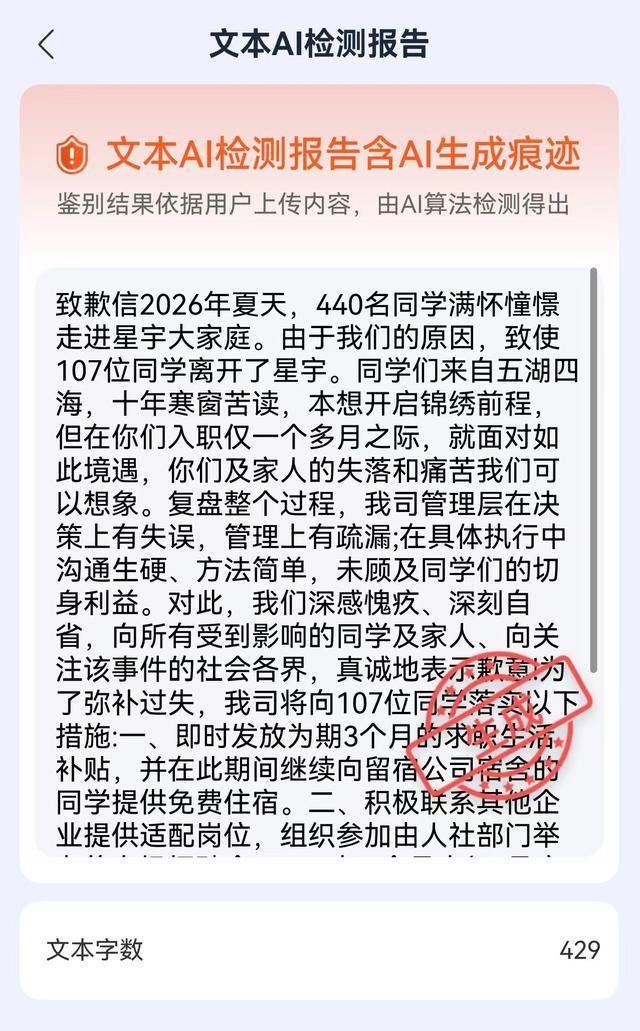
The chairman's words and actions are inconsistent. On September 2, the company's chairman, Zhou Xiaoping, stated at the performance briefing that "the company deeply reflects and sincerely apologizes," but immediately added that "the company has also filed complaints and reports against some media outlets for false reporting through the internet information and internet security departments." Jiu Haowi believes that it is justifiable for a company to protect its rights in accordance with the law, but in terms of communication effect, the juxtaposition of the two statements will only lead the public to interpret it as a forced apology, lacking sincerity.
Responding to a crisis with lies is the most fatal mistake, touching the bottom line of integrity. The announcement on August 25 was issued by government departments, but the information about the "suspension of the Human Resources Director" could only have come from the company itself. If no such position exists, it means that the information provided by Xingyu to the regulatory authorities is untrue, and it used the credibility of the official announcement to stage a show of accountability for the public.
A complete apology typically consists of three actions: acknowledging wrongdoing, holding someone accountable, and making amends. Among these, holding someone accountable means proving to the public that someone is taking responsibility for the mistake. Now, if holding someone accountable is just a superficial act, the apology loses its meaning.
Furthermore, what does falsification mean in crisis management? A company's crisis management is supposed to be an act of redeeming its reputation, which requires honest communication. If Star Universe cannot even uphold basic integrity, how can the public trust the promises it makes? The first five questions were about inconsistent statements and rough drafting, which are capability issues that the public can be patient with. Falsification, however, is an issue of stance, and it will completely change the public's perception.
Once the falsification by Xingyu is verified, from a regulatory perspective, the incident will spread from illegal employment to regulatory distrust, and subsequent investigations will only be more stringent and in-depth. In terms of the ongoing Hong Kong IPO, the capital market is most concerned about false disclosures, and for a company awaiting a hearing, a credibility flaw is far more fatal than an employment flaw. From a customer perspective, when Mercedes accepted the report, it titled the case "serious ethical and labor misconduct by suppliers". If the false accountability is confirmed, the phrase "ethical misconduct" will change from an accusation to a proven description, and German customers are looking at the credibility of reforms, not the number of apologies. Internally, the company's cohesion will be damaged, and employees will lose confidence in the company. From a public perspective, every response from the company will be presumed to be false in the future, and even if the company tells the truth, it may not be believed.
These six mistakes, viewed individually, are execution problems, but collectively they indicate that Star Universe lacks a sense of crisis public relations. The public relations department is apologizing, the securities department is trying to stabilize the stock price, the workshop is making statements, and the chairman is fighting back. Each department is doing its own thing, with no one overseeing the overall strategy of "how the company will present itself after the apology". The Star Universe perceived by public opinion is, in itself, a loose and disorganized entity.
This incident serves as a warning to all companies. An apology is not the end of a crisis; rather, it is when the public truly begins to scrutinize a company, and the standards will be much stricter.
Why Did Nubia Back Down in Just Three Days?
Looking back, the silence that followed the apology is even more intriguing. From August 8 to 27, Xingyu endured 19 days of turmoil, with revelations spreading, recordings being shared, and media outlets investigating, all while trending on hot searches and official reports being released, yet it didn't respond with a single word.
Interpreting silence as a slow response is a superficial reading. Silence was the first crisis decision made by Star Universe, betting that the incident would pass on its own. The half-life of labor-capital public opinion transmission is short, and once posts are buried, the company doesn't need to take any action. This approach has been effective for most A-share companies, and even after the report was issued, the company wanted to wait a bit longer, otherwise it would be hard to explain why the semi-annual report was still released on schedule on the 26th.
It lost the bet. The real motivations behind Xingyu's apology are the following four points, with supply chain compliance being the key.
On August 25, the Changzhou Human Resources and Social Security Bureau issued a report, transforming the incident from an online public opinion issue into a government-intervened labor compliance case, with simultaneous implementation of suspension, limited-time rectification, and special inspections. The company cannot ignore this and must provide an attitude and solution.
On August 27-28, the People's Daily issued consecutive statements, and on the 28th, it published a commentary titled "'Companies massively persuading college graduates to quit' is a blatant trampling of social credibility." The commentary stated, "This company has seen profit growth, abundant cash flow, and large-scale dividend distribution, and is still rushing to list on the Hong Kong stock exchange, which is 'absolutely not due to operational difficulties or inability to fulfill obligations'." This statement directly questioned Xingyu's compliance issues, and its destructive power is extremely strong for Xingyu, which is currently queuing for a Hong Kong IPO.
3. The listing process: On July 29, Star Universe submitted its application to the Hong Kong Stock Exchange for the second time and obtained a filing in mid-August. It is currently in the most sensitive period before the hearing, involving compliance review, especially since central media has directly questioned its compliance. If this is ignored, it may affect its listing process.
Fourth, compliance with labor laws in the supply chain, which Nine thinks is the key to the turning point in the incident. Germany's Supply Chain Due Diligence Act requires German companies to conduct human rights risk assessments on their direct suppliers, with violators facing fines of up to 2% of their global annual turnover.
Xingyu's Serbian factory serves mainstream European automakers such as Mercedes-Benz, BMW, Audi, Volkswagen, and Skoda, and was put into operation in 2022 as the first phase of the project. One of the uses of the Hong Kong stock offering this time is the second-phase expansion of the Serbian factory, which will focus on investing in intelligent automotive lighting and electronics, and upgrading to front lamp manufacturing. As a partner in the German automotive supply chain, Xingyu naturally needs to fulfill its compliance obligations in Germany, or it may lose cooperation opportunities.
It is understood that the 107 graduates who were laid off organized their offers, recordings of discussions, labor contracts, and chat records into a chain of evidence, partially translating them into English, and submitted them to four places: domestic labor supervision departments, the Hong Kong Stock Exchange's ESG complaint channel, the EU's forced labor regulation compliance channel, and the global compliance departments of Mercedes-Benz, BMW, and Volkswagen. As a result, the compliance departments of German car manufacturers have been drawn into the investigation, and this department has the power to decide whether Xingyu can continue to receive orders from German companies.
It is precisely because the graduates involved accurately understood the obligation structure of the German supply chain that their labor contract disputes could be converted into human rights risk leads that multinational automakers must legally accept.
According to a response letter from Mercedes-Benz disclosed by whistleblowers and reported by multiple media outlets, the company's compliance department accepted the complaint and generated a case number, stating in the letter that "the behavior you described does not conform to Mercedes-Benz's corporate principles." Although Mercedes-Benz has not publicly confirmed the letter, Volkswagen China has officially responded, saying "the group takes the relevant complaints very seriously and has immediately launched a special investigation, which is currently underway."
Therefore, the core of Juneyao's change in crisis management decision-making is driven by public opinion and compelled by interests.
Compliance is the Bottom Line
Xingyu is not a company in operational distress, as despite a year-over-year decline in net profit, it still plans to distribute dividends of 56.64 million yuan. In 2025, the company reduced its workforce by 2,894 people, while outsourcing labor hours increased to 10.87 million hours over three years. The issue is not with the adjustment of its workforce itself, but with the methods used. Forcing masters' degree holders to perform menial tasks like screwing, using background checks as pressure, and coercing employees to sign "voluntary resignation" letters is not a case of lax management, but rather managing by treating illegal risks as operational costs.
The consequences are clear: compensation, regulatory notices, central media exposure, customer-specific investigations, and a stock price at a five-year low. There is also an invisible loss: this supplier, which rushed to list on the Hong Kong stock exchange and raised funds to invest in European production capacity, has already been left with a "record" in the compliance review of its German clients. Professor Wu Yuming told Caixin that template-based compliance management systems have become difficult to adapt to the increasingly rigid international supply chain governance rules.
Many companies are beefing up their public relations efforts, but the Juneyao Airlines incident highlights that what they really need to focus on is compliance. Public relations can only play a limited role in damage control if it is not involved in decision-making from the outset.