Produced by | Miaotou APP
By Ding Ping
Photo | Visual China Group
A key variable has emerged: the cost structure of the pig farming industry may have hit a floor and can no longer be reduced.
In the view of Moyu Toutou, this will increase investors' optimistic expectations for the "pig cycle".
In recent years, the cost structure of the pig farming industry has continued to decline, mainly due to the gradual dissipation of the impact of epidemics, the decline in feed raw material prices, and the continuous improvement in breeding efficiency.
However, at present, these three cost-reduction benefits are approaching a bottleneck to varying degrees: there is limited room for feed prices to continue to drop significantly, and breeding efficiency, after several years of continuous improvement, has gradually entered a plateau period, making it increasingly difficult for costs to continue to decrease.
This means that if low pig prices persist, pig enterprises will find it increasingly difficult to absorb losses by reducing costs, and ultimately will have to rely on consuming cash flow to complete capacity clearance, which is also the core logic of our optimism about this round of pig cycle. For a detailed analysis, please refer to the Miaotou column "Pig Cycle Reversal, This Time It May Be Real".
A recent interaction with a first-line source has provided verification for our judgment.
On August 25, 2026, MiaoTou attended an investor conference organized by Muyuan Shares and exchanged views with the company on issues such as breeding costs, production efficiency, and pig price outlook. We found that Muyuan Shares' cost reduction has also entered a challenging phase.
Cost reductions are becoming increasingly difficult
First, we need to explain why Muyuan can become an important example for observing the bottom of industry costs.
On one hand, Muyuan Shares is the country's largest pig breeding enterprise, with 38.615 million pigs sold in the first half of 2026, accounting for around 10% of the national pig sales volume. On the other hand, Muyuan Shares is also in the first tier of the industry in terms of lowest cost and highest production efficiency, with a comprehensive cost that is currently about 1.5 yuan/kg lower than the industry average. To some extent, Muyuan represents the forefront of efficiency in large-scale pig breeding in the country.
It is for this reason that the remaining cost reduction space for Muyuan Shares has become an important reference for judging whether the industry's cost center can continue to decline significantly.
Even Muyuan Shares, which is at the forefront of efficiency, has entered a period of diminishing returns on cost reduction after several years of rapid cost cutting, indicating that relying on production efficiency improvements to drive significant declines in the industry's cost curve is becoming increasingly difficult.
And from this exchange, such signs have become increasingly apparent.
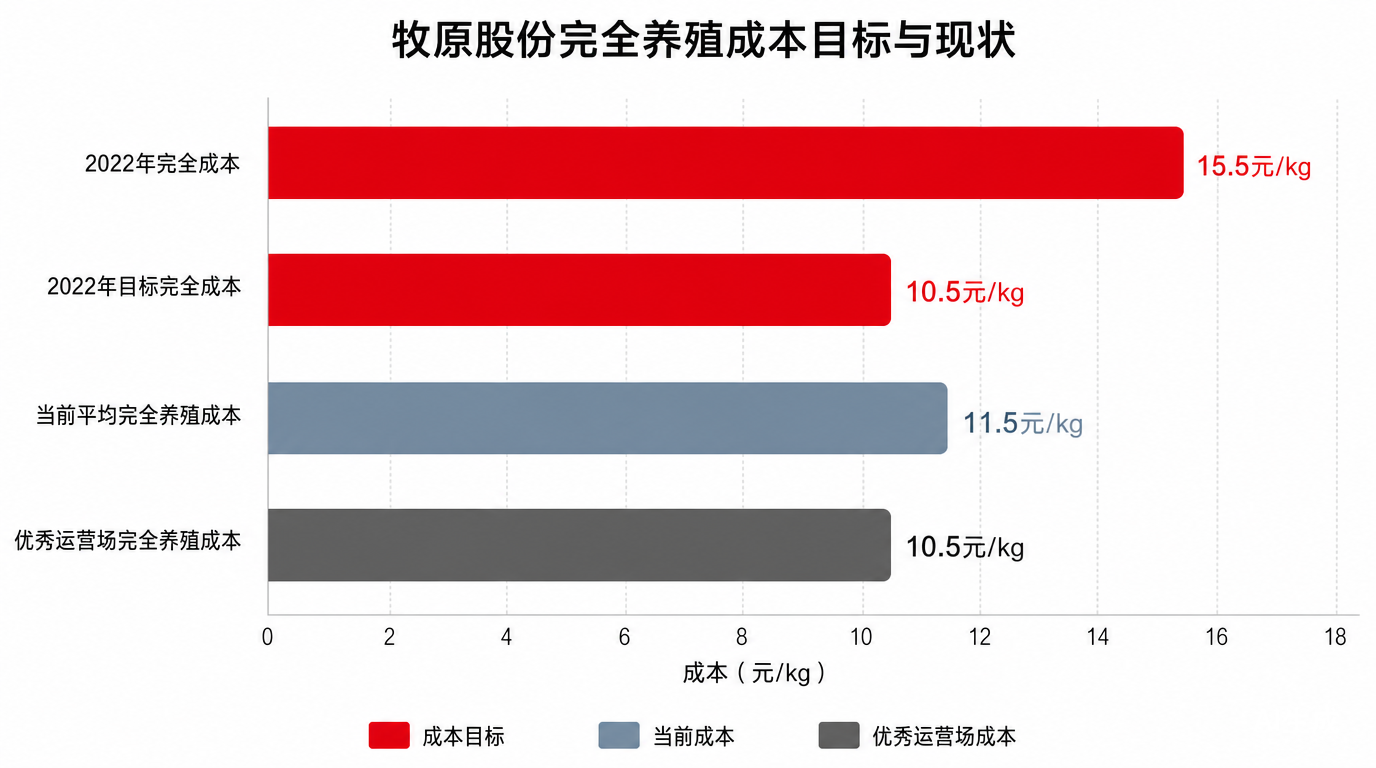
In 2022, Muyuan Shares claimed that "there is still a cost reduction space of 600 yuan per pig." Based on a calculation of 120kg per pig, this is equivalent to a cost reduction space of 5 yuan/kg. At the time, Muyuan Shares' all-in cost was approximately 15.5 yuan/kg, with a target of reducing it to 10.5 yuan/kg, and the cash cost could be reduced to 9 yuan/kg, which can be seen as Muyuan Shares' long-term cost reduction target.
However, by now, Muyuan Shares' average full-cycle breeding cost has dropped to 11.5 yuan/kg, with well-operated farms able to achieve 10.5 yuan/kg. Based on the original target, there is only about 1 yuan/kg of space left.
(Source of chart: AI-generated graphics)
A more critical issue is that the difficulty of reducing costs has increased significantly.
In the past, it may have taken only a year for the industry to reduce costs by 1 yuan/kg, but now it may take three years or even longer to achieve another 1 yuan/kg reduction. The closer the industry gets to the bottom of the cost curve, the higher the cost of efficiency improvements and management optimization may be for each further reduction.
Moreover, Muyuan Shares seemingly did not convey a clear expectation of "continuing to significantly reduce costs" to the market during this exchange. Muyuan Shares emphasized that PSY (the number of weaned piglets per sow per year, representing the production efficiency of sows) is very important, but cannot be the only indicator for measuring industry development. The production efficiency of the entire industry will continue to improve in the future, but no clear outlook was provided on the speed and magnitude of this improvement.
Meanwhile, Muyuan Shares also stated that, whether from the social average level or from the production efficiency of leading enterprises, the PSY of China's pig breeding industry is no longer low, and this is also the case when viewed globally.
This actually implies that the domestic pig farming industry's PSY has likely entered a plateau period, and the space for reducing costs by continuously improving PSY is becoming increasingly limited.
While Muyuan Foods' cost-side story is no longer as compelling as it once was—it can no longer offer the market expectations of significant cost reductions—this is, if anything, a positive for capital markets. And that is precisely one of the reasons we are beginning to turn optimistic on the hog cycle.
If costs can continue to decrease significantly, then after pork prices fall, companies can still withstand the pressure by reducing costs, making it extremely difficult for the industry to cut capacity. However, if the cost baseline stabilizes, the longer the industry suffers losses, the greater the cash flow pressure will be, ultimately forcing capacity to exit.
This process is currently underway, with listed pig companies having experienced cash flow losses for two consecutive quarters, the first and second quarters of 2026, and the third quarter of 2026 is also expected to be bleak.
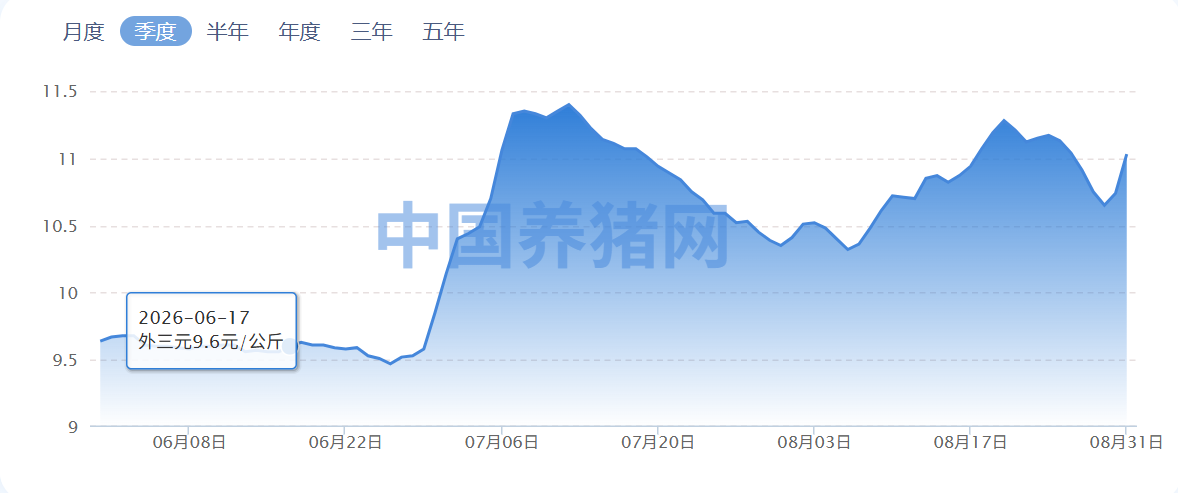
Although a small number of well-managed pig farming companies may avoid cash flow losses in the third quarter, such as Muyuan Shares, which currently has a cash cost of only 10.16 yuan/kg, possibly slightly lower than the average pig price in the third quarter, Muyuan Shares cannot represent the general state of the industry, with the current industry cash cost ranging from 11 to 12 yuan/kg, higher than the average pig price in the third quarter.
(Miaotou Investment: Generally, if a company's cash flow is in deficit for more than three consecutive quarters, it may face a situation where it is forced to reduce its scale)
Particularly now that purchasing piglets has entered a state of deep loss, it means that the economics of restocking and purchasing for fattening have significantly decreased, which also indirectly reflects that breeders are pessimistic about the market for the next six months, as piglets will become market-ready pigs after six months of fattening.
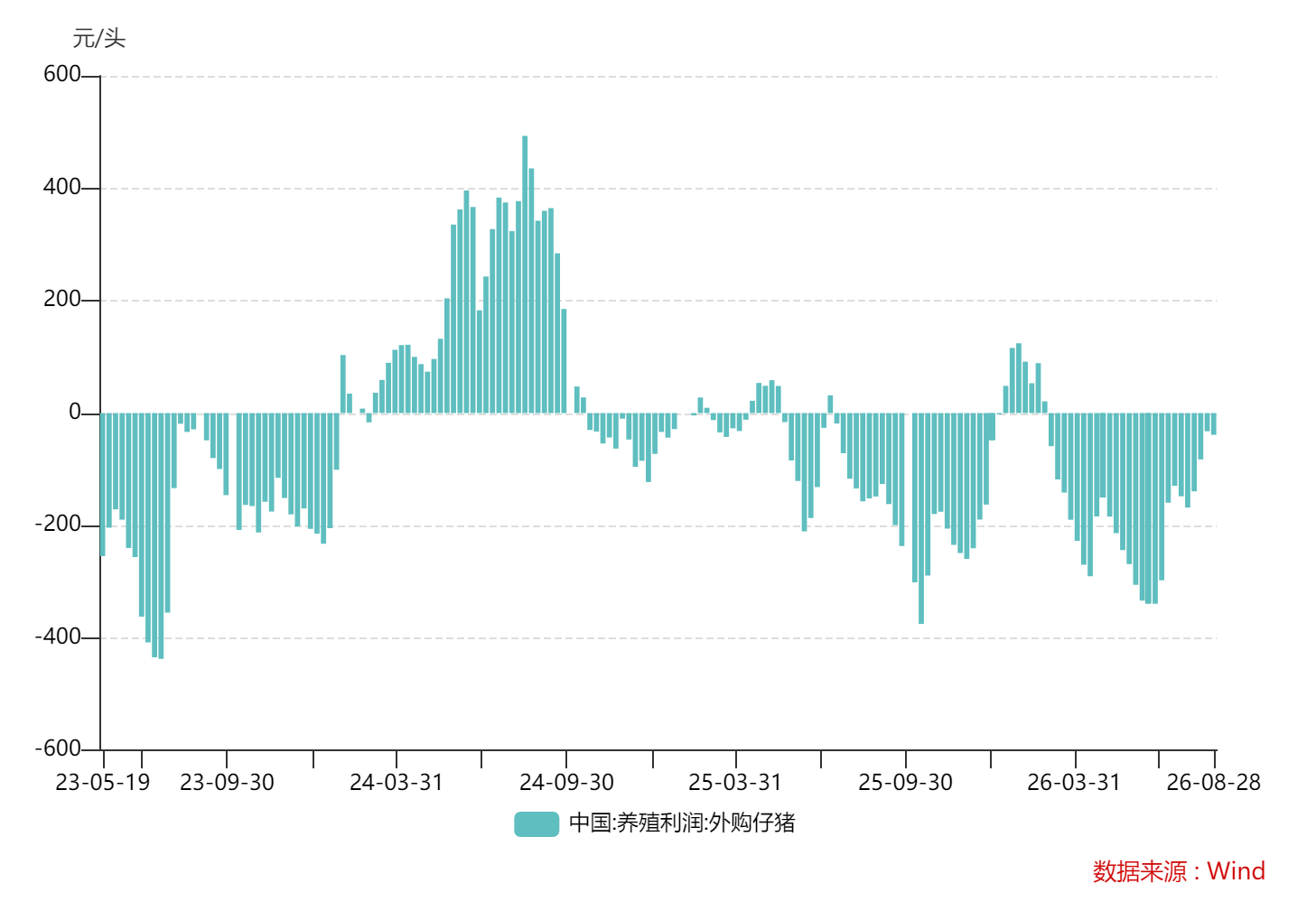
However, it's worth noting that the earliest time window for the acceleration of production capacity digestion is likely to be around September or October this year, while the data disclosure will be delayed by about a month.
So, during the 1-2 month gap period ahead, how will Muyuan Foods move? That will depend on the following two indicators.
Hog Prices, El Niño
First, let's look at pork prices.
Recently, the occasional rebound in pork prices is actually unfavorable for the pig cycle, as a rapid increase in pork prices would ease the cash flow pressure on pig companies, potentially slowing the pace of production capacity exit. Conversely, lower pork prices are more beneficial for the industry to continue incurring losses and accelerate the elimination of production capacity.
In the short term, the duration of low pork prices is more important than when prices will rise.
Muyuan Foods is also cautious in its assessment of future hog prices, saying this year remains difficult to predict, though it is broadly optimistic about 2027. The company's rationale is clear: counting from the fourth quarter of last year, the industry has now been loss-making for nearly a year. The sector is currently undergoing capacity reduction, and may even be in a phase of accelerating capacity cuts. That underpins its overall optimism for 2027, particularly given how weak the market has been this year.
In fact, for Muyuan Shares, the price of pigs itself is a very difficult question to answer.
Optimism pleases investors, but if everyone expects pork prices to rise, more funds will flow into the pig farming industry, potentially increasing future supply and exacerbating the oversupply situation. On the other hand, pessimism may deter companies from blindly expanding, but it will also disappoint investors.
Next, let's look at El Niño.
El Niño refers to the extreme meteorological phenomenon triggered by the large-scale and sustained abnormally high sea surface temperatures in the central and eastern equatorial Pacific, which in turn induce global large-scale climate anomalies.
In August 2026, the NOAA (National Oceanic and Atmospheric Administration) has clearly determined that El Niño is strengthening and is expected to reach an extremely strong level in the fall and winter of 2026, which will have an impact on the pig cycle, particularly in terms of costs.
The transmission chain can be simply summarized as: El Nino intensifies → corn and soybean meal prices rise → hog breeding costs increase → pig companies face greater loss pressure → production capacity reduction accelerates. Therefore, the stronger El Nino is, the more beneficial it is for the industry to clear out capacity.
(Miaotou Investment: In the cost of raising live pigs, feed accounts for 60%, with corn and soybean meal being the main components, accounting for around 85%)
El Niño expectations have recently driven corn and soybean meal futures prices higher, lifting anticipated pig-farming costs. The increase in input costs should accelerate capacity reduction in the industry, underpinning the hog cycle and partially offsetting the bearish impact of rising hog prices.
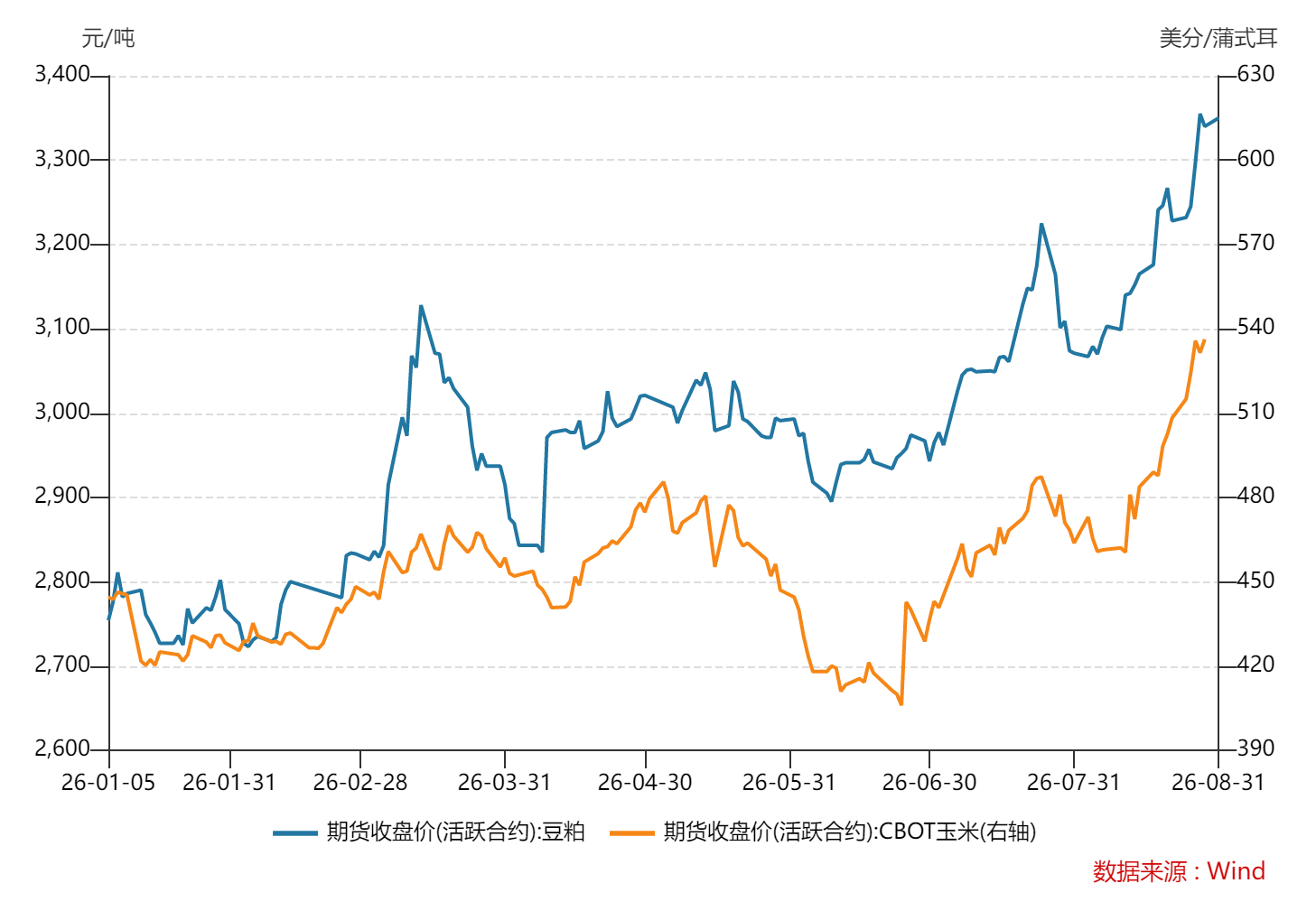
Next, we will continue to track the intensity of El Niño, focusing on two key areas: the high-temperature drought in the US Midwest corn and soybean production areas, and the precipitation in core production areas such as central and western Brazil.
There are two main signals that will invalidate our logic:
Firstly, pork prices have continued to rebound.
A short-term surge in pork prices does not necessarily disprove the logic, what truly warrants attention is the magnitude and duration of the pork price rebound. The greater the rebound and the longer it lasts, the more the reversal of this pig cycle will be delayed.
Pig prices are likely to rebound under certain circumstances, with one key indicator to watch being the expansion of the price gap between fattened pigs and benchmark pigs. The price gap refers to the difference in price between fattened pigs, which typically weigh over 130 kilograms, and benchmark pigs, which weigh between 110 and 120 kilograms. If this gap continues to widen, it indicates that larger pigs are relatively more valuable than benchmark pigs, which would boost the enthusiasm of breeders to hold back their stock and engage in secondary fattening, thereby delaying the release of supply and slowing the pace of the current pig cycle.
Second, PSY will continue to improve.
If the industry introduces a new breeding system in the future or achieves rapid improvements in production efficiency, further closing the gap with advanced levels in Europe and the US, the industry's cost structure may continue to decline. This means that our current judgment about the industry's cost reduction entering a deep-water zone needs to be reevaluated.
Summary
Over the next 1-2 months, the key factor to watch for Muyuan Shares' stock price will still be pig prices and the intensity of El Niño, as these two factors determine the sustainability of cash flow losses for pig companies.
But from a medium- to long-term perspective, there's another point worth tracking: Muyuan Shares is also transitioning from a cyclical to a value-driven model.
From an industry perspective, Muyuan Shares has maintained its breeding advantages while actively expanding its pork industry chain vertically, integrating from pig breeding to slaughter and deep processing of meat products, which is also the direction guided by policies. Referring to the current development pattern of white broiler chicken breeding, C-end expansion has become an industrialization trend in the industry.
In the first half of 2026, Muyuan Shares slaughtered 17.234 million pigs, up 50.98% year-on-year. The company's slaughtering and meat business generated operating revenue of 22.061 billion yuan, an increase of about 14% year-on-year, accounting for 37% of revenue.
If this transformation is successful, Muyuan's valuation logic will also shift from a cyclical livestock breeding stock to a food company, and its valuation center is expected to be lifted.
Of course, this is a medium- to long-term logic.
Ultimately, our current optimism about the pig cycle stems from a greater focus on the possibility that the industry's cost structure may have hit a floor, and the fact that Muyuan Shares' cost reduction efforts have entered a challenging phase is also a validating signal.
We have been closely tracking the pig cycle and have published several columns on it.
Regarding why we have turned optimistic about the pig cycle, reference can be made to "The Pig Cycle Reversal, This Time It May Be Real";
For the ceiling of this hog cycle and the potential upside for Muyuan Foods, see "Hog Cycle Reversal: How High Is Muyuan's Ceiling?"
Disclaimer: The content of this article is for reference only, and the information or opinions expressed herein do not constitute any investment advice. Readers are advised to exercise caution when making investment decisions.