As strong as Hermès is in the capital market, its stock expectations were actually lowered?
Last week, RBC Capital Markets downgraded Hermès' stock rating from Outperform to Sector Perform and lowered its target price from 1,900 euros to 1,700 euros. The institution analyzed that Hermès' growth performance has led to a narrowing of its "growth gap" relative to the overall luxury goods sector.
At the end of July, Hermès released what appeared to be an excellent semi-annual report, but after nearly a month of digesting the financials, the market gave a different verdict.
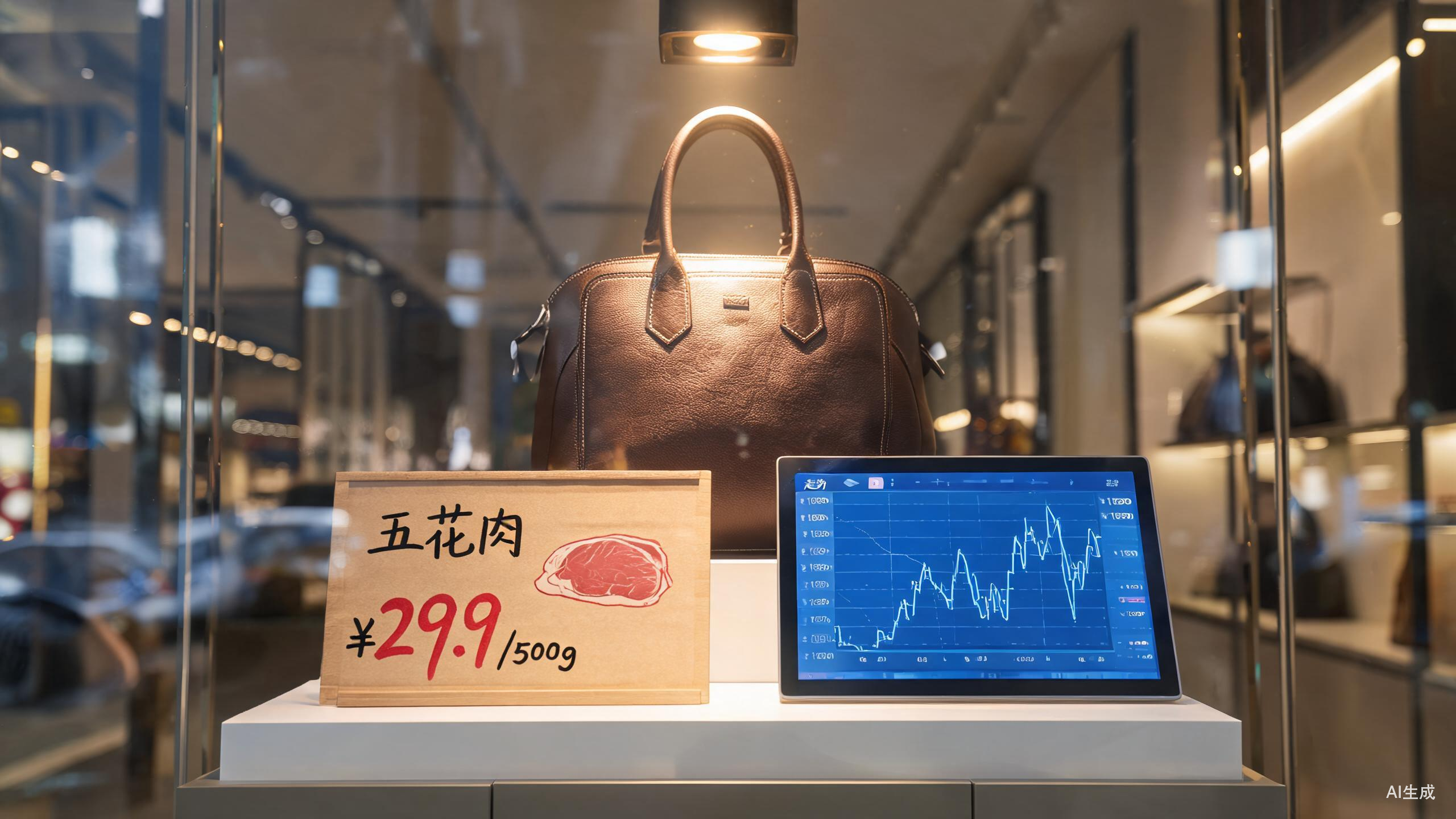
In the latest half-year report, sluggish growth in the Chinese market emerged as an unavoidable focal point. During the post-earnings conference call, Axel Dumas, Hermès' executive chairman, offered a distinctive take on the company's China performance—dubbing it the "pork price theory." In short, he argued that pork prices can serve as a barometer of consumer sentiment. With pork prices currently low, a rebound could signal that consumers are once again willing to celebrate and spend, which in turn would point to a return to high growth for Hermès in the Chinese market.
However, the market is not buying into Dumas' "pork price theory". Analysts believe that Hermès, previously recognized as the most recession-proof luxury brand globally, is seeing its growth gap with other luxury companies narrow. The market is starting to worry that the "perfect company" valuation previously given to Hermès may have exceeded its potential future growth.
As one foreign media outlet aptly put it: Chinese middle-class consumers are not simply "downgrading their consumption," but rather shifting towards the top of the product categories they can afford, rather than the bottom of expensive ones.
Perhaps Hermès has not lost Chinese consumers, but rather Chinese consumers are losing the urge to buy Hermès as if it is the only option.
Monitoring pork prices?
At the end of last month, Hermès announced its first-half 2026 results, with second-quarter revenue growing 6.7% to 4.09 billion euros at constant exchange rates, which seems satisfactory. First-half revenue reached approximately 8.2 billion euros, up 6% year-over-year, with an operating margin of around 41%.
The financial report itself was not the issue, but on July 29, the stock price plummeted by about 11% at one point, a rare large drop of over a decade. The market value evaporated by about 19.7 billion euros in one day. According to data from Euronext Paris calculated by Le Figaro, as of August 26, Hermès' stock price has fallen by about 27% this year, retreating from its high at the beginning of the year to around 1,550 euros.
It's not that Hermès' platinum bags have suddenly stopped selling, but rather the market no longer believes the company can forever decouple itself from the Chinese consumer cycle.
In the second quarter, sales in the Asia-Pacific region (excluding Japan) grew by only 2.5%, compared to around 13.7% growth in the Americas and over 12% in Japan, indicating that Hermès' growth is increasingly reliant on markets such as the US and Japan, with China failing to pick up the slack.
Regarding this performance, Axel Dumas, the sixth-generation heir and current executive chairman of Hermès, explained that the Chinese team performed well, with the Greater China region maintaining growth, but the growth rate has not yet recovered to previous levels, and no significant improvement has been seen on the demand side.
Later, during a conference call, Dumas summed up his assessment of the Chinese market with three keywords: stabilizing, not yet rebounding, and unclear. His choice of indicators, however, was puzzling. He focused on three metrics: the property market, the stock market, and pork prices. To gauge Chinese consumer confidence, he now watches pork prices.
Pork is an important indicator of people's willingness to celebrate, socialize, and host banquets, but now pork prices are very low.
The CEO of a global top luxury brand, in judging when Chinese people will start buying Hermès again, has begun referencing the trend of Chinese pork prices to determine when Chinese consumers' "consumption sentiment" will truly return. Many netizens have commented on this famous "pork theory," saying that Dumas is neither familiar with China's pork market nor aware of the current dietary consumption habits of Chinese people.
The capital market is revaluing the "Hermès myth"
Hermès remains a top performer in the luxury goods industry in terms of its operating data. The company's full-year revenue for 2025 exceeded €16 billion, with strong growth and profitability maintained throughout the year. In the first half of 2025, revenue reached €8.163 billion, representing a 6.1% increase at constant exchange rates, with the recurring operating margin remaining at 41%. In the first quarter of 2026, revenue grew 6% at constant exchange rates, with a 2% increase in Asia Pacific excluding Japan, and a "slight increase" in the Greater China region.
Two weeks after Hermès released its half-year report, Deutsche Bank lowered its target price for European luxury stocks, including Hermès, which fell about 2.5% on the day. Royal Bank of Canada Capital Markets subsequently downgraded Hermès' rating from "outperform" to "sector perform".
As of recently, Hermès' stock price was around 1,550 euros, with a 12-month average target price of approximately 1,870 euros given by the market. Royal Bank of Canada Capital Markets' adjustment of the stock price forecast from 1,900 euros to 1,700 euros also seems entirely logical.
The institution's analysis is based on the fact that Hermès' growth advantage once reached around 8% in 2025, but it is expected that from 2027 to 2030, this gap will narrow to about 2% relative to the average level of the luxury goods industry. In other words, Hermès will still grow faster than its peers, but it will no longer be "far ahead".
The UK's Financial Times noted that Hermès achieved an 18% sales compound annual growth rate from 2019 to 2024. Citi analyst Thomas Chauvet believes this level of growth is "unlikely to be sustainable in the long term," and growth is now gradually returning to high single digits. Meanwhile, as growth slows, investors are also starting to re-examine Hermès' high valuation relative to its peers.
Thus, the downward revision of stock expectations by some investment institutions is seen not as a crisis for Hermès itself, but rather as a "crisis of expectations" for Hermès.
Rise and fall with leather products?
Why has the market suddenly become dissatisfied with a company that is still growing 6% and has a profit margin of over 40%? Royal Bank of Canada Capital Markets pointed out a key issue: Hermès is becoming increasingly reliant on its leather goods.
Hermès, founded in Paris in 1837, is a benchmark company in the global luxury goods industry, with its own set of marketing and sales strategies, the most core of which is scarcity.
Hermès' strategy is not simply to sell a large quantity, but to ensure that each product generates extremely high profits, from a classic leather handbag to a small keychain.
With this combination, the customer structure is more inclined towards ultra-high-net-worth individuals, making it the "most resistant to cycles" in the luxury goods industry during downturns.
However, according to an analysis by RBC Capital Markets, "if sales do not accelerate significantly, Hermes' leather goods business revenue growth may be around 9%-10% starting from 2027. If the growth of the leather goods business slows down in the future, it will be increasingly difficult for Hermes to maintain the kind of excess growth it had in the past."
Data from the institution shows that from 2025 to 2030, leather goods are expected to contribute 63% to Hermès Group's revenue growth, compared to 40% in the previous five years.
Hermès, of course, has products such as silk scarves, perfumes, and cosmetics, but its true brand assets and profit drivers are still its leather goods.
Leather goods are precisely one of the categories Chinese consumers are most likely to defer right now. At the same time, with the rise of numerous Chinese affordable-luxury brands, "accessible luxury" has become a new trend, joining forces with the "guochao" movement to compete for market share.
According to a luxury goods analysis report from Bernstein cited in *Ouzhou Zhi* (Continental Journal), Chinese domestic leather goods brands are on the rise. Songxia Yousong, for instance, posted average annual sales growth of 59% between 2021 and 2025, versus just 13% for Coach. The report highlighted five Chinese leather handbag brands whose combined sales grew at a compound annual rate of 51% over the same period. Unit volumes rose about 37% annually, while prices increased only roughly 10%.
Unlike many European luxury brands, these companies design, source raw materials, and manufacture their products entirely in China, leveraging the country's already mature leather goods supply chain. This setup increases flexibility in terms of development cycles and transportation costs. Many emerging brands also focus on digital marketing, directly reaching consumers while bypassing the costs associated with large international retail networks.
But the conclusion from Shengbo Securities is also insightful - the pressure from these Chinese domestic brands is mainly on other "accessible luxury brands" such as Coach from the US and Longchamp from France, as they are in the same pricing range. However, traditional luxury giants, from Hermès, Dior to LV, have not been significantly affected.
However, the question remains: as Chinese consumers start to rethink "what kind of luxury goods are worth my money," can Hermès continue to maintain its past growth rate of 18%?