
"I never even went to their location to get a card," Qi Pengfei told Phoenix News' "Storm Eye."
In 2011, a loan of 50,000 yuan and three guarantees of 50,000 yuan each, totaling 200,000 yuan, appeared under his name.
Qi Pengfei said he never signed in person and never received the money.
This 15-year controversy reached a crucial juncture on August 26, 2026.
The court-appointed forensic authentication agency issued an opinion stating that the ten signatures in question were not written by Qi Pengfei himself, and the ten fingerprints were also not left by his fingers.
The case has not yet been decided, and whether he can have his adverse credit record cleared and obtain compensation still awaits a court ruling.
Regarding the situation reflected by Zhi Pengfei, Phoenix News' "Eye of the Storm" has contacted the Baofeng Branch of Henan Rural Commercial Bank multiple times to verify the relevant issues, but as of press time, no response has been received from the other party.
Not in the Country, So How Could They Sign?
Qi Pengfei first noticed something was wrong with his credit record in 2015.
That year, when he was preparing to purchase his first home and applied for a mortgage, the bank immediately informed him that there were overdue loan records, and his application was directly rejected.
According to the information he provided, on August 19, 2011, there was a personal loan of 50,000 yuan under his name; on the same day, he also provided joint and several liability guarantees for 50,000 yuan loans borrowed by three villagers, Yuan, Wang, and Yuan. The four debts totaled 200,000 yuan, with a loan term of two years, and could be renewed.
The original lender of the aforementioned loan was the Daying Credit Union of Baofeng County Rural Credit Cooperatives Union, and with the restructuring of local rural credit institutions, the relevant creditor's rights and debts of the former Baofeng County Rural Credit Cooperatives Union Daying Credit Union have now been taken over by the Baofeng Branch of Henan Rural Commercial Bank.
After four contracts expired, his signature was still on the contract extension in August 2013.
But Qi Pengfei claimed he was not in the country at all at that time.
Entry and exit records provided by Zhi Pengfei show that he left the country from Xiamen in July 2013 and entered the country in June 2014.
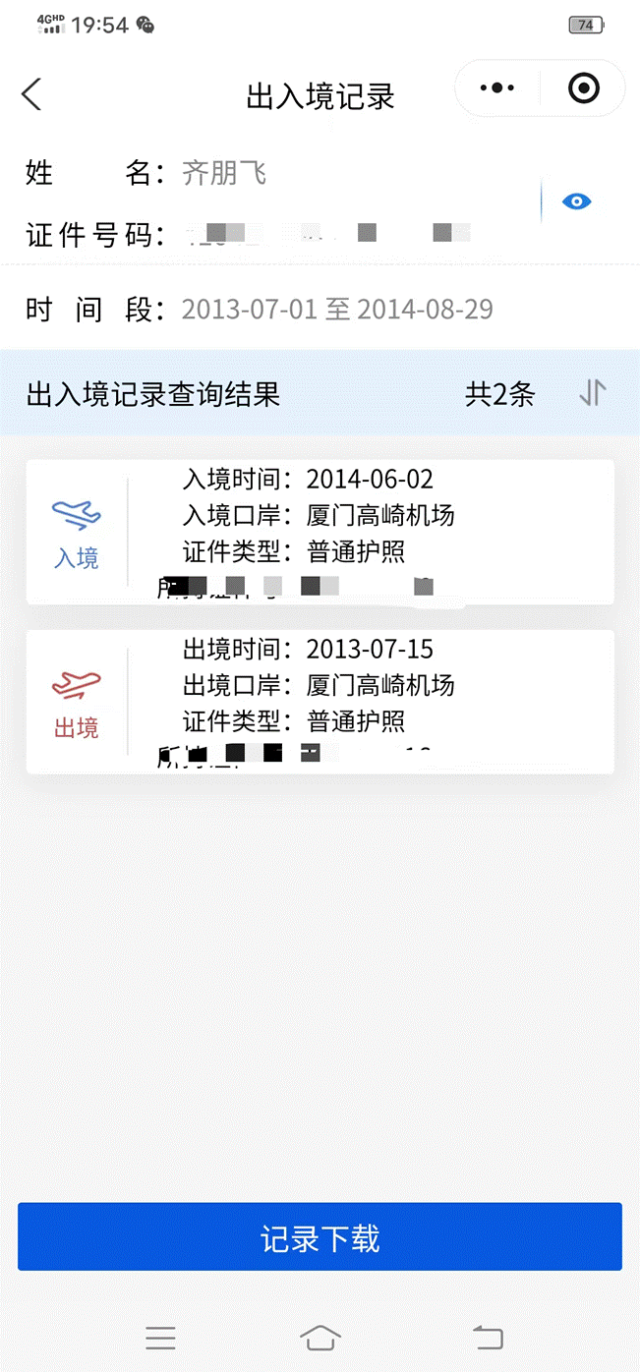
Photo source: provided by Qi Pengfei
"I was working in the Philippines at the time and wasn't even in the country, so how could I have signed for you?"
In 2018, Qi Pengfei planned to buy a second home and was again rejected for a bank loan due to the same overdue payment record.
Qi Pengfei said that this time he formally approached the bank in question to address the matter and also filed a police report. The bank only replied that it would "investigate," and then there was no further update.
This overdue loan has always been listed on his credit report, but the bank has never taken the case to court to pursue repayment.
Qi Pengfei recalled that around 2021, debt collectors came to his door. He told them on the spot that he had never taken out the loan, and the collection efforts subsequently stopped.
As he hasn't been subjected to enforcement procedures, his daily commutes remain unrestricted, and he can still take high-speed trains, with his life appearing to be normal in every way, except when he needs to take out a loan, at which point this invisible debt emerges to block his path.
Forensic examination reveals: 10 signatures and 10 fingerprints do not belong to the individual
In 2025, Qi Pengfei, a truck driver, planned to spend over 700,000 yuan to purchase a truck for self-operated transportation, but his loan application was rejected once again.
He has decided not to drag it out any longer and has directly submitted a lawsuit to the Baofeng County People's Court, requesting that the 2011 loan contract and three guarantee contracts be declared invalid, demanding that the bank remove the bad credit record, and seeking compensation for economic losses of 100,000 yuan and lawyer's fees of 10,000 yuan, totaling 110,000 yuan.
On April 24, 2026, the court officially filed the case and scheduled a second hearing for September 17.
According to a document provided by Qi Pengfei to ifeng.com's "Eye of the Storm", Henan Rural Commercial Bank Co., Ltd.'s Baofeng Branch requested the court to have Qi Pengfei produce his signature and fingerprint from his exit and entry documents for comparison, believing this would better reflect the objective and true situation.
Ultimately, at the commission of the Baofeng County People's Court, the Henan Zhongyi Judicial Appraisal Center initiated two judicial appraisals on the signatures and fingerprints in the documents related to the case.
On August 26, the appraisal results were officially released, showing that none of the ten signatures in question were written by Qi Pengfei, and none of the ten fingerprints were left by Qi Pengfei's fingers.
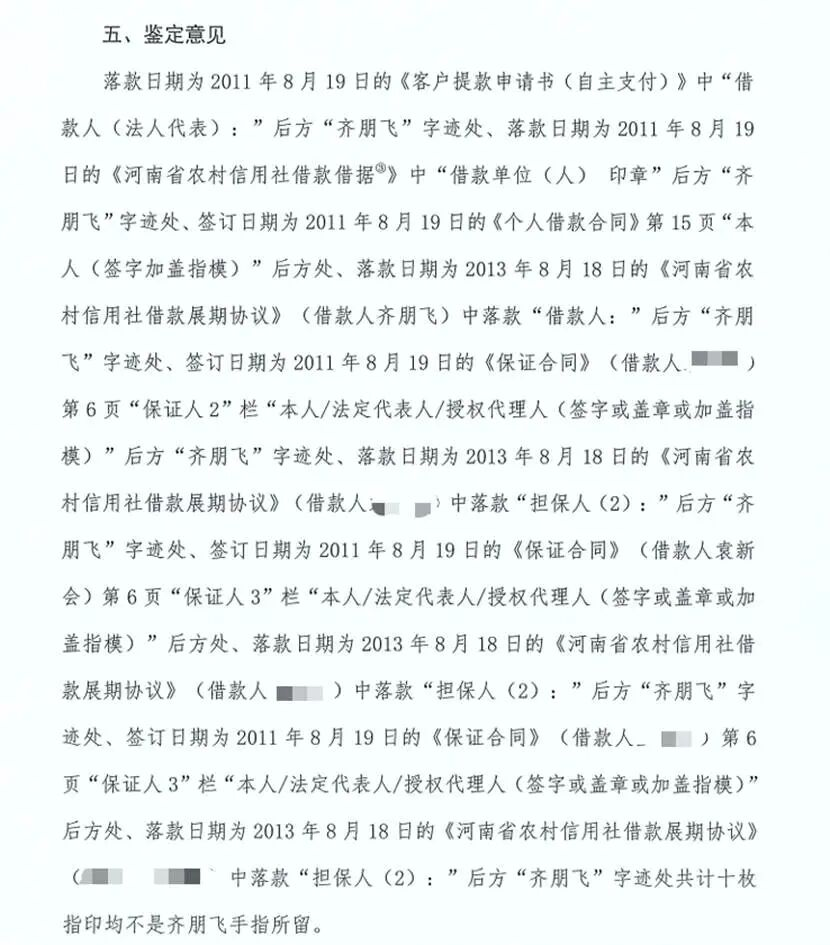
Image source: appraisal opinion document provided by Qi Pengfei
Li Haiquan, a lawyer at Shanghai Shenyihe Law Firm, told ifeng.com's "Eye of the Storm" that judicial appraisal has proven the signature and fingerprints are not those of Qi Pengfei, and considering his entry and exit records show he was not in the country during the extension period, it can be determined that the contract does not represent his true intentions. According to Article 146 of the Civil Code, "Civil legal acts performed with false expressions of intention are invalid," and Article 143, which stipulates the requirement for true intention, the aforementioned contract should be deemed invalid and has had no legal binding force from the start.
If the court rules the contract is invalid, it usually orders the bank to proactively remove the adverse credit record after the judgment takes effect. If the bank fails to do so, Zhi Pengfei can apply for the court to enforce it. Additionally, according to Article 25 of the Credit Reporting Industry Management Regulations, he can also directly raise an objection to the credit reporting agency or the information provider, requesting a correction, and the agency should investigate and handle the matter within 20 days of receiving the objection.
Unauthorized Loans Not an Isolated Case
Zhi Pengfei's experience is not an isolated case.
In recent years, the Henan Rural Commercial Bank system has been exposed to multiple cases of fraudulent lending, with victims often being rural residents with lower educational backgrounds and weaker rights protection capabilities.
In August 2026, a collective "being loaned to" incident was exposed at the Nanyang Wan Cheng branch in Henan.
A villager who farmed year-round with annual income below 30,000 yuan was tricked in 2020 by a fellow villager into signing documents and verifying his identity under the pretext of receiving subsidies. He later discovered he had been registered as the legal representative and shareholder of a technology company, under whose name two principal loans and one guarantee were issued at Henan Rural Commercial Bank's Nanyang Wancheng branch (formerly the Wancheng District Rural Credit Cooperative), totaling 14.8 million yuan. It was only in April 2026, when a court seized his personal accounts, property, and vehicles, that Gao Shan learned of the massive debt burden.
It is reported that a total of 8 villagers in the village have encountered similar scams, with 3 people having fixed complete evidence, and two other villagers mysteriously shouldering loans of 9.5 million yuan and 4.95 million yuan, respectively. The bank involved responded by saying "all procedures were confirmed and signed by the parties themselves".
Earlier in May 2026, a case in which a 60-year-old low-income resident, Xing Mingjin, from Tanghe County in Nanyang, was allegedly forced to take out a 200,000 yuan loan sparked public concern.
Xing Minjin can't even write his own name, and the signature on the contract was forged by someone holding his finger, with the bank automatically deducting repayments from his subsistence allowance account every month, totaling around 15,000 yuan over four years.
A joint investigation team confirmed that the case involves three individuals and three borrowed-name loans totaling 790,000 yuan, with evidence that the borrowers fraudulently obtained loans under others' names and that rural commercial bank staff committed irregularities.
In the end, all the problematic loans and frozen deposits were recovered, the credit default and enforcement information was deleted, and the Tanghe County disciplinary inspection and supervision authority and the Agricultural Bank of China's disciplinary committee took action against 15 relevant personnel.
An analysis by Storm Eye of multiple cases found that these fraudulent loans taken out in borrowers' names share highly similar characteristics: they are concentrated in grassroots branches at or below the county level, the misconduct typically occurs during the transition period when rural credit cooperatives were restructured into rural commercial banks, and victims generally lack financial risk awareness, making them easy prey for acquaintances who induce or trick them into signing documents under the guise of subsidies or favors. On the bank side, core risk-control procedures—identity verification, in-person interview requirements, and pre-loan due diligence—were all reduced to formalities in these cases, serving no gatekeeping function whatsoever.
This ultimately becomes a cost of rights protection for ordinary parties involved.
Li Haikuan stated that upon discovering a similar situation, one should immediately communicate with the bank, confirm that the loan is not their own, and request the bank to retrieve the full set of loan documents, including the loan contract, original signature, interview records, and audio and video materials. To preserve evidence, a written application can be mailed to the bank via EMS if necessary. If the bank does not accept the complaint, a report can be filed with the China Banking and Insurance Regulatory Commission, and a credit dispute application can be submitted to the local branch of the People's Bank of China. If the amount is large and may involve loan fraud, a report can be filed with the public security authorities for handling. If the issue remains unresolved for a long time, a civil lawsuit can be initiated. As the custodian of the contract, the bank bears the burden of proof to verify the authenticity of the signature.
He also specially reminded people not to blindly trust the so-called "pay to repair credit" and "help communicate with banks to repay debts" claims made by intermediaries on the market, in order to avoid suffering secondary losses.