
I make an advance payment on my mortgage every year.
The reason is not particularly compelling, as mortgage interest rates are still relatively high and it's hard to find more stable or better investments to cover them. Paying back the bank at least guarantees one thing: no longer having to pay interest on this portion of the principal.
The bank's app will tell me that the prepayment was successful and the remaining principal has been reduced. Of course, it won't say that I just used today's cash to buy back a small piece of my future.
On August 28, the maximum term for personal housing loans was extended from 30 years to 40 years. Another group of families was given the opposite option: taking an additional 10 years in the future in exchange for lower monthly payments today.
A loan of 1 million yuan, with an annual interest rate of 3% and equal principal and interest payments, would require a monthly payment of approximately 4,216 yuan for a 30-year term, and approximately 3,580 yuan for a 40-year term. The monthly payment is 636 yuan less for the 40-year term, but the total interest paid is approximately 200,000 yuan more. By the 30th year, the 40-year loan would still have approximately 370,000 yuan in outstanding principal.
Numbers won't ask you how many jobs you'll switch to in these thirty years, how many times your house will be renovated, whether your parents will get sick, or where your kids will live. All it does is neatly print the next forty years of your life, half of your lifetime, into a contract.
Pay a little bit of the future in advance
Paying off my mortgage ahead of schedule over the years didn't feel like a particularly smart decision to me.
It's more like a simple trade-off. With no better option for stable returns and no desire to gamble with the money, it's better to pay off a portion of the interest that will definitely be owed in the future. The cost is also clear: once the cash is put into the loan account, it's not easy to take it out again. The house won't automatically dispense a month's living expenses when you need money temporarily.
So I don't think paying off debts early is a universally correct answer.
Some individuals with stable incomes and surplus funds prioritize paying less interest, while others who have just started a family need liquidity for expenses such as home renovations, childcare, and medical care, making a few hundred yuan less per month more important than saving on interest payments decades later. Additionally, those who can find long-term investments with returns higher than their mortgage costs and can tolerate the associated volatility may not find it cost-effective to make early repayments.
The same mortgage can have different repayment priorities for different people, with some wanting to pay it off as quickly as possible and others needing to take it slower, neither approach being overly conservative or taking undue advantage of the bank.
A 40-year mortgage may only be adjustable in terms of how much is repaid each month.
Based on an assumption of a 1 million yuan loan at a 3% interest rate, the monthly payment for a 40-year mortgage is about 15% lower than that of a 30-year mortgage. If banks still review mortgage applications based on the rule that monthly housing payments cannot exceed 50% of income, people who were previously unable to afford the monthly payments may now be able to qualify. The new rules also raise the upper limit of the ratio of total debt repayment to income from 55% to 60%, but the 50% constraint on housing payments remains unchanged.
This means that some people can now afford to buy houses that they previously couldn't; it also means that a longer period of future income will be factored into today's purchasing power.
Houses have not become cheaper, down payments have not disappeared, they have just sliced the monthly payments thinner.
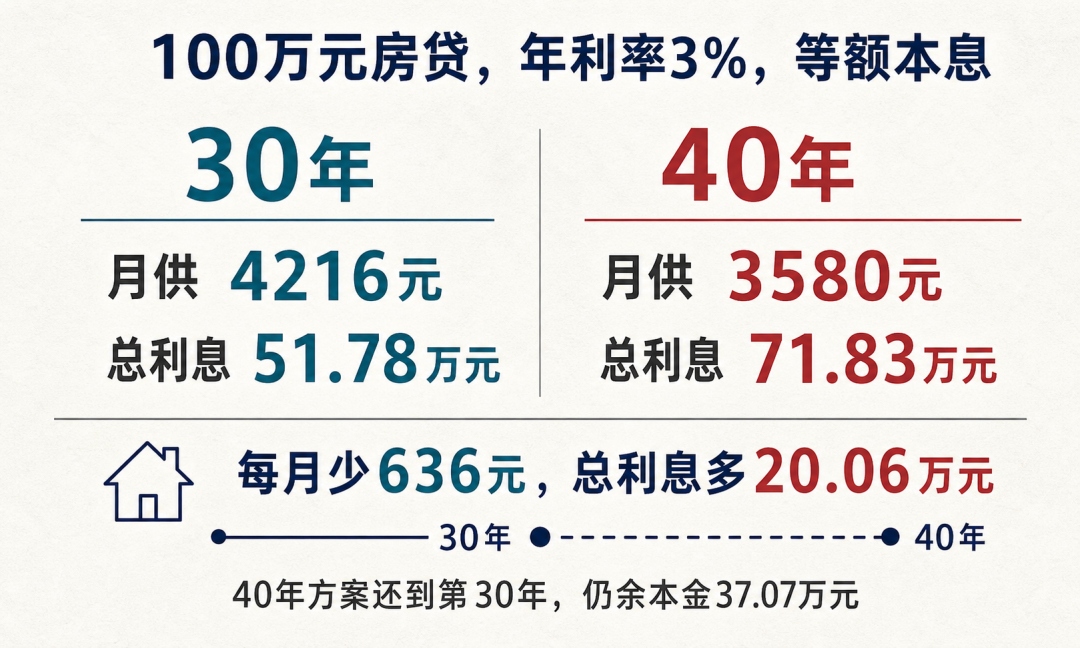
For a 1 million yuan mortgage, a 10-year extension of the loan term results in lower monthly payments, but higher total interest and a larger outstanding principal at the end of the loan.
Forty years is just a number written on the upper limit
The "longest 40 years" can easily be seen as a new nationwide product, as if walking into any bank, the teller can casually add ten more years.
Things won't actually be that straightforward.
The loan term ultimately still depends on the borrower's age, income, debt, property age, and bank regulations. At the beginning of the new policy's implementation, different regions and branches have different execution paces. Some bank branches have told the media they are following the "age plus term does not exceed 85 years" rule, while others are still waiting for internal guidelines.
This is just a sampling visit, not a uniform national rule, but it reminds us of one thing: 40 years is the farthest boundary allowed by regulatory guidelines, not a standard route that everyone can take.
Even if a 40-year mortgage is signed, few people can stick to the original repayment schedule for their entire lives. Houses may be sold, families may move, interest rates may be adjusted, incomes may change, and those with extra funds may make early repayments.
Repayment plans are good at assuming everything stays the same, people are not.
The policy also leaves room for negotiation for existing borrowers who have temporarily lost their income source, allowing them to discuss extensions, deferments, or delayed principal repayments with banks. The key word here is "negotiation". It is not an automatic suspension, nor is it a permanent waiver of principal and interest.
Banks can extend loan terms, but they cannot extend a person's career stability for forty years.
Don't start the clock on personal matters when the house isn't even built yet.
Viewed over a 40-year span, this round of policies can be easily understood as encouraging families to take on an additional decade of debt.
However, the same batch of documents also includes a change in the opposite direction, which is also worth considering together: the loan disbursement node for personal mortgages for pre-sold commercial housing has been postponed from the original main structure completion to after the project is completed and filed.
In the past, once a building was topped out, homebuyers' mortgage funds could be transferred into a pre-sale fund supervision account. Although the roof was in place, work on doors and windows, pipes, fire safety, landscaping, and subsequent inspections was still underway, but the clock on individuals' loan repayments could start ticking nonetheless.
The new rule turns back the clock.
Completion and acceptance do not equate to handing over the keys, nor do they mean that the property ownership certificate has been issued, and it does not imply that the pre-sale system has been abolished. Homebuyers may still face issues such as delayed delivery, quality problems, and difficulties in obtaining the property certificate, and the down payment is still at risk. Just because the loan is disbursed late, it does not mean that a house that has not yet been taken possession of is absolutely safe.
But the order has indeed changed.
Before a house reaches a more complete stage of construction, banks cannot prematurely turn a homebuyer's decades-long credit into cash for developers. A family's 40 years of credit should not be put on the line for a building that is still under construction.
This is precisely a crucial counterpoint to the notion of the "longest 40 years".
Policies allow families to stretch out repayments while requiring developers to delay accessing personal mortgages, preserving cash flow for families and preventing projects from borrowing too heavily against families' future finances.
Only the first policy seems to be shifting more burden to homebuyers; when the second policy is also taken into account, it becomes apparent that the overall policy is reassigning risk to determine who bears it first.
Before completion, where does the money come from
Personal mortgages will be delayed until after the completion of the project's registration, but construction on the building will continue and construction funds cannot be delayed.
Funds are to come more from developers' capital, development loans, and regulated project funds. The development loan guidelines, which were released at the same time as the new personal housing loan rules, make these responsibilities more specific: in principle, one project is to be managed by one lead bank, with independent accounting, independent fund operation, and closed account management. The lead bank is to conduct due diligence, monitor the account, and also track where the funds are going.
The development loan for pre-sale projects should not exceed 3 years in principle and 5 years at most; for existing house sales projects, it should not exceed 5 years in principle and 7 years at most. The first repayment of principal is also generally made after the project is completed and filed.
Looking at these together, the order of the capital chain becomes somewhat clearer.
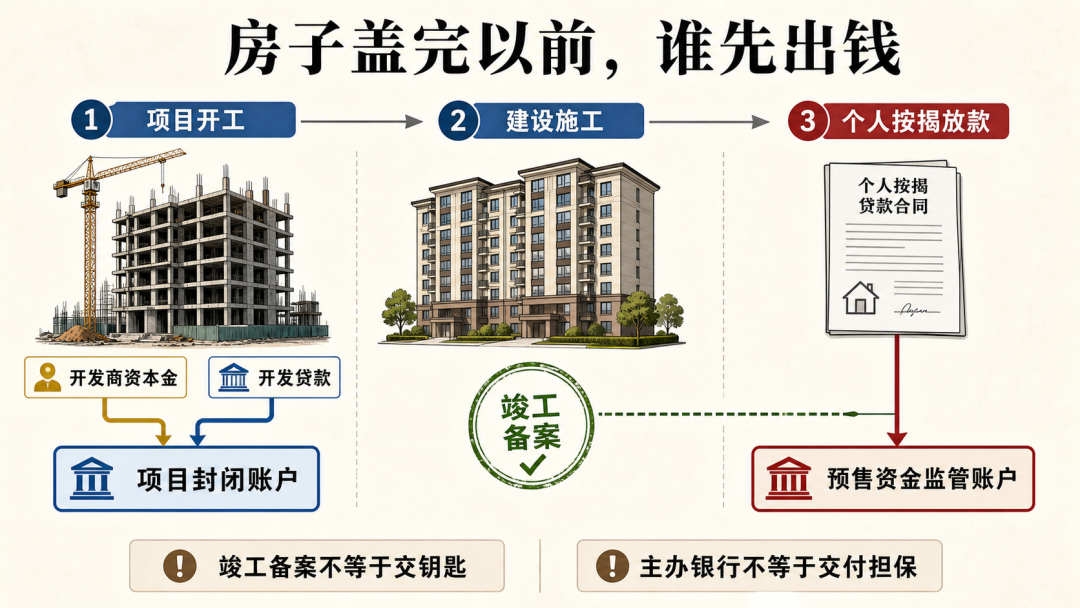
Personal mortgages will be postponed until after the completion of the project's registration, with financing responsibilities prior to completion falling more on the project, developers, and sponsoring banks.
Developers first use their own capital and project credit to secure financing, and banks initially assess whether the land, the company, and the development loan can complete the construction of the building. After the project is completed and registered, individual mortgages come in, followed by sales revenue.
In the past, the most convenient source of funding was long-term loans for homebuyers, which had long repayment periods, diverse sources, and guaranteed continued repayment by individuals according to contract once disbursed. Nowadays, this money arrives later, as developers cannot shift the risk of unfinished projects to thousands of families too early, and banks can no longer just review buyers' salary records while leaving the project itself to chance.
Of course, the lead bank is not the guarantor for the handover of houses.
Closing accounts cannot guarantee that management will never have loopholes, and approving development loans cannot turn bad projects into good ones. If banks misjudge and projects incur losses, engineering problems can still arise. The new regulations simply allow more capable institutions that can better assess projects, manage funds, and bear professional risks to take the lead, rather than inventing a way to build houses that never go bankrupt.
Moreover, with responsibility shifting back to developers and banks, costs won't simply vanish. Financing will depend more on project quality and development loans, making it harder for weaker developers to secure funding. Banks will grow more cautious, and the industry may continue to consolidate. Some will become safer as a result, but others will find that the door is no longer open to every project.
All that's missing is a mortgage account that was entered too early, construction, financing, and sales risks are all still there, they just need to be kept in the project account first.
In the past 40 years, there has been no such thing as a standard family
40-year mortgages are most likely to spark arguments because everyone tends to want to choose the same lifestyle for all.
Some people say that lower monthly payments have given young families an opportunity, while others claim that this is just a way of pushing unsold homes into the future for another decade.
Both views are not entirely incorrect, it's just that homebuyers are not a homogeneous group.
For a household whose income is still growing but faces heavy near-term expenses, extending the loan term can be a way to preserve cash. A 40-year contract doesn't mean you must pay for the full 40 years—if income rises later, you can repay early.
For someone like me whose income is already stable and who doesn't have better investment options, it's also normal to pay off a little more each year. Owing less may not necessarily increase assets, but it can lower the minimum amount that needs to be guarded each month in the future.
What's most feared is not the length of the term, but rather the assumption made on the day of purchasing a house that future salary, family relationships, health, and housing prices will all remain constant.
A contract can be calculated as such because a contract only requires one repayment date. A home cannot, as it needs to leave room for unemployment, illness, children, and temporary decisions, as well as a way out for someone who suddenly no longer wants to continue their original life.
This round of new regulations has done two things that appear to be contradictory.
It allows homebuyers to repay their debts more slowly and requires developers to receive payment from homebuyers at a later stage; it gives families a longer period and also leaves more pre-completion financing responsibilities to developers and banks.
This is not a solution for the real estate industry, but rather an acknowledgment that the previous sequence, in which loans were disbursed as soon as a building was completed and individuals began repaying them over several decades, cannot continue to be pretended to be cost-free.
As for whether 40 years is worthwhile, each family ultimately has to consider its own income, interest rates, and cash flow.
I will probably continue to pay off my mortgage ahead of schedule. It's not because I'm more aware than those who choose a 40-year term, but rather because there aren't better returns available to make it worthwhile for me to hold onto that debt.
As for someone choosing 40 years, I don't think that's foolish. Everyone wants to owe less, but life sometimes requires having more on hand first.
Banks make these distinctions in terms of time frames. For a family, it's just a matter of allocating limited funds to leave some room for maneuver in the future.