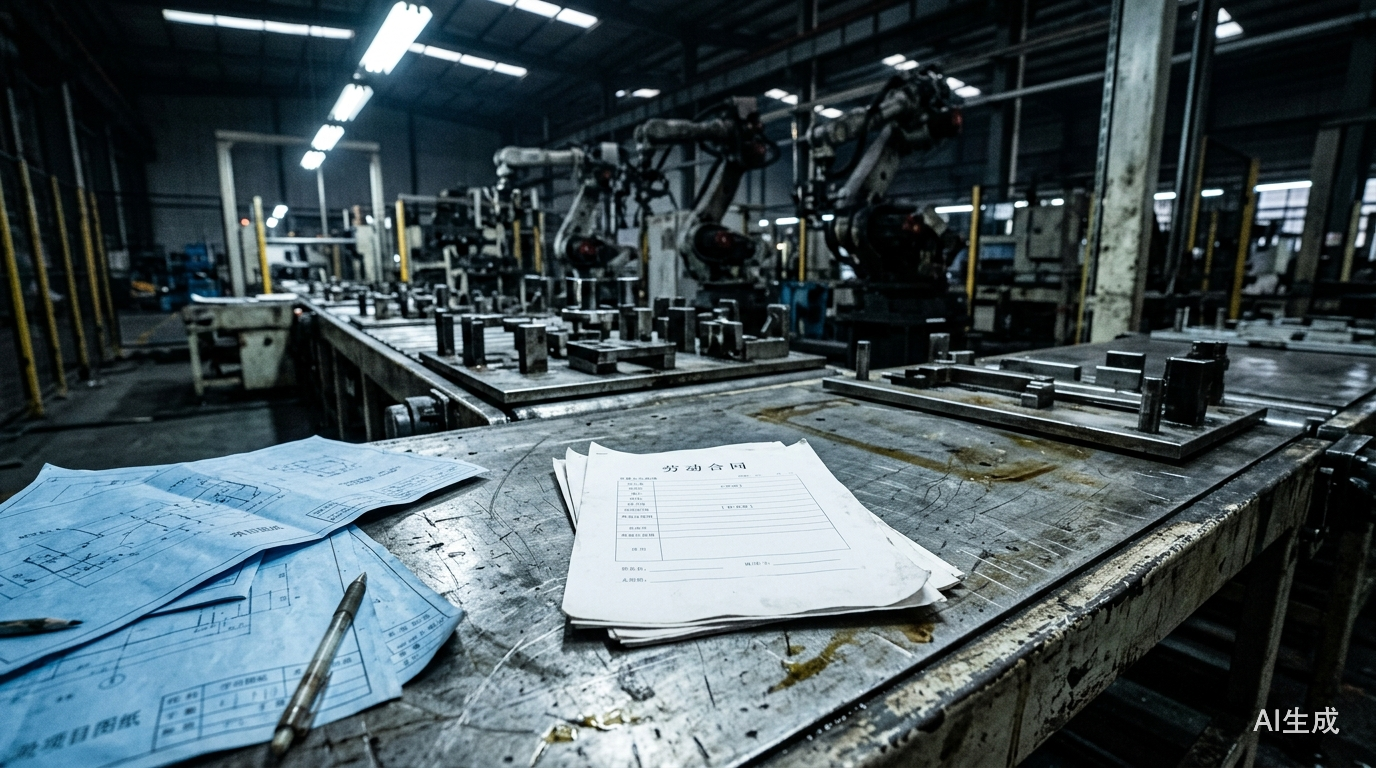
On July 1, Zhang Ming and more than 400 peers entered Changzhou Star-Ure Tech, signing on as an electronic project engineer with a monthly salary of 7,000 yuan.
A month later, on August 8, he was summoned to the conference room.
There were two options on the table: sign a resignation agreement citing "personal reasons" and leave with half a month's salary, or abolish the technical position and move to the production line to work on the assembly line, with the probationary period extended from one month to more than three months.
He later found out that the internal explanation at the company was that orders from automakers had plummeted at the end of July.
This year, the country has 12.7 million college graduates looking for jobs, an increase of 480,000 from last year.
Employee Resigns from ByteDance Citing Personal Reasons
Reported for duty on July 1 and entered the conference room on August 8.
There was more than a month in between.
According to a recording of a meeting obtained by The Paper, Xingyu Co., Ltd. presented employees with two options: sign a resignation agreement citing "personal reasons" and receive full on-the-job salary plus half a month's salary as compensation; or retain their employment relationship, but have their original technical positions abolished, and be uniformly transferred to the production line in the workshop to perform basic operations, with the probationary period extended from one and a half months to more than three months.
Those who refused to sign heard a different statement.
"We will directly forcibly transfer you and notify you of the details later."
This is not some supervisor losing emotional control.
A graduate who was interviewed by Jiemian News said that among the 440-person campus recruitment team, more than 300 people were summoned for a concentrated meeting on August 8.
On August 10, more than 30 people were invited to participate in a second round of interviews after the first round of negotiations was unsuccessful.
The company has relaxed its stance, saying that engineering positions can be retained, on the condition that workshop internships are extended from one month to three months.
On August 11, Zhang Ming completed his resignation formalities.
The Changzhou Human Resources and Social Security Bureau confirmed in a report on August 25 that Star Universe Holdings recruited 440 college graduates from the class of 2026, and terminated labor contracts with 107 of them, with the negotiation process being "overly simplistic and rigid, lacking sufficient and effective communication".
The announcement also stated that the company has suspended the human resources director.
However, the figure of 107 is only the official account.
According to the factory internship record obtained by Caijing, from August 10 to August 28, there were 121 college recruits on duty at the factory.
One student estimated that after the turmoil, no more than 160 of the original 440 employees remained.
The Zhongshan New North District Human Resources and Social Security Bureau explained that the 107 people only refer to "college recruits who were in the stage of adjusting positions and negotiating resignation with Xingyu Shares", and do not include those who resigned prior to this or after the negotiation ended.
This is a compressed statistic, with the metric being "how many people's negotiations broke down" rather than "how many people left".
More noteworthy is how these individuals were recruited in the first place.
According to recruitment presentations and announcements compiled by Interface News, Xingyu Shares promised that new graduates would only undergo short-term rotational training on the production line, and after the rotation ended, they would return to their contracted technical positions, with the assembly line serving as only an auxiliary training segment and not a long-term workstation.
When it comes down to specific individuals, the gap between promises and reality is this large.
A 2026 graduate recruit received a job offer in early November last year for the position of logistics planning engineer and started working at the factory in March this year through a work-study program.
She has done nearly four months of robot operation maintenance and troubleshooting.
On June 18, the human resources department notified her to attend a three-month production internship, with her direct supervisor not being informed in advance.
At the beginning of July, the formal labor contract the company was preparing to sign with her already had her position changed to production line team leader, with a salary of 17 yuan per hour.
She believes logistics planning engineers should be paid at least 24 yuan per hour.
Her direct supervisor explained it as "the factory's poor performance".
She did not sign and completed her resignation approval on July 10, so she is not among the 107 people.
Another student who was let go summarized their work on the production line into three tasks: plugging in wire harnesses, screw locking, and packaging.
There are also details hidden in the contract.
Several graduates who were interviewed by The Paper reported that when they signed labor contracts upon joining their companies, they only filled in their personal information and signed, with the rest of the contract left blank, which was then taken back by the company, only to be returned later during a meeting.
The reason for leaving stated on the partial cancellation of labor contract is "personal reasons".
The analogy is roughly like this: the restaurant has taken your deposit, and you've also given up the table you booked at another restaurant; just as the dish is about to be served, the waiter comes over and says the kitchen is closed, and asks you to sign a statement saying you're the one who doesn't want to eat.
The difference lies in the fact that if a restaurant were to do this, it would be complained about to the point of being shut down, whereas Xingyu Shares only needed to issue an apology letter at one point.
1.5 Million vs 451 Million: The True Cost of Default
On August 27, Xingyu Shares issued an apology letter.
The plan has three parts: immediate issuance of a three-month job-seeking living subsidy, an additional six months of salary compensation if employment is not found by the end of November, and free accommodation in the company dormitory for those who choose to stay.
A recent graduate who received the payment confirmed to Caijing that the total subsidy for three months was 15,000 yuan.
This amount of money only makes sense when viewed on the balance sheet of Xingyu Shares.
In 2025, the company's operating revenue was 15.257 billion yuan, up 15.12% year-on-year, and its net profit attributable to the parent company was 1.624 billion yuan, also maintaining double-digit growth.
By the first half of 2026, revenue reached 6.884 billion yuan, up 1.87% year-over-year, with the growth rate slowing by over 15 percentage points from the same period in 2025. Net profit attributable to the parent company was 669 million yuan, down 5.26% year-over-year. The comprehensive gross margin was 18.76%, a decline of 0.51 percentage points from the same period last year.
This is real pressure, but not the kind that makes life unbearable.
As of the end of June 2026, the company's monetary funds were approximately 2.738 billion yuan, and its trading financial assets were approximately 909 million yuan, totaling 3.647 billion yuan.
Net cash flow from operating activities was 991 million yuan in the first half of the year, down 17.3% year-on-year, but still a net inflow.
For the full year of 2025, the figure was 2.437 billion yuan.
In the first half of the year, multiple ongoing production capacity and new business projects increased investment by a total of approximately 255 million yuan, with over half of the funds being self-raised.
The Changzhou Benniu Intelligent Automotive Electronics and Vision System Industry Center, with a total investment of 5 billion yuan, is still under construction and is expected to be put into production in the first half of 2027.
The second phase of the Serbian factory was contracted in May this year, with an investment of 43.8358 million yuan in the first half of the year.
Chongqing Xingyu's production base started trial production in May and added 18.84 million yuan in investment in the first half of the year.
The calculation breaks down like this: at the end of 2025, Xingyu Shares had 7,532 employees, with a full-year net profit of 1.624 billion yuan attributable to the parent company, averaging 216,000 yuan per person.
This works out to around 590 yuan per day.
The cost of having a college graduate quit their job is 15,000 yuan.
Equivalent to 25 days of production.
On the other side of this account, another set of numbers is written.
According to the prospectus sorted out by Wall Street News, from 2023 to 2025, Xingyu Co., Ltd. received government subsidies of 118 million yuan, 175 million yuan, and 158 million yuan, respectively, totaling 451 million yuan over the three years, involving projects such as research and development and employment support.
In December 2025, the All-China Federation of Industry and Commerce, the Ministry of Human Resources and Social Security, and the All-China Federation of Trade Unions jointly awarded Xingyu Shares the title of "National Advanced Private Enterprise for Employment and Social Security", making it one of the only six private enterprises in Jiangsu Province to receive the award.
A company that received 451 million yuan in subsidies as a "vanguard of employment" laid off a college student who had been on the job for just one month, paying 15,000 yuan in compensation.
It's not a matter of being unable to pay.
This is a matter of being so cheap that it's no longer a constraint.
The default is not even reflected in a proper account on Star Universe's financial statements.
The cost of it happening in reality is lower than the loss of a single production line shutdown.
The benefits are clear: immediately cutting a batch of personnel costs that have yet to generate returns, without having to bear the costs of resettling old employees.
There is an economic concept known as "efficient breach," which refers to the situation where a rational person chooses to breach a contract and pay damages when the benefits of breaching the contract exceed the costs of fulfilling it.
Xingyu Shares has done this arithmetic to an extremely standard degree, to the point of being uncomfortable.
The only issue is that in this arithmetic problem, the cost is never borne solely by the company.
A total of 107 people were pushed into the talent market, who have to come to terms with the loss of eligibility for being considered new graduates due to having paid social insurance, as well as a work experience that is too short to be included on their resumes.
From 10,426 to 7,532: Campus Hiring Becomes a Buffer
Before hiring these 440 people, Xingyu Shares had just undergone a round of large-scale contraction.
The annual report shows that the company's total number of employees decreased from 10,426 at the end of 2024 to 7,532 at the end of 2025.
The number decreased by 2,894 people, a drop of nearly 30%.
The number of production personnel decreased by 3,182, a drop of 40%.
The number of technical personnel has increased by several hundred.
Between reduction and increase, the company's employment logic has changed: using fewer people to operate more machines, and using more external labor to fill the gaps in the production line.
Data on outsourced labor confirms this.
The company's disclosed outsourced labor hours increased from 2.384 million hours in 2022 to 10.874 million hours in 2025, a 4.6-fold increase.
Over the past year, the figure rose from 8.638 million hours in 2024 to 10.874 million hours in 2025, an increase of 25.9%.
In 2025, the compensation for outsourced labor services was 302 million yuan, up 24.2% year-on-year, compared with 244 million yuan in 2024.
The prospectus also disclosed two other things.
As of the end of 2025, the company had dispatched 2,984 workers, while its subsidiary, Foshan Xingyu, had an additional 120, with both exceeding the statutory limit of 10% of the total workforce.
Foshan Xingyu reduced its proportion to below 10% by the end of February 2026, but its parent company did not complete the rectification until May 31.
"elling data of a minimal data of a top of a top of a a top of a a top of a a top of a a a top of a a top of a any data of a any data of a any data of a “( ( of a “( of a “( of a “ “( of a “( of no data “( of no data “( of no in a “( of no data “( of no data “( of no data “. “( “( “( “( “ “. “( “. “ “. “( “. “ just “. “( “. “. “. “. “. “. “. “. “. “. “. “. “. “. “. “. “ a. “. “. “. “. “. “. “. “. “. “. “. “. “. “. “. “. “. “. “. “. “. “. “. “. “. “. “. “. “. “. “. “. “. “. “. “. “. “. “. “. “. “. “. “. “. “. “.
These numbers point to the same labor model: formal employment is kept as lean as possible, flexible employment is maximized, costs fluctuate with orders, and do not accumulate with the workforce.
The difference between buying and renting a house lies here.
Formal employees are like homeowners, once they've signed a contract, they have to keep paying, and even if the market is bad, they can't easily back out.
Outsourcing and labor dispatching are like renting a house, where you rent when you have an order and return it when the order is gone, with breach of contract costs being just a small deposit.
Xingyu Shares has been essentially switching from one account book to another in recent years.
New graduates are caught in the middle of two sets of rules: they signed contracts to buy houses but are being treated according to rental rules when it comes to refunds.
Thus, the role of campus recruitment in this model becomes very subtle.
It is no longer a human resources plan that fills vacancies based on positions, but more like a callable option - exercise when the market is good, cancel when the market is bad, with a cancellation cost of 15,000 yuan.
The question is, why the company chose to cancel at this point.
It's clear when you look at capacity utilization rates.
The prospectus shows that in 2025, the company's domestic front and rear automotive lamp production capacity utilization rates were 87.2% and 91.8%, respectively.
By the first quarter of 2026, the two indicators had fallen to 69.7% and 68.6%, respectively.
Nearly 30% of domestic production lines are idle.
The semi-annual report cited industry data to explain the reasons: in the first half of 2026, domestic passenger car production and sales fell by 5.9% and 6% respectively, with 8.288 million passenger cars sold domestically, down 24.3% year-on-year.
Domestic demand is sluggish, while exports are picking up - with 5.096 million vehicles exported in the same period, up 65.3% year-on-year.
Xingyu's main production capacity is in China, and its key customers' sales volumes are also domestic.
The pressure to recover payments has increased simultaneously: as of the end of June, the company's total accounts receivable and notes receivable had a carrying value of 6.503 billion yuan, accounting for more than 90% of the current period's revenue.
A former employee told Caijing that, according to internal company statements, orders from automakers plummeted sharply at the end of July.
That's the entire logic: orders are volatile, production lines are idle, and new college recruits are the last to be hired and the first to be laid off.
However, this logic has an unavoidable problem.
Given that the number of employees has decreased by nearly 3,000 in 2025 and the capacity utilization rate has dropped to 70%, why is the company still planning to recruit 440 graduates from the class of 2026 during the 2025 autumn and 2026 spring recruitment seasons?
The company has yet to respond to this question.
A former employee who joined in 2023 and left in 2025 provided another observation sample.
He recalled that the recruitment group chat he was in initially had more than 200 people, but less than 80 people remained a year later.
Changes in the number of group members cannot be directly equated to the number of people who have left, but in the absence of Xingyu disclosing the retention rate of previous campus recruits, this is the only visible retention snapshot.
Four Years Ago, Ideals and Xpeng Lost 5,000 Yuan
Star Universe Shares is not the first automotive supply chain company to do so.
In May 2022, a senior student in Guangzhou reported that he had received a job offer from XPeng Motors through campus recruitment and signed an employment agreement, but the following May, a company recruiter stated that due to business adjustments, the position could not be provided, and compensation of 5,000 yuan would be paid as a breach of contract penalty.
More than 20 students were stood up.
The topic surged to the top of Weibo's trending list, with over 170 million views.
Xpeng Motors responded at the time that the adjustment of some departmental positions and performance optimization involved a small number of recent graduates, and that they would continue to communicate and handle the matter properly.
Just a week ago, Li Auto faced a similar round of questioning, with the company responding that the reason was "adjustments to its business architecture".
That year, the predicament faced by these students was highly similar to today's.
By May, campus recruitment targeting new graduates had essentially concluded, leaving those who were reassigned to the market with hardly any choices.
Looking back at the fierce talent war of the previous year, the contrast is particularly striking.
In the 2021 autumn recruitment season, Xpeng Motors' "Explorer Program" campus recruitment launch event offered a pre-tax monthly salary of 12,000 to 16,000 yuan for new graduates, with a starting salary of 13 months and a maximum of 15 months. NIO provided a year-end bonus of 20,000 to 50,000 yuan for new graduates, and all employees held shares.
The speed of personnel expansion is equally astonishing.
Li Auto had 1,593 employees in 2018, 4,181 by the end of 2020, and 11,901 by the end of 2021, representing nearly a tenfold increase over three years.
Xpeng Motors' workforce grew from 5,084 people at the end of 2020 to over 13,900 people by the end of 2021.
Costs are rising along with personnel expenses.
Li Auto's total employee compensation for 2021 was 3.48 billion yuan, up 237% year-over-year, with average compensation cost per employee exceeding 290,000 yuan.
Xpeng's operating losses from 2018 to 2021 were 1.7 billion yuan, 3.78 billion yuan, 4.29 billion yuan, and 6.58 billion yuan.
Four years have passed and the scenario is repeating itself, with only three variables changed.
The first variable is the time point.
The batch of students in 2022 had their offers revoked before they started work, with only a tripartite agreement in place between the parties, which was handled in accordance with the agreement's breach of contract clause.
These 107 employees of Xingyu Shares reported to work on July 1, signed labor contracts, and paid social insurance, but were summoned for talks in August.
The second variable is price.
5,000 yuan became 15,000 yuan, a threefold increase.
The third variable is scale.
This year, 12.7 million college graduates are entering the job market, a new historical high.
The price also reflects this asymmetry.
In 2022, Xpeng offered monthly salaries of 12,000 to 16,000 yuan to new graduates, with a penalty of 5,000 yuan, which is less than half a month's salary.
15,000 yuan is more than two months' worth of Zhang Ming's salary.
What it compensates for is not the loss of opportunities in the job market, but rather the number of days the person has worked for the company.
The cost of defaults is rising, but at a much slower pace than the increase in the number of people who have to bear the consequences.
Legally, this termination is far from being as "amicable" as the term "mutual termination" suggests.
According to Zhou Han, a partner at Beijing Zhongyin Law Firm, if a company terminates a probationary employee solely due to market conditions or business changes, without any of the circumstances stipulated in the Labor Contract Law for termination, it may lead to disputes over illegal termination.
Beijing-based lawyer Zhao Zhanling from Jia Wei Law Firm believes that even if the written materials state "resignation for personal reasons" when the actual termination is initiated by the company, the true reason for the termination should still be determined by examining evidence such as recruitment information, labor contracts, chat records, and interview recordings in the event of a dispute.
Dong Yizhi, a lawyer at Shanghai Zhengce Law Firm, stated that for cases where technical and R&D personnel are reassigned to production operation posts, a comprehensive judgment is needed based on labor contract agreements, the reasonableness of the job transfer, and the actual implementation; if the primary purpose of the job transfer is not to continue employment but to force the laborer to quit, it may also lead to labor disputes.
The Changzhou Municipal Human Resources and Social Security Bureau's report concluded that the method used was "overly simplistic and rough, lacking sufficient and effective communication", which constitutes improper labor management, but did not rule it as an illegal termination.
This has left a vacuum: no one has answered whether companies can treat newly recruited graduates as flexible personnel who can be adjusted or persuaded to leave due to a decline in orders.
For those 107 people, the cost was concrete and lasting.
The brief period of employment that resulted in labor contracts and social insurance records caused them to lose some job opportunities targeted at new graduates; meanwhile, their work experience of just over a month was not enough to meet the threshold for social recruitment.
A campus recruit who left Xingyu in July is still job hunting to this day.
The saying "eat one's fill and gain wisdom" implies that the cost is never borne by the person uttering the phrase.
What Makes Companies Bow Their Heads Is Not Labor Inspectors, But Clients and Exchanges
What truly drove the matter forward were the three compliant internal channels of the enterprise.
The first one comes from the students themselves.
According to the Southern Metropolis Daily, some of the graduates involved have submitted complaints to the Hong Kong Stock Exchange regarding the matter and have received a response from the exchange stating that their concerns have been noted and forwarded to the Listing Department.
A student provided a response allegedly from the Mercedes-Benz Corporate and Personal Protection Office, stating that the relevant report had been forwarded to a professional team for further review.
The Shenzhen Stock Exchange also stated that it has received related complaints.
The second one comes from the client.
On September 1, a spokesperson for Volkswagen China confirmed that the company had received complaints about Xingyu Shares and immediately launched a special investigation.
Volkswagen stated that respecting the legitimate rights and interests of laborers is a core principle that it adheres to in its business operations, and this requirement also runs through its supply chain management system.
The third timeline comes from the capital market.
Xingyu Shares submitted its H-share listing application to the Hong Kong Stock Exchange for the first time in January 2026, and after the statutory filing validity period of six months expired, it resubmitted its application on July 29.
On August 15, the company received a filing notification from the China Securities Regulatory Commission regarding its overseas issuance and listing.
Filing is not equivalent to approval, and subsequent completion of the Hong Kong Stock Exchange's hearing is still required.
This incident occurred just before the hearing.
The prospectus states that the company "adopts a people-oriented approach" and "regards employees as our core assets".
This sentence has become the easiest one to be translated and compared.
More embarrassing is one of the positions listed in the notice.
The Changzhou Human Resources and Social Security Bureau said that Xingyu Co., Ltd. has suspended its human resources director.
However, after reviewing the company's recent Hong Kong IPO prospectus, The Paper found no "Human Resources Director" position, with executive director and vice general manager Li Shujun responsible for "business operations and human resources management".
The management hierarchy disclosed on the Xingyu Shares official website is "junior staff - team leader, group leader - director - department head - deputy general manager", which does not include a "director-general" level.
Several interviewed employees also stated that the company's internal job title system does not use the term "director".
A company insider said that they were not aware of the existence of a "Human Resources Director" position within the company.
As of press time, Xingyu Shares had not commented on the corresponding relationship of this position.
An individual listed as a subject of disciplinary action in an official announcement could not be found in the company's publicly available information.
The absurdity of the matter surpasses the event itself.
It means that this accountability, at least on paper, falls on a position that may not actually exist.
When summoned, the company's human resources department had revealed how the list was generated: it was formed through consultation between the recruitment head and the heads of various business modules, and was the "company's and departments' joint final decision", which was then confirmed by the company's management meeting.
This statement indicates that the decision to terminate contracts en masse was not made by the human resources department alone.
So, what standards did the various business departments use to select these 107 individuals?
The company has yet to respond.
On September 2, Xingyu Shares held an online performance briefing, where Chairman and General Manager Zhou Xiaoping responded, saying the company attaches great importance to this public opinion incident, has publicly released an apology letter explaining the true situation, and is currently implementing relevant measures under the guidance of government departments.
This is the company's top management's first public statement since the incident occurred.
It occurred on the second day after the public launched an investigation.
As for overseas operations, another set of data is worth noting: in the first half of the year, the company's overseas business revenue was approximately 332 million yuan, with a gross profit of only approximately 19.45 million yuan, and a gross margin of 5.86%; during the same period, domestic business revenue was 6.552 billion yuan, with a gross margin of 19.41%.
To put it more intuitively: for a car light sold in Europe for 100 yuan, the profit is 5.86 yuan; for one sold domestically for 100 yuan, the profit is 19.41 yuan.
The part of the globalization story that it most wants to tell the capital markets is precisely the part where it makes the least money.
A company that wants to sell its car lights to the whole world must first ask itself if it has the labor compliance capabilities required of a global supplier.
This is a question that will be asked by the Hong Kong Stock Exchange, the public, and Mercedes-Benz alike.
They are closer to the answer than any briefing.
From reporting for duty on July 1 to completing resignation procedures on August 11, the 107 individuals' careers at Star Universe lasted 41 days.
The price paid by the company is 15,000 yuan for three months.
The same company received 451 million yuan in government subsidies over three years, with one of the items being employment support.
It's not that they need the money, it's just that they think the money is cheap.
Four years ago, Xiaopeng lost 5,000 yuan, today Xingyu lost 15,000 yuan, with the price increasing by two times.
The number of college graduates entering the job market at the same time is 12.7 million.
Defaults are becoming more expensive, but not expensive enough to stop anyone.
What truly prompted the apology was not the notice itself, but the public's in-depth investigation and the complaint email forwarded by the Hong Kong Stock Exchange to the Listing Department.
It's the customers, not the regulators.
A company that wants to sell its car lights to the whole world must first answer a more fundamental question: whether the people it hires are considered its costs.
Campus recruitment should not be a job offer that can be withdrawn at any time.
That is a contract, not an option.
References
The Ministry of Education: the estimated number of college graduates in 2026 is 12.7 million people
The Paper: Xingyu Shares' 107 New Graduates Cancel Contracts Under Investigation
Changzhou Human Resources and Social Security Bureau: Notice on the Investigation of Star Universe Holdings' Employment Incident
Jiemian News: Automotive lighting leader Xingyu abruptly rescinds offers to around 100 fresh graduates, though its business outlook remains far from dire.
Caixin Finance reports that the contract termination controversy may impact Hong Kong IPOs. Xingyu Co., Ltd. is dealing with the aftermath, with some new graduates receiving a subsidy of 15,000 yuan.
Xingyu Shares: 2025 Annual Report
Xingyu Shares: 2026 Semi-Annual Report
Wall Street Insights: Star Universe Holdings Embroiled in Controversy at a Sensitive Time for Hong Kong IPOs
The Paper: New Car Manufacturers Frequently Break Contracts with College Graduates