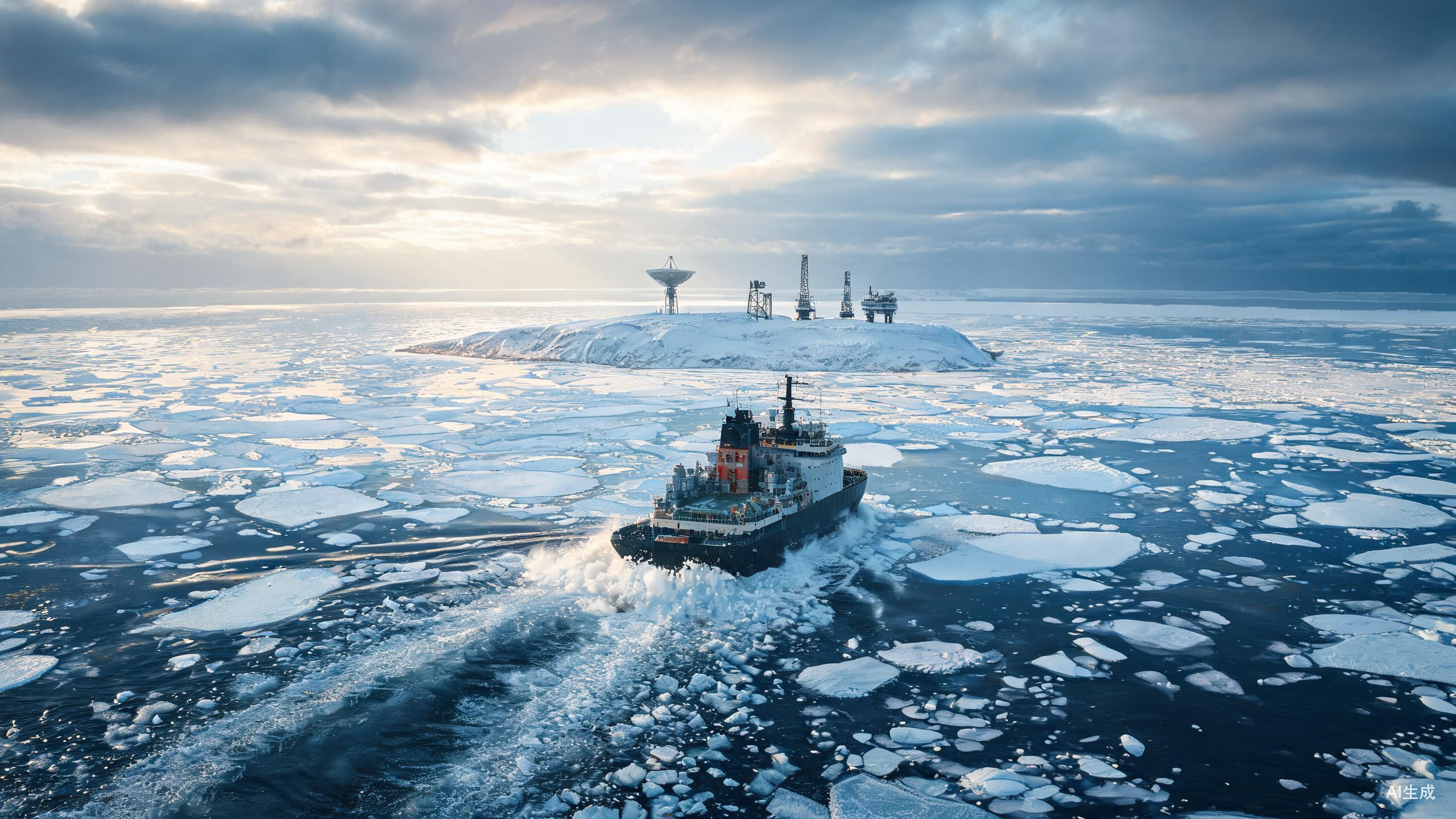
In 2019, then-US Secretary of State Pompeo stated at the Arctic Council Ministerial Meeting that "there are only Arctic and non-Arctic countries, no third category," downplaying China's legal status as a "near-Arctic country." Seven years later, US President Trump claimed that Greenland would be under de facto US control before the end of his term. Trump had long advocated for the US to gain control of Greenland, and his remarks reflected a shift in the US's Arctic strategy.
This article conducts an in-depth analysis of the operational mechanism and inherent contradictions of the US Arctic strategy, pointing out that its essence is to reconstruct the Arctic order with a logic of geopolitical competition. The author first sorts out the historical context of the US's geopolitical strategy towards the Arctic, noting that the Arctic has long been seen by the US as a natural barrier, but with the melting of sea ice and the increasing strategic value of high-latitude regions, the Arctic has become a frontline position directly related to homeland security. A set of "Northern Monroeism" that is both exclusive, defensive, and offensive took shape during Trump's second term, with China being explicitly listed as a key external country to be prevented and restricted under this doctrine.
The author further pointed out that maintaining US energy dominance is one of the core demands of the US Arctic strategy, as the Arctic possesses strategic resources such as oil, gas, and rare earths. To compete for these resources, the US is internally removing administrative obstacles to development through legislation, and externally strengthening its exclusive control over key Arctic resources, infrastructure nodes, and supply chain channels, with the intention of reshaping the transatlantic energy security landscape.
This article further analyzes the specific means by which the United States implements its Arctic strategy. In military terms, the US is implementing a deterrent-based approach. Its core role is to force competitors to abandon their attempts to achieve a quick victory in key directions by deploying forward and maintaining local conventional superiority, thereby securing a crucial strategic buffer period for the US. In diplomatic terms, the US is highlighting the political characteristics of the Monroe Doctrine. Its diplomacy not only prioritizes US interests but also further weakens the role of multilateral mechanisms. Finally, the author emphasizes that the US government's adjustment of its Arctic strategy is essentially a projection of the logic of maintaining US hegemony in global public domains. In this context, China should abandon emotional confrontation and passive follow-up strategies, and instead respond prudently from the perspective of maintaining the openness and inclusiveness of global public domains.
This article was originally published in the August 2026 issue of Culture Review, and only represents the author's views, for reference.
How Far Can the US's Northern Version of the Monroe Doctrine Go?
Since his second inauguration, the Trump administration's Arctic policy has been characterized by the simultaneous advancement of diplomatic maneuvering and military expansion. At the beginning of 2026, the US sent a tough signal, implying that it did not rule out the use of force against Greenland; it then shifted to relying on the NATO framework for negotiations, explicitly excluding the use of force, but still had fundamental disagreements with Denmark and Greenland on sovereignty issues. Meanwhile, the US significantly strengthened its military presence in the Arctic, launching the largest expansion of a military base in Greenland in decades and accelerating the deployment of cutting-edge equipment such as unmanned navigation vessels. To make up for the shortcomings in polar action capabilities, the US invested $3.5 billion to order five new Arctic security icebreakers. These initiatives clearly indicate that the US is attempting to incorporate the Arctic into an expanded Western Hemisphere security system, with the core logic of defining its sphere of influence.
The US has positioned the Arctic as its "fourth coast" and an area of exclusive influence, utilizing a combination of resource control, military deterrence, ally binding, and institutional exclusion to squeeze out the legitimate participation space of extraterritorial countries, particularly China, in the Arctic. By redefining the rules and setting the agenda for Arctic governance, the US is reshaping the threshold for entry and boundaries of behavior. A thorough analysis of the operational mechanisms and inherent contradictions of this strategy is crucial for judging the future direction of Arctic governance and safeguarding the legitimate rights and interests of extraterritorial countries, including China, in the Arctic.
Historical Evolution and Logical Foundation of the US Arctic Strategy
The gradual opening of the Arctic passage and the increasing feasibility of resource development have broken the long-standing strategic vacuum in the Arctic region. In the face of China's active participation in Arctic affairs as a near-Arctic state and Russia's restoration of its military presence in the Arctic, the US has developed strong geopolitical anxiety, driving a profound adjustment in its Arctic policy. A strategic logic that combines exclusivity, defensiveness, and offensiveness is taking shape, which can be defined as the northward extension of the Monroe Doctrine. Clarifying the connotation and historical context of this concept is the key to understanding the US's current strategy of curbing China's participation in the Arctic, particularly its structural squeeze on the "Ice Silk Road".
For a long time, the US has focused its geopolitical strategy on the Atlantic, Pacific, and Caribbean, with the Arctic often seen as a natural security barrier that does not require a large military presence. However, in recent years, with the melting of sea ice and the increasing strategic value of high-latitude regions, the US has begun to define the Arctic as its "fourth coast" at home. The strategic document released by the US Navy and Coast Guard in 2021 explicitly states that the Arctic waters are no longer a remote frontier, but a forefront position directly related to homeland security. The concept of the "fourth coast" marks the inclusion of the Arctic defense circle into the US homeland defense system. Under this cognitive framework, the business shipping, scientific research, and infrastructure cooperation of non-ally countries in the Arctic are all incorporated into the national security perspective, providing a policy basis for the US to strengthen its anti-missile deployment, situational awareness system, and high-latitude infrastructure construction in the Arctic.
The US's new Monroe Doctrine in the Arctic has a clear direction, with China becoming a key country to be prevented from and restricted outside the region. China's proposed position as a near-Arctic state is based on a scientific and rational definition of geographical proximity and climate correlation, but was denied by the US. Former US Secretary of State Pompeo's statement at the Arctic Council Ministerial Meeting in 2019 was representative, as he claimed that there are only two types of entities in the world: Arctic countries and non-Arctic countries, with no third category. This binary logic is essentially aimed at weakening China's legitimacy in participating in Arctic governance, labeling China as an "outside intervenor" in the Arctic order. Under this logic, China's investments, scientific research, and infrastructure cooperation in the Arctic are constantly incorporated into a securitized narrative, with the US using this as a pretext to promote stricter reviews and restrictions on related activities, elevating economic competition to a survival security threat, and using the so-called "Cold War Cuba effect" as an excuse to take comprehensive containment measures against China.
Resource Competition and the 'Decoupling from China' Feedback Loop
A notable feature of the US's Arctic strategy in the resource sector is its use of national security as a pretext to strengthen its exclusive control over the Arctic's critical resources, infrastructure nodes, and supply chain channels, preventing competitors like China from embedding themselves in the Arctic resource industry network through investment and cooperation. As the value of the Arctic's strategic resources, such as oil, gas, and rare earths, continues to grow, the US is deeply integrating resource development with supply chain security, elevating business cooperation issues to the level of geopolitical security and constructing institutional barriers to resource competition. The core intention is to concentrate control over critical resource development rights, infrastructure operation rights, and supply chain dominance, thereby blocking external market entities from deeply participating in Arctic resource development through market-based cooperation. On this basis, the US is working to create an Arctic resource development and supply system with itself at the core, followed by its allies, in order to weaken competitors' space and discourse power in the Arctic resource industry chain from the source.
Maintaining US energy dominance is one of the core demands of the Trump 2.0 administration's Arctic strategy. In the traditional energy sector, the Trump administration views the climate change agenda as a constraint on US competitiveness. In January 2025, Trump signed an executive order to restore US energy independence and develop Arctic resources, revoking the ban on leasing resources in the Arctic National Wildlife Refuge that was in place during the Biden administration, and requiring the Department of the Interior to simplify the review process under the National Environmental Policy Act, thereby completely removing administrative obstacles to the development of the second phase of the Alaska North Slope Willow project and subsequent projects. The geopolitical intention is to maximize Arctic oil and gas production, lower global energy prices, undermine Russia's energy-based financial foundation, reduce European allies' dependence on rival powers for energy, and reshape the transatlantic energy security landscape.
In the competition for key minerals, the US is using Greenland as a geopolitical fulcrum to break China's dominance in rare earth resources, promoting the security and instrumentalization of the mineral supply chain. The Trump 2.0 administration has abandoned verbal warnings and directly invoked the Defense Production Act, authorizing the establishment of the Arctic Strategic Resources Fund to provide financing guarantees for US and allied companies' mineral development projects in Greenland and northern Canada. More radically, the US Department of Commerce and Treasury have jointly utilized the extraterritorial jurisdiction clause in the Foreign Investment Risk Review Modernization Act to conduct in-depth reviews of third-country companies involved in Arctic mineral development, cutting off projects with equity ties or long-term underwriting agreements with overseas entities of concern from accessing the North American market. This move is essentially building a "de-China-ized" resource loop in the Arctic, converting business competition into a zero-sum security game, and giving the Monroe Doctrine a dual function of both military defense line and supply chain barrier.
The pan-securitization of infrastructure is a natural extension of the aforementioned logic. The US has elevated critical minerals to a common security issue for its alliances, with the goal of not only competing for control of individual mining projects, but also creating a structural environment unfavorable to external countries through supply chain alliances and standardization. This will marginalize and restrict the legitimate rights and interests of external countries in developing Arctic resources. This trend is consistent with the US military's Arctic strategy, which emphasizes expanding infrastructure, and Arctic governance is gradually shifting away from cooperation, science, and public goods, and becoming trapped in a securitized framework of confrontation, competition, and risk. From a policy implementation perspective, the US is blocking external countries from participating in Arctic infrastructure construction, not solely relying on direct investment, but rather leveraging the agenda-setting capabilities of its alliance system to link infrastructure investment with alliance security. The US is labeling countries like China as a "threat to alliance security." At the same time, the US is using alternative financing, technology support, and diplomatic commitments as bait to induce relevant parties to abandon low-cost cooperation schemes and choose a "de-China" path. Ultimately, this will lead to Arctic infrastructure nominally following market-oriented and local governance rules, but in reality being subject to
Military Deterrence and Forward Deployment for Deterrence
The strengthening of military power is the most rigid component of the Trump 2.0 administration's Arctic strategy. Compared to the US's restrained approach in the Arctic after the Cold War, relying on existing bases to maintain a limited presence, the current US military and political circles view the Arctic as a key direction for major power strategic games. The focus of the US Arctic military strategy is not only to respond to Russia's Arctic military deployment, but also to build a high-latitude defense system covering the northern part of North America and the North Atlantic passage through forward presence, situational awareness, and rapid response capability construction, and to carry out preventive containment of China's polar activities.
The Trump 2.0 administration's Arctic military strategy is deeply influenced by the nationalist trend of "Making America Safe Again". At its core, it aims to deeply integrate the Arctic defense circle into the US territorial defense system, promoting the concept of a "Fourth Coast" from idea to physical layout. On one hand, it strengthens the situational awareness network with missile early warning, satellite tracking, and communication command and control as its core; on the other hand, it enhances the high-latitude force projection capability and the frequency of joint exercises, demonstrating its ability to deter and strategically escalate control over competitors in the Arctic. In terms of force projection, the Trump administration is cautious about high-cost overseas deployments and instead focuses on promoting deterrent-based deterrence, a concept that has been incorporated into the 2025 National Security Strategy and has become a core support for the US's China strategy. The core function of deterrent-based deterrence is to force competitors to abandon their attempts to achieve quick victories in key directions through forward deployment and local conventional advantages, thereby giving the US a critical strategic buffer period. In essence, deterrence is a phase-based strategic defensive measure, rather than a ultimate solution, and its goal is not to maintain long-term strategic balance, but to avoid premature conflict and reserve
In the Arctic region, the US's deterrence-based military strategy is manifested in three aspects. Firstly, it is accelerating the deployment of next-generation over-the-horizon radar systems to fill the monitoring blind spots in the Arctic, and incorporating the Space Force's polar-orbiting satellite network into the command system of the North American Aerospace Defense Command, thereby creating a defensive barrier against hypersonic and cruise missiles through technological upgrades. Secondly, it is abandoning the large-scale ground force deployment model of the Cold War era, and instead focusing on using unmanned systems and high-tech monitoring networks to maintain a military presence, adopting a "light footprint, high deterrence" deployment model that aligns with the Republican Party's call to reduce public spending, while meeting the defensive needs to counter asymmetric threats from Russia and China. Thirdly, it is pushing for the transfer of military construction costs to its allies, with the Trump 2.0 administration explicitly requiring Canada and North European NATO member countries to bear part of the costs of modernizing and upgrading the North American Aerospace Defense Command. During the 2025 NATO Brussels summit, the US even hinted that if its allies fail to invest 2.5% of their GDP in areas such as icebreaker construction and polar radar station maintenance, the US
The escalation of military actions in the Arctic directly undermines the low-tension atmosphere and political mutual trust that underpin the "Arctic Exceptionalism," transforming the region from a relatively independent space for cooperation outside of global geopolitical conflicts into a forefront of military competition, where scientific cooperation and environmental governance agendas will be gradually marginalized by security issues. For China, the potential risks lie in the US using freedom of navigation, security checks, and protection of critical infrastructure as pretexts to selectively intervene in specific routes, port services, and commercial activities, and relying on its allies to expand the scope and legitimacy of such interventions, thereby damaging China's legitimate rights and interests.
Diplomatic Coercion and Institutional Exclusion
In contrast to adjustments in the realms of resources and the military, the diplomatic aspect of the Trump 2.0 administration's Arctic strategy highlights the political characteristics of Monroeism. Traditionally, while the US has prioritized its own interests in Arctic affairs, it has relied on the Arctic Council, NATO's coordination mechanisms, and institutionalized cooperation with allies such as Canada, Denmark, and Norway to advance its agenda. However, under the transactional diplomatic logic of the Trump administration, the role of multilateral mechanisms has been further weakened, with bilateral pressure, interest exchanges, and coercive coordination becoming the dominant policy tools.
One aspect is that the Trump administration tends to bypass or weaken consultative governance platforms such as the Arctic Council, prioritizing bilateral relationships to reshape the Arctic order. The Trump 1.0 administration has shown resistance to the Arctic Council's environmental agenda and multilateral declaration mechanism, as exemplified by Pompeo's refusal to sign a joint document mentioning climate change at the 2019 Arctic Council Ministerial Meeting. If the Trump 2.0 administration continues this trend, the US may further reduce its political investment in the Arctic Council, shifting policy resources towards the NATO framework, bilateral security cooperation, and small multilateral coordination mechanisms, resulting in the further weakening of low-politics cooperation attributes in Arctic governance, with security issues and bloc competition logic dominating.
Secondly, the Trump administration's coordination with allies on Arctic policy has taken on a more transactional tone. In areas such as Greenland, Arctic infrastructure construction, mineral investment, and underwater cable layout, the US has used security investments as a bargaining chip, requiring allies to make equivalent exchanges in terms of security commitments, economic support, and policy cooperation. The administration's demands for cooperation from countries such as Denmark, Canada, Iceland, and Norway have exceeded the traditional scope of alliances, with additional, stricter conditions for cost-sharing and strategic obedience. For its allies, this approach may bring more US security resources, but it also compresses their space for making independent decisions on economic and trade cooperation with China and Arctic affairs.
Thirdly, the Trump administration systematically implemented institutional exclusion against non-regional countries. This exclusion did not openly deny other countries' right to participate in the Arctic, but rather raised the actual threshold for certain countries to participate in Arctic governance and cooperation through procedural rules, technical standards, investment reviews, restrictions on scientific research cooperation, and the construction of public opinion narratives. For China, the US will continue to deny the legitimacy of its identity as a "near-Arctic state" and push for additional reviews of Chinese enterprises, research institutions, and shipping activities at the policy level. This rule-based exclusion is more sustainable than diplomatic accusations, easily embedded in the policy systems of allies, and forms collective constraints. From a deeper perspective, the US's anxiety about China's participation in the Arctic reflects its declining tolerance for openness and inclusiveness in global public spaces: when the US was firmly in its position as a global leader, it was relatively inclusive of non-regional countries' participation in Arctic affairs; when faced with strategic competitive pressure, it redefined the open Arctic governance space as a security domain with strict screening of participants. This indicates that the exclusivity and contraction of the US's Arctic strategy during the Trump 2.0 era are not targeted at a single issue, but rather a
The core of the Trump 2.0 administration's Arctic strategy is not to patch up the existing Arctic cooperation framework, but to thoroughly reconstruct the Arctic order with a logic of geopolitical competition. This strategic shift transforms the Arctic from a relatively open international cooperation space into a strategic game zone where resource exclusivity, military deterrence, and transactional coercion coexist, impacting the functional governance tradition borne by the Arctic Council and shaking the international consensus that the polar regions are a common heritage of humanity, replacing the benign governance chain of fair rules, guaranteed rights, and win-win cooperation with the hegemonic logic of security exceptions, selective rule application, and exclusive camp formation.
The adjustment of the Trump 2.0 administration's Arctic strategy is essentially a projection of the logic of maintaining US hegemony in the global commons. The practice of the Monroe Doctrine in the Arctic marks a fundamental shift in the US attitude towards the global commons: from a provider of public products in the international order after World War II to an exclusive interest "encloser". The US is trying to build a hierarchical order in the global commons through the privatization of public domains and the polarization of governance. If the public domain attributes of the Arctic are completely dissolved, the establishment of international rules in future fields such as deep-sea mining and lunar development may replicate the unequal pattern of "the strong delimiting boundaries and the weak being restricted". In this context, China should abandon emotional confrontation and passive follow-up strategies, and respond appropriately from the perspective of maintaining the openness and inclusiveness of the global commons. On the one hand, China should adhere to the bottom line of the law, firmly safeguard the rights to scientific research and navigation freedom granted by the United Nations Convention on the Law of the Sea, and oppose any form of unilateral enclosure; on the other hand, with cooperation as the path and capability as the support, China should strengthen coordination with non-Arctic countries and Arctic
References
Anne-Marie Brady's book "China as a Polar Great Power" was published by Cambridge University Press in 2017.
According to Marc Lanteigne's research in "China's Emerging Arctic Strategies: Economics and Institutions", published by the Centre for Arctic Policy Studies (CAPS) of the University of Iceland in 2014, pages 16 to 20 provide insight into China's Arctic strategies.
Oran R. Young, "The Arctic in Play: Governance in a Time of Rapid Change," The International Journal of Marine and Coastal Law, Vol. 24, No. 2, 2009, pp. 423-442.
Gaofei: "Adjustments to the US Arctic Strategy During the Biden Administration: Motivations, Impacts, and Structural Dilemmas," published in Ocean University of China Journal (Social Science Edition), 2024, Issue 6.
Kuang Zengjun: "New Developments in the US Arctic Strategy and Their Impact on Arctic Governance," published in International Studies, 2023, Issue 2.
The State Council Information Office of the People's Republic of China: "China's Arctic Policy", People's Publishing House, 2018 edition.
This article is a phased outcome of the Major Project of the National Social Science Fund "Research on the Practical Path of High-Quality Development of New Energy and Energy System Transformation" (Project No.: 25&ZD189).